The first time I entered the caves of the Drakensberg escarpment, a shiver ran down my spine. On these millennial walls, antelopes bounded with striking grace, their taut muscles frozen in ochre eternity. But what truly moved me was the disturbing detail of their hooves, the precision of their horns, the perfect anatomy of each joint. How had the San, these first inhabitants of southern Africa, managed to capture animal life with such scientific accuracy millennia ago?
Here's what the rock art of the San reveals to us: a mastery of anatomy that rivals our modern zoological illustrations, an intimate understanding of the animal kingdom that goes beyond simple observation, and an artistic heritage that transforms our South African caves into galleries of naturalist art of astonishing sophistication. These rock paintings are not mere primitive drawings, but veritable treatises on animal anatomy engraved in stone.
Many think that prehistoric art is reduced to crude silhouettes, approximate shapes traced by clumsy hands. This reductive vision prevents us from appreciating the true sophistication of these creations. When one discovers the rock art of Cape without prejudice, one realizes that one is facing artists of remarkable precision, capable of reproducing every muscular nuance, every dynamic posture with disconcerting fidelity.
Rest assured: understanding this anatomical precision requires no training in paleontology. In this article, I will take you to explore these rocky sanctuaries of South Africa, decipher the secrets of these San artists, and discover how their meticulous observation of African wildlife has produced works of disturbing modernity. You will see how these rock animals can still today inspire our relationship with animal art.
The hunter's eye: when observation becomes art
The San were not simply contemplative artists. They were hunters-gatherers, and their survival depended on an intimate knowledge of each animal species in the Cape. This vital necessity forged a gaze of exceptional acuity. Every representation of eland, antelope or rhinoceros in rock art is a testament to this daily, almost obsessive observation.
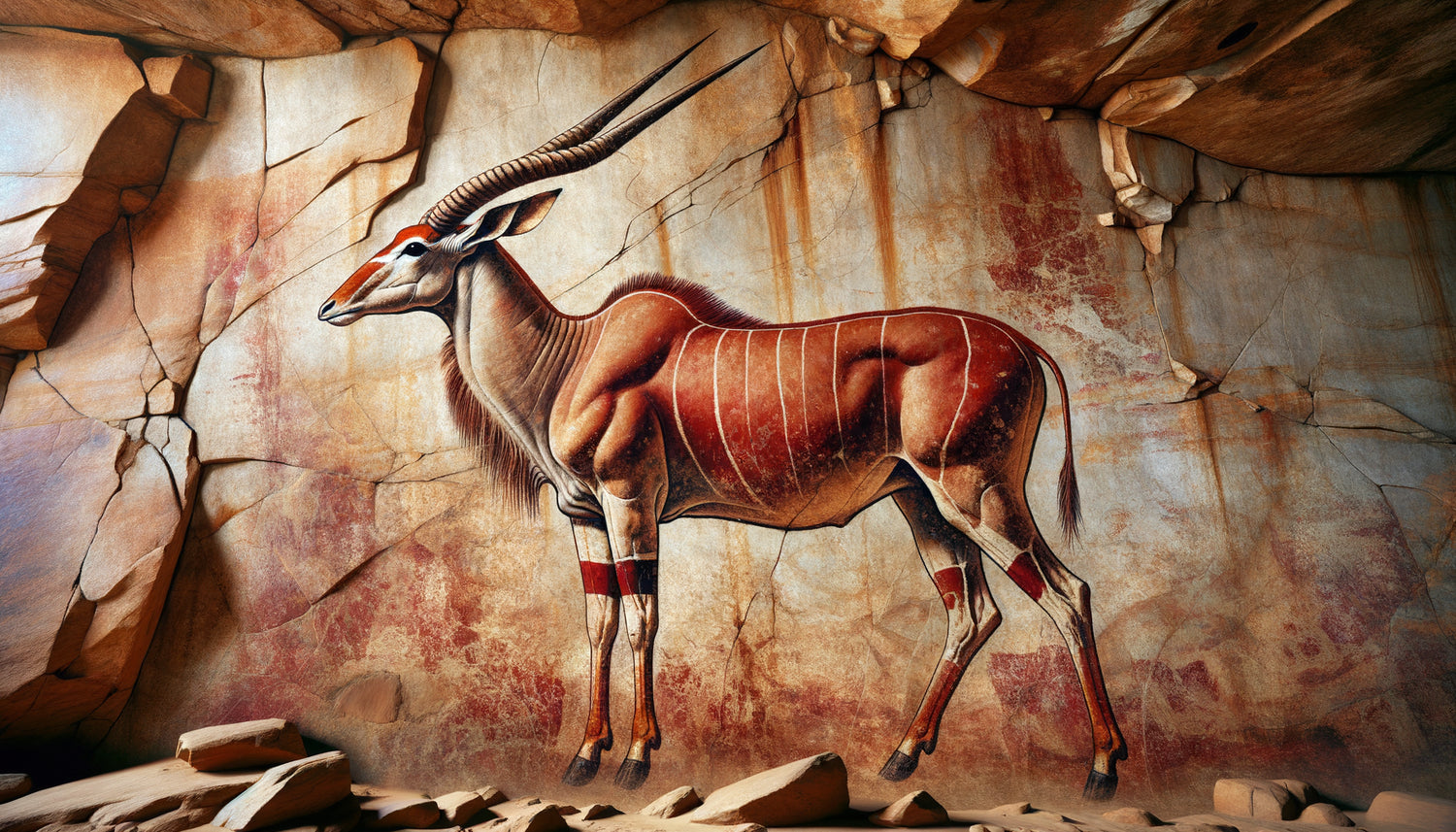
In the rocky shelters of Cederberg, I photographed paintings of elands where every anatomical detail stands out: the characteristic hump of the withers in adult males, the texture of the fur varying according to the seasons, the exact proportions between the length of the legs and that of the body. This anatomical precision is not accidental. The San knew the exact angle of the horns depending on the age of the animal, the specific musculature of each species, the postures adopted during running or resting.
What fascinates about the San people’s rock art is their ability to capture movement. The animals are never static: they leap, gallop, graze with a dynamism that defies centuries. The San artists mastered a technique that Western painters would take millennia to rediscover: the decomposition of movement. Their antelopes in full race present anatomically correct postures, with the legs positioned exactly as modern photography reveals today.
Pigments that defy time: the technique of the San masters
The anatomical precision of animal representations in Cape rock art is accompanied by an impressive technical mastery. The San prepared their pigments with meticulous care, mixing natural ochres, iron oxide, charcoal and organic binders such as blood, animal fat or egg yolk.
This limited palette – red, ocher, white, black – has never been a hindrance. On the contrary, it pushed the San artists to play on nuances, gradations, superimpositions to create volume and depth. In some caves near Cape Town, I observed depictions of elands where artists used up to seven different shades of ochre to restore muscular volumes, creating a striking relief effect.
The polychrome and hatching technique
The San developed sophisticated techniques such as hatching to suggest the texture of fur. On some rock paintings, parallel lines follow exactly the direction of hair growth, varying according to the anatomical areas of the animal. This attention to detail reveals a deep understanding not only of bone and muscle structure, but also of the superficial characteristics of each species.
Polychrome – the use of multiple colors on the same animal – allows to distinguish the lighter belly from the darker back, exactly as in nature. This chromatic fidelity reinforces the impression of realism and demonstrates that the San did not simply memorize shapes, but also colors and their variations according to body areas.

The Cape bestiary: a millennial zoological catalog
The rock art of the San constitutes a veritable inventory of prehistoric South African fauna. Elands, rhinoceroses, hippos, giraffes, zebras, antelopes of all kinds: each species is represented with its distinctive characteristics. This diversity testifies to the extent of the San’s zoological knowledge.
The eland takes a prominent place in this rock art. This animal, the largest of the African antelopes, held major spiritual significance for the San people. Representations of elands show astonishing anatomical precision: the slightly spiraled horns, the loose skin under the throat (the wattle), the characteristic fat hump, it's all there. Some paintings even distinguish males from females thanks to subtle anatomical details such as the size of the wattle or body build.
Felines – lions and leopards – are depicted with their powerful muscles, retractable claws, and characteristic gait. The San people even captured the facial expression of these predators, which required close observation and courage. In some rock shelters, I discovered hunting scenes showing the interaction between predators and prey, with a remarkable understanding of animal behavior.
Where anatomy meets the spiritual
The anatomical precision in the San people's rock art is not only a matter of documentary concern. It is part of a complex cosmology where animals play a role as mediators between the visible and invisible worlds. San shamans entered trances and symbolically transformed into animals to access the spirit world.
This sacred dimension explains why some animal representations combine anatomical realism with fantastic elements. We find antelopes with perfectly drawn hooves but endowed with human characteristics, or hybrid creatures combining several species. This fusion never compromises the anatomical accuracy of the animal parts represented.
The phenomenon of trance and its representations
Some rock paintings show animals with stiff legs, arched bodies, in postures that evoke shamanic trances. Even in these stylized representations, the anatomical structure remains consistent: the joints are in the right place, the proportions respected, the species-specific characteristics preserved. This ability to stylize without distorting is a testament to exceptional artistic mastery.
The San people believed that certain animals possessed a particular spiritual power. The eland, once again, was reputed to be the most important source of power. This belief motivated even more careful observation of this animal, generating representations of almost scientific accuracy in Cape rock art.

An observation school applicable today
What the rock art of the San teaches us goes far beyond archaeology. Their anatomical precision is the result of an observation method that any contemporary artist can adopt: to look for a long time, daily, with attention and respect. The San did not draw animals in general, but this specific eland seen yesterday, this particular antelope observed for hours.
This approach transforms our way of understanding modern animal art. When we decorate our interiors with animal representations, are we looking for the same accuracy, the same intimate connection with the subject? Can the animal paintings that adorn our walls carry the same attention to detail, the same reverence for living things?
The lesson of the San resonates particularly strongly today, as our relationship with the animal world becomes more distant. Their rock paintings remind us that truly observing an animal – understanding its anatomy, its movements, its essence – creates a bond that transcends simple representation. It is an act of knowledge, almost communion.
Preserving and transmitting a threatened heritage
The rock art of the Cape is now threatened by erosion, vandalism and climate change. These irreplaceable testimonies of ancestral anatomical precision require urgent protection. Several sites are listed as UNESCO World Heritage Sites, but many rock shelters remain vulnerable.
3D digitization initiatives can now preserve an exact record of these rock paintings. These modern technologies also reveal details invisible to the naked eye, confirming the technical sophistication of the San artists. Some anatomical features, imperceptible without digital processing, testify to an even more in-depth observation than previously thought.
Transmitting this heritage also means understanding its profound message: true art is born from an intimate relationship with its subject. The San did not copy, they knew. This distinction makes all the difference between an anatomically correct representation and a living work, inhabited by the spirit of the animal.
Extend this ancestral connection with the animal world in your interior
Discover our exclusive collection of animal paintings that capture the same precision and respect for living things that animated the San artists millennia ago.
A lesson in humility and wonder
Every time I contemplate a San rock painting in the caves of the Cape, I feel this same initial emotion: humility in the face of genius. These artists without academic training, without sophisticated tools, without theoretical models, have produced works of anatomical accuracy that defy our modern capabilities.
Their secret? A total presence in the world, a filterless observation, an infinite patience. They weren't seeking to impress or innovate, simply to capture the truth of what they saw. This authenticity shines through every line, every curve, every nuance of their animal representations.
The rock art of the San invites us to slow down, to really look, to recognize the complexity of living things. Their anatomical precision wasn't an end in itself, but a natural result of a loving and respectful gaze upon the creatures that shared their territory. In our era saturated with superficial images, their example resonates as a call for depth, patience, and true connection.
These rock animals, frozen on the walls of caves in South Africa for millennia, continue to teach us an essential truth: authentic art is born from relationship, intimate knowledge, respect. The San weren't drawing animals; they were honoring companions of existence. This fundamental difference explains why their works still touch us today, across the chasm of time.
Frequently Asked Questions
Can we visit the San rock art sites in South Africa?
Absolutely, and I strongly encourage you to do so! Several sites are accessible to the public, notably in the Drakensberg mountain range, in the Cederberg mountains near Cape Town, and in the Clarens region. Some sites require an accredited guide to preserve the rock paintings. The Kamberg Rock Art Centre and the Game Pass Shelter are among the most spectacular and best arranged for visitors. The anatomical precision of the animal representations is even more striking in person than in photographs. Plan on good hiking shoes, as many shelters require walking on mountainous terrain. The spectacle is well worth the effort: standing before these millennial works constitutes a deeply moving experience.
How do archaeologists date these rock paintings?
Dating the San rock art poses fascinating technical challenges. Unlike paintings made with organic charcoal, which can be dated using carbon-14, the mineral pigments used by the San (ochres, iron oxides) do not contain directly datable organic matter. Scientists therefore use indirect methods: dating archaeological layers on the ground of rock shelters, analyzing tools found on site, or dating mineral deposits partially covering some paintings. When the San used organic binders (blood, egg, fat), an analysis can sometimes be performed without damaging the artwork. The results indicate that the Cape rock art extends over an impressive period, with some paintings dating back more than 27,000 years, with continuous production until the 19th century. This longevity testifies to a remarkably stable artistic tradition, where anatomical precision has been maintained through generations.
Why is the eland so frequently represented in San rock art?
The omnipresence of the eland in San rock art can be explained by its exceptional cultural and spiritual importance. This animal, the largest of African antelopes, occupied a central place in the San cosmology. Shamans considered the eland as the most important reservoir of spiritual power, a kind of energy battery that they used during their trances. This sacred dimension motivated particularly careful observation, explaining the extraordinary anatomical precision of eland representations. On a practical level, the eland was also a choice game animal: its size guaranteed significant reserves of meat, fat and skin. The San organized complex rituals around eland hunting, and young girls at their first menstruation were symbolically associated with this animal. This entanglement between material and spiritual dimensions explains why the eland dominates the Cape rock bestiary, often represented with a luxury of anatomical details absent in other species also hunted.