In Paolo Uccello’s Florentine workshop, in the year 1450, an apprentice observes his master drawing a greyhound receding into the horizon of a hunting scene. The animal seems literally to plunge into the canvas, its massive hind legs contrasting violently with its tiny head in the distance. This unsettling illusion bears a name that every Renaissance artist whispered with respect: foreshortening, or *scorcio* in Italian.
Here’s what this ancestral technique brings to your décor today: it creates a striking depth in your wall compositions, naturally guides the eye through space, and infuses spectacular dynamism into your animal representations. Three centuries before the invention of photography, these masters had already unlocked the secret to making movement emerge from flat surfaces.
You admire these ancient paintings where horses and dogs seem to leap out of the frame, but you wonder how those artists managed to create such an impression of volume and distance? How could a simple brush and pigments deceive the eye to the point of suggesting that a deer is fleeing towards distant hills?
The answer lies in a meticulous observation of the real world, combined with a mathematical revolution that transformed European art. And understanding this technique will allow you to choose contemporary works that capture the same spatial magic.
I am going to reveal the secrets of animal foreshortening, this method which still transforms our interiors into windows open onto worlds in motion.
The scorcio: when proportions defy logic
Foreshortening – or *scorcio* – consists of deliberately distorting the proportions of a subject to simulate its position in three-dimensional space. When an animal moves away from us or approaches frontally, its different body parts seem compressed according to counterintuitive ratios.
Imagine a horse galloping directly towards you. Its massive chest occupies almost your entire field of vision, while its croup and hind legs appear ridiculously small, condensed into a few centimeters. This is exactly what Renaissance artists learned to reproduce: this dramatic compression of volumes.
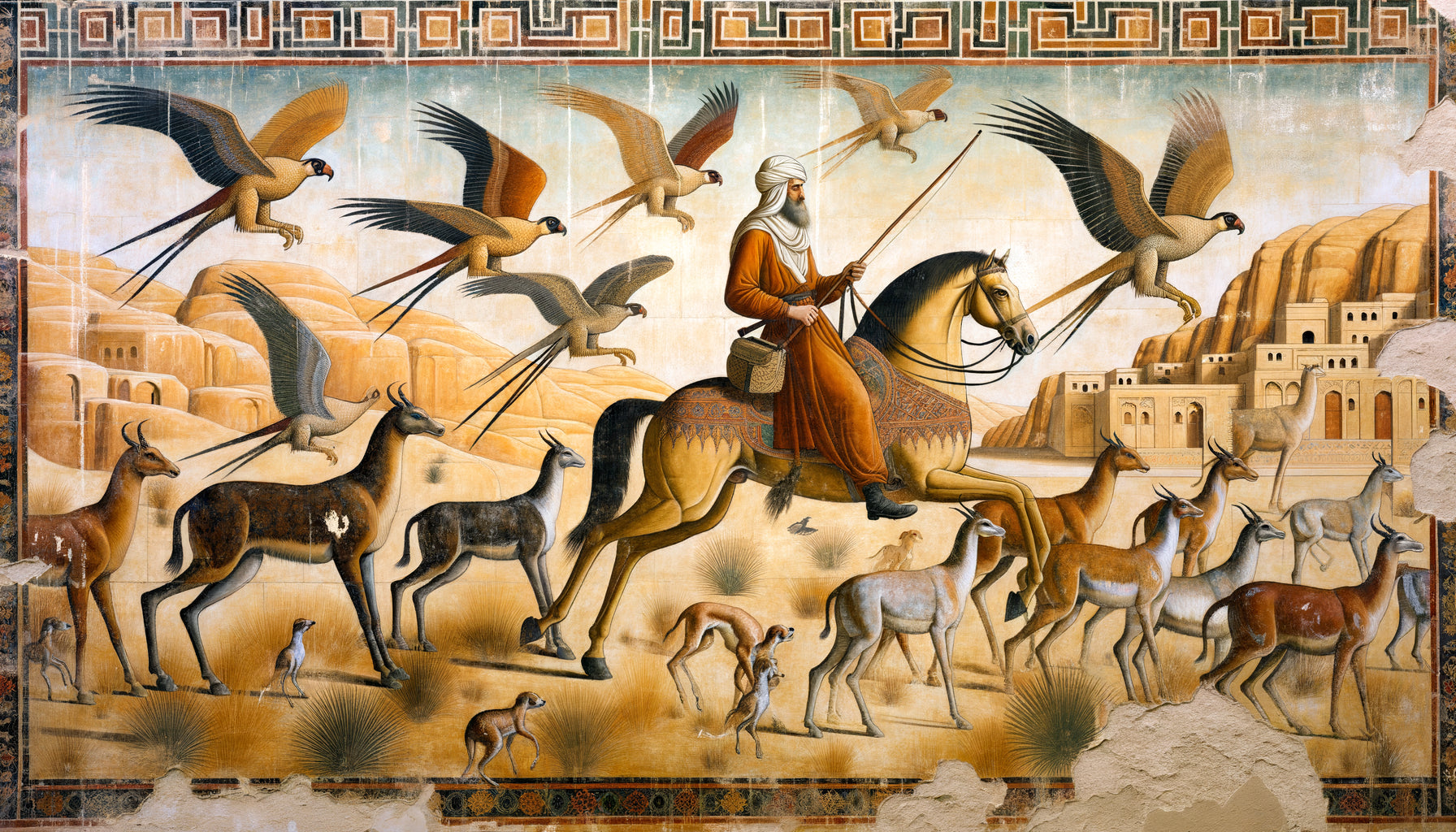
Andrea Mantegna, in his famous fresco of the *Camera degli Sposi* in Mantua (1465-1474), masterfully applies this technique to the hunting dogs depicted in the foreground. Some animals, seen from three-quarters rear, have disproportionate hindquarters that abruptly narrow towards the head. The effect is so convincing that the viewer physically feels the depth of the scene.
This distortion is not arbitrary: it rests on projective geometry theorized by Leon Battista Alberti in his treatise *De pictura* (1435). Artists literally traced lines of perspective from a single vanishing point, mathematically calculating how each segment of the animal’s body should diminish.
The perspective grid: the secret tool of the masters
To master the perspective shortcut on complex subjects such as animals, Renaissance artists employed an ingenious device: the perspective grid or velo.
Albrecht Dürer, in his manual Underweysung der Messung (1525), illustrates this tool precisely. It is a frame stretched with threads forming a grid, which the artist placed between himself and his model. By transferring to his paper – also gridded – what he observed in each square, he faithfully transposed natural perspective distortions.
For animals in motion, it was obviously impossible to pose a deer or a greyhound! Artists therefore created articulated mannequins made of wood or clay, which they positioned at the desired angle. Some workshops even kept skeletons of domestic animals to study anatomy from all angles.
This method explains why so many Renaissance hunting paintings present such dramatically converging compositions. Packs of dogs seem literally to draw the gaze into the depths of the landscape, creating what theorists call fuga prospettica – perspective flight.
Multiple vanishing points for complex compositions
When multiple animals occupy different depths, sophisticated artists like Piero della Francesca used multiple vanishing point systems. Each creature had its own line of convergence, while respecting the overall harmony of the scene.
This advanced technique of the perspective shortcut made it possible to create hunting or pastoral scenes of astonishing complexity, where dozens of animals coexisted in a coherent but dynamic space.

Compressed anatomy: distort without betraying
The true genius of the animal perspective shortcut lies in this delicate balance: to compress volumes without destroying anatomical recognition. A horse in scorcio remains identifiable as a horse, despite proportions that would seem grotesque if observed out of context.
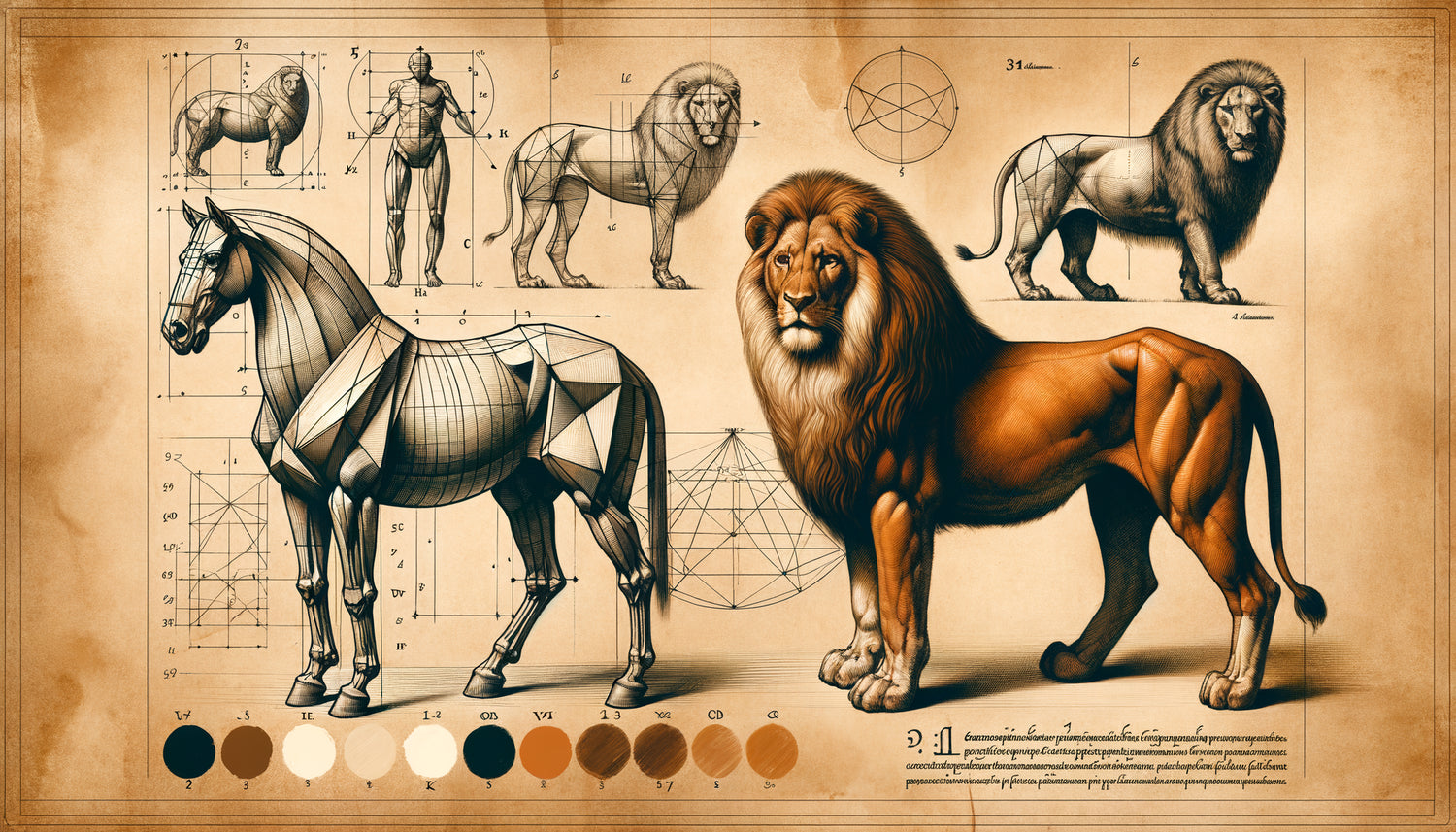
Renaissance artists developed an exceptional knowledge of anatomy. Leonardo da Vinci dissected animal cadavers to precisely understand how muscles and skeletons articulated. His notebooks are full of studies of horses seen from all angles, with annotations on compression ratios according to depth.
For a quadruped moving diagonally away, the rule of thumb was simple: the legs closest to the viewer should measure about three times the size of the distant legs. The head, if pointing towards the horizon, could be reduced to one fifth of its actual size compared to the rump.
These ratios created this unsettling sensation of frozen movement that characterizes the best works. In Carpaccio's Saint George and the Dragon (1502), the saint's horse has a monumental chest while its head, slightly turned backwards, seems tiny – an effect that simultaneously suggests the animal's power and the depth of the action.
Shadows: accomplices of the illusion
Perspective foreshortening alone is not enough to create convincing depth. Renaissance masters systematically associated it with a consistent system of shadows, which reinforced the impression of compressed volume.
A shadow cast by an animal in scorcio also undergoes perspective distortion. The further the animal plunges into the background of the scene, the longer and thinner its shadow becomes according to the same vanishing lines. Caravaggio, although baroque, pushed this technique to its paroxysm in his still lifes with game.
Artists calculated the angle of the light source – generally positioned to correspond to the natural light from a window – then geometrically traced how that light would project the shadow of each body segment onto the floor or wall.
This luminous coherence transformed a simple anatomical distortion into a true three-dimensional illusion. The viewer's eye, receiving simultaneously the information about volume compression and shadow projection, mentally reconstructs spatial depth.

Animal sfumato: blurring to distance
Leonardo da Vinci brought an additional dimension to perspective foreshortening: atmospheric sfumato. He observed that distant objects lose sharpness and saturation due to the intervening air.
Applied to animals in depth, this principle meant that a deer fleeing towards the horizon should not only be proportionally reduced and compressed, but also treated with blurrier contours and less intense colors than creatures in the foreground.
This technique of atmospheric perspective combined with geometric foreshortening created scenes of dizzying depth. In the backgrounds of the Mona Lisa, one can distinguish suggestions of almost ghostly animals that seem kilometers away.
Artists carefully measured this blur: too pronounced, it destroyed readability; too timid, it canceled out the effect of distance. The best practitioners of animal perspective foreshortening mastered this subtle gradation between absolute sharpness and vaporous dissolution.
The depth palette
At that time, the most expensive pigments – ultramarine, vermilion – were reserved for the near elements. Animals in depth received mixtures of earths and whites which naturally created this atmospheric distance effect.
This economic constraint became a conscious aesthetic choice, reinforcing the spatial hierarchy of the composition.
Contemporary heritage: how this technique influences our interiors
Today, contemporary animal artists perpetuate this tradition of perspective foreshortening, often without even knowing its technical name. Wildlife photographers and digital illustrators instinctively create these dramatic compressions.
For your interior decoration, choosing a work using scorcio has considerable advantages. These compositions instantly create a virtual window in your wall, visually breaking the limits of the room. A stag leaping into the depths of a forest transforms a 20m² living room into an open door to infinity.
Contemporary animal paintings that master this technique generally exhibit these characteristics: unusual viewing angles (worm's eye view, bird's eye view), marked depth of field, and diagonal compositions that draw the gaze.
Unlike static frontal representations, these works in perspective foreshortening remain visually stimulating even after years. The eye never tires of exploring these depths, measuring these compressed volumes, following these vanishing lines.
Transform your walls into windows on the wild world
Discover our exclusive collection of animal paintings that capture this spectacular depth inherited from Renaissance masters, for interiors that breathe space and movement.
Conclusion: the art of sculpting space on a flat surface
The perspective foreshortening that Renaissance artists applied to animals in depth was not just a technical feat. It was a philosophical revolution: the conviction that art could capture not only the static appearance of things, but their dynamic existence in space and time.
These bold compressions, calculated distortions, and plays of shadows and blurs created works that continue, five centuries later, to trouble us with their vitality. A horse in scorcio does not simply decorate a wall: it traverses it.
From now on, when you choose an animal representation for your interior, you will know how to recognize this ancestral magic. Look for compositions that defy conventional proportions, that compress and stretch space, that transform your gaze from simple observer into traveler traversing the depths of the canvas.
For that is exactly what Uccello, Mantegna and their contemporaries aimed for: not to represent the world, but to project you into it.
FAQ : Understanding Animal Foreshortening
Why did Renaissance artists so often distort the proportions of animals?
This distortion was not an error, but a scientifically accurate representation of what we actually see. Our eye naturally perceives a dog receding with a disproportionate hindquarters compared to its distant head. Renaissance artists were the first to understand that it was necessary to reproduce this perception – and not the actual anatomical proportions – to create a convincing illusion of depth. This is the birth of optical perspective, as opposed to medieval symbolic representation where all important elements remained the same size regardless of their spatial position. Foreshortening therefore marked a revolution: painting what the eye sees, not what the mind knows.
How to recognize a good use of foreshortening in an animal painting?
A successful foreshortening is recognized by three signs. Firstly, despite seemingly strange proportions, the animal remains perfectly identifiable and anatomically consistent – you never think it is deformed, simply that it occupies a particular position in space. Secondly, your eye instinctively feels the depth: you feel as if you can mentally measure the distance between the front and back of the animal. Thirdly, the composition creates a natural dynamism – the lines of the body seem to draw you towards the depths of the painting or leap towards you. If these three elements are present, you are facing an authentic mastery of this technique, whether it is classical or contemporary.
Does this technique work in modern interiors?
Absolutely, and even particularly well! Contemporary interiors, often minimalist with white walls and geometric lines, greatly benefit from artworks creating an illusory depth. An animal artwork using forced perspective acts as a three-dimensional window that visually breaks the flatness of the walls. In a loft or a minimalist apartment, this added depth creates a fascinating contrast with the surrounding flat architecture. Moreover, these dynamic compositions bring movement into spaces that are sometimes too static. The key is to choose an appropriate scale: in a small room, prioritize a single animal in dramatic foreshortening rather than a complex scene, to maximize the spatial breakthrough effect without visually overwhelming the space.