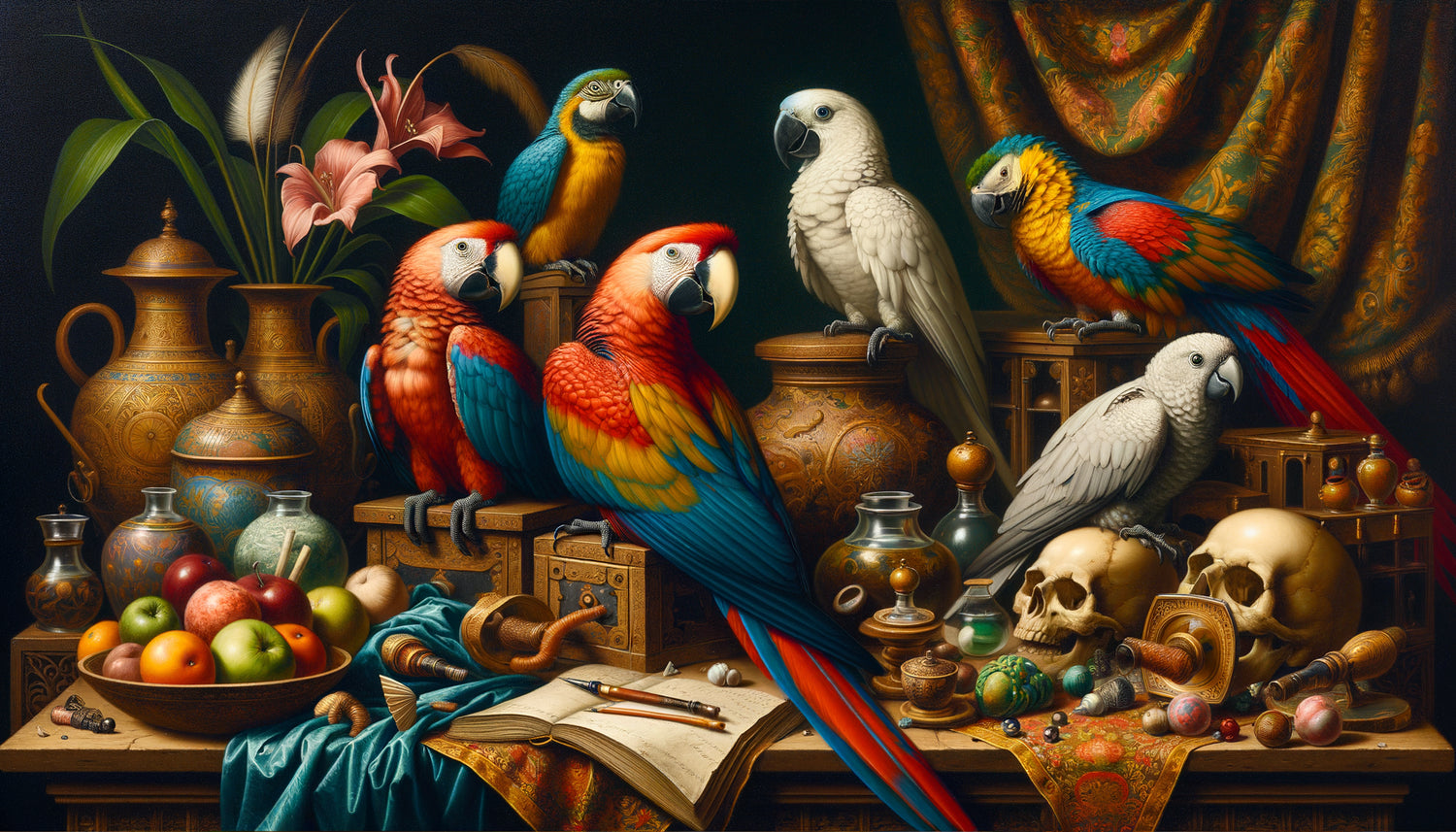
Imagine a moment: you are strolling through the cobbled streets of Antwerp in the early 16th century, when suddenly, in the workshop of a painter, you notice a flash of scarlet red, plumage of a deep blue that exists nowhere in Europe. A New World parrot, proudly perched on an easel, immortalized within a Flemish still life. This encounter between exoticism and Nordic art is no accident: it tells the fascinating story of a world opening up, of princely collections being enriched, and of a merchant bourgeoisie wanting to display its modernity.
Here's what the intrusion of exotic birds into Flemish painting reveals: the birth of a global consciousness, the expression of a new social status, and the profound transformation of European naturalist art. Three upheavals that forever change the way nature is represented.
Perhaps you wonder why these tropical creatures suddenly invade Flemish canvases when they were completely absent before? How could painters who had never left Bruges or Ghent represent South American macaws with such precision? This transformation does not come out of nowhere. It takes place at a pivotal moment in European history, where maritime routes redraw the map of the known world.
Rest assured: understanding this evolution requires no expertise in art history. Simply follow the thread of colorful feathers, from the painter's workshop to the holds of merchant ships, to grasp how exoticism has become a visual language of power and curiosity.
In this article, you will discover the specific reasons for this sudden fascination with exotic birds, how it transforms Flemish aesthetics, and why these paintings continue to captivate our collective imagination five centuries later.
When ships bring back more than spices
The year 1492 changes everything. When Christopher Columbus returns from the Americas, it is not only gold and spices that disembark in European ports, but living creatures of astonishing beauty. Exotic birds quickly become the spectacular ambassadors of these distant lands.
Antwerp, the great commercial port of the Spanish Netherlands, becomes the main gateway for these wonders from the beginning of the 16th century. Portuguese and Spanish merchants bring back parrots, toucans, cockatoos, creatures so strange that they seem straight out of medieval illuminations. But this time, they are real, alive, noisy.
These tropical birds do not remain in the holds of ships. They quickly find their place in the cabinets of curiosities of princes and wealthy merchants. Owning a Brazilian parrot becomes an outward sign of wealth, tangible proof that one is connected to new global trade routes. The exotic bird embodies the modernity of the 16th century.
The Flemish workshop becomes a global aviary
Flemish painters are not mere observers of this revolution; they become its most talented visual chroniclers. Their tradition of meticulous observation of nature, inherited from Jan van Eyck and the masters of the 15th century, meets a new fauna that defies imagination.
Artists such as Joris Hoefnagel, Jan Brueghel the Elder or Roelant Savery specialize in representing exotic birds with astonishing scientific precision. They do not paint from memory or imagination: they work from life, observing living specimens for hours kept in princely menageries or private collections in Antwerp and Brussels.
This encounter between the Flemish tradition of detail and the novelty of tropical species creates an unprecedented pictorial genre. Exotic birds invade still lifes, Eden gardens, allegories of the five senses. A scarlet parrot now coexists with a European heron, a cockatoo visually dialogues with a local robin.
The hidden symbolism of colorful feathers
But be warned: these exotic birds are never mere decorative elements. In Flemish painting, every detail carries a meaning. The parrot, with its flamboyant plumage and ability to speak, symbolizes eloquence, sometimes vanity. The toucan, with its oversized beak, evokes the strangeness of the new world. The peacock, already present in Europe but reserved for elites, has its symbolism of immortality reinforced by the presence of its tropical cousins.
The commissioners of these paintings are not mistaken. Having one's collection of exotic birds painted is certainly a way to display wealth, but also intellectual curiosity, openness to the world, belonging to this enlightened elite that understands that the boundaries of the known have just exploded.

Princely menageries: laboratories of exoticism
To understand the explosion of exotic birds in Flemish painting, one must enter the menageries of the princes of the Netherlands. Emperor Rudolf II in Prague, Archduke Albert and Archduchess Isabella in Brussels constitute extraordinary zoological collections that become veritable places of artistic research.
These menageries are not mere precursors to zoos. They are spaces where naturalists, scholars, and artists mingle daily. Roelant Savery, for example, spends years at the court of Rudolf II, tirelessly observing and drawing the hundreds of species gathered in the imperial gardens. His sketchbooks become a visual encyclopedia of global biodiversity.
Painters develop a true scientific method of representation. They note the exact colors of plumage, the proportions of beaks, the characteristic postures of each species. This precision is not gratuitous: it responds to a demand from a new type of patron, these erudite collectors who want faithful, almost documentary images of the natural wonders they possess or covet.
When exoticism becomes a visual language
Over the decades, exotic birds cease to be mere curiosities and become a true pictorial vocabulary. Their presence in a painting instantly codes certain messages for the informed viewer of the 16th and 17th centuries.
In representations of the Garden of Eden, a genre particularly favored by Jan Brueghel the Elder, tropical birds symbolize the infinite diversity of divine Creation. Their vibrant plumage illustrates the generosity of the Creator, who invented so many forms and colors. The earthly paradise becomes literally a global aviary where all known species coexist, from European sparrows to American macaws.
In vanitas, these still lifes meditating on the brevity of life, the presence of a caged parrot or a dried bird of paradise recalls that even the rarest wonders in the world are perishable. Exoticism becomes a memento mori: even the most dazzling feathers eventually tarnish.
The trade of models and images
A fascinating phenomenon emerges: Flemish painters no longer work only from nature but also from collections of images that circulate from workshop to workshop. Drawings of exotic birds become valuable commodities, copied, exchanged, sold between artists.
This circulation sometimes creates comical situations: certain exotic birds appear in dozens of different paintings, always in the same posture, proof that they were copied from the same drawn model. Art historians can now trace these visual lineages, follow the journey of a single red parrot from Brussels to Prague, from Amsterdam to Frankfurt.

The contemporary legacy of this fascination
Five centuries later, why do we continue to be fascinated by these Flemish paintings populated with exotic birds? Perhaps because they capture a unique moment in human history: when the world became, for the first time, truly global.
These paintings bear witness to a curiosity, an amazement at the diversity of living things that our image-saturated era has sometimes lost. An Antwerp merchant from the 16th century, seeing a blue and yellow macaw for the first time, probably felt what we experience when discovering new planets: a vertigo before the unknown, excitement at the widening of horizons.
Flemish tableaux d'oiseaux exotiques also remind us that art has always been a way to possess what eludes us. Unable to travel to the Amazon or Insulinde, 16th-century collectors commissioned paintings that brought these distant worlds into their living rooms. A gesture that strangely resonates with our own desire to bring a touch of exoticism into our contemporary interiors.
Want to capture the same magic in your interior?
Discover our exclusive collection of animal paintings
Bringing wonder home
The history of exotic birds in Flemish painting teaches us something essential: distant beauty has always had the power to transform our view of the world. These merchants and princes of the 16th century who hung in their homes paintings representing creatures from elsewhere were not simply decorating their walls. They were opening windows onto infinity, they were visually dialoguing with the unknown.
Today, integrating an artistic representation of exotic animals into your interior perpetuates this centuries-old tradition of cultivated wonder. It is to recall that our world, despite its exhaustive cartography, retains its ability to surprise us, to enchant us.
The Flemish masters showed us the way: look carefully, represent faithfully, and above all, never cease to be amazed by the prodigious diversity of living things. Their bird paintings continue to speak to us because they embody this inexhaustible curiosity that makes us human. So, what colorful creature will you choose to open your own window on elsewhere?
Frequently Asked Questions
Did Flemish painters really see these exotic birds?
Absolutely! Contrary to popular belief, Flemish painters did not work from imagination. They observed living specimens kept in the princely menageries of Antwerp, Brussels or Prague. Artists like Roelant Savery spent months drawing the zoological collections of Emperor Rudolf II. Some painters even owned their own exotic birds in their workshops. This direct observation explains the astonishing scientific accuracy of their representations: each feather, every detail of the beak corresponds to anatomical reality. They also developed networks for exchanging drawings between workshops, allowing a painter from Bruges to visually access a specimen observed in Prague. This combination of direct observation and circulation of images guaranteed the authenticity of their exotic birds.
Why do exotic birds appear specifically after 1500?
The date is no coincidence: it corresponds precisely to the opening of major sea routes to the Americas and Southeast Asia. Before 1492, Europeans knew almost no tropical birds. The great explorations radically change the situation. Portuguese, Spanish and then Dutch ships began bringing back live specimens from the early 16th century. Antwerp, which became the main commercial port of the Netherlands, regularly receives these extraordinary creatures. At the same time, the growing economic prosperity of the Flemish merchant bourgeoisie creates a demand for these exotic curiosities. Owning a parrot becomes a status symbol, and having one's collection painted becomes a way to display one's connection to new global trade circuits. The meeting between opportunity (the arrival of birds) and demand (from wealthy collectors) explains this explosion after 1500.
How to integrate this Flemish aesthetic into a modern interior?
The aesthetic of exotic bird paintings, such as flamingos, blends remarkably well with contemporary interiors, precisely because it combines naturalist precision and decorative dimension. For maximum impact, prioritize generous formats that recall the ambition of original paintings: the Flemish masters did not paint small! A large painting depicting tropical birds instantly creates an elegant focal point, particularly effective in a minimalist living room or dining room. In terms of color palette, these works work beautifully with interiors in neutral tones (white, gray, beige) where the vibrant colors of the plumage stand out spectacularly. The spirit of curiosity cabinets can also inspire staging: combine your painting with a few natural elements (feathers under glass, branches, tropical plants) to create an atmosphere of refined collection. The important thing is to maintain this tension between rigor and wonder that characterized the Flemish approach.