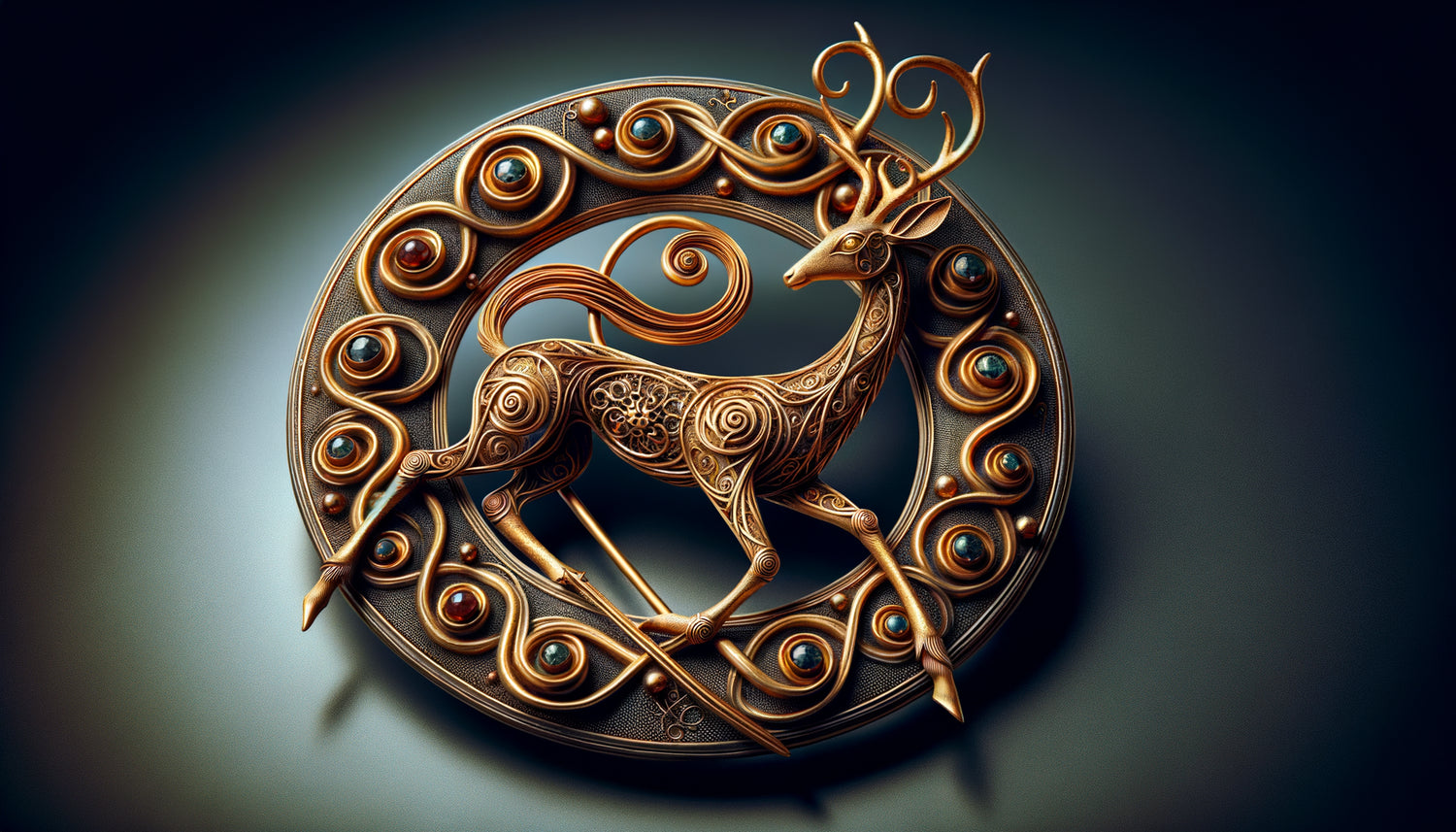
It started with a click while handling a Merovingian fibula in the museum's reserves. This stylized stag, taut muscles, fierce gaze... I had just spent three months cataloging Scythian plaques. The similarity struck me as an obviousness: these Central Asian steppes were dialoguing with medieval Europe through metal and animals.
Here’s what the influence of Scythian animal bronzes brings to European medieval goldsmithing: unparalleled animal narrative power, stylistic codes instantly recognizable, and an aesthetic continuity that transcends 1500 years of history. Three legacies that transform our view of medieval precious objects.
The problem? We admire belt buckles, brooches, medieval clasps without understanding their genealogy. We see "decorative" animals where millennia-old visual codes circulate. This lack of knowledge deprives us of a deeper, more unsettling reading of these objects.
Good news: recognizing Scythian influence requires neither a degree in archaeology nor access to museum reserves. A few stylistic markers are enough to decipher this fascinating cultural transmission. I'll show you how my eye was formed, how these connections became obvious.
After fifteen years of comparing goldsmithing pieces from the Black Sea to Scandinavia, I share with you the keys to this recognition. You will never look at a medieval fibula the same way again.
When the steppes meet the West: the invisible heritage
The Scythians dominated the Eurasian steppes from the 7th to the 3rd century BC. Their animal bronzes – harness plates, quiver appliqués, jewelry – circulated over vast territories. When great migrations push peoples westward, these objects travel in tombs, treasures, and commercial exchanges.
European medieval goldsmithing, particularly between the 5th and 12th centuries, inherits this tradition. Not by servile copying, but by assimilation of visual codes that cross cultures. The Goths, the Huns, the Avars, the Vikings: all these migrating peoples carry in their visual memory the animal aesthetics of the steppes.
In my research, I have traced disturbing stylistic lineages. A Scythian panther from the 5th century BC found in Pazyryk formally dialogues with a Merovingian dragon from the 6th century AD. Eleven centuries separate them, but the same plastic language unites them.
The first clue: the torsion of the animal's body
The most striking marker of Scythian influence? The representation of animals in extreme torsion. Scythian animal bronzes adore bodies that twist on themselves, heads looking backwards, legs folded at impossible angles.
This “composite view” – profile of the body, face or three-quarter view of the head – creates a characteristic visual tension. It is systematically found in European medieval goldsmithing: Merovingian griffins with turned necks, Lombard lions in a frustrated attacking position, Anglo-Saxon stags with heads thrown back.
I photographed hundreds of pieces where this twist appears. On a Frankish loop plate from the 6th century, a quadruped bites its hindquarters, exactly as on Kostromskaya Scythian appliques. This is not a coincidence: it's an inherited visual grammar, passed down hand to hand, workshop to workshop.
Stylized anatomy as a signature
Scythian bronzes never seek naturalism. They stylize: muscles in volutes, joints marked by spirals, hips shaped like hearts. This schematization passes intact into medieval goldsmithing.
Observe an Ostrogothic fibula: the legs of the animals end in scrolls, the shoulders bear circular relief motifs. These are the same conventions as on Siberian gold Scythian plaques. The medieval goldsmith does not copy a living animal – he reproduces an ancestral decorative formula.

Revealing motifs: bestiary and symbolism
Certain creatures immediately betray the influence of Scythian animal bronzes. The deer with hypertrophied antlers, first of all. In Scythian art, the deer is royal, its branches spread out in spectacular tree-like structures along the back.
This iconography crosses European medieval goldsmithing. Alaman loop plates, Scandinavian fibulae, Anglo-Saxon clasps: everywhere, this monumental deer with enormous antlers reappears. It is not realistic – it is symbolic and ornamental, just like among the Scythians.
Felines are another example. Panthers, lions, hybrid creatures: Scythian art represents them in a frozen attack position, mouth open, claws extended. Merovingian and Lombard goldsmithing takes up these codes: walking lions with stiff legs, manes treated in parallel hatching, eyes inlaid with garnets.
Animal interlace as an evolution
Medieval goldsmithing does not simply reproduce: it transforms. Scythian animals, often isolated in a decorative field, become intertwined in medieval art. Bodies that bite each other, tails that intertwine, creatures that form knots.
But look closely: even entangled, these animals retain the twist, the muscular stylization, the proportions inherited from Scythian animal bronzes. The influence does not disappear – it becomes more complex.
Goldsmithing techniques as cultural tracers
Beyond style, metallurgical techniques reveal connections. The Scythians excelled in cast bronze work, repoussé, and inlay. These skills migrate to medieval Europe with the populations.
Cloisonné – this technique of embedding stones or glass paste into metal cells – finds its roots in Scythian and Sarmatian goldsmithing. The Goths adopt it, and then the Merovingians make it their aesthetic signature. European 6th-century cloisonné decorated fibulae descend directly from inlaid Scythian plaques.
I compared sections of Scythian bronzes and Merovingian jewelry under a microscope. The alloys, casting techniques, surface treatments: the continuities are striking. Medieval workshops use processes developed in the steppes a thousand years earlier.

How to train your eye: a practical method
Want to recognize this influence yourself? Start by systematically comparing. Place side by side images of Scythian plaques (collections of the Hermitage Museum) and Merovingian goldsmithing (Cluny Museum, British Museum).
Look for these markers:
- The torsion of the animal body: is the neck turned? Does the head look back? The stylization of muscles: do the hips form hearts? Do the shoulders bear spirals? The proportions: short legs, compact body, disproportionate head? The decorative treatment: parallel incisions, geometric patterns on the fur?
Visit collections of medieval goldsmithing with this reading grid. You will see everywhere the legacy of Scythian animal bronzes. What seemed chaotic becomes coherent. What appeared “barbarian” reveals a millennial sophistication.
Traps to avoid in identification
Attention: not every medieval animal representation comes from the Scythians. Europe has its own traditions – Celtic, Roman, Christian art. The Scythian influence is recognized by the combination of markers, not a single isolated detail.
An animal in torsion + muscle stylization + cast bronze technique = probable Scythian influence. A simple profile lion in a medallion = perhaps Roman or Byzantine. Train your eye to the convergence of clues.
Extend this fascination for ancestral animal art
Discover our exclusive collection of animal paintings that capture this timeless symbolic power, from medieval bestiaries to contemporary representations.
Your gaze transformed on silverware
From now on, every Merovingian brooch you encounter will carry this double history: that of the medieval craftsman who shaped it, and that, older one, of Scythian animal bronzes which nourished its imagination. You will see the steppes in European treasures.
This recognition changes everything. It reveals medieval Europe not as an isolate, but as the culmination of immense cultural migrations. European medieval silverware tells the story of peoples, techniques, dreams that circulated from Central Asia to the Atlantic.
Start simply: visit a collection, observe a brooch, look for the torsion, the stylization, the heritage. Your eye will sharpen. And you will join this small circle of enthusiasts who see, in a bronze fragment, the silent dialogue of civilizations.