

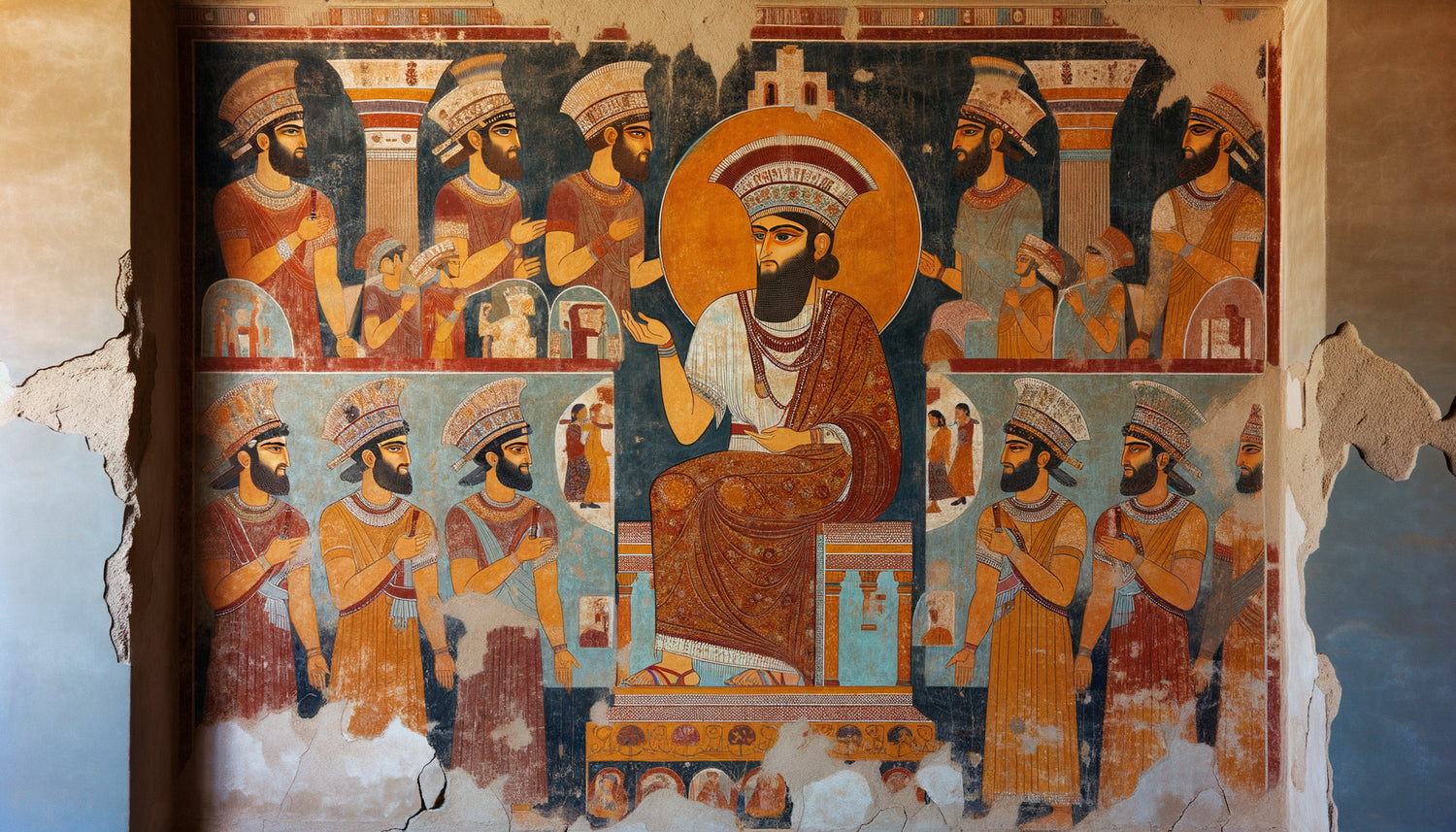
Imagine a crossroads lost in the Syrian desert, where for three centuries, anonymous artists created the impossible: merging worlds that everything opposed. In Dura-Europos, this forgotten city on the Euphrates, daring fresco painters broke all conventions by mixing the hieratic frontality of the Parthians with the Greco-Roman narrative depth. Their walls tell a silent revolution that would forever transform the history of art.
Here is what this unique artistic alchemy reveals to us: a revolutionary method of cultural synthesis through juxtaposition without fusion, a philosophy of frontal gaze that redefines divine presence, and hybrid pictorial techniques that anticipate Byzantine art four centuries later.
You contemplate ancient frescoes and feel that familiar frustration: how did these distant civilizations manage to create visual coherence despite seemingly incompatible traditions? Art history textbooks talk about "influences" without ever explaining the concrete creative process, the hand hesitating between two techniques, the choice of one pigment rather than another.
Rest assured: the artists of Dura-Europos left on their walls a fascinating visual manual of their methodology. Each fresco is a living testimony to their aesthetic decisions, their ingenious compromises, their quiet boldness.
Let's plunge into the dusty workshops of this border city to understand how these creators orchestrated the explosive encounter between Parthian Orient and Hellenistic Occident, creating a visual language that still resonates in our contemporary interiors.
The gaze that pierces the centuries: Parthian frontality as a manifesto
In the synagogue of Dura-Europos, a revelation immediately seizes you. The characters do not look at each other: they look at you. This absolute frontality, pure heritage of Parthian aesthetics, transforms each figure into a living presence, an eternal witness that establishes direct contact with the viewer.
The artists of Dura-Europos understood that Parthian frontality was not a technical blunder, but a philosophy of gaze. Unlike the Greco-Roman tradition which favored elegant profiles and subtle three-quarters views, the Parthian approach affirmed the immediate presence of the divine and the sacred. Each eye fixed straight ahead established a mystical connection, a bridge between the earthly world and the beyond.
This frontality was accompanied by a powerful visual hierarchy: important characters occupied the center of the composition, fixing the viewer with hypnotic intensity, while secondary figures could adopt more varied poses. The fresco painters thus combined hieratic Parthian frontality for divine protagonists with greater narrative freedom for secondary scenes, creating an extraordinarily modern visual tension.
Symmetry as cosmic order
Observe the arrangement of frescoes: an almost obsessive symmetry structures each major composition. This spatial organization, directly imported from Parthian palace aesthetics, transforms walls into symbolic architectures. The artists of Dura-Europos arranged characters like living columns, creating compositions in superimposed registers that simultaneously evoke the reliefs of Persepolis and Roman narrative friezes.
When color speaks two languages: the hybrid palette
The pigments tell a story of trade and compromise. The artists of Dura-Europos worked with a palette that married the earthy ochres of Mesopotamian tradition to Egyptian blues and Mediterranean cinnabar reds. This chromatic fusion was not an accident: it reflected the geographical position of the city itself, a crossroads between East and West.
But the true innovation lay in the application. The fresco painters combined the Parthian technique of colored planes – uniform surfaces of color without modulation – with the Hellenistic tradition of modeling by hatching and gradations. On the same face, you could observe a flat ochre for the general complexion, while subtle brown hatchures suggested the volume of the cheekbones, creating an aesthetic tension between Eastern flatness and Western three-dimensionality.
This technical duality was particularly evident in the treatment of clothing. The artists of Dura-Europos loved to represent sumptuous Parthian costumes – these baggy trousers, these richly embroidered tunics – using flat decorative motifs typically oriental, but suggesting the folds and drape with techniques borrowed from Greco-Roman painting. The result? Figures that seem to simultaneously belong to two distinct visual worlds.

The art of narrative compromise: telling without perspective
How to tell a complex story without using atmospheric perspective dear to the Romans? The artists of Dura-Europos invented a brilliant narrative system that combined Parthian spatial juxtaposition with Greco-Roman temporal sequencing.
In the frescoes of the synagogue, scenes unfold in stacked horizontal registers, in the manner of Parthian reliefs from Hatra. But within each register, narrative episodes follow one another from left to right, following the logic of Hellenistic reading. The same character can appear several times in the same composition, identically dressed, performing sequential actions – a procedure that the Parthians would have considered redundant, but that the artists of Dura-Europos adopted to satisfy Mediterranean narrative appetite.
The hierarchical scale reinvented
The size of the characters obeyed a fascinating hybrid logic. Following Parthian tradition, important figures were represented larger – not due to an inability to render perspective, but by deliberate symbolic choice. Yet, the artists of Dura-Europos modulated this hierarchy with a Greco-Roman subtlety: differences in scale remained measured, avoiding the monumental effect of royal Parthian reliefs to favor a more intimate narrative intimacy closer to Pompeian domestic painting.
The details that betray: Parthian objects, Hellenistic rendering
Take a close look at the weapons, jewelry, and architectural elements depicted. The artists of Dura-Europos painted resolutely Parthian objects – these characteristic composite bows, these torques around the necks of nobles, these iwan architectures – but they rendered them with an attention to detail and an attempt at three-dimensionality inherited from the Greek naturalist tradition.
This creative tension was particularly evident in the treatment of armor and military equipment. Parthian cataphracts, these fully armored cavalrymen who fascinated and terrified the ancient world, appear in several frescoes. Their scale armors are rendered with perfect ethnographic precision – each metal lamella carefully drawn – but the whole seeks to suggest volume, the curvature of the body under the metal, using techniques of light and shadow completely foreign to traditional Parthian art.

The revolution of the background: between oriental abstraction and western landscape
If you examine the backgrounds of the Dura-Europos frescoes, you may discover the most revolutionary hybridization. The artists oscillated between two radically different approaches, sometimes within the same composition.
On one hand, Parthian tradition favored abstract backgrounds – solid color surfaces, sometimes punctuated with geometric or stylized floral motifs, which never claimed to represent a real space. On the other hand, Greco-Roman painting developed sophisticated landscapes, perspective architectures, and complex spatial indications.
The artists of Dura-Europos created a third path: backgrounds suggested rather than described. A few floating architectural elements indicate an interior space, while a few horizontal lines evoke a floor without truly defining it. This economy of means, which may seem primitive at first glance, actually reveals a remarkable conceptual sophistication: it allows scenes to unfold in a space that is both symbolic and narrative, satisfying Eastern expectations of abstract transcendence while offering Western viewers minimal spatial cues.
The invention of symbolic architectural decor
Particularly ingenious: the use of Parthian architectural elements – columns, arches, vaults – as compositional frames rather than illusionistic decors. These painted structures organize the space of the fresco in the manner of Persian carpets, creating narrative compartments while affirming the decorative flatness of the wall. A brilliant solution that simultaneously respects the Parthian horror of illusionist void and the Greco-Roman need for spatial structure.
The invisible heritage: from Dura-Europos to your living room
Why should this artistic alchemy from a city lost 1700 years ago interest you today? Because the visual solutions invented by the artists of Dura-Europos literally shaped the aesthetics we consider "natural".
Byzantine art, which will dominate the Mediterranean world for a millennium, is a direct heir to these experiments. The hieratic frontality of icons, the abstract gold backgrounds, the juxtaposition of narrative scenes, the hierarchy of scales – all of this germinates in the dusty workshops of Dura-Europos, where anonymous artists simply sought to satisfy commissioners with divergent cultural tastes.
Moreover: our contemporary aesthetics, which values cultural hybridity and the fusion of influences, finds in these ancient frescoes a troubling precedent. The artists of Dura-Europos were already practicing what we now call "creative cultural appropriation," this ability to borrow visual elements from different traditions to create something entirely new.
Transform your space into an inspiring cultural hub
Discover our exclusive collection of animal paintings that capture this same timeless fusion between artistic traditions, bringing historical depth and visual sophistication to your contemporary interiors.
Create with the spirit of Dura-Europos
The artists of Dura-Europos teach us a fundamental lesson: true creation is not born from the rejection of traditions, but from their bold conversation. They never sought to erase the contradictions between Parthian and Greco-Roman aesthetics; on the contrary, they allowed them to coexist, creating a productive tension that gave their works a unique vitality.
In your own space, this philosophy finds a direct application. Rather than seeking absolute stylistic consistency – whether it's pure Scandinavian minimalism or integral bohemian maximalism – dare thoughtful juxtapositions. An oriental symmetry in the overall organization, western details in the textures. Bold flat colors, nuanced by subtle gradients. An assumed frontality in the masterpieces, balanced by narrative lateral elements.
The frescoes of Dura-Europos remind us that the greatest aesthetic revolutions often arise at borders, in those spaces of uncertainty where cultural certainties dissolve and experimentation becomes a necessity. For three centuries, anonymous artists painted on mud walls a vision of art that transcended empires and dogmas, creating a hybrid beauty that still speaks to our contemporary sensibilities hungry for multicultural authenticity.
Their legacy? Tangible proof that there is not one way to see, represent, or create – but an infinity of possible dialogues between traditions. And that sometimes, it is precisely in the refusal to choose, in the acceptance of contradiction, that the greatest originality is born.


