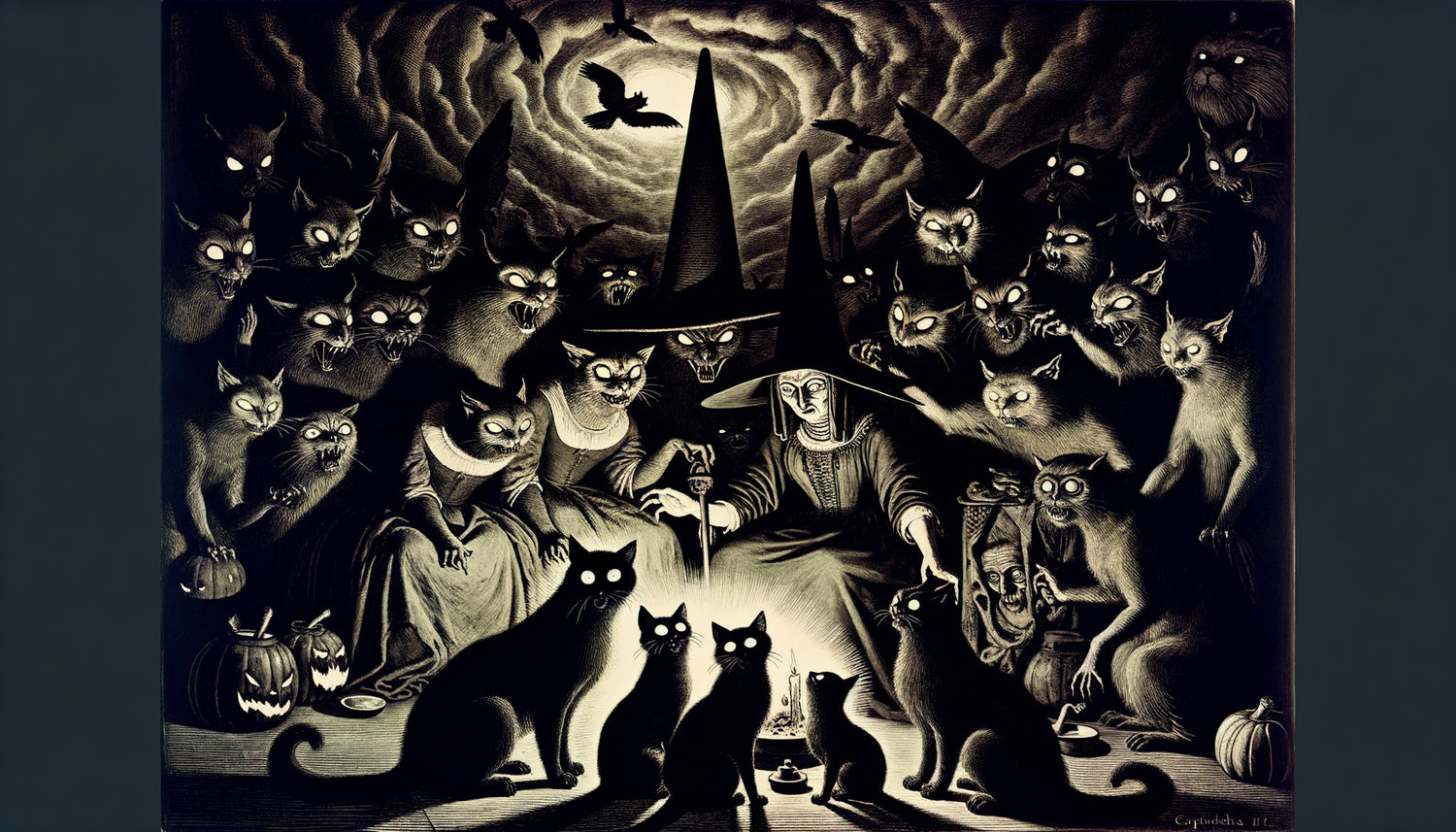
In the dim light of a Madrid print shop, I first discovered Goya’s Caprices. Trembling in my hands were these engravings where cats with incandescent eyes seemed to emerge directly from nightmares. Their sharp claws, their threatening postures, their almost demonic presence instantly fascinated me. Why had this Spanish master chosen to depict felines in such a sinister light, so far removed from the natural grace we know them for? This question led me on an exciting journey into the heart of 18th-century Spain, where sorcery, superstition and social criticism mingled in the collective imagination.
Here’s what Goya’s malevolent cats reveal: a fierce critique of Spanish society, a universal symbolic language of superstition, and a visionary aesthetic that transforms our contemporary interiors. You may have wondered why some works of art are as disturbing as they are fascinating, why these dark animal representations exert a magnetic attraction in our modern living spaces. Rest assured, this tension between repulsion and seduction is an integral part of Goya’s genius. I invite you to plunge into the creative darkness of this visionary artist to understand how his malevolent cats have become timeless icons.
The Darkness of Spain: When Cats Embodied Witchcraft
Goya's Spain was steeped in an atmosphere of intense superstition. During my research in the Inquisition archives, I discovered hundreds of trials where cats appeared as companions of witches, diabolical familiars capable of metamorphoses. In the Caprices engravings, created between 1797 and 1799, Goya masterfully captures this popular belief.
Goya’s felines are never innocuous. In the famous etching number 61, Volavérunt, hybrid creatures half-women half-bats are accompanied by cats with threatening silhouettes. These animals symbolize the dark side of human nature, hidden vices, lust and deception. The artist uses popular imagery of nocturnal cats to denounce the obscurantism of his time.
What particularly fascinates me is how Goya translates these superstitions into a universal visual language. His cats with arched backs, bristling fur, and gleaming eyes in the shadows are not mere folkloric illustrations. They become visual metaphors for a society riddled with fear and ignorance.
The Satirical Claw: Cats as Weapons of Social Critique
Behind these malevolent representations lies a far more subversive intention. Goya, witness to the abuses of the Inquisition and the corruption of the aristocracy, uses cats as instruments of political satire. In his engravings, these felines often accompany scenes of debauchery, religious hypocrisy or charlatanism.
I spent hours analyzing plate 68, Linda maestra!, where a witch teaches her disciples to fly while cats observe the scene. This composition is not simply a fantastic narrative: it denounces corrupted education and the transmission of superstitions. The cats become silent witnesses to human absurdity.
In the series of Disparates, created later, the evil cats take on an even more nightmarish dimension. Goya, aging and darkened by the horrors of the Napoleonic wars, intensifies their monstrous character. These feline creatures now symbolize gratuitous violence and unleashed human bestiality.
The coded language of artistic resistance
During the Inquisition's repression, Goya could not openly criticize the authorities. The evil cats offered him a coded language understandable to initiates, but ambiguous enough to escape censorship. This strategy of concealment transforms each engraving into a visual enigma, where the feline becomes the bearer of a seditious message.

The aesthetics of shadow: engraved techniques of malice
The technical representation of the evil cats in Goya deserves particular attention. Mastering aquatint with unparalleled virtuosity, the artist creates gradations of shadow that give the felines an almost palpable presence. The dark areas envelop the cats, their outlines dissolve into darkness, creating a disturbing ambiguity between animal form and spectral manifestation.
In my workshop, I tried to reproduce these effects to understand the creative process. Aquatint allows grainy textures that perfectly evoke erect fur and the nocturnal atmosphere. Goya brilliantly exploits this technique to suggest furtive movement, a threatening presence without ever revealing everything. This economy of means paradoxically amplifies the impression of danger.
The eyes of the cats, often reduced to simple points of light in the darkness, immediately catch the eye. This strategic focus creates a hypnotic connection between the work and the viewer. Even in a modern reproduction hanging in a contemporary living room, these feline gazes continue to exert their unsettling fascination.
Visual legacy: when Goya's cats haunt our modern interiors
The influence of Goya's malevolent cats transcends centuries. In the galleries I frequent, I regularly observe how contemporary artists revisit this dark imagery. Decorative neo-gothic directly borrows from the master’s tenebrous universe, particularly in animal illustrations charged with symbolism.
This aesthetic is experiencing a spectacular resurgence in contemporary interior decoration. Lovers of dark academia style or mysterious atmospheres specifically seek this tension between classical elegance and latent unease conveyed by Goya's felines. A framed engraving of these malevolent cats brings a profound narrative depth that no conventional animal photograph can match.
I also observe how graphic designers appropriate these visual codes to create modern animal compositions. Striking contrasts, enigmatic silhouettes, piercing gazes: all elements from Goya’s engravings irrigate contemporary visual iconography. They transform a simple cat into a carrier of narrative, an element of decoration steeped in history.
Integrating Goya's legacy into your decoration
For those who wish to introduce this aesthetic into their interior, I recommend prioritizing intimate spaces: libraries, offices, reading corners. Representations of mysterious cats wonderfully dialogue with noble materials such as leather, dark velvet or patinated wood. Soft lighting gradually reveals the details of these compositions, creating an evolving visual experience throughout the day.

Cats as a mirror of the human soul
Beyond social criticism and superstition, Goya's malevolent cats fulfill a profound psychological function. They embody our archaic fears, that shadow aspect which Carl Jung would identify as our collective unconscious. The nocturnal feline, silent predator with dilated pupils, awakens ancestral terrors deeply rooted in our psyche.
Goya himself, tormented by illness and deafness, projects his own inner demons onto his cats. These creatures become symbolic self-portraits of his anxieties, his perception of a world that has become hostile and incomprehensible. This autobiographical dimension adds a layer of emotional complexity to these representations.
In my conversations with collectors, I notice that these dark works exert a cathartic function. Confronting one's fears visually, taming them through art, paradoxically allows to domesticate them. The malevolent cats of Goya thus offer an experience of aesthetic sublimation where anguish transforms into fascinated contemplation.
Let the symbolic power of animals transform your space
Discover our exclusive collection of animal paintings that capture this narrative intensity and bring depth and character to your walls.
From engraved nightmare to timeless decorative icon
The malevolent cats of Goya bear witness to the timeless power of art to transcend its original context. Born from a desire for social critique in obscurantist Spain, these dark felines still speak to us today. They remind us that beauty does not exclude unease, that elegance can coexist with subversion.
Imagine your gaze meeting that of a Goya cat every morning in your living room. This silent presence invites you to question appearances, to seek hidden meanings, to cultivate a complex aesthetic sensibility. It is precisely this narrative depth that distinguishes a simple decoration from a truly thoughtful artistic choice.
Perhaps start by exploring reproductions of original engravings, or opt for contemporary interpretations inspired by this universe. The essential thing is to dare this unique aesthetics which, far from darkening your interior, confers it a poetic and intellectual dimension rare in conventional decoration.
FAQ
Do representations of malevolent cats really suit modern decor?
Absolutely! It’s even one of the most sophisticated trends in contemporary decor. Malevolent cats by Goya fit perfectly into interiors that seek a narrative depth rather than simple decorative prettiness. They remarkably dialogue with neo-gothic, maximalist or even contrasted minimalist aesthetics. In a sleek living room with neutral tones, a dark engraving by Goya creates a dramatic focal point that awakens curiosity. In a richly furnished library, it reinforces the intellectual and mysterious atmosphere. The key is balance: these powerful works require visual space around them to breathe. Avoid overloading them with other elements that are too present. Personally, I have accompanied many clients in integrating these works, and the result systematically brings an additional dimension to the space, transforming a banal interior into a place full of character and history.
Why did Goya specifically choose cats rather than other animals?
Goya’s choice of the cat is never arbitrary and responds to several superimposed logics. Firstly, in 18th century Spanish collective imagination, the cat was inextricably linked to witchcraft. The Inquisition trials are full of testimonies accusing cats of being familiar demons. Secondly, the feline possesses a natural ambivalence perfect for satire: domestic yet wild, graceful but predatory, affectionate but independent. This duality allowed Goya to visually express the human duplicity he denounced. Unlike the dog, symbol of loyalty too unambiguous, or the serpent, too obviously diabolical, the cat offered this grey area where the viewer cannot definitively decide between innocence and malice. Technically, the feline morphology also lent itself wonderfully to aquatint: arched postures, furtive silhouettes, luminous eyes in the shadow create visually powerful compositions. Goya thus simultaneously exploits the cultural symbolism and the aesthetic potential of the animal.
How to recognize the influence of Goya in contemporary animal art?
The legacy of Goya's malevolent cats can be recognized by several distinctive visual signatures. First, look for extreme contrasts between shadow and light, this dramatic chiaroscuro technique that isolates the animal in an undefined and threatening environment. Then observe the treatment of the eyes: in Goya and among his spiritual heirs, the feline gaze is never innocent or cute, but charged with an almost human intelligence, even a conscious malice. The narrative composition constitutes a third clue: the animal is not represented for its intrinsic beauty, but as a carrier of a symbolic or critical message. Finally, note the deliberate ambiguity between anatomical realism and expressive distortion. Artists influenced by Goya generally respect animal morphology while introducing slightly disturbing elements: exaggerated proportions, impossible postures, subtle anthropomorphic details. In contemporary galleries, this aesthetic particularly irrigates works inspired by Gothic, surrealist or symbolist art. It attracts collectors seeking intellectually stimulating animal representations rather than simply decorative ones.