In the silent galleries of Egyptology museums, behind protective display cases, lie strange mummified creatures. Thousands of sacred ibises, these birds with long curved beaks, traverse the millennia with a disturbing dignity. But what has fascinated curators and scientists for decades is this obsessive question: how have these dazzling white feathers retained their golden, ochre, and even reddish hues after more than 3000 years? The answer lies in a natural dyeing technique as sophisticated as it is unexpected, revealing the cosmetic genius of ancient Egypt.
Here's what this millennial technique reveals: exceptional botanical mastery, a deep spiritual connection with the animal world, and conservation secrets that still inspire our contemporary approaches to natural beauty. Because beyond the simple funerary ritual, the Egyptians had understood the art of sublimating nature to honor their gods.
Have you ever wondered why some ancient artifacts seem to defy the laws of time? Why these bird mummies, exhibited at the British Museum or the Louvre, still display chromatic nuances that our modern dyes struggle to maintain for a few seasons? This enigma has long frustrated Egyptologists until spectroscopic analyses revealed the incredible truth.
Rest assured, we will explore together this fascinating intersection between spirituality, botany and craftsmanship. You don't need to be an archaeologist to appreciate the beauty of this discovery. I promise you that at the end of this journey, you will never look at natural colors in the same way again.
Sacred henna: the vegetal gold of embalmers
The revelation came from microscopic analysis of feathers taken from ibis mummies dating back to the New Empire. Researchers identified characteristic traces of lawsone, the active pigment in henna. This Mediterranean plant, Lawsonia inermis, grew abundantly in the gardens of Egyptian temples. The embalming priests harvested its leaves with ceremonial care, dried them under the sun of Thebes, then reduced them to a fine powder of deep olive green.
The process of henna dyeing plumage was not just an aesthetic gesture. It was part of a complex ritual of purification and spiritual transformation. Ibis, terrestrial avatars of the god Thoth – divinity of wisdom and writing – had to be embellished before their journey to the afterlife. Their natural white plumage was considered incomplete, requiring this golden touch to reflect the divine light of Ra.
Artisans prepared a thick paste by mixing henna powder with Nile water, sometimes enriched with lemon juice or bark infusions to intensify the color. This preparation rested for several hours in earthenware jars, allowing the lawsone molecules to fully activate. The temperature of the desert played a crucial role in this natural alchemy.
The delicate art of application: a feather-by-feather ceremony
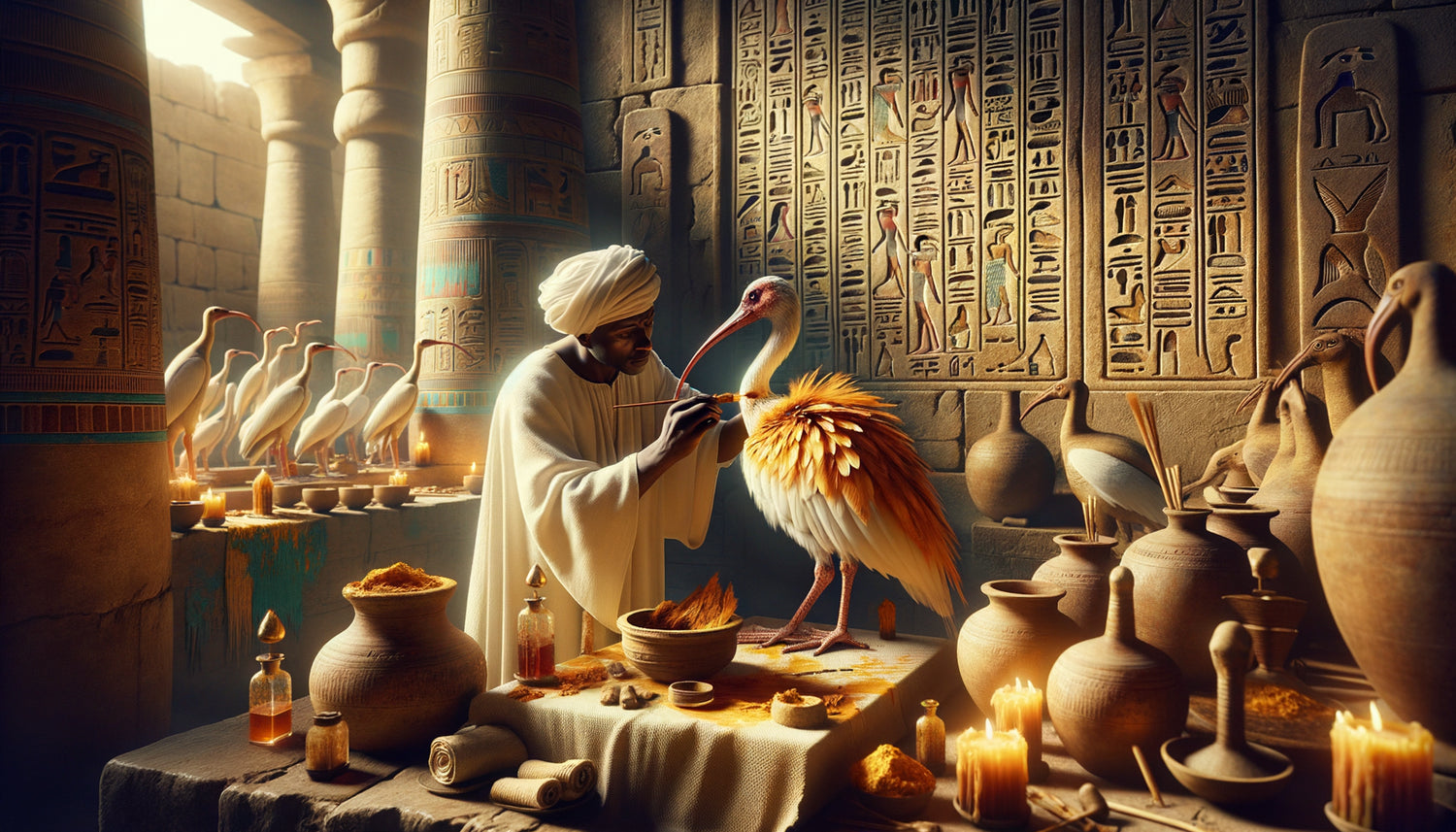
Imagine the embalming workshop: a cool room carved into limestone, lit by oil lamps. The priest-artisans, with shaved heads and dressed in immaculate white linen, handled each mummified bird with meticulous devotion. Applying henna to the feathers required extraordinary dexterity. Unlike modern hair dyes that saturate the material, this technique required precise gestures to avoid weighing down the plumage or altering its structure.
The embalmers used fine brushes made from tapered papyrus stems. They took tiny amounts of henna paste and applied it to the remiges and rectrices – these large feathers of the wings and tail that formed the majestic silhouette of the ibis. Each feather received individual attention, a delicate stroke of the brush depositing a translucent layer of pigment.
The duration varied depending on the desired color intensity. To achieve these amber hues that we admire today, artisans left the henna to act for several hours, sometimes an entire night. The mummies were arranged on wooden racks, in a natural position, allowing the dry desert air to gradually fix the color. This slow and regular drying process was essential: too fast, it would have created uneven shades; too slow, it would have risked damaging the mummified tissues.

Why henna rather than another dye?
The Egyptians had an impressive botanical palette: saffron, indigo, beetroot, turmeric... So why favor henna to color the plumage of sacred ibises? The answer reveals a deep understanding of natural chemical properties. Henna has exceptional preservative qualities that other vegetable dyes do not offer to the same degree.
Lawsone contained in henna acts as an antiseptic and antifungal agent. By penetrating the keratin structure of the feathers, it creates additional protection against microbial decomposition. This property transformed the dye into a true extension of the embalming process. The priests were not only seeking to beautify, but to preserve the physical integrity of these divine messengers for eternity.
Moreover, henna develops its color by natural oxidation, a process that improves with time rather than degrading. Unlike modern synthetic dyes which fade under the effects of light and oxygen, the pigments in henna stabilize by chemically binding to the proteins in the feathers. This reaction creates lasting nuances that explain the remarkable chromatic persistence observed on millennia-old specimens.
The symbolic dimension also played a major role. Henna was associated with magical protection, used to adorn the hands of the living during important ceremonies. Transposing this practice to mummified ibises created a ritual continuity between the earthly world and the realm of Osiris. Each dyed feather became a colorful amulet, a talisman guaranteeing a safe passage to the afterlife.
Intentional chromatic variations
Not all ibis mummies show the same intensity of coloration. This diversity is not the result of chance or uneven degradation, but rather the result of deliberate choices on the part of the artisans. Spectrometric analyses revealed varying concentrations of lawsone depending on the individuals, suggesting different levels of treatment.
Some specimens display a slight golden veil, almost imperceptible, obtained by a single and diluted application. Others exhibit deep copper-red hues, requiring several successive layers and prolonged setting times. This gradation probably reflected spiritual hierarchy or the importance of the votive offering. An ibis offered by a pharaoh received more elaborate treatment than a bird deposited by a simple scribe.
The embalmers also mastered the art of botanical blends. Some analyses detected traces of other plant substances mixed with henna: safflower extracts to enrich orange tones, or pomegranate peel to bring cooler nuances. These chromatic adjustments testify to a true science of color, transmitted from generation to generation within the houses of life – these institutions where sacred knowledge was preserved.

The contemporary legacy of an ancestral technique
This fascinating discovery strangely resonates with our current concerns. As the modern cosmetic industry rediscovers the virtues of natural dyes in the face of damage caused by chemicals, the Egyptians remind us that they had already found the solution 3000 years ago. Henna is now experiencing a spectacular resurgence, not only for coloring hair, but also in textile restoration and museum conservation.
Researchers are now using the principles discovered on ibis mummies to develop protective treatments for historical ornithological collections. Feathers of birds naturalized in natural history museums slowly degrade under the effects of light and humidity. The application of compounds inspired by Egyptian henna helps to significantly slow down this deterioration.
In the realm of interior decoration, this aesthetic of naturally weathered colors profoundly influences current trends. These warm, slightly uneven tones bring a depth that uniform industrial pigments cannot reproduce. Textile designers draw inspiration from this amber palette to create upholstery fabrics with organic nuances, evoking the timeless nobility of antique artifacts.
The underlying philosophy also deserves our attention. The Egyptians did not seek to dominate nature by radically transforming it, but to reveal its latent beauty through measured interventions. This respectful approach, which works with the intrinsic properties of materials rather than against them, offers a valuable model for our contemporary sustainable design practices.
Be inspired by this millennial wisdom
Discover our exclusive collection of animal paintings that celebrate the timeless beauty of wildlife and perpetuate this ancestral art of sublimating nature.
Reproducing the Egyptian spirit in our interiors
How to transpose this fascinating aesthetic into our living spaces? It's not about transforming your living room into a burial chamber, but about adopting this philosophy of natural color that transcends eras. The hues obtained with henna – these warm ochres, these luminous ambers, these subtle coppers – create a soothing and sophisticated atmosphere.
In a contemporary interior, prioritize naturally dyed textiles : linen cushions treated with henna and other dye plants, wool blankets with gradient shades reminiscent of these millennia-old plumage. These elements bring chromatic richness that evolves with the daylight, creating a living and changing ambiance.
Lovers of animal art can look for representations of ibis or other sacred birds, preferring works with earthy and golden palettes. An antique engraving of an ibis, framed in patinated wood, dialogues beautifully with walls in neutral sand or Sienna earth tones. This approach creates a cultural stratification that adds depth to the decoration.
Lighting plays a crucial role in revealing these subtle nuances. Opt for warm light sources that mimic the light of the Egyptian desert: lamps with exposed filaments, shades made from natural fibers letting through an amber glow. This lighting atmosphere makes the henna tones vibrate as it once animated the feathers of ibises in the Saqqarah necropolises.
The art of meaningful detail
The Egyptians attached great importance to meaningful details. Every gesture, every color, every material was chosen for its symbolic dimension as much as practical. This meticulous attention can inspire our way of decorating our spaces. Rather than accumulating decorative objects, select a few significant pieces with naturally weathered hues.
A simple terracotta bowl containing henna powder becomes a contemplative object, recalling these embalmers' workshop jars. Naturally sourced feathers – ethically obtained – arranged in a transparent vase create a tangible link to this millennial history. These simple, almost monastic elements carry an emotional charge that industrial trinkets cannot match.
The approach is to create interiors where every element tells a story, where colors are not arbitrary choices but conscious cultural references. This approach transforms decoration into a form of cultural meditation, enriching our daily lives with a historical and spiritual dimension.
Conclusion : Color as a bridge between eras
The henna dyeing technique for mummified ibises goes far beyond the scope of an archaeological curiosity. It reveals a civilization that had understood the very essence of lasting beauty: working with nature, respecting materials, seeking meaning behind appearance. These golden plumage that cross the millennia whisper to us that true elegance does not lie in fleeting brilliance, but in the noble patina that time enhances.
When contemplating these artifacts during your next museum visit, see beyond the simple bird mummy. Perceive the patient gesture of the anonymous artisan, his intimate knowledge of plants, his spiritual devotion. Then, back home, look differently at the colors around you. Perhaps prioritize natural nuances, organic textures, and hues that tell stories. This is how the spirit of ancient Egypt continues to live, not fossilized in display cases, but vibrant in our daily aesthetic choices.
Start simply: look for henna-dyed textile, observe how its color evolves with the light. This small gesture will connect you to an unbroken chain of creators who, for 3000 years, have celebrated the beauty that nature and art can create together.