

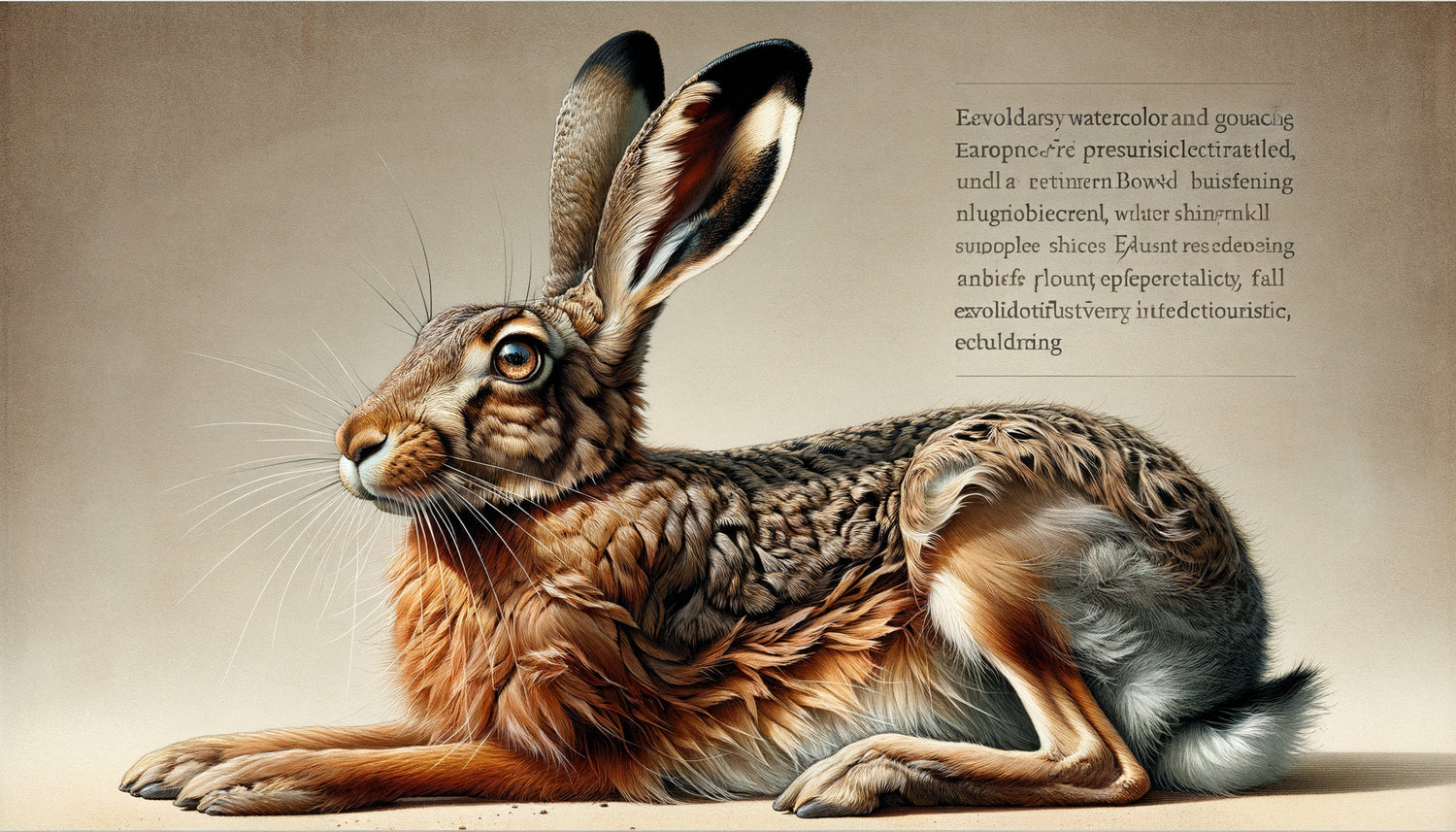
1502. In his Nuremberg workshop, Albrecht Dürer fixes to paper what will become one of the most copied works in art history: a hare. Not a symbolic representation, not a creature from a medieval bestiary. A living hare, with its ruffled fur, its translucent ears, its moist gaze. This watercolor and gouache drawing is set to revolutionize five centuries of artistic tradition. But why does this simple animal still fascinate art lovers today? Here's what Dürer’s hare brings: a timeless lesson in meticulous observation, proof that ordinary nature holds extraordinary beauty, and the perfect inspiration to integrate animal art into our contemporary interiors. You might think that antique works have no place in a modern decor? That animal realism lacks sophistication? Think again. Dürer’s hare proves that rigorous observation and pure emotion can coexist in a single image. Let's discover together how this revolutionary 16th-century drawing continues to influence our relationship with animal art.
When Dürer revolutionizes the gaze on nature
At the beginning of the 16th century, representing an animal generally means stylizing it, symbolizing it. Medieval bestiaries are full of fantastic creatures and allegorical interpretations. But Albrecht Dürer, a visionary artist of the Northern Renaissance, chooses a radically different path. His Young Hare, created in 1502, marks a fundamental break: it is an observation drawing pure and simple.
Dürer’s hare is not a concept. It's an individual, probably captured alive and observed for hours. Each hair seems to vibrate with its own life. The artist uses mixed techniques – watercolor, gouache, white highlights – to capture the texture of the brown-gray fur, the delicacy of the ears, the moist gleam of the eye that reflects the light of the workshop. This precision borders on technical miracle.
What makes this drawing revolutionary is its total absence of narrative pretension. The hare symbolizes nothing. It exists, simply. Dürer signs and dates his work with the same solemnity as a royal portrait, thus granting this small animal an unprecedented dignity. This gesture affirms that ordinary nature deserves as much attention as traditional noble subjects.
The technique behind the masterpiece: lesson in observation
How does Dürer manage to create this illusion of life? By applying a systematic method of observation that foreshadows modern scientific approaches. Observational drawing according to Dürer is based on several principles that we can still admire today.
First, directional light. The hare is illuminated from the left, creating areas of shadow and light that sculpt its volume. Reflections in the eye – four small white windows – suggest the panes of glass in the workshop, anchoring the animal in a real space. This attention to the light source transforms a flat drawing into a three-dimensional presence.
Secondly, the hair-by-hair technique. Dürer doesn't paint a uniform mass. He builds up the fur by accumulating fine strokes, varying the tones from warm brown to cold gray, creating an almost tactile texture. You feel like stroking this hare across the centuries. This patience in execution reveals a philosophy: really observing means slowing down.
Thirdly, the precise anatomy. The proportions are correct, the posture natural. The hare seems alert, slightly tense, ready to leap. Dürer captured not only the appearance but the temperament of the animal. It is this animal psychology that gives the work its emotional depth.

Why this hare still fascinates five centuries later
Dürer's Young Hare is now one of the most reproduced works in the world. Posters, tote bags, calendars: this 16th-century drawing appears everywhere. But this popularity is not just a commercial phenomenon. It reveals something profound about our contemporary relationship with nature.
In the age of digital technology and increasing urbanization, Dürer's observational drawing reminds us of a quality that is disappearing: sustained attention. Looking at this hare means slowing down, observing minute details, rediscovering a form of contemplation. In our often minimalist and technological interiors, this work brings a touch of organic life, a breath of nature.
Contemporary collectors and decorators are precisely looking for this combination: technical sophistication and natural presence. Dürer's hare works just as well in a classic interior as in a modern loft. Its neutral palette – browns, grays, whites – harmonizes with almost all decorative styles. And its precise realism contrasts beautifully with contemporary abstractions.
More deeply, this drawing embodies an ethics of looking. It tells us that every creature, even the most humble, deserves to be given time. In a culture of disposable images and infinite scrolling, Dürer's hare affirms the value of patient observation and faithful representation.
Dürer's legacy in contemporary animal art
The influence of the observational drawing initiated by Dürer crosses the centuries. The naturalists of the 18th century, the scientific illustrators of the 19th, to contemporary animal artists, all inherit this tradition: really looking before representing.
The great names in naturalistic illustration – Audubon, Gould, Haeckel – apply Dürer's principles: anatomical precision, attention to light, meticulous rendering of textures. But they add the scientific dimension, transforming artistic observation into precise documentation of living things. Dürer’s hare thus opens the way for a double tradition: artistic and scientific.
Today, contemporary artists working on the theme of animals consciously or unconsciously follow this lineage. Whether through hyperrealistic wildlife photography, pencil drawings with surgical precision, or even some contemporary installations that question our relationship to animals, Dürer’s legacy persists.
In interior design, this tradition finds new life. High-quality reproductions of the hare, but also original creations inspired by this observational drawing, are experiencing growing success. They meet a deep need: to bring nature back into our living spaces, not in an idealized way, but in its organic truth.

How to incorporate the spirit of the hare into your interior
You obviously do not have access to the original, preciously preserved at the Albertina in Vienna. But the spirit of Dürer’s hare can nevertheless inhabit your interior. Here's how to capture this essence in your decor.
Prioritize quality reproductions. A high-definition print on art paper will do justice to the meticulous details of the original drawing. Frame it simply: a simple frame made of natural wood or matte metal will allow the work to breathe. Place it in a space where you take your time – office, reading corner, bedroom – rather than in a passageway.
Think about the wall composition. Dürer’s hare dialogues wonderfully with other naturalist studies: botanical prints, bird drawings, landscape watercolors. Create an observation gallery that tells of your sensitivity to nature. Vary the formats and techniques while maintaining chromatic consistency around natural tones.
Explore contemporary interpretations. Some contemporary artists revisit the theme of the hare by drawing inspiration from Dürer. Black and white photographs, stylized drawings, minimalist sculptures: these modern variations capture the essence of observational drawing while speaking our contemporary visual language.
Finally, extend the principle beyond the hare. The spirit of Dürer is to celebrate the beauty of living things observed with attention. A painting depicting any animal with the same respect and precision will prolong this philosophy in your space.
Transform your interior into a naturalist gallery
Discover our exclusive collection of animal paintings that captures the essence of observational drawing in a refined contemporary style.
From Nuremberg's workshop to your living room: a timeless journey
Dürer’s hare teaches us a simple but profound lesson: beauty lies in the attention we pay to things. This little animal, fixed on paper over five centuries ago, continues to move us because it embodies a quality that has become rare – patient contemplation of life.
By incorporating the spirit of this observational drawing into your decor, you do more than just add an image to the walls. You affirm that your interior is a space of presence and attention, not just functionality. You create a daily dialogue with nature, even in the heart of the city.
So take time. Really observe the works you choose. Look for that quality of gaze that Dürer crystallized in his Nuremberg workshop. And let your space become, too, a place where life – even represented – can unfold in all its delicate complexity.
Frequently asked questions about Dürer’s hare and animal art
Why is Dürer’s hare considered revolutionary?
The Young Hare by Dürer, created in 1502, revolutionized art because it marks a turning point in the way of looking at nature. Before Dürer, animals in art primarily served symbolic or decorative functions. Medieval bestiaries are full of fantastic creatures charged with religious or moral meanings. Dürer chooses a radically different approach: pure observational drawing. He studies a real hare, probably kept alive in his workshop, and represents it with a precision that borders on scientific. Every hair, every reflection in the eye, every nuance of color is observed and faithfully rendered. This approach foreshadows modern naturalistic illustration and affirms that ordinary nature deserves as much artistic attention as traditional noble subjects. By solemnly signing this work, Dürer elevates the very status of the animal in the artistic hierarchy. It is this combination – virtuoso technique, rigorous observation and respect for the subject – that makes the hare a revolutionary work whose influence can still be felt today.
How to integrate a reproduction of Dürer’s hare into a modern interior?
Dürer’s Hare remarkably suits contemporary interiors thanks to its neutral palette and timeless aesthetic. To integrate it harmoniously, start by choosing a high-quality reproduction on art paper that will do justice to the meticulous details of the original. Framing is crucial: opt for a simple frame in light natural wood, matte black or fine metal that does not compete with the work. In a Scandinavian minimalist interior, the hare will bring a welcome organic touch. In an industrial style, its realism will create a sophisticated contrast with raw materials. Place it in a room where you take the time to contemplate: office, library, bedroom. You can present it alone, as a centerpiece, or integrate it into a naturalistic wall gallery with other botanical or animal studies. The trick is to maintain chromatic consistency around natural tones – beiges, soft greens, grays – to create a soothing atmosphere. The hare works particularly well above a wooden piece of furniture, surrounded by green plants, or in a space dedicated to reading and reflection.
Which other artists have been inspired by Dürer’s observational drawing?
The legacy of observational drawing inaugurated by Dürer runs throughout the history of naturalist art. In the 18th century, Maria Sibylla Merian applies these principles to the study of insects, creating plates of remarkable precision that combine scientific rigor and artistic beauty. In the 19th century, John James Audubon revolutionizes ornithological illustration with his life-size representations of American birds, capturing not only their appearance but also their behavior. Victorian scientific illustrators like Ernst Haeckel push this tradition even further, documenting marine biodiversity with almost microscopic precision. More recently, contemporary artists such as Robert Bateman or Carl Brenders perpetuate this approach in their hyperrealistic paintings of wildlife. In photography, artists like Tim Flach adopt the same philosophy of patient and respectful observation of the animal subject. Even some street artists like ROA draw inspiration from this precise anatomical tradition in their monumental murals. They all share Dürer’s founding principle: really look before representing, giving the natural world the meticulous attention it deserves.


