Imagine standing before the wall of a cave, in the flickering light of a resin torch. Under your fingers, the cold limestone reveals shapes that seem to come alive: a galloping horse, a powerful bison, a herd of deer crossing eternity. These images are 30,000 years old, yet they vibrate with an intensity that grips you in the gut. Prehistoric wall art is not simply rock decoration; it's the first great dialogue between human and animal, engraved in stone to traverse the millennia.
Here's what the representation of animals in prehistoric art reveals to us: a deep spiritual connection with nature, an astonishing technical mastery of Paleolithic artists, and a universal symbolic language that still inspires our contemporary interiors. These ancestral frescoes tell the story of a world where the animal was not simply a subject, but a sacred presence, a companion for survival, a cosmic force.
Many think these rock paintings were simple illustrations of hunting scenes, primitive trophies. However, reality is infinitely more fascinating and complex. Why did these Upper Paleolithic artists descend into the dark depths of caves to paint there? Why this obsession with certain animal species, while others, though hunted, never appear?
Let me take you on a journey through 300 centuries, to where it all began, in the underground sanctuaries of Western Europe. You will discover that cave art was not simply a pastime, but a vital, almost magical necessity, which still resonates today in our fascination with animal representations.
When the Animal Becomes Art: The Creative Awakening of the Paleolithic
The first animal wall representations appear about 40,000 years ago, marking an extraordinary cognitive revolution. In Indonesia, in the Lubang Jeriji Saléh cave, a red ocher bovine testifies to this simultaneous emergence of art on several continents. But it is in Europe that this artistic expression reaches its peak.
The Chauvet, Lascaux, Altamira caves: these names resonate like cathedrals of prehistoric time. In Chauvet, in the Ardèche region, the animal frescoes dating back 36,000 years reveal an astonishing technical sophistication. The artists already used the natural relief of the rock to create an illusion of volume, a technique we now call trompe-l'oeil.
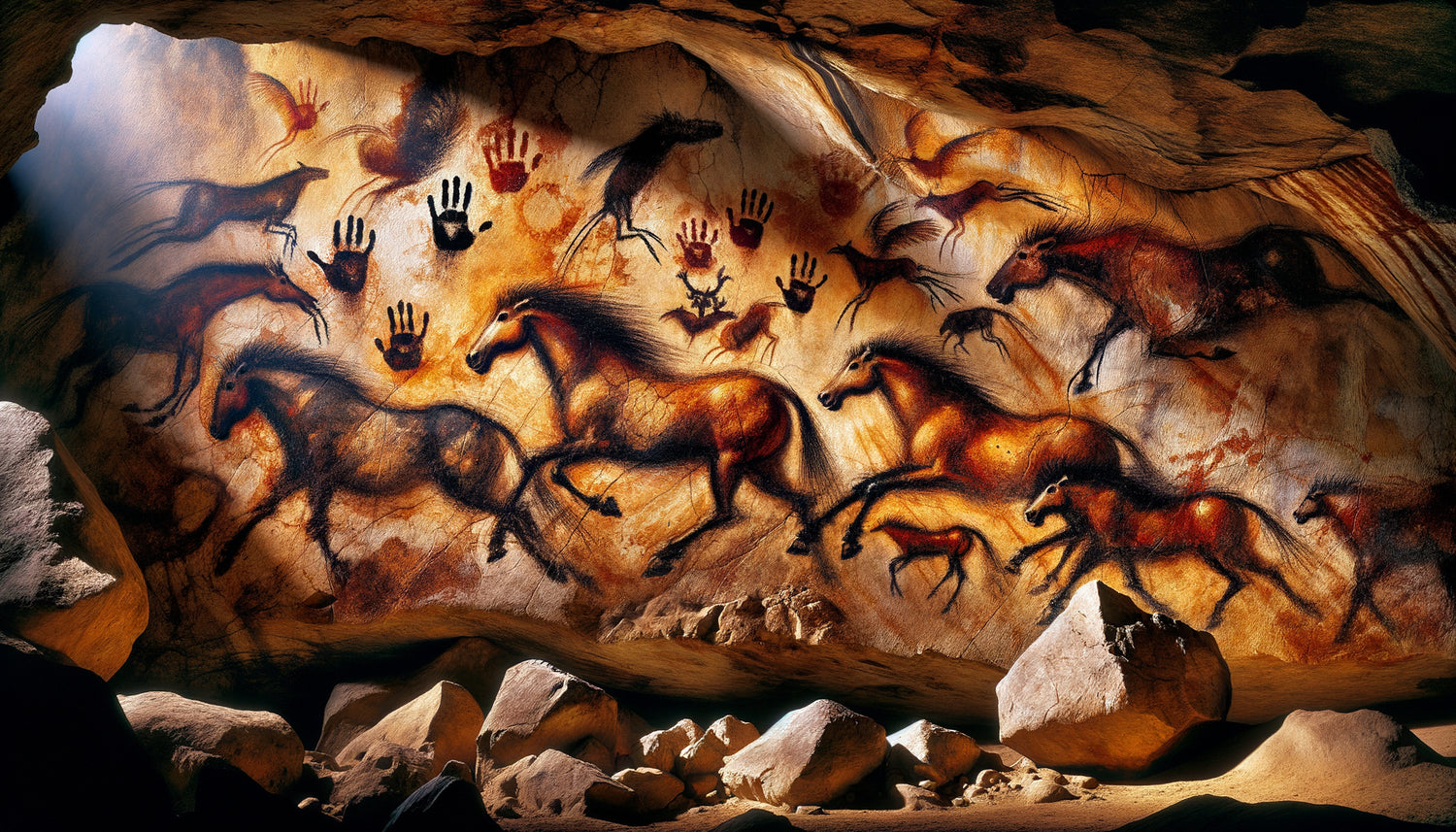
These first creators perfectly mastered animal anatomy. Every muscle, every posture, every movement was observed with almost scientific precision. The horses of Lascaux gallop with a dynamism that modern photographers took centuries to capture. This was not the work of amateurs scribbling on walls, but that of true artists, probably specialized and recognized within their community.
The Pigments of Eternity
To create these animal cave paintings, prehistoric artists ground red and yellow ochres, charcoal, manganese oxide for a deep black. They mixed these powders with animal fat, water, sometimes saliva, creating durable binders. Some blew the pigments directly onto the wall through hollow bones, creating remarkable gradient effects.
This limited color palette – essentially red, black, ocher, and white – nevertheless created incredible emotional depth. The bison of Altamira, painted 14,000 years ago, seem to emerge from the rock thanks to the masterful use of natural reliefs and shading. A technique that our contemporary designers rediscover with fascination.
The sacred bestiary: which animals and why?
In prehistoric parietal art, not all animals are equal. Of the hundreds of species that coexisted with these populations, only a handful appear on the walls. Horses dominate (30% of representations), followed by bison, aurochs, deer, ibexes and mammoths. Strangely, reindeer, often the main food source in many regions, are almost absent.
This selection is not random. These animals were not simply hunted; they were venerated, feared, respected. The horse may have symbolized speed and freedom, the bison power and fertility, the mammoth primordial strength. Each species carried a symbolic charge that we can only guess at.
Felines – lions, bears, panthers – appear rarely but always in remarkable positions, often at the back of caves, in the most inaccessible areas. At Chauvet, the rear chamber reveals an impressive concentration of prehistoric felines, as if these predators guarded access to an ultimate sanctuary.
The revealing absence
Humans are almost absent from prehistoric animal wall art. A few schematic silhouettes, hand negatives blown on the wall, but no realistic portrait comparable to the anatomical precision of animals. This difference in treatment is fascinating: humans faded before the animal, perhaps recognizing in it a spiritual superiority, a direct connection with the invisible forces of the world.

The theories that illuminate these mysterious origins
Why paint in the total darkness of caves, sometimes kilometers from the entrance, in narrow and dangerous passages? This question has haunted prehistorians since the discovery of the first decorated caves in the 19th century.
The magico-religious theory, proposed as early as the 1900s, suggests that these images served to guarantee the success of the hunt. By representing the animal, one appropriated its spirit, ensured its capture. Some frescoes actually show animals pierced with arrows or spears, reinforcing this hypothesis.
But other theories, more nuanced, are emerging. The shamanic hypothesis proposes that these caves were initiation sites where shamans entered a trance to communicate with the world of animal spirits. The conditions – darkness, cold, sensory isolation – favored altered states of consciousness. Animals were not prey but spiritual guides.
More recently, some researchers speak of mythography: these frescoes would tell founding myths, cosmogonic stories where animals play the main roles. The complex compositions, with their superimpositions and recurring associations (horse-bison, mammoth-feline), suggest a structured narrative, a codified symbolic language.
The sacred acoustics of caves
A fascinating recent discovery: the most decorated areas of caves often correspond to points of optimal acoustics. Animal representations concentrate where sound resonates best, suggesting that these places were ritual theaters where songs, percussion and images combined in multisensory ceremonies. Cave art may never have been contemplated in silence, but accompanied by music, dance, recitation.
From prehistoric gesture to contemporary inspiration
These animals painted on the walls tens of thousands of years ago continue to exert an irresistible fascination on our modern sensibilities. Why do these images cross time with such emotional force?
Perhaps because they remind us of a world where animals were not domesticated, controlled, industrialized, but remained a free and wild power. A world where humans did not dominate nature but dialogued with it, in a respect tinged with awe. This lost relationship resonates within us as an ancestral nostalgia.
Contemporary creators draw abundantly from this prehistoric repertoire. The clean lines, the power of silhouettes, the chromatic minimalism of animal rock art inspire designers, decorators and artists. This raw, authentic aesthetic, charged with symbolism, brings a spiritual depth to our ultramodern living spaces.
In a contemporary interior, an animal representation inspired by prehistoric art is never insignificant. It creates a bridge between the cyclical time of origins and our fragmented present. It reintroduces a sacred dimension, a living presence that transforms a simple wall into a temporal portal.
Reconnect your interior to the timeless power of origins
Discover our exclusive collection of animal paintings that capture this ancestral force and transform your walls into contemporary sanctuaries.

The living heritage of a millennial dialogue
The origins of prehistoric animal art remain partly mysterious, and it is precisely this mystery that nourishes their power. These images are not just archaeological testimonies; they are windows open onto an emerging human consciousness, on the first existential questions of our species.
Our Paleolithic ancestors created more than just images: they invented a universal language that transcends cultures and eras. A language where the animal embodies beauty, power, mystery, connection with the invisible forces of life. This visual grammar still resonates today in our collective fascination for animal representations.
When you contemplate a stylized horse on your wall, when you choose a leopard print, when you integrate an animal sculpture into your decor, you unconsciously extend this ancestral dialogue. You participate in a conversation that began 40,000 years ago in the dark depths of a cave, and has never ceased since.
Prehistoric mural art reminds us of this essential truth: we are not separated from the animal kingdom; we are part of it. These murals were perhaps humanity's first attempt to understand its place in the great theater of life. A question that remains surprisingly current as we rediscover the urgency of reconnecting with nature.
Frequently asked questions about prehistoric animal art
Why did prehistoric artists mainly paint animals and not humans?
This difference in treatment likely reveals the worldview of these populations. Animals represented spiritual powers, mediators between the visible and invisible world. Their extremely realistic representation suggests a profound observation and an almost religious respect. The human being, on the other hand, appears only in schematic form, as if secondary to animal majesty. This symbolic hierarchy perhaps reflected a conception of the world where humanity did not consider itself dominant but as an integral part of a sacred ecosystem. Shamans, the only humans sometimes represented, often appear half-human, half-animal, emphasizing this permeability between realms.
How could the pigments of these paintings have survived tens of thousands of years?
The exceptional preservation of prehistoric parietal art is due to several remarkable factors. First, caves offer stable climatic conditions: constant temperature, regulated humidity, absence of direct light. Second, the pigments used were of great chemical stability: iron ochres, charcoal and manganese oxide are practically unchanged. Natural binders (fat, sap) have sometimes created a protective film. Finally, many of these caves naturally sealed during millennia, protecting the frescoes from climatic variations and human intervention. Ironically, it is often their modern discovery that threatens them most: the CO₂ of our breathing, temperature variations and humidity disrupt these millennial balances.
How to integrate the spirit of prehistoric art into a contemporary decoration?
The aesthetics of animal rock art adapts wonderfully to modern interiors thanks to its purified graphic power. Favor animal representations with simple and dynamic lines, in natural tones (ochres, earths, deep blacks) that recall the original pigments. Contrast works particularly well: a monumental animal silhouette on a white wall creates a strong visual impact while maintaining a minimalist spirit. Focus on formal simplicity rather than profusion of detail. A single striking piece – a large format representing a stylized horse, a moving bison – is enough to anchor an entire space in this timeless dimension. Prehistoric art teaches us that power lies in the essential, not in accumulation.