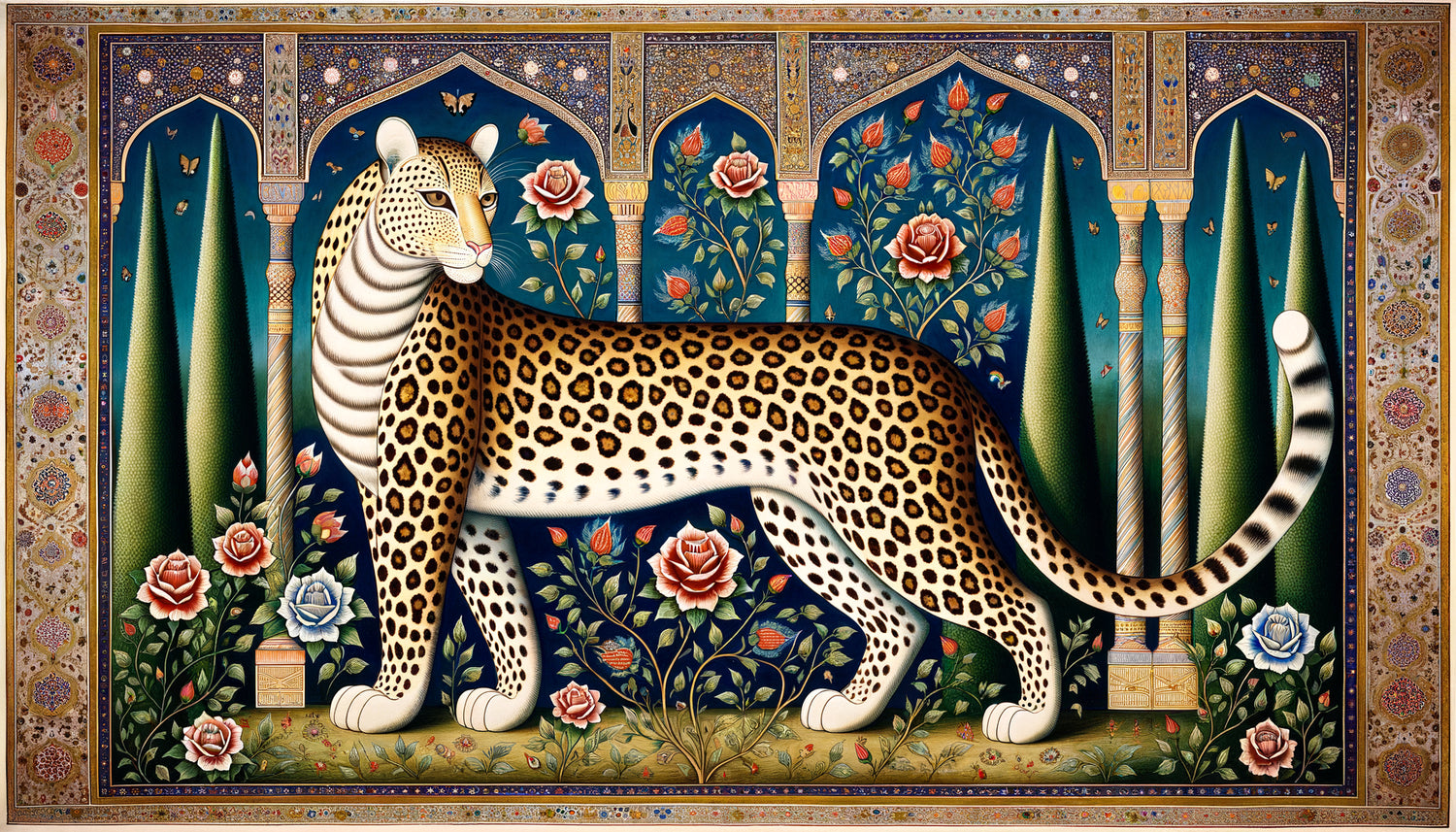
In the workshops of Tabriz in the 15th century, a painter blends lapis-lazuli pigments and gold leaf to bring to life a leopard lurking in the foliage of a paradise garden. This creature, traced on vellum with microscopic precision, will become the model for countless mural frescoes adorning palaces and madrasas. The art of Persian miniature has profoundly transformed the way Islamic artists represent felines in their monumental compositions, creating a visual language that still resonates within our contemporary interiors.
Here's what this millennial influence brings: a refined aesthetic where felines become symbols of elegant power, sophisticated color palettes that magnify each composition, and a narrative approach that transforms the animal into a spiritual guardian of space.
Yet, faced with these fascinating motifs on the walls of our museums or in decorative reproductions, we often feel helpless. How could these tiny illustrations have exerted such an influence on large-scale mural art? What mystery connects these illuminated pages to spectacular frescoes?
Rest assured: understanding this dialogue between miniature and fresco is accessing a fascinating reading grid that enriches our relationship with oriental decorative arts. I invite you to explore together this aesthetic journey where Persian felines leap from manuscripts to walls, carrying with them all the sophistication of a civilization.
When illuminated pages become a school for the eye
The Safavid and Timurid imperial workshops functioned as veritable artistic academies. Persian miniatures, created to illustrate the Shahnameh or the works of Nizami, served as visual repositories for all artisans. A muralist about to decorate a pavilion would consult these precious manuscripts as we would today consult a catalog of references.
In these miniatures, felines occupy a privileged place. Lions, leopards and lynx appear in royal hunting scenes, symbols of courage and authority. But their representation follows precise conventions: stylized postures, musculature suggested by flowing curves, pelts adorned with quasi-abstract decorative motifs.
This codification allowed for effective transmission. A young artist learned to trace a leopard in the Persian manner by reproducing these miniaturized models, before transposing them on a monumental scale onto ceramic enamel walls. Study notebooks circulated between workshops, disseminating these aesthetic canons from Herat to Istanbul, from Cairo to Bukhara.
The visual grammar of the noble feline
In Persian miniature art, the feline is never depicted naturalistically. Its silhouette obeys a sacred geometry: the arch of the back responds to that of the tail, the head fits into a perfect circle, and the paws follow mathematical proportions. This elegant abstraction is intact in Islamic murals, where a guardian lion adopts exactly the same formal conventions as its miniaturized ancestor.
The colors also follow a precise vocabulary. The royal beast often displays ochre tones enhanced with gold, while the mythological leopard is adorned with cobalt blues and emerald greens, precious colors reserved for creatures of paradise. This chromatic palette, initially constrained by the pigments available for miniature painting, becomes a stylistic signature in mural art.
Felines as guardians of sacred thresholds
In Islamic architecture, representations of felines occupy strategic locations: portals, iwans, mihrab niches. This symbolic function directly inherits from miniatures, where large felines frame scenes of power. A majestic lion in a royal manuscript foreshadows the monumental lions flanking the entrance to a caravanserai.
The murals of the Chehel Sotoun Palace in Isfahan perfectly illustrate this lineage. The felines that leap in battle scenes reproduce line for line those of Behzad or Sultan Muhammad's miniatures, enlarged to architectural scale but retaining their characteristic graphic dynamism. The same contained energy, the same perfect curve of the body in full flight.
This transposition is not merely an enlargement. Mural artists adapted compositions to architectural constraints, playing with perspective and depth in unprecedented ways. A leopard lurking in a manuscript becomes, on a vault, a celestial creature seeming to emerge from three-dimensional space, while retaining the precious stylization of its model.
From vellum to ceramic tile
Ceramicists played a crucial role in this translation. To transfer motifs from miniatures to wall panels, they developed cartonnage and sanding techniques. A preparatory drawing, often directly copied from a miniature, was traced and then transferred onto the ceramic tiles before firing.
The result is striking: in the mosques of Uzbekistan or Iranian madrasas, stylized felines run along the friezes with the same graphic grace as their manuscript counterparts. The medium changes - from ink and gold to enamel and faience - but the formal vocabulary remains identical, proof of the power of this visual language.

The contemporary heritage: when miniatures inspire our interiors
This tradition of feline representation from Persian miniatures resonates today in our decorative approach. Contemporary illustrators and designers draw abundantly on this repertoire, creating works that dialogue with eight centuries of artistic history.
The characteristics that made these representations strong - elegant stylization, sophisticated color palette, balance between naturalism and abstraction - seduce our modern sensibilities. A painting depicting a feline in the spirit of Persian miniatures brings to our interiors this touch of refined exoticism, far from orientalist clichés.
Motifs inspired by Islamic wall art are experiencing a resurgence of interest in contemporary decoration. Wallpaper, digital prints, decorative ceramics take up these millennial aesthetic codes, creating bridges between heritage and modernity. The Persian feline, with its hieratic posture and princely bearing, thus enters our living spaces.
Composing with Persian heritage
Integrating this aesthetic does not require literally reproducing the Safavid frescoes. Rather, it is a question of appropriating certain principles: dynamic symmetry, the use of saturated colors in harmony, stylization that confers nobility to the animal. A large feline represented according to these codes immediately becomes a focal point, anchoring the space in a long temporality.
The characteristic shades - deep blues, jade greens, warm golds - create sophisticated color combinations that structure the atmosphere of a room. Associating a Persian-inspired feline decorative element with textiles featuring Islamic geometric patterns generates a powerful aesthetic coherence, a contemporary echo of historical decorative ensembles.
Stylization techniques: a lesson in balance
What makes the felines in Persian miniatures so captivating is their exact position between naturalistic observation and poetic interpretation. Artists perfectly knew feline anatomy - the Safavid court maintained an impressive menagerie - but chose to transform it.
This approach is found in wall art, where a lion can be simultaneously recognizable and fantastic. The proportions are slightly altered to create maximum elegance: lengthening of the body, refinement of the legs, expressive widening of the eyes. These formal freedoms, far from weakening the representation, confer an increased symbolic presence.
Ornamental motifs integrated into the fur constitute another distinctive characteristic. In miniatures as in frescoes, the feline's fur becomes a decorative surface where spirals, palmettes, and plant intertwines are inscribed. The animal thus becomes a microcosm of the paradise garden, bearing on it the motifs of the universe it inhabits.
The narrative composition inherited from the manuscript
Wall scenes often take over the narrative structure of miniatures: the feline appears in a specific narrative context, hunting scene, allegory of power, creature of the legendary bestiary. This narrative dimension enriches the reading of the work, transforming a simple animal representation into a support for storytelling.
In our interiors, this lesson remains relevant. A feline representation that suggests a story - the rest of the predator, the vigilance of the guardian, the elegance of movement - engages the gaze more than a purely descriptive image. The influence of Persian miniatures teaches us this semantic density, where each element carries meaning.
Let the feline nobility of Persian arts transform your interior
Discover our exclusive collection of animal paintings that capture this timeless elegance where tradition and modernity meet.

A millennial conversation that continues
The influence of Persian miniatures on the representation of felines in Islamic wall art illustrates the power of transmission of visual languages. These small, precious illustrations, created for princely libraries, have generated a formal vocabulary that has unfolded at an architectural scale, crossing centuries and borders.
Today, when we choose a decorative work featuring a feline with that characteristic elegance - stylized silhouette, refined palette, symbolic presence - we unconsciously perpetuate this aesthetic dialogue. We welcome into our spaces the echo of a sophistication elaborated in the workshops of Herat and Tabriz.
This lineage is not nostalgic but alive. It reminds us that great artistic traditions are not frozen in the past but continue to inform our sensitivity, our way of composing space, of choosing the images that surround us. The feline from Persian miniatures, becoming a wall motif then contemporary inspiration, thus accomplishes a fascinating journey through supports and centuries.
Invite this visual nobility into your home. Observe how a feline represented according to these millennial codes transforms the atmosphere of a room, creating a focal point rich in history and refinement. You will never see these representations the same way again, now aware of the invisible thread that connects your interior to the Safavid palaces.
Frequently asked questions about Persian feline art
Why are felines so present in Persian and Islamic art?
Felines, particularly lions and leopards, occupy a central place in the Persian-Islamic imagination for several converging reasons. First, they symbolize royal power and warrior courage - the lion was the emblem of the Persian monarchy long before Islam. In miniatures and frescoes, representing the sovereign accompanied by felines meant visually his legitimacy and strength. Secondly, these animals appear abundantly in the founding texts of Persian culture, notably the Shahnameh (Book of Kings), where heroes and felines confront or ally themselves. Finally, from an aesthetic point of view, the silhouette of the feline - with its elegant curves and contained power - offered artists an ideal motif to demonstrate their technical mastery. The characteristic stylization of Persian miniatures, with its balance between naturalistic observation and poetic interpretation, found in the feline a perfect subject. This triple dimension - symbolic, narrative and aesthetic - explains the recurrence of these representations which have subsequently influenced mural art on a large scale.
How to recognize the influence of Persian miniatures in a mural fresco?
Several visual clues betray this direct lineage. Firstly, observe the stylization of the feline: if it presents a slightly elongated anatomy, idealized proportions rather than strictly naturalistic, and an elegantly symmetrical posture, you are probably facing an influence from miniatures. Secondly, examine the treatment of the fur: artists trained in the tradition of manuscripts often adorn the animal's coat with decorative motifs - spirals, plant intertwines, golden dots - which recall illuminations. Thirdly, the color palette is a major clue: saturated and precious colors (ultramarine blues, emerald greens, luminous golds) rather than naturalistic tones. Fourthly, look at the narrative context: if the feline is set in a royal hunting scene, a paradise garden or a symbolic composition, this storytelling comes directly from the tradition of narrative miniatures. Finally, the presence of characteristic accessory elements - stylized clouds shaped like flames, lush vegetation with fanciful colors, very high horizon - confirms this influence. In the madrasas of Central Asia or the Safavid palaces, these characteristics combine to create a visual language immediately identifiable.
How to integrate this Persian feline aesthetic into a contemporary interior?
The aesthetics of Perso-Islamic felines adapts remarkably well to contemporary interiors, provided that some principles of harmony are respected. Start by choosing a centerpiece: a painting, print or quality reproduction featuring a feline in the style of Persian miniatures. Favor medium to large formats that allow you to appreciate the details of the stylization. Place this work on a clean wall, preferably in a neutral shade (off-white, pearl gray, warm beige) which will highlight the characteristic saturated colors. Then, create subtle chromatic echoes: if your feline sports blues and golds, introduce these shades in touches in cushions, a rug or decorative objects, without seeking to reproduce the tones exactly. The goal is resonance, not imitation. In terms of furniture, Persian style pairs particularly well with clean and modern lines - the contrast between the ornamental richness of the work and the sobriety of the furniture creates a sophisticated visual tension. Add some elements that subtly evoke the Orient: a pierced metal luminaire, a few bound books on Islamic art, perhaps a rug with geometric patterns. The essential is to avoid overload: let the Persian feline reign majestically, accompanied rather than surrounded, creating this elegant focal point that characterizes the best interiors inspired by this millennial tradition.