Imagine a horse frozen in a medieval painting: stiff, disproportionate, almost caricatural. Then observe the one painted by Leonardo da Vinci – muscles bulging, tendons visible, movement captured with surgical precision. Between these two works, a silent revolution took place in Renaissance workshops.
Here's what this rediscovery of animal anatomy brought to Western art: a stunning veracity that transforms the canvas into a window on reality, an intimate understanding of movement that breathes life into painted creatures, and technical mastery that elevates the animal to the rank of noble subject.
For centuries, artists had reproduced conventions rather than direct observation. Medieval bestiaries perpetuated anatomical errors, and these symbolic representations were not questioned. But something shifted in the 15th century.
Rest assured: this is not an austere history of art lesson. It's the fascinating saga of men who dared to look – really look – at the animal world, armed with scalpels and sketchbooks. Their legacy still inspires our way of appreciating and representing wildlife in our interiors today.
Secret notebooks: when the workshop becomes a laboratory
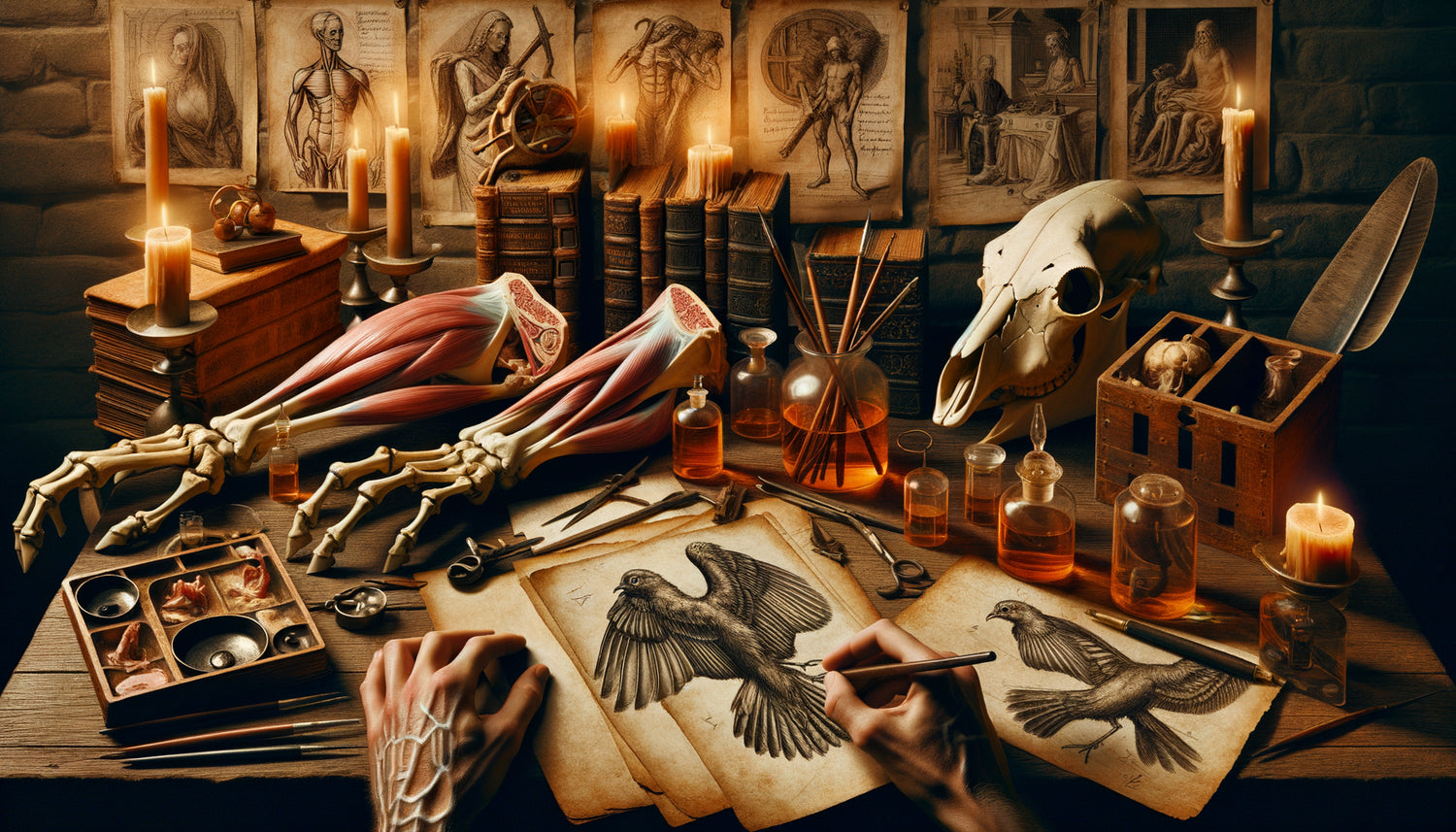
In the dim light of his Florentine studio, Leonardo da Vinci methodically dissects the cadaver of a bear. His ink-stained hands darken the pages of his notebook with obsessive frenzy. It's not morbidity – it's a thirst for understanding.
Renaissance painters rediscovered animal anatomy by adopting a revolutionary method: direct observation combined with systematic dissections. Leonardo dissected dozens of animals – horses, birds, dogs, bulls – documenting each muscle, each joint with a precision that ancient treatises did not offer.
But he was not alone. In Padua, anatomist Fabricius d'Aquapendente opened his anatomical theater to artists. In Rome, Michelangelo studied flayed specimens. This collaboration between art and science created a new visual language where each creature regained its physiological truth.
Sketchbooks then become veritable visual encyclopedias. Albrecht Dürer travels to the Netherlands to draw a rhinoceros – which he has never seen with his own eyes – compiling detailed descriptions. His drawing, although imperfect, testifies to this obsessive quest for anatomical precision that defines the era.
The rediscovery of ancient texts: Aristotle resurrected
The fall of Constantinople in 1453 triggers a massive exodus of Byzantine scholars to Italy. In their luggage: Greek manuscripts forgotten for centuries. Among them, Aristotle's treatises on animal anatomy find a fascinated audience.
These texts offer Renaissance artists a theoretical framework for their empirical observation. Aristotle meticulously described the anatomical differences between species, the function of organs, the mechanics of movement. Painters discover that the ancients had already mapped this unknown territory.
But unlike the medievalists who accepted texts as absolute truth, Renaissance artists confront Aristotle with reality. They verify, correct, complete. This dialectic between ancient wisdom and modern observation forges a precise animal anatomy, free from medieval fantasies.
Giorgio Vasari recounts how Verrocchio, Leonardo's master, kept plaster casts of horse hooves and dog heads in his workshop. These three-dimensional references allowed apprentices to understand the bone structure beneath the skin, the real volume under the appearance.

The horse: a Renaissance anatomical obsession
No animal captivated Renaissance artists as much as the horse. Symbol of power, mount of princes, protagonist of battles – its faithful representation becomes a major artistic challenge.
Leonardo da Vinci spends years studying equine anatomy for his unfinished equestrian monument to Duke Sforza. His drawings reveal an astonishing understanding: he identifies and names every muscle, analyzes ideal proportions, breaks down the gallop into sequential phases – four centuries before Muybridge's instantaneous photography.
Antonio del Pollaiuolo dissects horses in Florentine slaughterhouses. His anatomical studies influence a whole generation. In his Battle of Naked Men, the horses possess an astonishing muscular accuracy, every tension visible under the skin.
This obsession radically transforms equestrian painting. Compare Giotto's stiff horses with those dynamic ones by Raphael in The Battle of Constantine: the difference testifies to a revolution in anatomical understanding. Artists now master the biomechanics of equine movement.
Birds and winged creatures: the anatomy of flight decoded
Leonardo's obsession with flight leads him to dissect dozens of birds. He draws their outstretched wings, identifies the rectrices, understands how pectoral muscles generate thrust. This precise anatomical study nourishes his flying machines, but also his painting.
Birds in Renaissance paintings acquire a disturbing truthfulness. Look at Piero della Francesca's doves, Flemish still life partridges, or the angel of the Annunciation with its anatomically correct wings – based on the study of large goose and swan wings.
Albrecht Dürer pushes this precision to the extreme. His watercolor of a blue roller wing (1512) is a masterpiece of anatomical observation: each feather is individualized, their placement follows the actual bone structure, chromatic nuances respect natural pigmentation.
This anatomical mastery allows artists to represent mythological creatures with unprecedented credibility. Renaissance dragons possess consistent musculature, griffins respect comparative anatomy. Fantasy is grounded in science.

Princely menageries: living laboratories
Italian courts frantically collect exotic animals. These menageries become observation laboratories for artists. Laurent de Médicis possesses lions, giraffes, leopards – all living models for Florentine painters.
Pope Leo X receives a white elephant named Hanno in 1514. Raphael tirelessly draws him, documenting his wrinkled skin, massive proportions, the structure of his trunk. When the animal dies two years later, Raphael probably attends its autopsy – a unique opportunity to study the internal anatomy of a pachyderm.
These direct observations revolutionize animal representation. Medieval bestiaries described elephants without knee joints, unable to lie down. Renaissance artists correct these errors through empirical observation, restoring anatomical veracity lost since Roman Antiquity.
Andrea Mantegna has access to the Gonzaga menagerie in Mantua. His frescos in the Camera degli Sposi show hunting dogs with remarkable anatomical precision – musculature, dentition, proportions – the result of hours of direct observation.
The legacy: when science nourishes emotion
This rediscovery of animal anatomy was not only for scientific accuracy. It allowed capturing the very essence of the animal – its movement, temperament, presence.
Look at the greyhound in Pisanello's Vision of Saint Eustace: its tense posture, taut muscles, watchful gaze testify to an anatomical understanding that transcends simple visual rendering. Anatomical precision becomes the vehicle for emotional expression.
This tradition still irrigates our contemporary relationship with animal representations. Animal paintings that adorn our interiors directly inherit from this Renaissance revolution: this subtle alliance between scientific accuracy and artistic sensitivity that transforms a painted animal into a vibrant presence.
Dürer's engravings circulate throughout Europe, disseminating these new anatomical knowledge. His Rhinoceros becomes the reference for three centuries. His studies of hares, squirrels, birds establish standards of precision that later artists strive to equal.
Let this reawakening tradition transform your interior
Discover our exclusive collection of animal paintings that combine the anatomical precision of old masters with contemporary aesthetics, to capture this vibrant presence in your living space.
Your gaze transformed
From now on, whenever you contemplate an animal in an antique painting, you will perceive this invisible revolution. You will distinguish medieval conventions from reawakening observations. You will recognize the hand of an artist who has truly looked, dissected, understood.
This rediscovery of precise animal anatomy by Renaissance painters reminds us of an essential truth: artistic beauty is rooted in intimate knowledge of reality. To truly observe, to deeply understand, and then to transcend through art – this is the legacy these pioneers have left us.
So next time you choose an animal artwork for your interior, ask yourself: does this creature possess that anatomical accuracy which gives it an authentic presence? Because it is precisely this alliance of science and sensitivity that transforms a decorative image into a silent companion in your daily life.