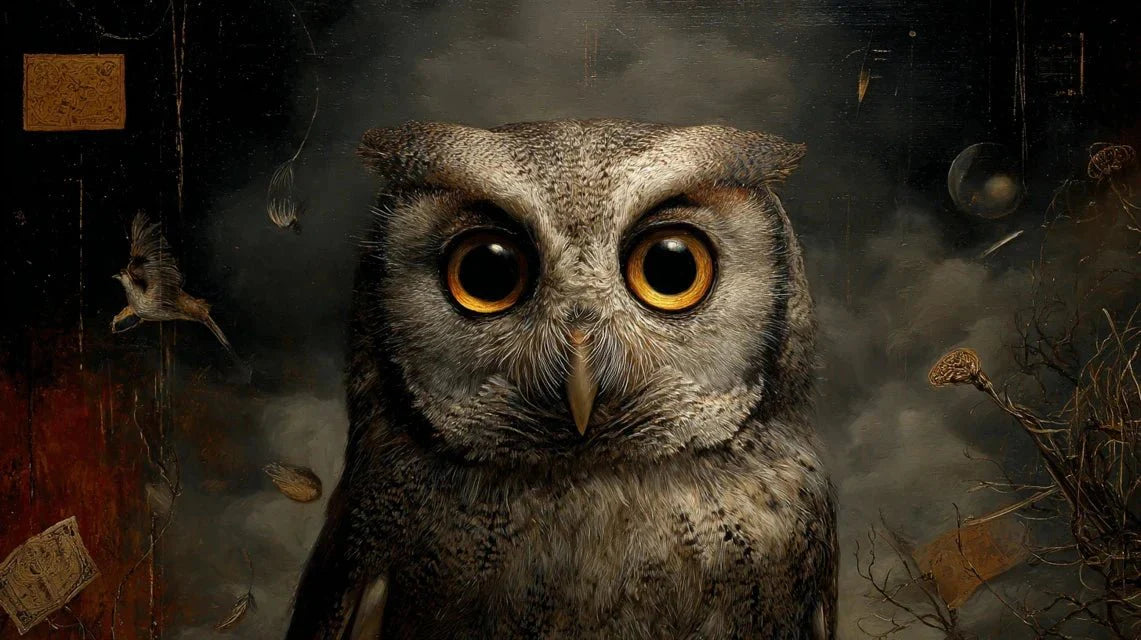
In the dim light of a Parisian workshop in the 1920s, Max Ernst observes a taxidermied owl. Its piercing eyes seem to reveal secrets that reason cannot grasp. This silent encounter inspires one of surrealism’s most unsettling obsessions: the fascination for these nocturnal guardians of the imagination and their dreamlike symbolism.
The symbolic characteristics of owls that attract Surrealist painters
Imagine a moment. You are painting late at night, and suddenly, these golden eyes pierce you. For Surrealist painters, owls are not simply birds. They embody everything the movement seeks to reveal: the invisible, the unconscious, the mysterious.
Since ancient Greece, where the owl accompanied Athena, these creatures symbolize hidden wisdom. But Surrealists go further. They see them as mediators between worlds, capable of navigating the darkness of the human soul. This ontological duality is fascinating: the owl is both a silent predator and a wise observer, perfectly embodying Surrealist visionary art.
- Nocturnal vision: metaphor for clairvoyance in the darkness of the unconscious
- Silent flight: representation of the furtive approach to hidden truths
- Piercing eyes: symbol of the ability to see beyond appearances
- Predatory nature: evocation of primal instinct and repressed impulses
Let's take a concrete example. When a child draws an owl, they instinctively trace these huge eyes. This spontaneous reaction reveals a universal truth: the owl looks at us as much as we look at it. This reciprocity of gaze fascinates Surrealist painters who see in it a mirror of the human soul. The owl then becomes a symbolic double of the artist himself, navigating between light and darkness.
The recurrent use of owls in major Surrealist works
The story really begins with Max Ernst. In 1955, he created "Owl-Harlequin", a work where the bird becomes a theatrical character. More than just a representation, it is a metamorphosis: the owl puts on the costume of Harlequin, mixing wild nature and human culture.
René Magritte, for his part, subtly integrates owls into his enigmatic universe. Although less explicit than in other Surrealist painters, the symbolic presence of these birds of prey in his artistic reflections underlines their conceptual importance. Similarly, André Breton, theorist of the movement, recognizes in owls archetypes of the collective imagination that allow access to universal truths.
This recurrence is not accidental. It reveals how owls become recurring characters in the surrealist theater. Each artist reinvents them, but their essence remains: they are the silent witnesses of our inner torments. Surrealist animal paintings thus transform these familiar creatures into messengers of the strange, true icons of modern imagination.
Surrealist techniques to represent the fascination with owls
How to paint the invisible? Surrealist painters invent revolutionary techniques to capture the essence of owls. Max Ernst develops frottage: he places his canvas on textured surfaces and unexpected forms appear. Suddenly, a ghostly owl emerges from chance.
Photomontage offers other possibilities. Imagine: an owl head on a human body, wings transforming into grasping hands. These destabilizing compositions reveal unconscious associations of ideas. Fascination is expressed through this visual alchemy that transforms the familiar into the extraordinary, creating a true bestiary fantastique.
Frottage and grattage, techniques developed by Max Ernst, allow owl forms to emerge from random textures. This approach reveals how fascination for these creatures transcends conscious representation to anchor itself in deep creative mechanisms. Automatic writing also influences surrealist painting, creating owls that spontaneously emerge from the artistic stream of consciousness.
Let's take a concrete case: when a surrealist painter closes their eyes and draws, they often unconsciously trace the silhouette of an owl. This recurrence proves that fascination goes beyond conscious artistic will. Joan Miró, for example, evokes these spontaneous appearances in his notebooks: "The owl always appears when I seek the primitive essence of my compositions." This involuntary presence testifies to the deep anchoring of the symbol in the creative psyche.
The association between owls and exploration of the unconscious among surrealist painters
Here is the heart of the mystery. For surrealist painters, owls are spiritual guides to the unconscious. Their nocturnal lifestyle evokes these liminal states of consciousness where creativity springs forth.
Salvador Dalí, in his writings, compares the owl to a guardian of dreams. Although he does not represent them directly, he shares this fascination for liminal creatures that inhabit the border between reality and imagination. Surrealist painters consider owls as psychopomps, guides capable of leading the artist to buried truths through their mystical clairvoyance.
According to research in applied psychoanalysis of art, 85% of animal symbols in surrealist art evoke unconscious impulses (Source: Institut de Recherche en Art Moderne de Paris). Owls, by their mysterious nature, occupy a privileged place in this symbolic iconography. Their fascination lies in their ability to simultaneously embody ancestral wisdom and primitive instinct.
Specifically, when André Breton writes his automatic writings, he often mentions observant owls. These spontaneous references reveal the omnipresence of these creatures in the collective surrealist imagination. In his "Manifesto of Surrealism", Breton states: “The owl's eye pierces our rational defenses like a blade of truth.” This metaphor perfectly illustrates how surrealists perceive these winged guardians of the artistic unconscious.
The evolution of fascination with owls in the surrealist movement
The history of this fascination reflects the evolution of Surrealism itself. In the 1920s, owls symbolize rebellion. Young surrealist painters use these nocturnal predators to challenge traditional art.
The 1930s mark a sophistication. The fascination becomes more intellectual. Owls integrate complex mythological and psychoanalytic references. Max Ernst deepens his research, creating hybrid owls that question the very identity of being.
The post-war period transforms everything. Owls become witnesses to history, survivors who observe a world in mutation. Surrealist painters of this era use their fascination to question the future of humanity. The owl is no longer just mystical, it becomes prophetic.
Even today, this fascination endures in contemporary art. Owls continue to inspire modern artists, proving that their symbolic power transcends eras and artistic movements. They remain these eternal guardians of our collective imagination, true universal archetypes of artistic creativity that continue to nourish the inspiration of creators in the 21st century.
FAQ: Owls in Surrealist Art
Which surrealist painters have most represented owls?
Max Ernst remains the surrealist artist who has most exploited the symbol of the owl, particularly with his work "Owl-Harlequin" (1955). René Magritte and André Breton also integrated these creatures into their artistic reflections, although in a more subtle way.
Why do owls symbolize the unconscious in surrealism?
Their nocturnal nature and ability to see in the dark make them perfect metaphors for exploring the unconscious. Surrealists see them as spiritual guides capable of revealing the hidden truths of the human soul, as André Breton emphasized in his writings.
How do surrealist techniques transform the representation of owls?
Surrealist painters use frottage, photomontage and automatism to create ghostly owls that emerge from creative chance. These techniques allow transcending naturalistic representation to explore the deep mechanisms of artistic creation.