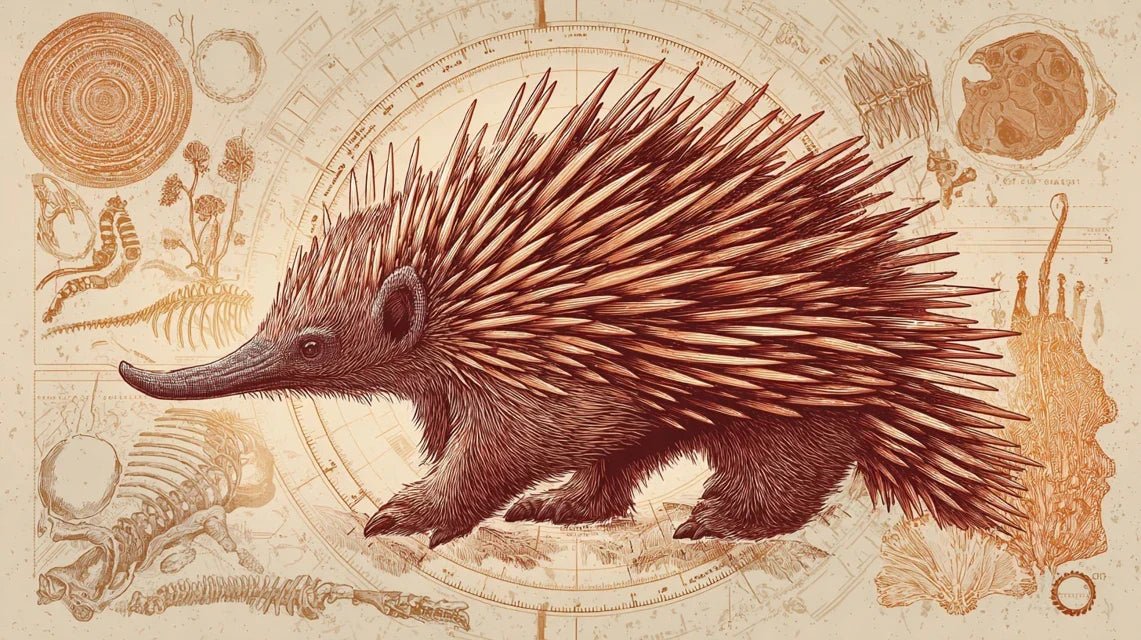
Imagine a primitive mammal that lays eggs like a reptile but nurses its young like a mammal. Picture a creature covered in spines resembling a giant hedgehog with a mole's snout. These monotremes do exist: they are echidnas.
These extraordinary mammals now number only four living species. Yet, they embody one of the most revolutionary forms of evolutionary art on our planet. Their very existence defies everything we thought we knew about biological classifications.
For over 100 million years, echidnas have orchestrated a remarkable survival that fascinates scientists worldwide. These privileged witnesses to evolutionary history tell a unique story: that of a lineage that has managed to preserve its ancestral secrets while all other mammals evolved.
Echidnas and evolutionary art: A fascinating biological enigma
How have echidnas managed the feat of crossing the ages with such success? Their evolutionary art tells a unique story in the mammalian universe. These monotremes exhibit a combination of characteristics that create a perfectly coordinated fascination.
Where other mammals have abandoned their primitive traits, echidnas have retained them intelligently:
- They lay eggs like their reptilian ancestors while feeding their young with milk
- Their body temperature oscillates daily, unlike other mammals
- Not a single tooth in their mouth: specialized horn structures replace them
- A single orifice manages all their vital functions, as in birds and reptiles
The discovery of the fossil Kryoryctes cadburyi has revolutionized our understanding of their evolutionary art. This 108 million-year-old creature proves that the ancestors of echidnas lived in water before conquering land. An "extremely rare" evolutionary reversal that fascinates paleobiologists (Source: Proceedings of the National Academy of Sciences).
Genetically speaking, female echidnas have 64 chromosomes while males only have 63. Their sex determination system, with five X chromosomes and four Y chromosomes, defies all known models. This unique genomic architecture testifies to a evolutionary art that governs their reproduction in an incomparable way.
The evolutionary art of echidnas: Unique adaptation techniques
The evolutionary art of echidnas is manifested through remarkable adaptations that ensure their survival in varied environments. These mammals have developed an arsenal of adaptation techniques that inspire legitimate fascination.
Their defense strategies perfectly illustrate this evolutionary art:
- Spines hollowed out and mixed with fur for optimal protection
- Ability to curl into a ball when facing predators
- Powerful claws allowing for rapid burrowing into the ground
- Long, sticky tongue capable of extending 20 centimeters
The fascination for the evolutionary art of echidnas intensifies when examining their unique reproductive system. The female lays an egg directly into a temporary ventral pouch, creating a natural incubatorium. This revolutionary technique combines the advantages of reptilian oviparity and mammalian lactation.
Evolutionary art in echidnas is also revealed in their adaptive metabolism. Unable to regulate internal temperature effectively, they may exhibit torpor phases under unfavorable climatic conditions. This fascination for their thermal adaptation demonstrates a remarkable pragmatic evolution.
Echidna fascination: Artistic applications in representation
The fascination with echidnas transcends the scientific realm to invest the artistic universe. These creatures evoke a particular attraction among Australian Aboriginal artists who have considered echidnas as totemic beings for time immemorial.
In the Aurukun region, in northern Queensland, Aboriginal artists sculpt echidnas with remarkable precision, testifying to this ancestral fascination. Roderick Yunkaporta, a renowned artist, uses innovative sculpting techniques to capture the essence of the evolutionary art of these mammals.
This fascination for echidnas extends to contemporary representations. Modern animal paintings often capture the mysterious essence of these creatures, visually translating the evolutionary art that characterizes them.
Evolutionary art in echidnas also inspires popular culture. The Knuckles character from the Sonic the Hedgehog saga draws directly on this fascination for these spiny mammals. This playful representation testifies to the cultural impact of echidnas on the collective imagination.
The fascination for the evolutionary art of echidnas can even be found on Australian currency, where the short-nosed echidna appears on the 5 cent coin, symbolizing the patrimonial importance of these unique mammals.
Evolutionary art echidnas: Optimization of primitive characters
Evolutionary art in echidnas demonstrates a remarkable optimization of characters considered primitive. This fascination for their adaptation reveals sophisticated evolutionary mechanisms that maximize the effectiveness of each ancestral trait.
Electroreception, though less developed than in the platypus, is a testament to the art of evolution in echidnas. Their sensitive beaks can detect electric fields produced by subterranean insects, optimizing their hunting strategies. This fascination with their unique sensory ability reveals evolutionary ingenuity.
Echidnas have optimized their digestive system to process exclusively ants and termites. Their simplified stomach and specialized metabolism perfectly illustrate the art of evolution oriented towards a specific ecological niche. These remarkable evolutionary adaptations perfectly illustrate this art of evolution oriented towards a ecological niche.
Statistically, short-nosed echidnas live approximately 10 years in the wild but can reach 35 years in captivity (Source: Encyclopædia Universalis), demonstrating the robustness of their art of evolution. This remarkable longevity for a mammal of their size is a testament to the effectiveness of their optimized primitive adaptations.
Echidna art fascination: Maintaining ancestral heritage
The fascination with the art of evolution in echidnas culminates in their extraordinary ability to maintain an ancestral heritage of over 100 million years. These mammals represent a living testimony to evolutionary continuity, preserving characteristics lost by all other modern mammals.
Echidnas maintain their art of evolution ancestral through remarkable genetic conservatism. Their genome preserves archaic sequences that illuminate the early evolution of mammals.
Mechanisms for preserving echidna ancestry include:
- Conservation of primitive genes essential for oviparity
- Maintenance of an archaic but efficient energy metabolism
- Preservation of original anatomical structures such as the cloaca
- Genome stabilization against modern selective pressures
This fascination genetic reveals exceptional evolutionary stability mechanisms.
The lactation without nipples of echidnas perfectly illustrates this maintenance of ancestral heritage. Milk seeps through skin pores, a primitive but effective technique that is a testament to the original art of evolution of mammals. This fascination with their unique method of lactation reveals the deep roots of mammalian lactation.
The survival of echidnas in the face of marsupial competition demonstrates the solidity of their ancestral art of evolution. Despite the marsupial invasion of Australia, these primitive mammals have retained their specialized ecological niches. This exceptional ancestral biodiversity is a testament to an evolutionary fascination for adaptive coexistence.
Today, three species of New Guinea echidnas are threatened with extinction, making the preservation of this unique evolutionary art crucial. Scientific fascination for these exceptional mammals must translate into conservation efforts to keep this irreplaceable evolutionary heritage alive.
FAQ: Understanding Echidna Fascination
Why are echidnas considered primitive mammals?
Echidnas retain ancestral characteristics lost by other mammals: they lay eggs, possess a unique cloaca, and have no nipples. This unique combination reveals the original evolutionary art of mammals.
How exactly do echidnas reproduce?
The female lays a single egg directly into a temporary ventral pouch where it incubates for 10 days. After hatching, the young licks milk that beads through its mother's skin pores for several months.
What is the main evolutionary difference between echidnas and platypuses?
Although both are monotremes, echidnas have evolved towards a terrestrial digging life while platypuses have retained a semi-aquatic lifestyle. This divergence illustrates two different expressions of evolutionary art in primitive mammals.