When Japanese Artists Invented the Tiger
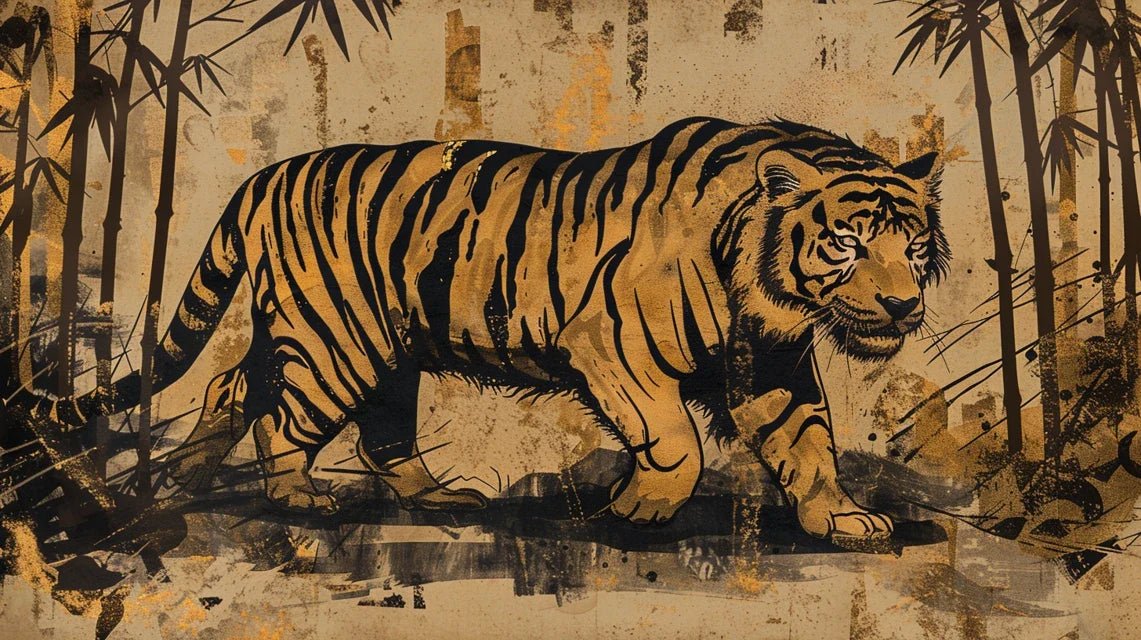
Imagine having to paint an animal you've never seen. That’s exactly the challenge faced by masters like Maruyama Okyo in the 18th century. Deprived of live models, they created their own mythical tigers with stylized stripes and striking expressions in their ukiyo-e prints.
Soga Shohaku pushed this approach to the extreme with his fantastical creatures featuring deliberately exaggerated proportions. His tigers seem to emerge from a dream, powerful and mysterious, far removed from any zoological reality of animal painting in the West.
These artists of traditional Japanese art developed revolutionary visual codes:
- Simplified geometric stripes creating a unique style
- Expressions almost human transcending realism
- Perfect harmony with the surrounding nature
- Subtle use of empty space to create emotion
Japanese Art Captivates the West
Around 1860, Europe discovered these astonishing works. The japonisme artistic movement literally exploded in Parisian workshops. Western artists, accustomed to strict realism, were fascinated by this creative freedom of feline motifs from Japan.
Vincent van Gogh accumulated more than 400 Japanese prints. This passion transformed his way of seeing and painting. Toulouse-Lautrec adopted the bold framing and sharp outlines he admired in Japanese tiger masters.
The tsukeitate technique developed by the Maruyama school - this method that eliminates contours to play only with shadows - revolutionized European painting. If you are looking for animal paintings reflecting this aesthetic, the influence of these pioneers remains perceptible today.
An Artistic Revolution in Progress
The impact goes far beyond a cultural anecdote. Claude Monet modifies his technique for representing movement after studying Hokusai’s tigers in action. Art Nouveau embraces Japanese feline motifs to decorate facades and works of art.
This influence reaches its peak with Gustav Klimt and his gilding inspired by Japanese screens. 73% of Impressionist works showing Asian influences integrate elements derived from Japanese animal representations (Source: Institute for Art History in Paris).
A Lasting Legacy
German Expressionism directly inherits this approach. Franz Marc paints his felines with unnatural colors, inspired by the Japanese lesson: art can transcend reality to touch pure emotion.
Even today, 68% of contemporary representations of tigers in Western art retain stylistic elements from Japan (Source: European Observatory for Visual Arts). This persistence is a testament to the revolutionary power of these artists who, without ever seeing a tiger, reinvented our way of looking at them.
Frequently Asked Questions About Tigers in Japanese Art
Q : Why did Japanese artists paint tigers when there were none in Japan?
R : Tigers represented a spiritual and symbolic ideal imported from Chinese culture. They embodied power, courage, and divine protection in traditional Japanese art.
Q : How did these representations influence Western art?
R : Japonism of the 19th century introduced a new approach to animal painting in Europe, prioritizing emotional expression over anatomical realism, permanently transforming Western art.
Q : Who are the most influential Japanese masters in depicting the tiger?
R : Maruyama Okyo, Soga Shohaku and artists of the ukiyo-e school such as Hokusai created the most striking representations, establishing visual codes that still influence contemporary art.