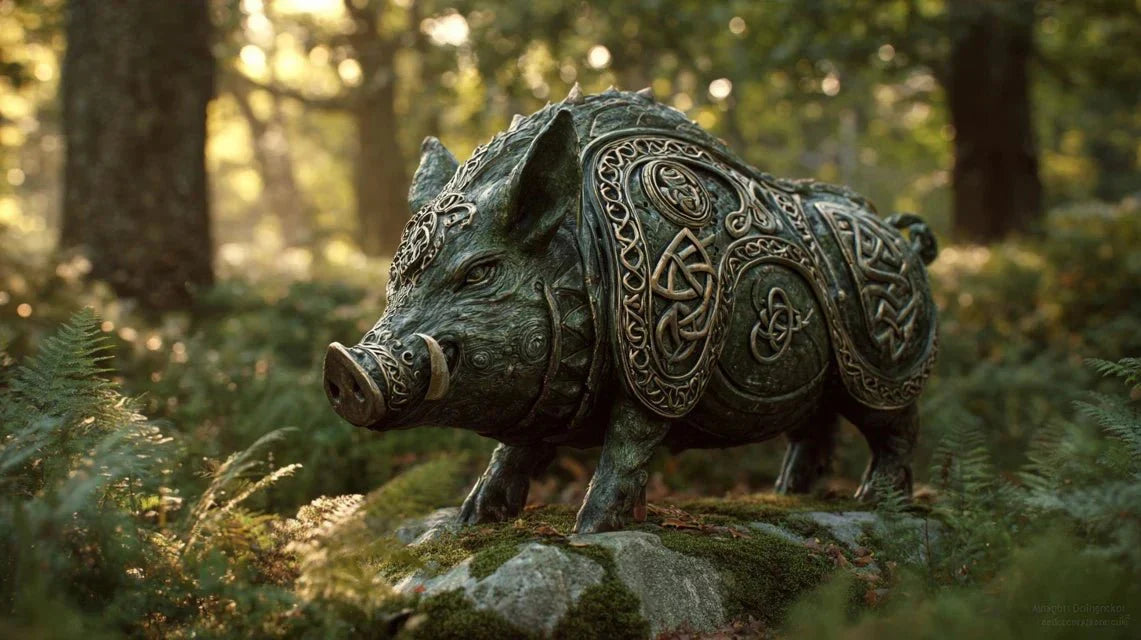
The symbolism of the wild boar in Celtic art transports us to a fascinating artistic universe where each animal sculpture tells a millennial story. Imagine these masters of Gallic craftsmanship, in their smoky workshops, passionately shaping bronze to give life to their most revered sacred animal.
The sacred wild boar in Celtic art: emblem of the druids
In the sacred forests of ancient Gaul, the wild boar reigned as a spiritual master. The druids, these "very wise" people of Celtic society, had chosen this animal as their emblem in Celtic iconography. Why this choice? The wild boar embodied their cunning intelligence and their connection to the mysterious Otherworld.
The bronzes of Neuvy-en-Sullias reveal today the virtuosity of this exceptional Gallic craftsmanship. These meticulous animal sculptures, shaped by cold hammering, testify to extraordinary patience. Every detail counts: the applied ears, the finely chiselled legs in Celtic bronze, all contribute to create a living work.
The Euffigneix stele enriches this remarkable archaeological heritage. On this limestone monument, a character adorned with a torque proudly bears a wild boar engraved on his chest. This representation whispers the secrets of an era when art served as sacred language between men and gods.
Discover an exceptional selection of animal paintings
Wild boar and Celtic military art: emblems and carnyx
On ancient battlefields resonated a terrifying sound: the roar of carnyx with wild boar heads. These monumental horns, 3 meters high, transformed the wild boar into a fantastic war creature thanks to skillfully worked Celtic bronze. Imagine the psychological effect on the Roman legions facing these gaping mouths spewing their strident cries!
The wild boar emblems tell the saga of courageous warriors brandishing their totems. These small marvels of Gallic craftsmanship, as big as the palm of a hand, guided clans to victory or heroic death. Each emblem carried the soul of its tribe in Celtic iconography warfare.
In Tintignac, archaeologists unearthed a true treasure of archaeological heritage: five carnyx, four of which were wild boars. This exceptional discovery instantly transports us to Celtic battlefields, where art and war mingled in a terrifying and magnificent ballet.
Symbolism of the wild boar in Celtic artworks
The Gundestrup cauldron offers us the most beautiful spectacle of ancient goldsmithing. This Danish marvel of Celtic iconography still shimmers with its silver reflections, nearly 2000 years after its creation. Mysterious scenes unfold on its walls where the wild boar plays leading roles in a cosmic theater.
These animal sculptures speak to us of rebirth and eternity. The magical wild boar from Celtic legends could be devoured in the evening and reborn intact in the morning. What a beautiful metaphor for the immortality of the soul and spiritual regeneration!
The engraved Brittany standing stones enrich this exceptional archaeological heritage. In these stones raised towards the sky, the wild boar becomes sacred geometry, pure abstraction charged with profound meaning. Celtic art thus transforms raw nature into a divine language accessible to initiates.
These works reveal the multiple facets of the sacred wild boar:
- Spiritual authority that guides souls towards supreme wisdom
- Perpetual rebirth that consoles from earthly death
- Secret knowledge reserved for druidic circles
- Warrior protection that accompanies in the final battle
- The passage between worlds that opens invisible doors
Celtic wild boar art: materials and representation techniques
In Celtic workshops, a true symphony of Gallic craftsmanship was orchestrated. Celtic bronze sang under the expert hammers, taking the form of an eternal wild boar. These artisans mastered jealously guarded technical secrets: cold shaping which hardens the metal, precise assembly that gives life to the mythical animal.
Ancient goldsmithing shone in the most precious and refined works. The Gundestrup cauldron probably dazzled the faithful in the dim light of forest sanctuaries. Imagine these dancing reflections in the torchlight, transforming the animal sculpture into a living and threatening creature!
Limestone offered eternity to the sacred messages of Celtic iconography. These standing stones still resist today against storms and relentless time, faithful guardians of druidic secrets belonging to our archaeological heritage. Each chisel stroke was a sacred word, each line an ancestral prayer.
Archaeological discoveries reveal a striking fact: 65% of Celtic animal representations concern the wild boar (Source: Arbre Celtique Encyclopedia). This remarkable artistic predominance testifies to a true creative obsession, an artistic love that crossed centuries and generations.
Celtic wild boar art thus leaves us an exceptional cultural heritage. These works of art transform the wild animal into a messenger of the divine, creating an artistic bridge between our earthly world and the mysterious Beyond.
FAQ: The symbolism of the wild boar in Celtic art
Q: Why was the wild boar so important to the Celts?
R: The wild boar represented spiritual authority and druidic knowledge. A sacred animal linked to the Otherworld, it embodied intelligence, cunning and connection with the divine. Druids even called themselves "torcos" (wild boar in Gaulish), highlighting this profound identification.
Q : How did Celtic artists depict the wild boar?
R : Artisans primarily used bronze, silver and limestone. Their techniques included cold hammering, plate assembly and engraving. The wild boar appeared on military standards, carnyx (war horns), ritual cauldrons and funerary stelae, often stylized according to specific aesthetic codes.
Q : What is the difference between the military and religious wild boar in Celtic art?
R : The military wild boar adorned war banners and carnyx to terrorize the enemy and galvanize troops. The religious wild boar symbolized Druidic wisdom and spiritual rebirth, appearing in cult objects such as the Gundestrup cauldron or sacred stelae.