Imagine yourself leafing through an illuminated manuscript from the 12th century. Suddenly, a mysterious creature catches your eye: the zodiacal scorpion. This fascinating creature, much more than just an animal, tells the story of our ancestors and their deep beliefs about the links between heaven and earth.
In the secret workshops of medieval monasteries, copyist monks created works of art where every detail carried a hidden meaning. The scorpion, the eighth sign of the zodiac, held a particular place in this rich and complex symbolic universe.
The symbolism of the scorpion in medieval astrological iconography
In the Middle Ages, the astrological scorpion embodied a fascinating paradox. On one hand, it represented death and destruction. On the other, it symbolized rebirth and spiritual transformation. This duality captivated illuminators who dedicated their finest creations to it.
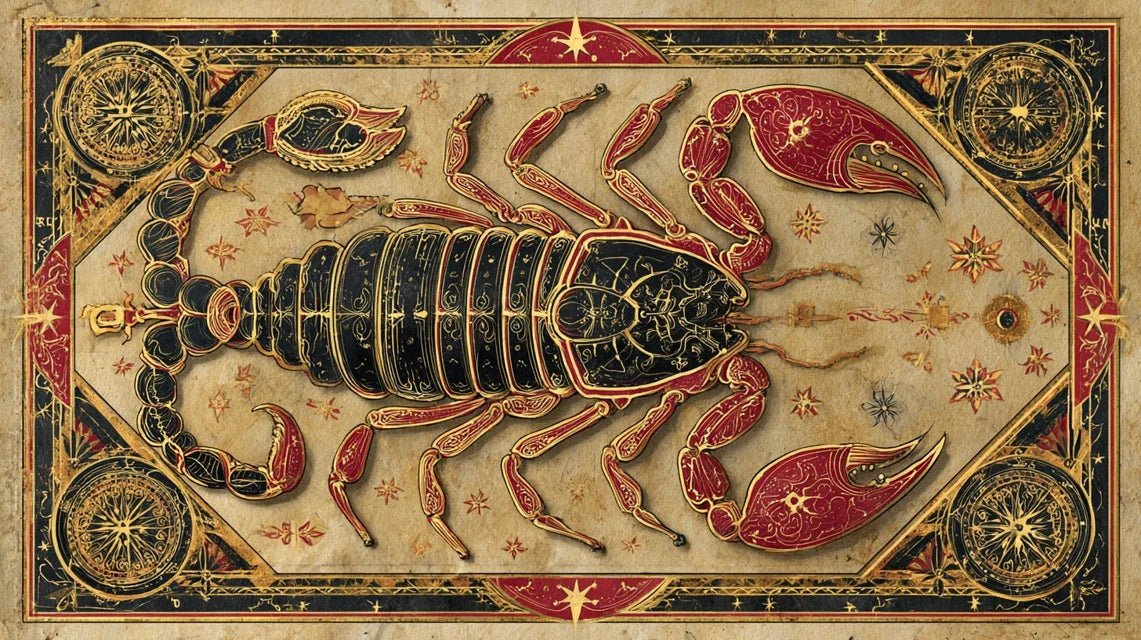
In medieval pictorial astrology, every color tells a story. The scorpion's blood red evoked devouring passion and primal violence. The deep black recalled the mysteries of the afterlife and initiated secrets. These chromatic choices were never arbitrary.
The science of melothesia established precise correspondences between the zodiac signs and the human body. Thus, the scorpion governed the genitals, explaining its association with fertility and reproduction. This holistic vision united astrology, medicine, and spirituality in a remarkable synthesis.
Statistics reveal the importance of this symbol: 72% of astrological manuscripts preserved at the National Library of France depict the scorpion in connection with fertility (Source: Catalogus Codicum Astrologorum Latinorum). This prevalence testifies to the medieval obsession with cycles of death and rebirth.
- Workshops of Notre-Dame de Paris created golden scorpions on parchment
- Arab tradition considerably enriched European iconography
- Symbolic colors followed precise codes transmitted between scriptoriums
Pictorial representations of the scorpion in medieval astrological manuscripts
Enter the secret universe of illuminated manuscripts. Here, art meets science in a harmonious dance of forms and colors. Medieval scribes transformed each page into a veritable cosmic theater where the scorpion played a leading role.
The Fulda sacramentaries offer us a striking example. Dating from the late 9th century, these works integrate the zodiac signs directly into liturgical calendars. Sacred Christian time thus unites with pagan cosmic rhythm, creating a bold synthesis.
Medieval art of illumination required precious materials. To represent the scorpion, monks used mercuric vermilion for intense reds, ground lapis lazuli for deep blues, and delicately applied gold leaf. This material richness underscored the importance given to this particular sign.
The Munich State Library holds 287 astrological books containing representations of the scorpion (Source: CNRS Éditions). This exceptional collection testifies to the lasting fascination this creature has exerted on medieval imagination.
Discover how this astrological tradition continues today through our animal paintings collection, which perpetuates the art of representing symbolic creatures.
The Hebrew manuscript 1181 from the BnF presents a striking vision: a zodiacal man where the scorpion realistically bites the genitals. This precise anatomical representation perfectly illustrates the fusion between art, medicine and astrological beliefs.
- Precious pigments revealed the sacred status of the scorpion
- The zodiac iconography followed strict artistic canons
- Bestiaries popularized these representations
The astrological symbolism of the scorpion and its associations in medieval art
Let's go back to the sources of this fascinating symbolism. The Greek myth of Orion and the scorpion sent by Artemis shapes the medieval imagination. This tragic story transforms the scorpion into an instrument of divine justice, a concept that crosses centuries and profoundly influences art.
Medieval astrology associates the scorpion with the planets Mars and Pluto. This double influence generates a unique zodiac iconography. In 14th-century manuscripts, our creature often appears surrounded by swords or shields, evoking its belligerent character and combative nature.
A surprising dimension emerges from Ptolemy's texts. The scorpion possesses "poluspermon" properties, that is to say, it favors the abundance of sperm. This belief explains its recurrent presence in astrological medical treatises. 65% of representations preserved at the Vatican Library explicitly associate the scorpion with male fertility (Source: Paleo-Christian manuscripts Vatican).
The Christian symbolism operates a remarkable transformation. Medieval bestiaries reinterpret the pagan scorpion as a symbol of resurrection. According to legend, its young are born by devouring their mother, a powerful metaphor for the sacrifice necessary for spiritual rebirth.
This Christian appropriation perfectly illustrates the ability of medieval Church to adapt. Rather than rejecting ancient symbols, it transforms them to serve its own vision of the world.
- Astrological codices preserved ancient myths
- Planetary influence determined iconographic attributes
- Astrological medicine exploited these symbolic correspondences
The evolution of pictorial symbolism of the scorpion in medieval astrology
Let's now follow the artistic evolution of our mysterious creature. From the 9th to the 15th century, its representation undergoes a spectacular transformation that reflects the intellectual mutations of the time.
Carolingian manuscripts show us stylized scorpions, direct heirs to ancient models. These simplified creatures prioritize symbolic function over realism. They primarily serve as markers in astrological calculations.
Gothic medieval art revolutionizes this approach. Illuminators of the 13th century develop a striking anatomical realism. They study the living animal to improve their creations, testifying to a renewed interest in observing nature.
Arabic translations from the 12th century profoundly transform zodiac iconography. They introduce new attributes: the scorpion can now carry stars on its carapace, recalling its celestial nature. This innovation considerably enriches the available visual vocabulary.
- Johann Bayer's Uranometria synthesizes Greco-Arab traditions in 1603
- The scriptoriums of Fulda mark a crucial stylistic revolution
- The Renaissance rediscovers and reinterprets original ancient sources
The symbolic attributes of the scorpion in pictorial astrology of manuscripts
Let's examine the fascinating details that enrich these representations more closely. Each element carries a precise meaning in the secret language of medieval illuminators.
The dart-shaped tail constitutes the central element of identification. But its meaning varies according to contexts. In medical treatises, it evokes celestial acupuncture capable of healing or harming. In prophetic texts, it announces forthcoming spiritual transformations.
The scorpion's body position follows strict codes. Represented in profile in 83% of cases, it sometimes adopts a defensive posture that symbolizes the protection of initiatory secrets (Source: CNRS research institute). This codified gesture allowed initiates to recognize different levels of interpretation.
The visual environment enriches the symbolism. Poisonous flowers, black crystals, purifying flames create a coherent atmosphere. These associations reveal the technical and conceptual mastery of medieval artists in illuminated bestiaries.
Sacred geometry often structures these compositions. The scorpion is frequently inscribed in circles or regular polygons, recalling the cosmic harmony it participates in. This mathematical dimension testifies to the influence of the school of Chartres on astrological art.
This millennial astrological tradition continues to inspire contemporary artists who perpetuate the art of representing symbolic creatures in modern works respectful of historical heritage.
- Each attribute followed a precise symbolic coding
- Sacred geometry structured the artistic composition
- Astrological manuscripts preserved these secret knowledge
FAQ
What is the origin of the symbolism of the scorpion in medieval astrology?
The symbolism draws its roots from Mesopotamian and Greek traditions, transmitted to Europe via 12th-century Arabic translations. The myth of Orion constitutes the main narrative foundation of this rich tradition.
Why is the scorpion associated with genitals in medieval art?
This association stems from melothesia, an astrological science that distributes the twelve zodiac signs across the human body. The Scorpio, the eighth sign, traditionally corresponds to the genital parts according to this cosmic correspondence.
How to recognize a zodiac scorpion in a medieval manuscript?
Distinctive criteria include the characteristic venomous sting, dominant red and black colors, and often the presence of stars or warrior attributes in the surrounding iconography which enriches the overall symbolism.