Imagine a bird capable of being reborn from its own ashes. This fascinating image crosses millennia and continents, but tells profoundly different stories depending on whether it is born under Eastern or Western brushes. The phoenix becomes much more than a simple mythical creature: it reveals two diametrically opposed visions of the world, shaping an exceptional artistic cultural heritage.
In the East, this wonderful bird dances in the cosmic harmony of Chinese mythology. In the West, it rises from the flames of Christian resurrection. This artistic duality invites us on a captivating journey to the heart of two civilizations that have shaped our collective imagination around these legendary creatures.
The symbolism of the phoenix in Eastern art: feng huang and pictorial representations
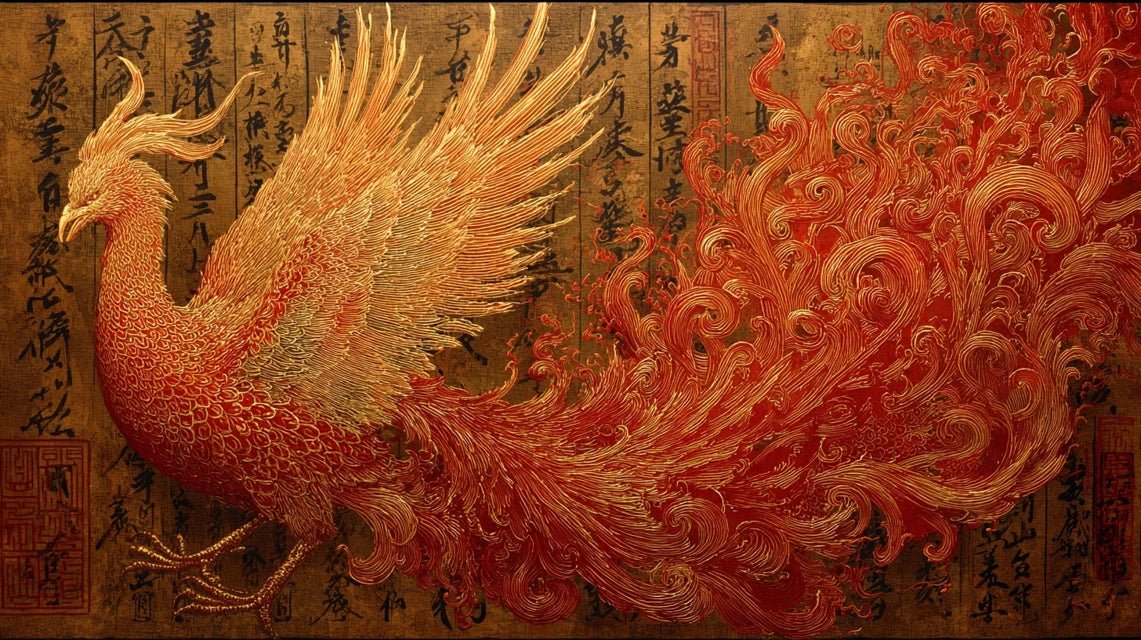
In Chinese workshops, the feng huang is never alone. This creature from mythology evolves in a universe where every element dialogues with others. Chinese tradition considers it a symbol of cosmic balance between yin and yang, appearing in art as a harbinger of prosperity (Source: Vision Times).
Traditional Chinese art develops a specific iconography around the feng huang. Take the example of a silk painting from the Han dynasty. Two phoenixes face each other delicately, their silhouettes intertwined in an eternal dance. These works reveal the Eastern dual vision: a male (feng) and a female (huang) symbolizing marital harmony and universal balance (Source: Wikipedia). Each brushstroke tells this philosophy of harmony, creating an aesthetic.
Eastern art develops a unique technique where suggestion is paramount to description. Artists use the same brush and ink as for calligraphy, creating a natural kinship between writing and painting the phoenix (Source: BnF Essentials). This approach reveals a conception where traditional art does not copy reality but captures its spiritual essence.
Today, this tradition continues. Contemporary animal paintings are still inspired by this refined aesthetic, perpetuating a millennial artistic heritage in our modern interiors.
The symbolism of the phoenix in Western art: renaissance and Christian iconography
Let's now cross continents to discover a dramatic-looking phoenix. Western art radically transforms this symbol, developing a specific Christian iconography. From the Roman Empire, the phoenix became a symbol of perpetuity, then Christianity established the link with the resurrection of Christ thanks to its wonderful regeneration (Source: At the borders of reality).
In medieval illuminated manuscripts, a striking scene repeats: a majestic phoenix perches on its spice pyre, flames licking its golden feathers. This iconography tells a story of voluntary sacrifice and triumphant rebirth, integrating these legendary creatures into Christian cultural heritage. During the Renaissance, Guillaume Du Bartas poetically describes its "reviving members" with plumage of red and gold of incomparable beauty (Source: Wikipedia).
Western art thus develops an aesthetic of the sublime. Where the East favors harmony, the West chooses dramatic intensity. In Western alchemical art, the phoenix symbolizes the Rubedo, the accomplishment of the Great Spiritual Work (Source: Baglis TV). This esoteric dimension adds a mystical depth to iconography.
Artistic techniques for depicting the phoenix: Eastern vs Western art
Observing the techniques reveals two fascinating artistic philosophies. Eastern art cultivates the art of suggestion in its representation of these legendary creatures. A few vigorous strokes are enough to capture the vital essence of the phoenix, prioritizing spiritual substance over appearance (Source: BnF Essentiels). Imagine a master calligrapher: three brushstrokes, and behold, a phoenix comes to life in the imagination of the viewer.
Western art takes an opposite path in its aesthetic approach. It seeks anatomical precision, drawing inspiration from the golden eagle to give body to its mythological creature. Herodotus describes its "wings partly golden and partly red, entirely conforming to the eagle" - a description that durably influences Western art (Source: Wikipedia).
These approaches reveal two distinct artistic conceptions in world cultural heritage:
- The East favors expressive economy and harmonious integration
- The West develops descriptive realism and dramatic narration
- The East stylizes geometrically with streamlined forms
- The West meticulously details each flamboyant feather
Comparative symbolism of the phoenix: Eastern and Western philosophies in art
This technical divergence reveals fundamentally different philosophies in the approach to these legendary creatures. The oriental Fenghuang symbolizes earthly harmony and political virtue, while the Western phoenix represents eschatological hope and spiritual transcendence (Source: Studinano).
Specifically, this translates into opposing iconographies in the cultural heritage of each civilization. In China, the phoenix often accompanies the emperor in scenes of wise governance. It embodies collective prosperity and social harmony. In the West, it often appears alone, in its sacrificial dimension, symbolizing the individual quest for salvation.
This difference explains why oriental art associates the phoenix with dragons in a logic of balance, while Western art isolates it in its redemptive dimension (Source: The Violet Fairy). Two worldviews clash: collective harmony versus individual transcendence, each creating its own aesthetic.
Contemporary applications of the symbolism of the phoenix in oriental and western art
Contemporary art offers a fascinating spectacle: the progressive fusion of these two traditions in the approach to these legendary creatures. Current artists explore both abstract and figurative dimensions simultaneously, creating hybrid works blending Eastern and Western influences (Source: Artmajeur).
In contemporary art galleries, we discover monumental installations where giant phoenixes tower over urban spaces, symbolizing either the economic renaissance of Asian metropolises or the resilience of Western societies in the face of crises. This new iconography reinterprets traditional cultural heritage.
Digital art also reimagines these traditions, creating an innovative hybrid aesthetic. Animations reproduce millennia-old calligraphic gestures, while architectural sculptures integrate the phoenix into modern public art. This contemporary artistic synthesis is a testament to creative globalization where these legendary creatures transcend their cultural origins, continually enriching our collective cultural heritage.
FAQ
What is the main difference between the oriental phoenix and the Western phoenix?
The oriental feng huang symbolizes cosmic harmony and political virtue in a collective approach, while the Western phoenix represents spiritual resurrection and individual transcendence in the Christian tradition.
How do artistic techniques reflect these symbolic differences?
Oriental art favors suggestion and expressive economy with clean lines, creating an aesthetic of harmony. Western art seeks descriptive realism and dramatic narration, developing an aesthetic of the sublime.
Why does the phoenix remain popular in contemporary art?
Its universal symbolism of rebirth and transformation responds to contemporary concerns about resilience in the face of crises. Modern artists fuse Eastern and Western approaches, creating a transnational artistic language that speaks to our era of rapid change.