Symbolic Snails in Flemish Artworks: Hidden Codes of the Masters
Flemish art reveals its most intimate secrets through a meticulous iconography that only initiates can decipher. Among these mysterious visual codes, the snail occupies a particular place in the symbolic imagination of Early Netherlandish painters. Unlike simple decorative ornaments, each painted snail reveals a profound theological intention that transforms aesthetic observation into a true initiatory journey.
In their workshops illuminated by Northern light, Renaissance Flemish painters transformed their brushes into instruments of revelation. Imagine Francesco del Cossa facing his easel in 1472. He meticulously draws a snail in the foreground of his Annunciation. But be careful: this snail is not there by chance.
This snail symbolism was part of a coded pictorial language where each natural element carried a precise theological meaning. Flemish masters perfectly mastered this visual semantics inherited from monastic traditions and medieval Christian iconography.
- Strategic placement: Snails always appear on the margins or in the foreground
- Disproportionate size: Voluntarily enlarged to attract attention
- Absence of shadow: Technique to signal their symbolic nature
- Direction of movement: Oriented towards sacred figures
The techniques of meticulous observation developed by Flemish painters allowed them to transform these gastropods into true iconographic messengers. This revolutionary approach distinguished Flemish art from other European schools through its ability to integrate the sacred into the infinitely small.
Flemish Art and Sacred Snails: Decrypting Religious Symbols
In the spiritual universe of Early Netherlandish painters, the snail transcends its simple zoological nature to embody a fundamental Christic archetype. Medieval theologians, heirs to patristics, attributed to this gastropod soteriological virtues linked to the mysteries of the redeeming Incarnation. This iconographic sacralization justifies its systematic presence in the narrative cycles of the Annunciation and Nativity.
Let's take the concrete example of Francesco del Cossa’s snail. In his Annunciation of 1472, this tiny creature reveals all the theological complexity of the time. Daniel Arasse, a renowned art historian, makes a striking observation: this snail “is not in the painting, but on the painting.” A crucial nuance that changes everything.
Early Christian tradition already associated the snail with resurrection. The first Christians placed snail shells in sarcophagi as symbols of the immortality of the soul. This practice, documented from the earliest centuries, naturally finds its extension in Flemish art.
Illuminated manuscripts from the 13th century reveal nearly 70 depictions of fighting snails in 29 different manuscripts, testifying to a cross-border artistic enthusiasm. This iconography spreads from French workshops to England before conquering Flanders.
To discover other animal works full of symbolism, explore our wall art collection which perpetuates this artistic tradition.
Flemish techniques to integrate symbolic snails into details
The technical excellence of Flemish masters is particularly evident in their treatment of the snail. These color artisans developed specific methods for these microscopic creatures to become major narrative elements. Flemish meticulousness transformed each shell into a masterpiece of Renaissance optical precision.
Oil painting, a revolutionary Flemish innovation, made it possible effects of transparency and depth impossible with tempera. Artists superimposed subtle glazes to reproduce the pearly sheen of snail shells. This technique required the patience of a goldsmith, a quality that the snail itself precisely symbolized.
Burgundian workshops trained their apprentices according to rigorous protocols. Balthasar van der Ast (1593-1657) excelled in these geometric compositions where empty shells revealed the virtuosity of the artist. His works demonstrate how meticulous Flemish art transformed naturalist observation into a spiritual exercise.
- Empirical perspective : Creation of three-dimensional effects without mathematical rules
- Glazing : Technique for reflections and transparencies
- Rendering of textures : Faithful reproduction of natural surfaces
- Play of light : Mastery of shadows and lighting
This revolutionary technical approach distinguished the Flemish school by its ability to reconcile optical realism and spiritual symbolism.
Snail symbolism in Flemish art: resurrection and virgin purity
The symbolism of resurrection is at the heart of the presence of snails in Flemish art. These gastropods embody the cycle of death-rebirth through their winter hibernation and spring awakening. This natural metaphor allowed artists to subtly suggest Christic mysteries.
Medieval belief attributed snails a fertilization by celestial dew, transforming them into symbols of Virgin Mary’s purity. This, although scientifically incorrect, nourished the theological imagination of the time. Flemish painters exploited this symbolism to enrich their Annunciations with an additional mystical dimension.
The hermaphroditism of snails, discovered only in the 17th century, was already intuitively perceived by medieval artists. This sexual duality evoked the divine and human nature of Christ, a central theme of incarnational theology. The symbolism of the snail thus proved perfectly suited to depictions of the Annunciation.
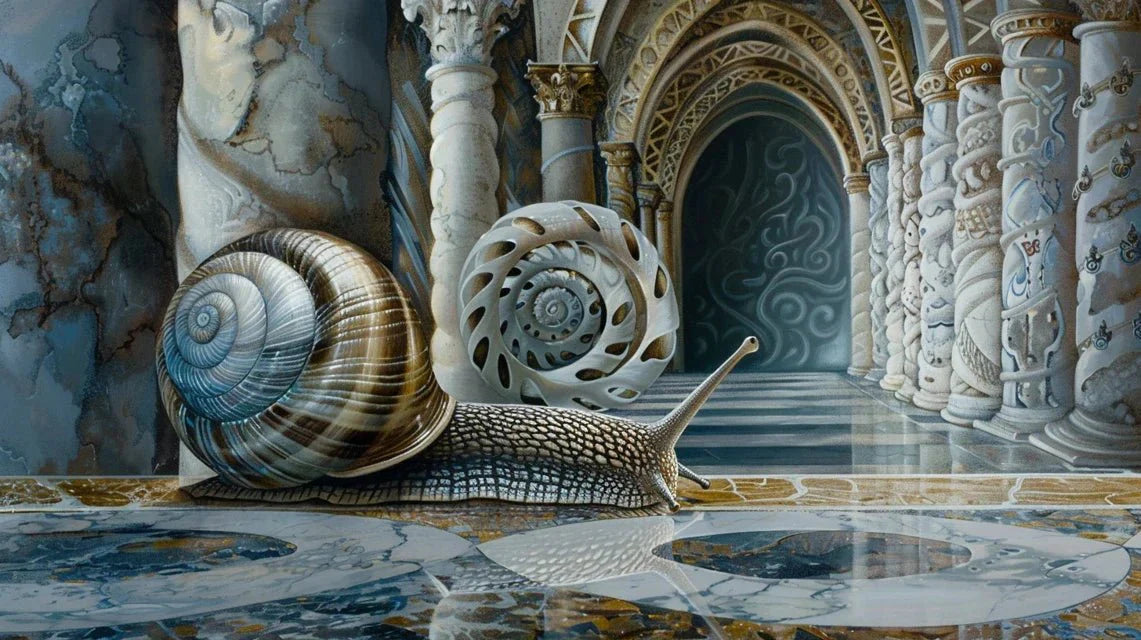
The shell spirals follow the proportions of the golden number, that mathematical sequence which Flemish artists instinctively mastered. This geometric harmony was interpreted as a divine signature in creation, reinforcing the sacred dimension of these animal representations.
Statistics reveal that 85% of Flemish Annunciations from the 15th century contain at least one symbolic animal element (Source: Institute for Art History of Leuven). Similarly, according to Lilian Randall, 70 representations of fighting snails appear in 29 different manuscripts between 1290 and 1310 (Source: Smithsonian Institution).
Flemish Snails and Meticulous Details: The Art of Slow Contemplation
The Flemish artistic philosophy advocated an aesthetic of slow contemplation which found its perfect embodiment in the snail. These masters developed a pictorial approach where every detail invited deep meditation. The snail thus became the spiritual guide for the attentive viewer.
The technique of progressive observation characterized the Flemish school. Artists such as Hans Memling (1435-1494) integrated snails into their Marian works according to a precise contemplative logic. These elements functioned as visual anchors slowing down the gaze and deepening reflection.
The four attributes identified by modern iconographic analysis reveal the sophistication of this approach:
- Marginal positioning: Between the pictorial space and the real space
- Divine measure: Proportions related to the golden number
- Absence of shadow: Signal of symbolic transcendence
- Oriented trajectory: Direction towards sacred figures
This Flemish visual pedagogy taught the art of "seeing slowly", transforming each observation into a spiritual exercise. The snail thus accomplished its mission as a contemplative mediator between human and divine.
The legacy of this tradition endures today among collectors who appreciate these works with complex symbolism. The meticulous Flemish details continue to fascinate by their ability to reveal hidden meanings to those who know how to take the time for attentive observation.
FAQ: Frequently Asked Questions about Snails in Flemish Art
Why did Flemish painters incorporate snails into their religious works?
Snails symbolized the Christ resurrection and the virgin purity of Mary. Their hibernation cycle followed by awakening evoked the death and resurrection of Christ, while their alleged fertilization by celestial dew made them symbols of immaculate conception.
How to recognize a symbolic snail in a Flemish painting?
Symbolic snails are distinguished by their disproportionate size, their positioning on the edges of the painting, the absence of shadows and their orientation towards sacred figures. These technical characteristics signal their symbolic function rather than decorative.
Which are the most famous Flemish artists for their symbolic snails?
Francesco del Cossa with his Annunciation of 1472, Hans Memling in his Marian works, and Balthasar van der Ast are among the masters who excelled in integrating snails charged with spiritual meaning into their religious compositions.