Imagine yourself in the heart of Madagascar, in a traditional Sakalava village. The sun barely rises when the sacred makis take their morning posture, arms outstretched towards the dawn. This daily scene has inspired Malagasy artists for centuries, who see much more than just animal behavior in it. For them, these endemic primates embody true spiritual messengers.
This mystical vision of makis transcends their animal nature. In traditional Malagasy art, they become "tompon-tany" - the masters of the land - whose artistic representation reveals a sacred dimension deeply rooted in the Malagasy soul. Each sculpture, each painting tells a spiritual story where makis serve as a bridge between the world of the living and that of the ancestors.
Among the Sakalava in particular, the Ankomba (Eulemur macaco) holds a special place in Malagasy craftsmanship. The elders tell stories that these black lemurs once belonged to the royal family. Even today, their descendants live in the heart of coastal villages, venerated as masina (sacred) creatures. This legend nourishes the inspiration of artists who create ritual works of art, each artistic detail carrying a precise spiritual meaning.
The ancestral art of sculpting makis spirits
In the traditional workshops of Ambositra, the sound of scissors on wood has resonated since dawn. Here, master Rakoto perpetuates a know-how that is centuries old in Malagasy sculpture. His skilled hands shape ebony and rosewood to bring representations of sacred makis to life. Each chisel stroke follows a millennial tradition passed down from father to son.
"The choice of wood is never arbitrary," explains the artisan. Rosewood for the most sacred sculptures, black ebony to represent the royal Ankomba. These precious essences reinforce the spiritual aura of each work. The sacred materials used in Malagasy art representing makis include:
- Black ebony : reserved for representations of the royal Ankomba, symbolizing the spiritual nobility and divine protection of the Sakalava ancestors
- Purple rosewood : used to sculpt makis in a meditative position, evoking ancestral wisdom and connection with the spirit world
- Rosewood : sacred essence chosen for the most venerated ritual sculptures, reinforcing the mystical aura of the artwork
- Endemic natural pigments : red for spiritual power, ocher for telluric connection, white for the purity of ancestral spirits
The geometric marquetry technique adds an extra dimension to traditional patterns. These patterns are not decorative but constitute a veritable secret language. Each triangle, each rhombus tells part of the spiritual story of the lemurs. The ancient masters jealously guarded these codes, passing them on only to apprentices deemed worthy of this sacred knowledge.
When lemurs become divine symbols
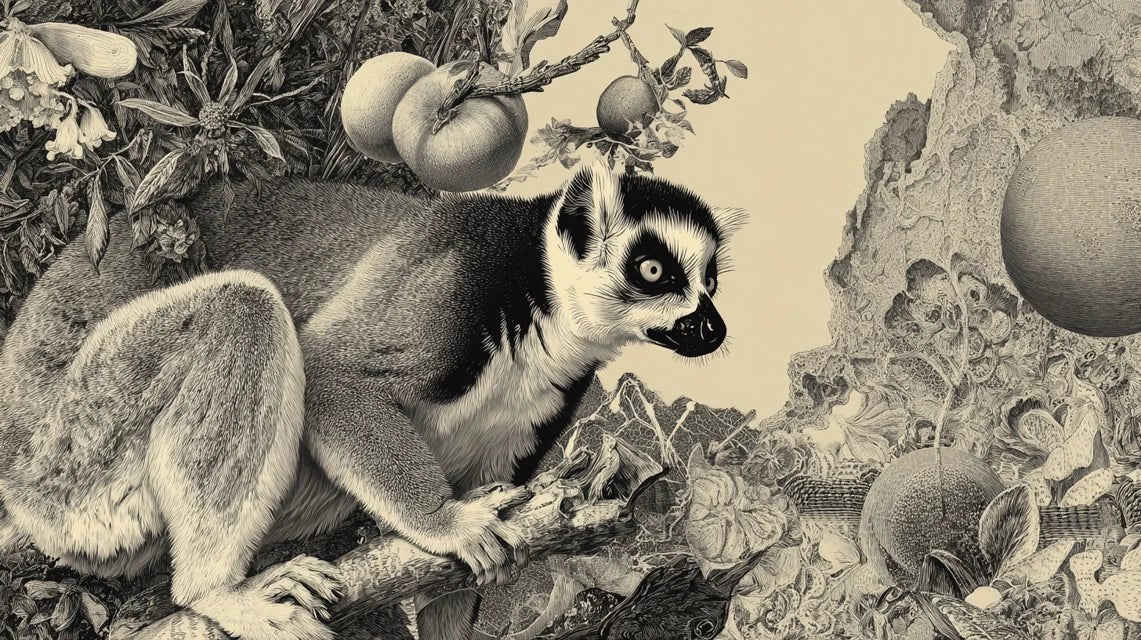
Through Malagasy art, lemurs reveal their true symbolic nature in spiritual traditions. The ring-tailed lemur, with its tail of black and white rings, does not only represent an animal. For the Malagasy people, these alternating circles evoke the eternal cycles of life, the continuity between past and future generations.
The black Ankomba embodies royal majesty in sacred iconography. In traditional sculptures, it is often depicted adorned with sacred pearl necklaces or wearing ceremonial diadems. These attributes are not fanciful: they tell the story of this Sakalava royalty where lemurs lived alongside sovereigns.
This profound symbolism finds new echoes today. Even in contemporary art, as in some collections of animal paintings, we find the influence of ancestral Malagasy symbolic tradition. Art evolves but the spiritual essence remains, preserving ancestral beliefs.
Living rituals around sacred works
Malagasy art representing lemurs never remains static. These works come to life during tsakafara ceremonies, where villagers gather to honor their ancestors. The sculptures of sacred lemurs then take center stage in the ritual, sprinkled with honey and traditional rum according to Malagasy rituals.
In Sakalava villages, these ceremonies follow a precise protocol. The works of art must face east, the direction of the sacred dawn. Participants form a circle around the sculptures, formulating their wishes to the ancestral spirits. The sculpted lemurs then become true spiritual mediators, transmitting prayers to the afterlife.
These rituals respect strict fady (taboos). The artist cannot work on certain days of the week. The sculpture can only be touched by pure hands. Every gesture, every word follows a centuries-old tradition that keeps alive the sacred dimension of Malagasy art.
Preserving a unique spiritual heritage
Today, this artistic tradition faces new challenges. Maître Ratsimba, one of the last guardians of these ancestral techniques, is worried: "Young people are leaving for the cities. Who will perpetuate our sacred art?" Deforestation also threatens traditional precious woods, while the evolution of beliefs affects the demand for ritual art.
Fortunately, conservation initiatives are emerging. Community workshops document ancestral techniques. Training centers welcome young apprentices, passing on not only the technical gestures but also the spiritual understanding of this unique art.
Because beyond aesthetic beauty, Malagasy art depicting sacred makis tells the story of a people in harmony with their endemic fauna. It bears witness to a spirituality where the animal becomes divine, where art transcends matter to touch the soul. This exceptional tradition deserves to be preserved, as it carries within it the very essence of Malagasy identity.
FAQ - The representation of makis in sacred Malagasy art
Why are makis considered sacred in Malagasy art?
Makis hold a sacred place in Malagasy art because they are perceived as "tompon-tany" (masters of the land) and spiritual mediators between the world of the living and that of the ancestors. This mystical vision is rooted in ancestral beliefs where these endemic primates, present on the island long before humans arrived, embody primordial wisdom and divine protection.
What specific materials do Malagasy artists use to represent sacred makis?
Malagasy artists prefer precious woods such as black ebony for the royal Ankomba, purple rosewood for meditative makis, and pink sandalwood for the most sacred sculptures. They also use endemic natural pigments: red for spiritual power, ochre for ancestral connection, and white for the purity of spirits, creating works full of spiritual symbolism.
How are artworks depicting makis integrated into Malagasy rituals?
Sacred makis sculptures come to life during tsakafara ceremonies, where they are placed at the center of rituals facing east (the sacred direction of dawn). Participants form a circle around the works, sprinkle them with honey and traditional rum, and express their wishes to the ancestors. These sculptures then become true spiritual mediators, respecting strict fady (taboos) that maintain their sacred character.