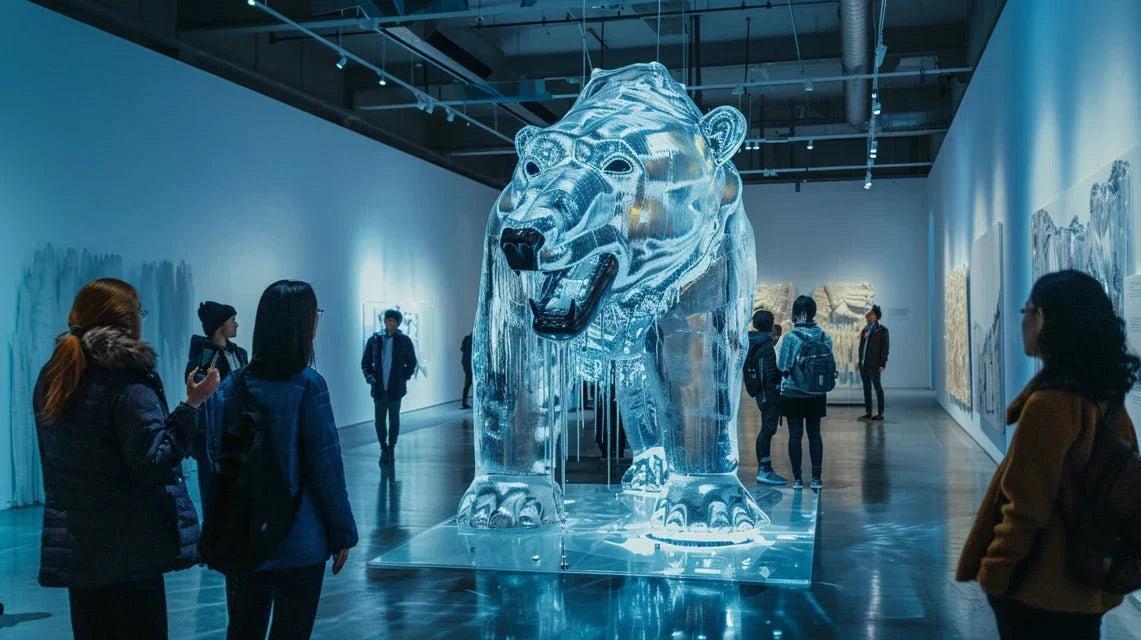
Since the early 2000s, the polar bear has conquered contemporary art galleries like never before. This emblematic inhabitant of the Arctic is no longer just an animal: it has become the silent spokesperson for a planet in climatic distress. Contemporary artists around the world have embraced this moving figure to create artworks that speak directly to us about global warming through impactful and immersive artistic installations.
This artistic appropriation transcends geographical and cultural boundaries. From New York to Tokyo, from Paris to Sydney, creators are transforming the polar bear into a universal symbol of environmental urgency. This powerful visual metaphor goes beyond mere aesthetics to challenge our consciences about the critical state of our planet.
When polar bear installations tell the story of global warming
Imagine a life-size polar bear literally melting before your eyes. That's exactly what Mark Coreth proposes with his shocking artistic installation "Polar Bear on Ephemeral Ice”. This monumental contemporary artwork weighing 6 tons ingeniously mixes different materials - plaster, rubber, ceramic, wax and bronze - in a meticulous technical assembly.
The artistic spectacle begins when the ice completely encasing the contemporary sculpture starts to melt gradually, revealing the animal's metallic skeleton little by little. This striking metaphor for global warming was strategically presented at the COP15 in Copenhagen in 2009, a crucial historical moment for global climate negotiations. The emotional impact on viewers is immediate and profound.
Olafur Eliasson, a major figure in environmental art, goes even further in the immersive experience. This visionary Danish artist had the revolutionary idea of transporting 80 tons of real Arctic ice to the heart of Paris. With “Ice Watch”, he radically transforms the public square into a life-size climate laboratory. Passersby can touch, feel and see this millennial ice melting directly from the natural habitat of the polar bear. This unique sensory experience makes tangible and concrete what often seems abstract and distant to us.
Object-Oriented Art pushes the artistic concept even further with "L'empreinte écologique". Marion Laval-Jeantet and Benoit Mangin undertook a perilous journey to Svalbard to bring back a real footprint of an polar bear in its original snow. This extreme and risky conceptual art approach profoundly questions our complex relationship with nature in a very direct and provocative way.
How contemporary art reinvents the image of the polar bear
The aesthetic evolution is particularly striking in recent contemporary artworks. The royal and majestic polar bear of former romantic representations is a thing of the past. Contemporary artists today deliberately present a fragile, vulnerable animal, sometimes even in existential distress. This radical artistic transformation accompanies our growing environmental awareness and firmly embraces an engaged and militant art approach.
This iconographic evolution also reflects the scientific evolution of our knowledge. Current research shows that the polar bear faces unprecedented survival challenges. Their natural habitat is inexorably shrinking, forcing these apex predators to change their ancestral behaviors.
Contemporary animal paintings faithfully reflect this new emerging ecological sensitivity. Creators consciously abandon traditional aesthetic idealization to show bluntly the reality: an animal whose habitat is dramatically disappearing due to accelerated global warming.
Jacky Tsai, provocative Chinese artist, adopts a deliberately ironic and critical approach with "Petrol Rainbow". He symbolically represents a polar bear on a leash near industrial oil platforms. This impactful and disturbing visual metaphor directly points the finger at major industrial responsibilities in the current global climate crisis.
From decorative art to militant art: the evolution of the polar bear
The artistic transformation is absolutely remarkable. The artistic representation of the polar bear has evolved parallelly and synchronously with our deepened scientific knowledge about global warming (Source: OpenEdition - Vincent Lavoie). In the 1990s, pioneering environmental photographers began systematically associating three recurring visual elements: an isolated animal, a floating piece of ice, and the dark threatening water surrounding it.
This specific iconography gradually becomes a universal visual language. It transcends cultural barriers to convey an urgent climate message understandable by everyone, regardless of geographical origin or level of education.
Current contemporary artworks significantly amplify this environmental message through innovative and spectacular artistic performances. Pascal Bejeannin, a committed French sculptor, meticulously sculpts a monumental bear from industrial steel specifically intended for Greenland, philosophically questioning the durability of art in the face of planetary climate emergency. This creative approach symbolically transforms industrial steel into a powerful symbol of ecological resistance.
Alarming scientific reality directly and constantly nourishes contemporary artistic creation. When we discover that the surface area of the Arctic ice cap is decreasing dramatically by 13.4% per decade (Source: WWF France), contemporary artists immediately translate this abstract statistical data into concrete visual and emotional experiences accessible to the general public.
Participatory art: when the public becomes an actor in the climate message
Contemporary art resolutely evolves towards more direct interaction and citizen participation. Peter Ittukallak, an authentic Inuit artist, traditionally sculpts ephemeral ice bears during public environmental awareness events. The spectator witnesses in real time the inexorable melting of the work, becoming an active and moved witness to this living metaphor of climate warming.
This participatory approach creates a deep emotional connection between art and the public. Spectators are no longer passive observers but become conscious actors of the ecological message conveyed.
This major artistic evolution is characterized by several significant fundamental changes:
- From imposing monumental works to intimate and personalized experiences
- From complex abstract symbolism to accessible concrete reality
- From traditional contemplative art to art that directly questions consciences
- From distant passive observation to engaged active participation
Digital art and new technologies also enrich this approach. Interactive installations use motion sensors to trigger visual effects representing the melting of ice when visitors approach. This immersive technology reinforces the emotional impact of the climate message.
Today, contemporary art definitively transforms the polar bear into a true artistic ambassador for climate warming. These visionary works go far beyond simple aesthetic beauty to become profound transformative experiences that directly question us about our collective responsibility in the face of current global environmental emergency.
FAQ: The polar bear in contemporary art
Why has the polar bear become a symbolic artistic representation of climate warming?
The polar bear perfectly symbolizes vulnerability to climate change because its habitat - the Arctic ice floe - is rapidly disappearing. Artists use this evocative image to make a crisis often perceived as abstract visible and emotional. Its artistic popularity coincides with the first scientific studies correlating global warming and the decline of polar bear populations in the 1990s.
What are the most commonly used artistic techniques to represent the polar bear in climate art?
Ephemeral installations using real melting ice (such as Olafur Eliasson's "Ice Watch") are particularly popular. Mixed sculptures combining different materials, participatory performances, and interactive digital art are also frequent. These techniques allow for the creation of an immersive experience where the viewer physically feels the effects of global warming.
How do these works of art influence climate change awareness?
These creations transform abstract scientific data into concrete emotional experiences. They reach a wider audience than traditional scientific reports and create a lasting emotional connection. Art allows to circumvent psychological resistance to bad news about the climate by offering a sensitive and aesthetic approach to the problem.