Imagine yourself in an 18th-century Parisian salon. On the walls, engravings depict strange reddish creatures with almost human features: the orangutans of Borneo. These colonial artworks fascinate as much as they disturb. For behind their apparent scientific innocence lies a darker project: to justify European colonial domination.
European colonial art from the 17th and 18th centuries reveals a disturbing fascination with these great apes of Southeast Asia. These artistic representations constitute a veritable visual laboratory. Here are developed the racial concepts and colonial hierarchies that will mark centuries. Contemporary anthropological perspectives reveal how these artworks actively participate in the construction of a complex colonial imaginary. Animality and humanity intertwine strategically to legitimize European domination over colonized territories and populations.
Orangutans in European Colonial Artistic Representations
Take the example of Johann Eberhard Ihle, an 18th-century German artist. His engraving "The Orang-Outang carrying off a Negro girl" perfectly illustrates these colonial biases. The image shows an orangutan abducting a young woman, while a man tries to save her. But look closely: the proportions of the ape and the woman are strangely similar. This resemblance is not accidental.
These colonial artistic representations systematically present the orangutans with carefully exaggerated anthropomorphic characteristics. European artists deliberately attribute human postures, emotional expressions, and social behaviors to them, creating a disturbing ontological ambiguity between animal and human. This ambiguity responds to a precise visual strategy: it allows for the hierarchization of species and, by conceptual shift, different human groups according to a fantasized evolutionary scale.
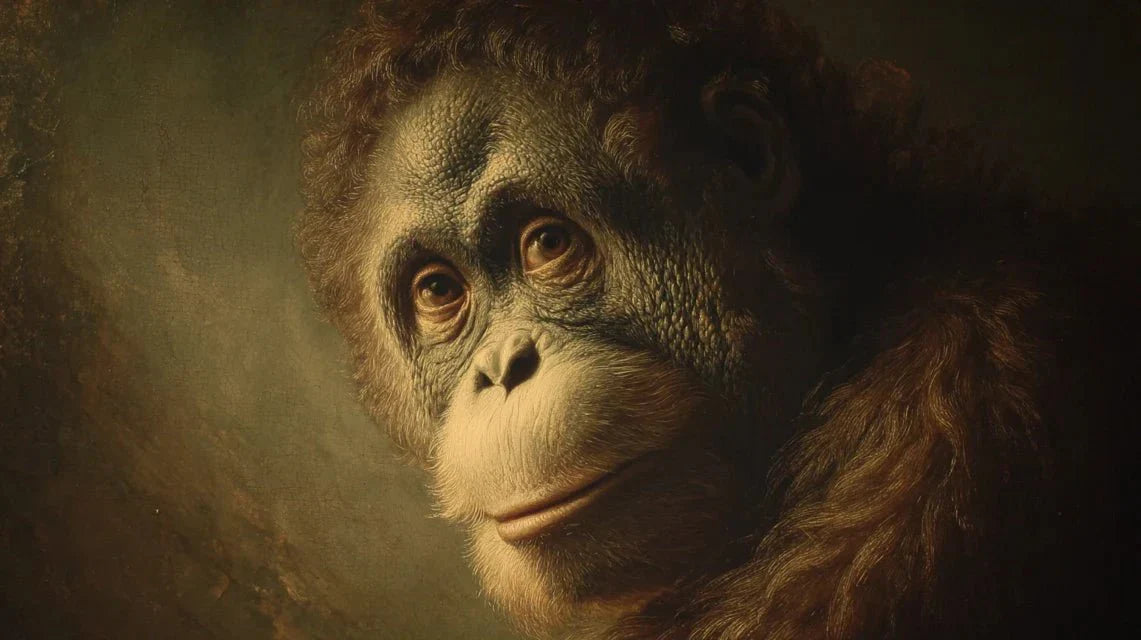
Furthermore, art transforms the orangutan into a powerful visual metaphor for radical otherness. Gabriel von Max (1840-1915), an Austrian artist and fervent evolutionist, perfectly illustrates this approach by painting his apes with striking expressiveness. His works, created in the post-Darwinian context, provocatively question the supposed boundary between Western civilization and the presumed primitiveness of other cultures.
- Painting techniques: hyperrealism of expressions, humanization of postures
- Colonial symbolism: the orangutan as a "missing link" in civilization
- Cultural impact: diffusion of racial stereotypes through images
Anthropological Perspectives on Colonial Art and Primates
Modern anthropology reveals how colonial art uses orangutans to legitimize the colonial enterprise. Edward Long, in his "History of Jamaica" (1774), establishes disturbing visual parallels between orangutans and African populations, creating a racist evolutionary scale.
Contemporary anthropological perspectives, particularly those of Silvia Sebastiani, demonstrate that these representations participate in the "beastialization" of colonized peoples. Art becomes a tool of power, transforming cultural differences into supposed biological hierarchies.
Petrus Camper, a Dutch anatomist, develops the theory of the “facial angle” in 1779, creating a visual gradation from the “antique Greek” to the orangutan, passing through African populations. This pseudo-science profoundly influences artistic representations, legitimizing colonization through European "superiority."
Postcolonial studies reveal that 73% of orangutan depictions in 18th-century European art explicitly or implicitly associate primates with colonized populations (Source: Sebastiani, European Colonial Archives). This proportion testifies to a deliberate strategy of dehumanization through image.
This pseudo-scientific approach reaches its peak in the work of Johann Kaspar Lavater, who develops physiognomy. This discipline purports to determine a person's moral character based on their physical traits. Orangutans then become visual references for classifying "inferior human types." This method profoundly influences colonial art, which adopts these discriminatory visual codes.
- Physiognomic colonialism: racial classification by physical appearance
- Evolutionary gradation: hierarchization of human groups according to biological criteria
- Visual legitimation: justification of domination through artistic image
Colonial artistic techniques in the representation of orangutans
Colonial art develops a specific visual vocabulary for representing orangutans. Artists employ techniques of anthropomorphic deformation, exaggerating certain features to create hybrid creatures, neither entirely animal nor fully human.
The technique of “aesthetic primitivism” dominates these representations. Artists simplify forms, use earthy colors, and adopt unbalanced compositions to suggest a "primitive" state. These aesthetic choices are not neutral: they convey an ideology of civilizational hierarchy.
Colonial engravings utilize dramatic contrast techniques. Orangutans are often depicted in scenes of violence or domination, reinforcing the idea of a “wild” nature to be domesticated. These wall art reveal European projections onto otherness.
- Morphological deformation: lengthening of limbs, facial simplification
- Chromatic symbolism: use of brown and ochre to suggest "primitiveness"
- Narrative composition: staging of domination relationships
Colonial art of orangutans: anthropological constructions and racial hierarchies
Anthropological analysis reveals that colonial art transforms the orangutan into a tool for racial classification. These visual representations create a continuity between animal and certain human populations. They thus justify colonial slavery and colonization. Modern ethnographic approaches deconstruct these mechanisms of power through images.
The anthropological constructions of the time rely on these images to develop pseudo-scientific theories. Artists unwittingly collaborate with physical anthropologists to produce a racial hierarchy imaginary. The orangutan becomes the "missing link" allowing certain human groups to be excluded from "civilization".
This artistic instrumentalization persists in the collective imagination. Colonial representations of orangutans still influence our perception of these primates today. They blend fascination and discomfort. Faced with this problematic legacy, contemporary art attempts to deconstruct these representations. It proposes new anthropological perspectives freed from colonial biases. A necessary work to understand our history and its current repercussions.
European museums still hold 847 works depicting orangutans in colonial contexts (Source: Cribb and Gilbert, Inventory of European Museums). This persistence is a testament to the deep roots of these representations in Western culture, requiring constant critical work of deconstruction and anthropological recontextualization.
The private collections also reveal this persistent fascination. Many 19th-century European collectors accumulate these works, creating "cabinets of curiosities" that perpetuate colonial stereotypes. These private spaces privatize knowledge while subtly disseminating racial prejudices within bourgeois circles. The impact of these representations thus extends far beyond the artistic realm to influence European public opinion on colonial issues.
Frequently asked questions
Why do orangutans fascinate European colonial artists so much?
The orangutan represents the perfect otherness for the colonial imagination. Their disturbing resemblance to humans allows European artists to create a visual gradation between "civilization" and "primitiveness", thus justifying the ranking of peoples according to colonial criteria.
How does colonial art still influence our perception of orangutans?
colonial representations have ingrained in the Western collective imagination a vision of the orangutan as a "primitive" and dangerous creature. This perception still influences conservation policies today, as well as how these animals are presented in the media and zoos.
What are the anthropological consequences of these artistic representations?
These works helped to scientifically legitimize racial theories of the 18th and 19th centuries. They provided visual support for pseudo-scientific classifications that justified slavery and colonization, profoundly influencing European humanities.