Andean llamas tell a fascinating story that dates back millennia. Imagine these majestic sacred camelids traversing snowy peaks, carrying on their shoulders more than just simple goods: they carry the spiritual soul of an entire people.
When Llamas Become Messengers of the Gods
In pre-Columbian iconography, the llama is never just an animal. The ancient Incas saw it as a living bridge between earth and sky. Take the striking example of the Tambo Viejo excavations: archaeologists discovered mummified llama heads there, carefully adorned with colorful jewelry. These animals had not been sacrificed to feed the community but offered to the gods as a sign of pure devotion.
This practice reveals the spiritual depth of Andean civilizations. Each decorated llama represented a silent prayer addressed to Viracocha, creator of the world, and Inti, the sun god. The multicolored threads attached to their ears told sacred stories that only shamans knew how to decipher.
- Llamas were adorned with colorful ribbons during ceremonies
- Each sacrifice followed a precise spiritual protocol
- Andean communities considered these animals as members of the family
The Art of Sculpting the Sacred
Andean artisans mastered the art of transforming raw stone into a spiritual masterpiece. At Choqek'iraw, an archaeological site perched over 3000 meters above sea level, immense mosaics depict stylized llamas. These gigantic works testify to the importance given to these animals in the spiritual hierarchy.
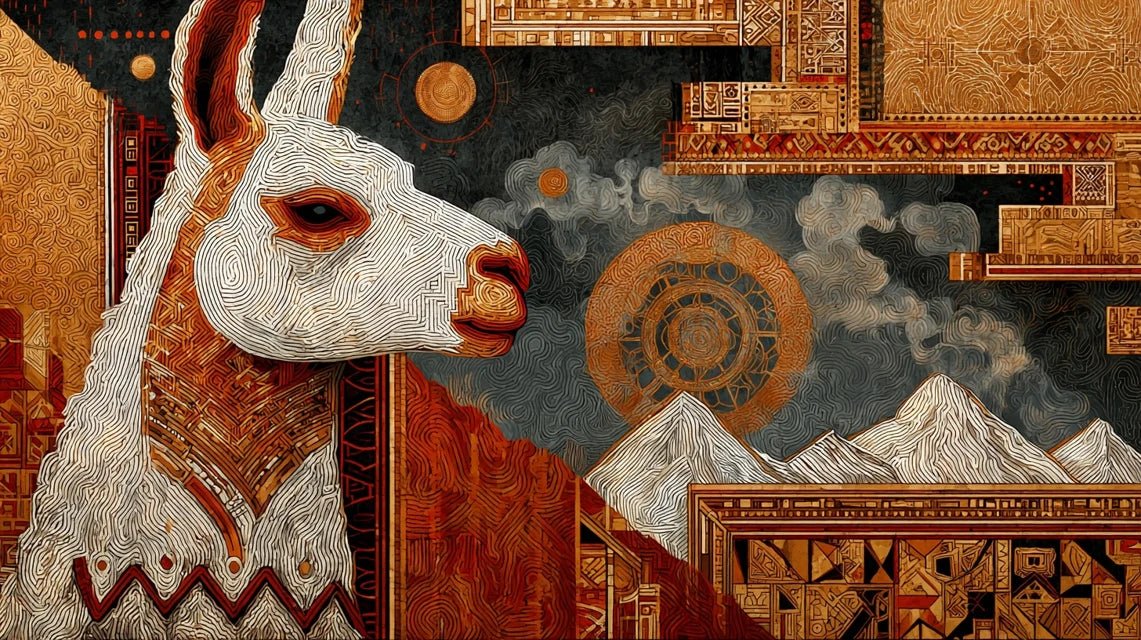
Every detail counts in these representations of pre-Hispanic sacred art. The position of the erect ears evokes divine listening, while the proud posture symbolizes noble endurance. Artists were not seeking photographic realism but rather the spiritual essence of the animal.
This artistic approach finds a contemporary echo in a rich collection of animal paintings that perpetuates this tradition of symbolic representation.
Weavings That Speak to Souls
Andean textile art may reveal the most intimate dimension of this spiritual relationship. Women weavers, heirs to a millennial know-how, integrate llama motifs into their aguayos - these multicolored textiles that accompany all moments of life.
Today, 3 million llamas still populate the Bolivian highlands (Source: Bolivian Geographical Institute), perpetuating this ancestral connection. In Quechua communities, weaving a llama on a textile is equivalent to invoking its protection and wisdom.
Weaving techniques reveal remarkable sophistication: each color carries a specific spiritual message, each motif tells a fragment of the cosmic history according to the Andean cosmovision.
Guardians of Spiritual Traditions
These artistic representations go beyond simple decoration. They constitute a secret language passed down from generation to generation. In Andean spirituality, the llama embodies perseverance in the face of adversity - an essential quality for surviving at over 4000 meters above sea level.
Contemporary shamans perpetuate these beliefs during Andean rituals where the image of the llama guides souls towards enlightenment. This living tradition demonstrates that this Andean heritage does not belong to the past but continues to inspire and nourish the spirituality of highland peoples.
Mini FAQ
Why are llamas considered sacred in Andean art?
The llamas symbolize the spiritual connection between the earthly and divine worlds. Their unique ability to thrive in the extreme conditions of the highlands makes them natural messengers of the Andean gods.
How can you recognize a llama in traditional textile art?
Llamas often appear stylized as geometric patterns. Artisans use specific visual codes: slender silhouettes, pointed ears and symbolic colors according to the region of production.
Does this artistic tradition still exist today?
Absolutely! The Quechua and Aymara communities perpetuate these ancestral techniques. Many contemporary artisans continue to weave, sculpt and paint llamas according to traditional spiritual codes.