In the icy waters of Antarctica, a silent artistic revolution is taking shape. Krill, this minuscule translucent crustacean, now inspires a new generation of creators who discover in it the very essence of polar life.
Antarctic krill: Artistic muse of eternal ice
Imagine a creature only 6 centimeters long, weighing barely 2 grams, yet capable of forming pink swarms visible from space. Euphausia superba fascinates artists with its paradox: a tiny individual, a giant collective. Its biomass of 500 million tons (Source: 1990s estimates) makes it one of the most abundant species on our planet.
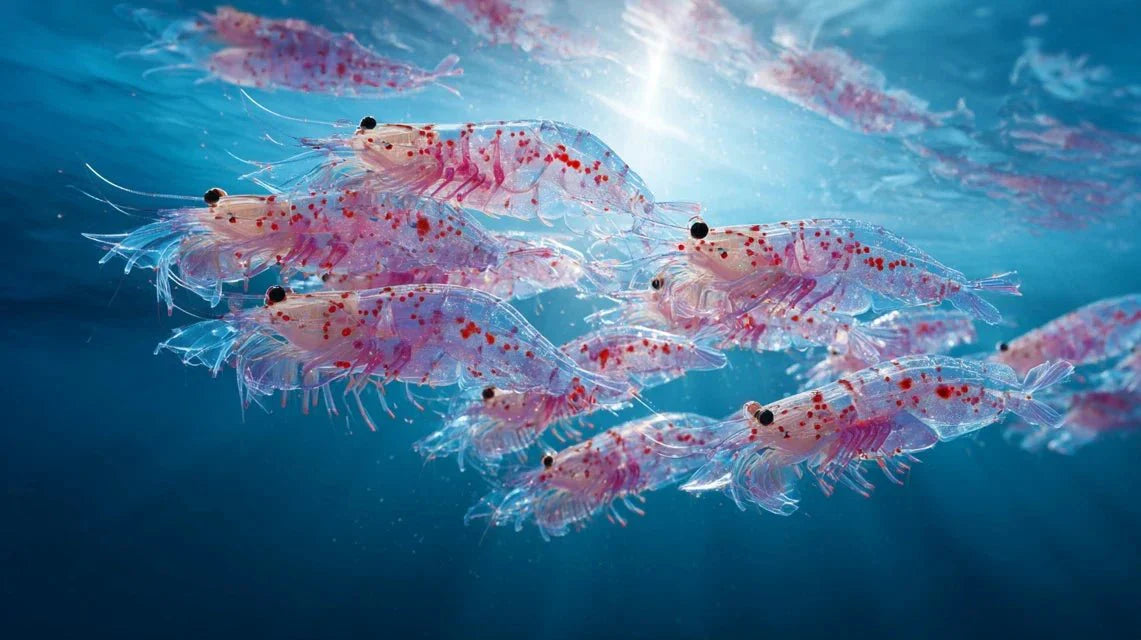
This small crustacean hides extraordinary visual secrets. Its transparent body reveals an inner universe tinted green by the phytoplankton it consumes. Its characteristic red spots and large black compound eyes create a unique aesthetic that polar artists explore with passion.
Pierre Bernay, explorer painter, says: "Painting krill in the open air, in the middle of Antarctica, is capturing the very essence of life in this ice desert."
Artistic techniques: Capturing the invisible in the marine ecosystem
Artists are developing innovative approaches to represent these ephemeral creatures of the Southern Ocean. Watercolor allows reproduction of their natural translucency, while colored inks recreate the spectacular pink hues of massive swarms.
Sarah, scientific illustrator, explains her method: "I start by observing nocturnal vertical migrations. These movements of 100 meters (Source: National Museum of Natural History) create invisible ballets that I translate into artistic sequences."
Contemporary art is also revolutionizing the representation of krill. Animations make it possible to visualize the scale of swarms: formations of 450 km² (Source: Terra Antarctica) which transform the ocean into a natural canvas.
Krill, star of polar art collections
Animal paintings representing krill are experiencing growing success. Collectors and art lovers discover in these works an unexpected poetic dimension of polar biodiversity.
Marc, a gallery owner specializing in this field, testifies: "These works tell the story of the food chain antarctic. They reveal how 98% of crab seal feeding depends on these tiny creatures."
Contemporary art also explores the ecological dimension of krill. These crustaceans sequester 23 million tons of carbon annually (Source: Imperial College London), equivalent to the emissions of 35 million cars.
Creative innovation: When science and art merge
Light installations are inspired by the bioluminescent organs of krill. These interactive creations evoke the communication signals of creatures evolving in polar darkness.
Lisa, digital artist, reveals: "I recreate virtual swarms of 30,000 individuals per cubic meter (Source: National Museum of Natural History). The effect is striking: you suddenly understand the immensity of this natural phenomenon."
Activist art: raising awareness about the fragility of the polar food chain
Climate urgency transforms krill art into an alert message. The decline of 80% of populations since 1970 (Source: WWF France) inspires committed works that raise awareness of environmental issues.
Artists also document overfishing: 450,000 tonnes are caught annually, threatening the balance of the Antarctic ecosystem.
Key takeaways:
- Krill inspires authentic and innovative polar art
- Artistic techniques evolve to capture its essence
- Art becomes a vector for environmental awareness
- These creations reveal the hidden beauty of the Antarctic ecosystem
Frequently asked questions about krill in Antarctic art:
Q: Why does krill inspire polar artists?
R: Krill represents the paradox of Antarctic life: tiny individually but forming gigantic swarms visible from space. Its translucency, its colors and its fundamental ecological role make it a rich and symbolic artistic subject.
Q: What artistic techniques are used to represent krill?
R: Watercolor captures its translucency, colored inks reproduce the hues of swarms, digital art visualizes its migrations, and light installations evoke its natural bioluminescence.
Q: How does krill art raise awareness about environmental issues?
R: The works document the decline of 80% of populations since 1970, alert on the overfishing of 450,000 tonnes annually and reveal the importance of krill in oceanic carbon sequestration.