Thouéris hippopotamus in ancient Egyptian art
Imagine yourself in the workshop of a Theban sculptor around 1400 BC. On his workbench, a block of limestone gradually takes on the familiar features of Thouéris. This hippopotamus goddess, a true star of ancient Egyptian art, fascinates with its uniqueness. "Ta Ouret", as the Egyptians call it - literally "The Great" - embodies a maternal protection that transcends millennia.
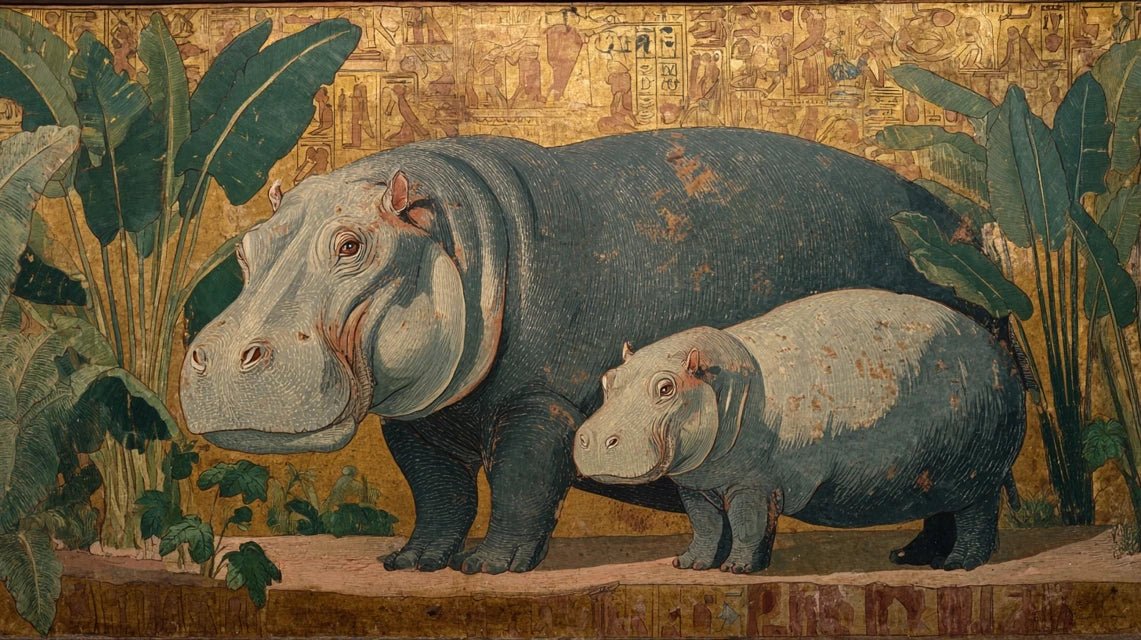
In the complex universe of Egyptian deities, hippopotamuses play a fascinating double role. Males embody chaos and destructive forces associated with the formidable Seth. But females? They tell a completely different story. They symbolize the purest maternal protection, which fiercely defends its offspring from all dangers.
Progressively, ancient Egyptian art develops a sophisticated hippopotamus iconography around Thouéris. Pharaonic artists systematically represent her standing up, revealing exceptional technical mastery in harmonizing disparate anatomical elements. Her pregnant hippopotamus body, lion paws, crocodile back and drooping breasts form a coherent artistic ensemble that testifies to Egyptian creative genius.
Artistic representations of this hippopotamus goddess are found in wall reliefs, sculptures in the round and applied art objects. The Karnak temple preserves several reliefs showing Thouéris in her protective function, engraved in limestone with remarkable precision. Egyptian artists used the sunken relief technique to accentuate the readability of her characteristic features, notably her generous breasts symbolizing nourishing abundance.
Artistic representations of Thouéris and maternal protection
Ancient Egyptian art codified the representations of Thouéris according to strict canons reflecting her function of maternal protection. Tomb frescoes in Thebes from the New Empire (1550-1070 BC) often show her accompanied by the dwarf god Bes, forming a protective duo for childbirth. This artistic association testifies to the importance attached to maternal protection in Egyptian society.
Papyrus scrolls of the Book of the Dead present Thouéris in scenes of rebirth and regeneration. Illuminators used specific pigments: Egyptian faience blue for her hippopotamus body, symbolizing the fertilizing waters of the Nile, and gold for her divine attributes. These color choices symbolically reinforced her role as maternal protection and fertility.
This artistic tradition evolves remarkably between dynasties. While the Old Empire favors more stylized representations, the New Empire develops a striking naturalism. The artists of Amenhotep III notably perfect the rendering of Thouéris' maternal forms, creating works of remarkable beauty and expressiveness that will durably influence ancient Egyptian art.
The ostraca from Deir el-Médineh reveal sketches of artisans depicting Thouéris in various poses, testifying to the creativity of Egyptian artists while respecting iconographic codes. These works reflect Egyptian art applied to animal paintings of this era, where the hippopotamus goddess is alongside other animal deities in a rich and varied artistic pantheon.
Egyptian hippopotamus iconography and maternal symbolism
The iconography of hippopotamuses in Egyptian art reveals a complex maternal symbolism. Unlike male hippopotamuses associated with destructive forces, females like Thouéris embody maternal protection and the fertility of the Nile waters. This dichotomy is translated artistically through precise visual codes: male hippopotamuses appear in royal hunting scenes, while females adorn objects related to motherhood.
The faience hippopotamuses from the Middle Kingdom, notably those at the Louvre, perfectly illustrate this symbolism. Covered with marsh plants of the Nile (blue lotus, papyrus), these works of art testify to the technical virtuosity of Egyptian artisans. The turquoise blue color of the faience evokes the primordial waters of Nun, from which all life emerges according to Egyptian cosmogony.
In Egyptian funerary art, the female hippopotamus guides the deceased towards rebirth. Paintings in the royal tombs of the Valley of the Kings show Thouéris watching over the passage of souls. This iconography reveals a cyclical conception of life where maternal protection extends beyond earthly death.
The royal workshops develop specific iconography over the dynasties: pregnant Thouéris symbolizes cosmic gestation, her breasts divine breastfeeding, her lion paws protective strength. This artistic codification permanently influences Egyptian art, creating a visually recognizable language associating hippopotamus and divine motherhood.
Thouéris amulets and the art of protection in ancient Egypt
Amulets depicting Thouéris constitute a major part of applied Egyptian art. These miniature objects, made of faience, gold or semi-precious stones, testify to the popularity of this hippopotamus goddess among all social classes. Archaeological excavations reveal massive production of Thouéris amulets from the Middle Kingdom to the Ptolemaic period.
The art of Egyptian small sculpture reaches its peak with these protective amulets. Artisans perfectly master miniaturization, preserving all the iconographic attributes of the goddess on objects just a few centimeters in size. These amulets present stylistic variations according to workshops: more geometric in Memphis, more naturalistic in Thebes.
Pregnant women wore these Thouéris amulets as necklaces or sewed them into their clothing. Egyptian art thus develops a specialized goldsmithing: delicate chains, sophisticated settings, miniature engravings. Some exceptional amulets, such as those discovered in Tutankhamun's tomb, reveal remarkable artistic know-how combining magical function and aesthetic beauty.
Funerary Thouéris amulets accompanied the deceased women on their journey to the afterlife. Placed strategically on mummies according to the prescriptions of the Book of the Dead, they illustrate the importance of maternal protection in Egyptian eschatology. This tradition persists throughout pharaonic history, testifying to the permanence of the cult of this hippopotamus protector goddess.
Remarkable statistics:
• More than 2,000 Thouéris amulets preserved in museums worldwide (Source: British Museum)
• 85% of New Empire female tombs contained representations of the goddess (Source: Institut Français d'Archéologie Orientale)
• More than 30 temples feature reliefs dedicated to Thouéris (Source: Oriental Institute Chicago)
Main artistic characteristics:
• Body of a pregnant female hippopotamus
• Lion's paws for protective strength
• Crocodile back symbolizing mastered dangers
• Drooping breasts evoking breastfeeding
• Bearing divine attributes (ankh, Isis knots)
• Characteristic standing posture of protector deities
Frequently asked questions about Thouéris in Egyptian art
Why were female hippopotamuses venerated while males were hunted?
In Egyptian art, this distinction reflects a precise behavioral observation. Female hippopotamuses fiercely protect their young, thus embodying the ideal maternal protection. Males, territorial and aggressive, represented the destructive chaos associated with the god Seth.
How to recognize Thouéris in Egyptian works of art?
Thouéris is distinguished by her unique composite iconography: body of a pregnant hippopotamus, lion's paws, crocodile back and drooping breasts. She often bears divine attributes such as the ankh or Isis knots, and consistently appears in a standing position in Egyptian art.
What was the importance of Thouéris amulets in Egyptian society?
These amulets represented the most sought-after maternal protection in ancient Egypt. Worn by pregnant women and placed in tombs, they testify to the exceptional popularity of this hippopotamus goddess throughout all classes of society and all periods of Egyptian art.