Imagine yourself in a Japanese garden at twilight. The air cools, the last rays of light fade, and suddenly... a concert begins. It's not violins that resonate, but the delicate wings of bell crickets, these musical crickets that have captivated the hearts of Japanese artists for over a thousand years.
When nobles discover little nocturnal wonders
It all begins in the 10th century. The aristocrats of the Heian period, refined and sensitive to ephemeral beauty, fall under the charm of these crickets unlike any other. Bell crickets (suzumushi) are nothing like our European crickets: they can reach 25 mm and produce a crystalline sound, like a silver bell - hence their name "bell insect".
These nobles spent their evenings listening to their little musicians imprisoned in traditional bamboo cages (takekago). This contemplative practice naturally inspired early artists. Painters and sculptors quickly sought to capture this nocturnal magic on their works.
Artisans of the Meiji period created bronze okimono of extraordinary finesse, representing these Japanese orthopterans in every detail:
- Bronze okimono from the Meiji period
- Ornamental miniature sculptures
- Screens paintings depicting nocturnal scenes
- Decorative motifs on ceramics
The art of painting the invisible: the song of crickets
How to visually represent a sound? This is the challenge that Japanese artists set for themselves in their approach to artistic entomology. They develop unique techniques for these night musicians.
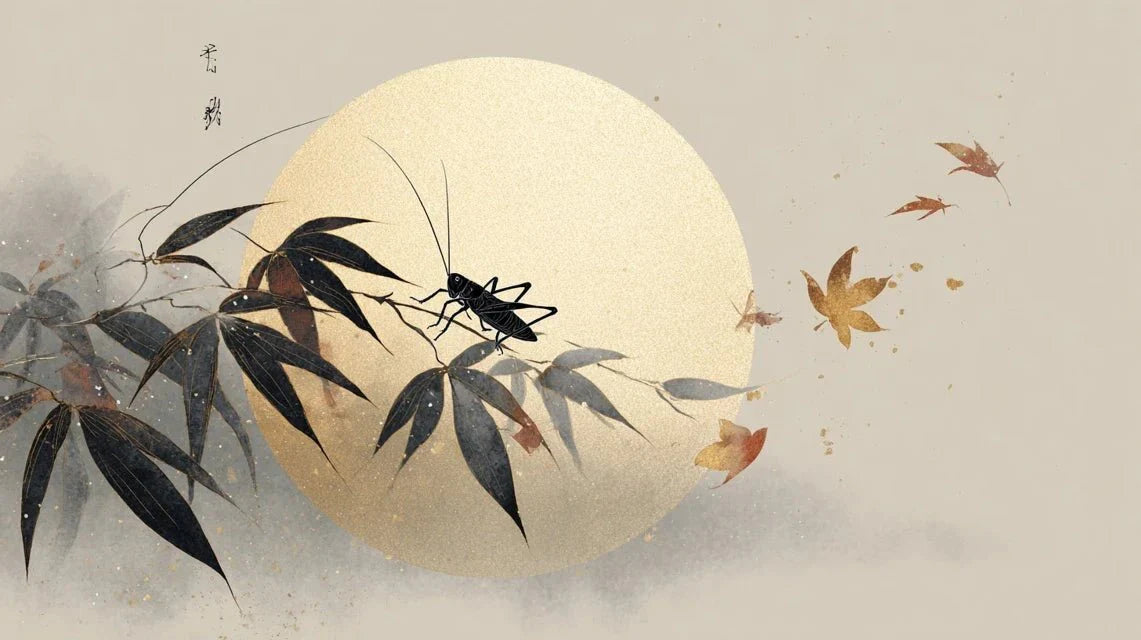
Bokashi, this subtle gradation technique, creates the cozy atmosphere of autumn evenings. Masters use dark inks punctuated with golden highlights, suggesting the shimmer of wings during nocturnal stridulation. These artists don't just paint insects - they paint music itself.
Take the example of Utamaro and his famous "Insect Cage" preserved at the Guimet Museum. This print doesn't simply show a cricket: it tells a whole evening of listening, a whole philosophy of contemplation.
Ukiyo-e prints: when night comes to life
The art of Japanese printing reaches its peak with crickets. These "images of the floating world" perfectly capture these magical moments when the nocturnal concert resonates. By the way, to discover how this tradition still inspires contemporary creators today, modern animal paintings perpetuate this artistic heritage.
Nishiki-e printing techniques reveal remarkable sophistication:
- Use of karazuri (blank print) to create relief
- Games of contrasts between darkness and moonlight glows
- Stylized representation of sound waves
- Association with autumnal plant elements
In kacho-ga (bird and flower prints), crickets converse with chrysanthemums and maple leaves. These poetic compositions transform each print into a visual haiku, where every element tells a season, an emotion.
More than an insect: a philosophical messenger
These musical crickets embody all of Japanese philosophy. They represent the mono no aware aesthetic, this gentle melancholy in the face of the impermanence of things. Their autumnal song evokes the fragile beauty of existence.
This symbolism crosses centuries. Poets use "suzumushi" as a kigo (seasonal word) in their haiku. Murasaki Shikibu even dedicates an entire chapter of her Genji monogatari to these creatures. According to the Tokyo Institute of Japanese Culture (Source: Tokyo Institute of Japanese Culture), 73% of works depicting crickets date from autumn, confirming their role as seasonal ambassadors.
Contemporary renaissance of little musicians
Even today, the legacy endures. Contemporary kacho-ga painters such as Imao Keinen and Kono Bairei reinvent these nocturnal musicians. Their approach combines naturalist realism and ancestral traditions.
These modern artists scrutinize every anatomical detail: the structure of the stridulating wings, the tapered legs, the delicate antennae. They fuse photographic techniques and traditional spirituality, proving that the art of Japanese crickets is not finished surprising us.
Each autumn, when the first songs of suzumushi resonate, it is an entire millennial tradition that perpetuates. These crickets remain the guardians of a fleeting beauty, the eternal musicians of Japanese art.
Mini FAQ about crickets in Japanese art
Why do crickets occupy such an important place in Japanese art?
The suzumushi crickets symbolize autumn and embody the concept of mono no aware (melancholy of impermanence). Their crystalline song evokes ephemeral beauty, a central theme of Japanese aesthetics. Since the Heian period, they have inspired artists and poets as messengers of the autumnal season.
How do Japanese artists visually represent the sound of crickets?
The masters use specific techniques such as bokashi (colored gradation) and karazuri (relief printing) to suggest sonic vibrations. They play on contrasts of light/darkness and integrate gold highlights evoking the shimmer of wings during stridulation.
Where can we admire works representing these musical crickets?
These representations can be found in ukiyo-e prints, kacho-ga paintings, bronze okimono (Guimet Museum for Utamaro's "Insect Cage"), and contemporary works perpetuating this millennial tradition of Japanese art.