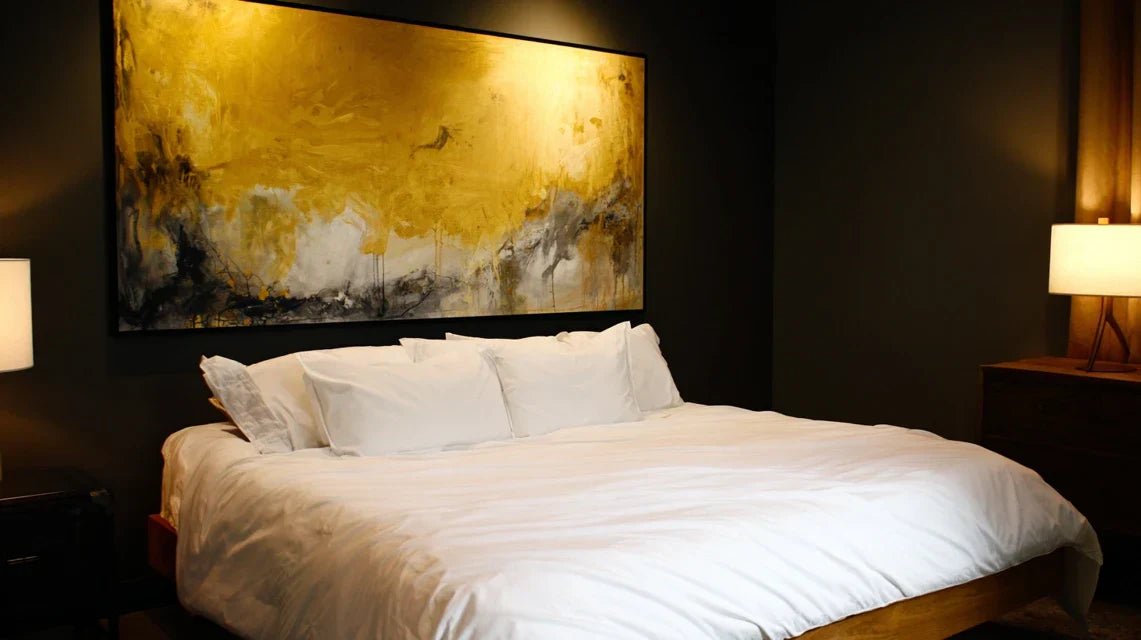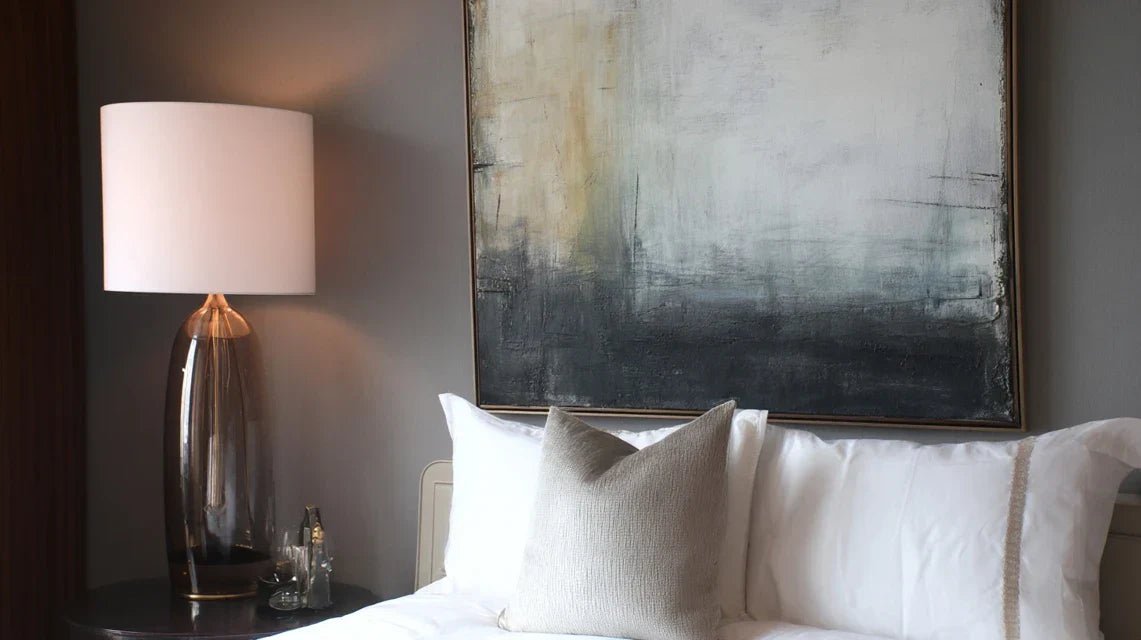
Do you dream of transforming your bedroom into a luxurious sanctuary worthy of the finest palaces, but each decorative attempt leaves you with the frustrating feeling that something is sorely lacking.
No matter how much you change the sheets, invest in soft lighting, carefully consider every detail, your bedroom remains desperately ordinary, far from the refined and soothing atmosphere you seek.
You've probably tried hanging a few frames picked up here and there, tried reproductions of classic art found in big-box stores, or even invested in framed posters. The result: your wall looks more like an amateur gallery than the elegant simplicity of a presidential suite.
This is perfectly normal and it's certainly not a lack of taste on your part. The real reason for this failure? Luxury hotels don’t choose their artwork at random, they follow specific codes, a true science of visual harmony that no one has ever explained to you.
By the end of this article, you will master the secrets of interior decorators for prestigious hotels to select the perfect paintings that will instantly transform your bedroom into a showcase of sophistication where you’ll want to wake up every morning.
Why wall art makes all the difference in a bedroom's ambiance?
Wall art in a bedroom is not just simple decoration, it’s the silent conductor that harmonizes all other elements. If you wait too long to consider it, you risk missing out on this magical transformation that turns an ordinary bedroom into an extraordinary refuge. Imagine the effect on your guests when they discover your space transformed into a true hotel suite.
🏨 Testimony from a Parisian hotel manager: "We tested the same room with and without our signature paintings. Guests rated the experience 6/10 without wall art, and 9/10 with our carefully selected artworks. The difference? Paintings create an emotional narrative that transforms a simple stay into a memorable experience."
💬 Conversation with a decor expert
The golden rule of luxury hotels: A perfectly chosen painting acts as an ambiance amplifier that reveals and magnifies all other elements of your decor. You will observe this transformation from the first day of installation, the effect is instant and lasting.
Understanding what’s really happening in your current room
Perhaps you recognize these three situations: your room feels cold and impersonal despite your efforts, You feel like it lacks character and personality, or your guests find it “pretty” but never express that “Wow!” that you secretly hope for.
What’s really happening is your room suffers from what interior architects call the "blank page syndrome". All functional elements are present, but it lacks that artistic soul that transforms a sleeping space into a sensory experience. The problem isn't your taste or budget, it's the absence of a coherent artistic strategy.
Imagine your room as a beautifully bound book whose pages have remained blank. Wall art is the ink that will finally tell your story.
The first hidden cause: the proportion error
Contrary to what many think, the majority of decorative failures do not come from the choice of colors or the style of paintings, but from a lack of knowledge of proportions. Luxury hotels apply precise mathematical rules that individuals totally ignore.
It’s like trying to wear a suit: even the finest fabric in the world will achieve nothing if it's not perfectly fitted to your body shape. A painting that is too small on a large wall will create a ridiculous disproportion effect, while an artwork that is too imposing will completely crush the space.
This proportion error unconsciously affects your well-being in the room and explains why you never feel totally comfortable in your own bedroom. Mastering this rule will radically change your perception of space.
🔍 Instant test: Take a photo of your main wall and draw a rectangle representing 2/3 of its width and height. This is the optimal space for your future artwork. You'll immediately see if your current pieces respect this magical proportion.
The trap of decorative uniformity
Most people believe that you need to perfectly match the decorative elements of a room. In reality, luxury hotel decorators rely on a contrasting harmony that creates depth and character.
Think of a sophisticated musical chord: it's not identical notes that create beauty, but the harmonious tensions between different but complementary notes. Your artwork should dialogue with your decor, not copy it.
This search for excessive uniformity explains why your room feels boring despite all your efforts, and why it lacks that natural sophistication that characterizes the most beautiful hotels.
The invisible impact of lighting on art
Here's a secret almost no one notices: the same artwork can be magnificent or disappointing depending on how it is lit. Luxury hotels invest as much in the 'lighting of their artworks' as they do in the artworks themselves.
You can recognize this problem at home if your paintings seem "dull" during the day and completely disappear in the evening, or if certain areas of your artworks create glare depending on the time.
This neglect of artistic lighting has the potential to transform even the most beautiful works in invisible decorations and explains why your investment does not produce the expected effect.
🔍 The 3 signs of unsuitable lighting:
- The phantom effect: Your painting "disappears" visually as soon as natural light decreases, a sign that artificial lighting does not highlight it
- Parasitic reflections: Annoying bright areas appear on the surface, revealing an incorrect angle of illumination that hinders contemplation
- Color distortion: Tones seem different depending on the time, indicating a color temperature of lighting unsuitable for the type of work
The emotional factor: personal resonance
The true secret of unforgettable hotel rooms lies in their ability to create an emotional resonance immediate with its occupants. It's like a tuning fork that vibrates at the exact frequency of your deepest aspirations. You can identify this resonance when a painting instantly soothes you, creates a feeling of positive déjà-vu, or makes you want to stay longer in the room.
The rule of triple harmony: A successful artwork must create harmony with the space (proportions), with the decor (colors and style), and with yourself (emotion). If one of these three elements is missing, the overall effect will be compromised. Test this rule by observing your immediate feeling towards a work.
| ❌ Amateur approach | ✅ Hotelier method | 💡 Why it works | 🎯 Immediate benefit |
|---|---|---|---|
| Choosing based on impulsive infatuation | Analyzing the space before the artwork | The environment determines the art, not the other way around | Guaranteed harmony from the moment it's hung |
| Prioritizing impressive size | Respecting the 2/3 rule | The human eye has ideal proportions | Visual comfort and balance |
| Perfectly matching colors | Creating harmonious tensions | Controlled contrast energizes the space | Sophistication and character |
| Neglecting artwork lighting | Prioritizing lighting | Light reveals or kills art | Permanent enhancement |
The 3-step method of prestigious hotel decorators
Rassurez-vous, transformer votre chambre en suite d'hôtel n'exige ni formation artistique ni budget illimité. Les plus grands décorateurs suivent une méthode progressive aussi logique que la construction d'une maison : d'abord les fondations (analyse de l'espace), puis la structure (choix et positionnement), enfin les finitions (éclairage et harmonie). À chaque étape, vous verrez votre chambre se transformer jusqu'à atteindre cette élégance raffinée qui vous semblait inaccessible.
🎯 Vision d'ensemble de votre transformation : Étape 1 - Diagnostic de l'espace et définition du style (fondations solides), Étape 2 - Sélection et positionnement stratégique (structure visible), Étape 3 - Éclairage et harmonisation finale (raffinement luxueux). Chaque étape vous rapproche de ce refuge personnel où vous aurez envie de vous détendre chaque jour.
Étape 1 : Diagnostic de votre espace et définition de votre style signature
Commencer par cette analyse fondamentale vous évitera les erreurs coûteuses et les regrets futurs. C'est comme prendre les mesures avant de commander un costume sur-mesure : indispensable pour un résultat parfait. Once this step is complete, vous ressentirez cette clarté rassurante qui vient de savoir exactement où vous allez et comment y arriver.
🔧 The essential tools for your diagnosis
- A professional measuring tape: Unlike approximate smartphone apps, a measuring tape will give you the exact dimensions needed for proportion calculations. Choose a model of at least 3 meters, check that the graduations are clear. Inexpensive measuring tapes often distort measurements by a few centimeters, compromising all your calculations.
- A camera or smartphone: Taking photos under different lighting conditions reveals details invisible to the naked eye such as reflections, shadows, and color distortions. Use the "grid" mode to better visualize proportions. The photo objectifies your perception, often biased by habit.
- A dedicated notebook: Immediately note your observations and measurements to avoid approximations. A physical notebook allows you to sketch quick diagrams and remains accessible even without a battery, unlike mobile apps.
Now, let's move on to concrete action:
🎯 Carry out your diagnosis in 4 precise actions
Map your wall space: Measure the length and height of each wall, noting the position of windows, doors, electrical outlets, and switches. These obstacles determine the possible hanging zones. Also take the ceiling height to calculate the ideal hanging height (center of the artwork at 1m65 from the floor).
⏱️ Time: 15 minutes | ✅ Successful when: You have a precise plan with all dimensions and obstacles | ⚠️ Attention: Many forget to measure distances between obstacles, which limits hanging options
Analyze natural light: Observe your bedroom at 3 key times: morning (8am), afternoon (2pm) and evening (7pm). Note which areas are lit or in shadow, where reflections appear that are disturbing. This analysis determines the optimal location and the type of complementary lighting needed.
⏱️ Time: 30 minutes spread over a day | ✅ Successful when: You clearly identify favorable and unfavorable zones | ⚠️ Attention: Do not test on an exceptional weather day, choose a representative day
Inventory your existing palette: Photograph all the colored elements in your bedroom (walls, bedding, curtains, furniture) and create a color board. This palette guides the chromatic choice of your future painting to create harmony or the desired contrast.
⏱️ Time: 20 minutes | ✅ Successful when: You identify 3-4 dominant colors and their shades | ⚠️ Attention: Artificial lighting alters color perception, do this inventory in natural light
✅ Validation of your diagnosis: Your space is perfectly analyzed when you can mentally visualize where to hang a 60x80cm painting and predict its rendering under different lighting conditions. If you are still hesitating about certain areas, repeat the light analysis. Congratulations, you now master your space like a professional!
OUR RECOMMENDED PRODUCTS
Step 2: Artistic Selection and Strategic Positioning
You are now entering the creative phase where your vision takes concrete form. This is where your refined personal taste is revealed by the professional analysis of the previous step. This stage is particularly rewarding as you finally see harmony emerge between your aspirations and your real space.
🎨 Your Professional Selection Criteria
- The 2/3 proportion rule: Your painting should occupy approximately 2/3 of the width of the wall or furniture above which it will be hung. This rule used by all decorators avoids the "stamp" or "crushing" effect. Calculate this dimension before any artistic research.
- Reflected chromatic harmony: Choose either a work in the tones of your existing palette (harmony), or a complementary color to create a focal point (contrast). Avoid neutral colors that create dullness. The choice determines the atmosphere: soothing or dynamic.
- Emotional resonance: Faced with the chosen work, you must feel an immediate positive emotion: serenity, joy, inspiration, escape. If the artwork leaves you indifferent, it will never create the desired atmosphere. Trust your first emotional impression.
Define your signature theme: Choose an artistic direction that reflects the desired atmosphere: soothing nature (landscapes, botanicals), urban sophistication (geometric abstracts), poetic escape (watercolors, impressionism). This thematic coherence creates the unique identity of your space.
⏱️ Time: 45 minutes | ✅ Success when: You clearly express the desired emotion | ⚠️ Attention: Avoid mixing too many styles, it dilutes the impact
Position with the hotel method: Center of the work at 1m65 from the floor (eye level standing), perfect alignment with existing elements (bed, dresser), respect for a minimum space of 20cm with obstacles. This precise geometry creates the visual balance of luxury hotels.
⏱️ Time: 25 minutes | ✅ Success when: The location seems "naturally right" | ⚠️ Attention: Mark with pencil before drilling, positioning errors are difficult to correct
Step 3: Professional Lighting and Final Harmonization
This final step transforms a correct hanging in an exceptional staging. This is the difference between a well-decorated room and a true personal sanctuary worthy of the most beautiful establishments. Your mastery reaches here the professional level, you now create custom atmospheres that your guests will never forget.
Install dedicated lighting: Add a specific light source to your artwork: adjustable wall lamp, track spotlight, or discreet LED lighting. The light should come from above at a 30° angle to avoid reflections. This professional lighting reveals all the details of your painting.
⏱️ Time: 1 hour | ✅ Success when: The artwork remains perfectly visible in the evening | ⚠️ Attention: Test the lighting before final installation
The rule of progression of masters: You can move on to advanced optimization when your work instantly creates the desired emotion, remains perfectly illuminated in all circumstances, and elicits spontaneous admiring comments. Patience in installation guarantees decades of satisfaction.
You now master the fundamentals of expert level. Here are the advanced subtleties that distinguish the true connoisseurs of decorative art and give you that distinct advantage that palace decorators possess.
🎨 Master decorator technique: The "rule of the golden triangle" consists of creating an imaginary visual triangle between your main painting and two smaller decorative elements (bedside lamp, plant, object). This invisible geometric composition naturally guides the eye and creates a subconscious harmony that explains why some spaces instantly seduce us.
💭 Frequent question from our readers
"I'm afraid my choice of painting won't please everyone... How can I be sure not to make a mistake?"
I perfectly understand this apprehension, it is very human to want our space to be appreciated. But here is a liberating truth: the most beautiful hotel rooms never seek to please everyone, they create a strong identity that deeply seduces their target clientele. Your room should first resemble you and soothe you. An authentic and thoughtful choice will always be more successful than a bland compromise. Moreover, the rules you have just learned guarantee a technical harmony which pleases universally, even if the style remains personal.
🔍 Validation test: Show a photo of your chosen artwork to 3 trusted people without asking for their opinion, but observing their first spontaneous reaction. An immediate smile or a "oh it's beautiful!" confirms that your choice works emotionally.
⚠️ Pitfalls to absolutely avoid (errors observed)
I prefer to alert you about these frequent errors that I regularly observe, as they can spoil months of effort and significant investments. These errors are perfectly normal when starting out, but so easily avoidable with the right reflexes.
- ⚡ The impulse buy without measurements: It's so tempting to snap up a piece of art discovered by chance! Unfortunately, a poorly proportioned painting will ruin the harmony of the entire room. Result: frustration and the need for a new purchase. Solution: always have your ideal dimensions noted in your phone. This rush affects 80% of enthusiasts. 🔧 Neglecting the sturdiness of the hanging system: A painting that falls can damage furniture, create wall cracks, and destroy the artwork itself. Budget-friendly hanging systems often fail after a few months. Invest in professional fixings suitable for the actual weight. Think safety before aesthetics. 💡 Forgetting complementary lighting: An invisible painting at night becomes an unnecessary investment. Without dedicated lighting, even the most beautiful artwork disappears into shadow or creates annoying reflections. Result: daily disappointment and waste. Always plan for lighting when purchasing. 🎨 Multiplying styles in the same room: Trying to "enliven" the space by mixing abstract, figurative, modern and classic creates a visual cacophony. The eye doesn't know where to rest, the relaxing effect disappears. A successful bedroom has a clear stylistic identity. Choose a direction and deepen it. 📏 Ignoring standard hanging height: Hanging too high (above 1m70) or too low (below 1m50) visually unbalances the entire composition. This mistake is immediately noticeable and gives the whole thing an "amateur" look. The 1m65 rule (center of the artwork) works in 95% of cases.
🛡️ Your safety checklist before installation: Check that your dimensions respect the 2/3 rule, test the sturdiness of the hanging system with an equivalent weight, observe the location under different lighting conditions, confirm that the style harmonizes with what already exists. If any of these points are questionable, consult a professional before investing.
🎁 Special reader offer
Because you took the time to inform yourself, enjoy 10% discount on your first order:
❓ Your most frequently asked questions about wall art in the bedroom
For a piece that will truly transform your bedroom, expect to spend between €150 and €400 depending on the size and technique. A budget of €250 allows you to acquire a handcrafted artwork measuring 60x80cm that will last for decades. Optimize by choosing original artworks rather than reproductions: the emotional impact is incomparable, and the value holds up. It's an investment that pays off from the first year with daily enjoyment.