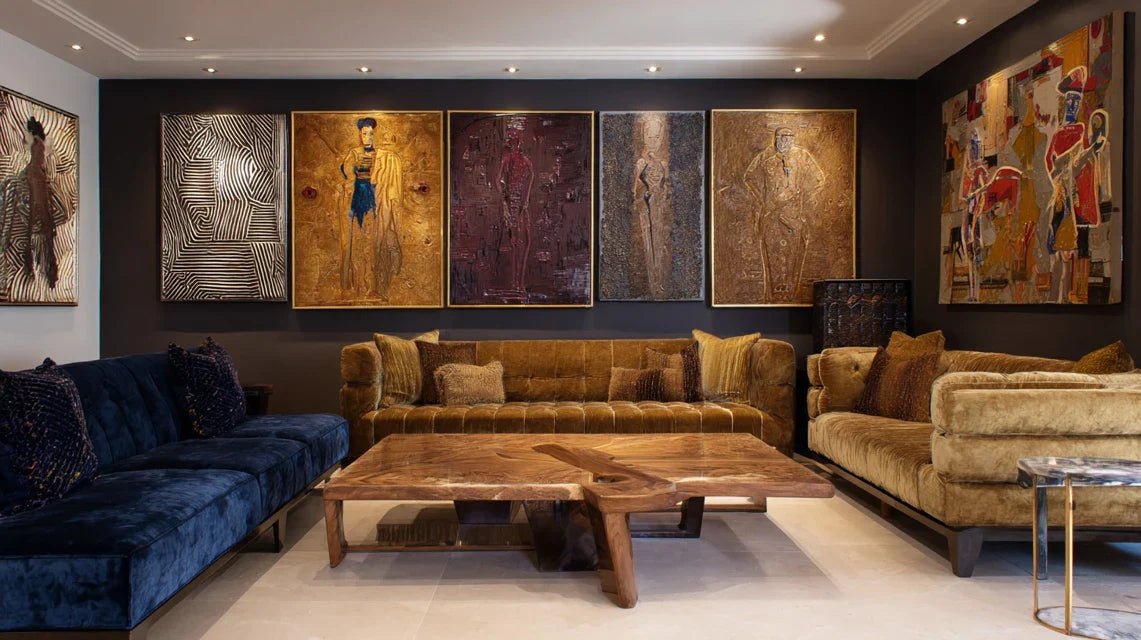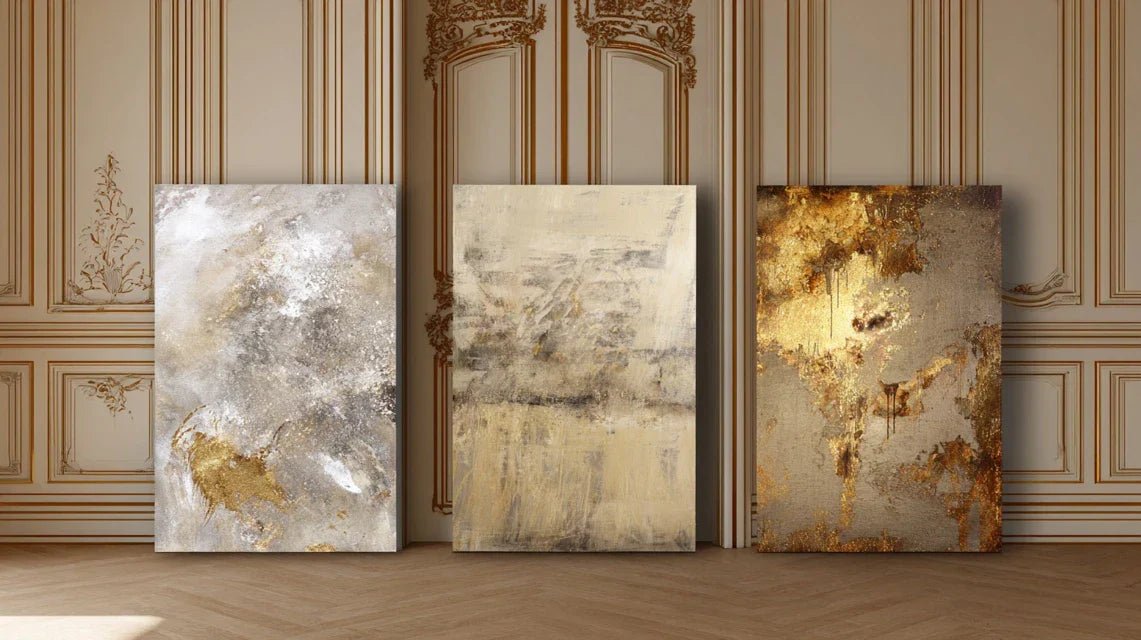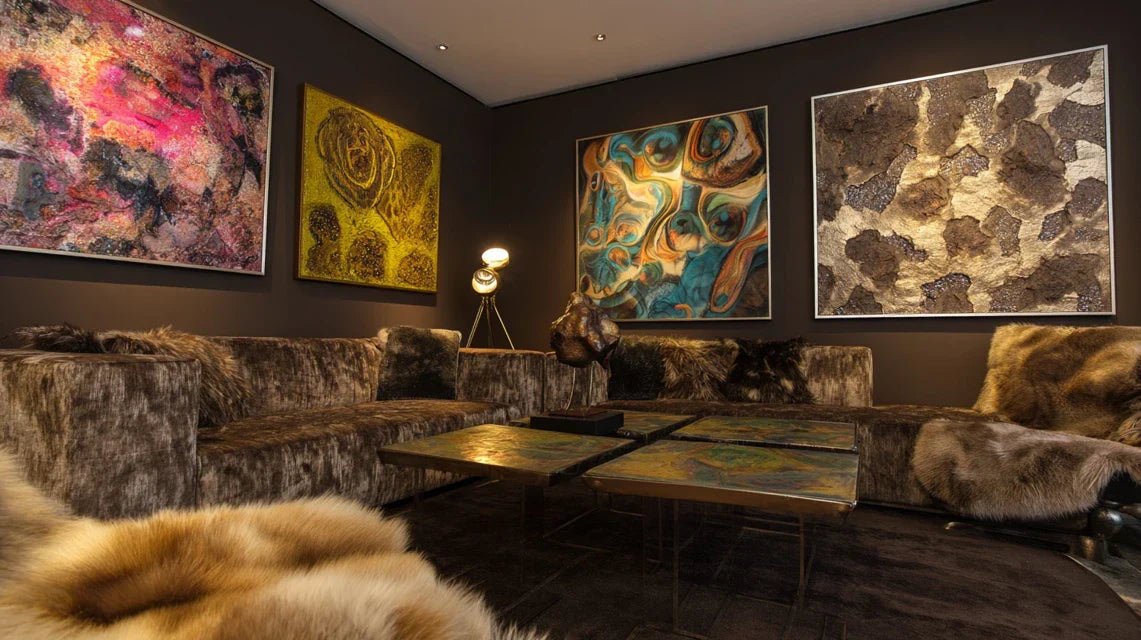
The cold lighting reveals faded reproductions in cheap frames, a chemical smell still hangs in the air, and this heavy silence that makes you regret your small apartment with its full-of-character imperfections.
You may have already tried to bring this hotel sophistication home by buying paintings "in the style", but the result lacks that authentic soul that distinguishes true charming addresses. The colors don't match, the whole thing looks artificial, disconnected.
It’s not a lack of taste on your part, but rather the absence of a coherent cultural approach in choosing your artworks. The most beautiful boutique hotels draw their identity from millennia-old aesthetic traditions, not from fleeting trends.
By the end of this article, you will know exactly how to create an authentic hotel atmosphere inspired by Scandinavian, Japanese and Italian codes, and transform your interior into a true sanctuary of timeless refinement.
Why wall art determines the soul of a hotel space?
In the world of luxury hospitality, every detail counts, but wall artworks play a particular role: they immediately tell the story of the place. It’s like the first impression during a meeting - it forms in 7 seconds and influences everything else about the experience. Waiting to personalize your walls is leaving your guests in uncertainty about your aesthetic identity.
🏨 Remarkable case study: The Noma Hotel in Copenhagen displays works by local artists using raw materials such as birch bark and lava stone. Result? An identity so strong that guests leave wanting to recreate this atmosphere at home, and the recommendation rate reaches 94%.
💬 Conversation with a decor expert
Wall art acts as an emotion amplifier: It transforms a simple living room into a complete sensory experience, exactly like a signature fragrance in a luxury hotel lobby. You will see the first signs of transformation from the hanging of the first artwork, and the full effect is revealed in 2-3 weeks when the whole finds its balance.
What does your current wall decor really reveal?
Observe your living room: reproductions of Impressionists bought in supermarkets, a few family photos in mismatched frames, perhaps that travel poster pinned "temporarily" for two years. Or conversely, walls completely bare out of fear of "doing it wrong". Your gaze instinctively avoids these areas, an unconscious sign of aesthetic discomfort.What you feel isn't a lack of taste, but the absence of a coherent cultural guideline. It’s like trying to compose a gastronomic menu by mixing excellent ingredients from incompatible culinary traditions.
Imagine your interior as a open book: each artwork is a sentence that must contribute to the same story. Without a guiding thread, even the most beautiful pieces create a visual cacophony.
h3>The unconscious influence of missed cultural codes Here's a truth that few decorators admit: each culture has developed its own aesthetic codes to create specific emotions. The Scandinavians cultivate serenity, the Japanese contemplation, the Italians refined passion. Mixing these approaches without understanding their essence is like wearing a kimono, a three-piece suit, and cowboy boots at the same time.Think of your favorite restaurant: its success comes from its ability to create a consistent atmosphere where every element reinforces the overall identity. The tableware, lighting, music, and of course the wall art, tell the same story.
This aesthetic dispersion deprives you of the sought-after "cocoon" effect and prevents your guests from experiencing that total immersion which characterizes the most beautiful boutique hotels in the world.
🔍 Immediate revealing test: Close your eyes for 30 seconds in your living room, then open them. If your gaze flits around without finding a harmonious anchor point, it's a sign of a dispersed aesthetic identity. A successful space naturally guides the eye towards a soothing visual progression.
It's like a polite but superficial conversation: technically correct, but leaving no lasting impression. Your interior becomes a transit space rather than a place of rejuvenation.
As a result, you feel that dull frustration of never managing to recreate at home the emotion experienced in those exceptional addresses that mark you during your travels.
The overstimulation of fleeting trends
Conversely, some accumulate "decor crushes" by following every new Pinterest trend, creating an unconscious visual chaos. This is visible in interiors where industrial style, bohemian chic, Nordic minimalism and ethnic touches coexist without any unifying logic.
Like a perfume that's too complex where no note stands out clearly, your space loses emotional impact. You quickly get tired and feel the constant need to "change something".
This aesthetic instability prevents you from developing that deep sense of belonging to your space, that serenity one feels immediately upon entering an authentic Japanese ryokan or a traditional Tuscan villa.
🎯 3 alarm signals to identify at home:
- Involuntary visual avoidance: Your gaze avoids certain areas of the room, a sign that your brain is unconsciously rejecting an aesthetic disharmony.
- Syndrome of "something's wrong": You regularly feel like moving or changing elements without knowing why, revealing instability in the overall composition.
- Permanent nostalgia for elsewhere: You systematically prefer the atmosphere of other places (hotels, restaurants, friends' homes) to your own interior, indicating a lack of personal aesthetic identity.
The trigger of an authentic cultural approach
The real revolution comes when you understand that the most beautiful hotels in the world don’t seek to please everyone, but to create an intense emotional experience for their target clientele. It's a domino effect: once you adopt a coherent cultural approach, each new addition reinforces the whole instead of diluting it. You will recognize this trigger when your guests start asking you "where did you find this extraordinary atmosphere?"
Golden rule of cultural harmony: A successful interior tells a single story with different chapters, never several stories simultaneously. Test immediately: can you describe the atmosphere of your living room in three coherent words? If you hesitate, it's time to choose your cultural guiding thread.
| ❌ Common scattered approach | ✅ Consistent cultural method | 💡 Mechanism of action | 🎯 Perceived benefit |
|---|---|---|---|
| Accumulation of "heartfelt" pieces without connection | Curation around a cultural aesthetic | Create a harmonious visual resonance | Feeling of immediate peace when entering your home |
| Seeking a "one-size-fits-all" consensus | Affirmation of a strong aesthetic identity | Generate a distinctive, memorable emotion | Pride in receiving and recognition of your style |
| Following current decor trends | Drawing inspiration from millennial aesthetic traditions | Build on proven timeless foundations | Durable investment that increases in value |
| Fear of "doing it wrong" that paralyzes | Confidence in established cultural codes | Relying on proven aesthetic systems | Creative freedom within a secure framework |
How to create an authentic hotel atmosphere: the method of 3 cultural legacies
Rassurez-vous, transformer votre intérieur en écrin digne des plus beaux hôtels-boutiques ne demande pas de révolutionner toute votre déco. C'est plutôt comme learning to cook a signature dish: you need to master 3-4 fundamental techniques, then adapt them to your tastes. By following one of the three cultural approaches (Scandinavian, Japanese or Italian), you will obtain a consistent result that will impress your guests on their first visit.
🗺️ Your roadmap in 3 steps: First, you will choose your dominant cultural identity according to your personality and lifestyle. Then, you will select your foundational works that will set the general tone. Finally, you will create harmonious accords that will sublimate the whole. At each step, you will feel your space gain character and sophistication.
Step 1: Choose your founding aesthetic legacy
This first step is crucial because it determines everything else: it's like choosing the foundations of your house. Once this base is laid, each subsequent addition will reinforce the overall consistency. You will immediately feel that feeling of "coming home" when your choice really corresponds to your temperament.
🎨 The 3 aesthetic legacies and their signatures
- The Scandinavian spirit - "Lagom" (the perfect balance): Prefers dusty tones, raw natural materials and soft luminosity. Ideal if you are looking for serenity after intense days. Recognizable by its unique ability to create a cocooning atmosphere without heaviness. Hotels like Et Hem in Stockholm illustrate this perfectly with their textile works and Nordic landscape photographs.
- Japanese aesthetics - "Wabi-sabi" (beauty of imperfection): Celebrates subtle asymmetries, meaningful empty spaces and contemplation. Perfect for lovers of meditation and refined minimalism. The principle: each element must have a reason to be, nothing superfluous. The impact is measured by this feeling of deep calm that immediately invades the space.
- Italian refinement - "Sprezzatura" (studied carelessness): Blends sophistication and spontaneity, warm colors, and rich textures. Ideal for those who like to entertain with flair. It is recognized by this ability to appear naturally luxurious without ostentation. Think of Venetian palazzos transformed into boutique hotels where contemporary art and historical heritage converse effortlessly.
Now, let's move on to the selection of your first artworks
🖼️ Selecting your foundational artworks
Define your masterpiece: Choose ONE artwork that embodies the soul of your space, like the signature dish of a Michelin-starred chef. This piece should be larger than you spontaneously imagine (minimum 80x60cm for a standard living room) as it will set the scale for everything else. Prioritize a museum quality support rather than a standard print: the difference is immediately visible in the depth of colors.
⏱️ Time: 2-3 hours of research | ✅ Successful when: The artwork evokes a strong emotion and perfectly corresponds to your chosen cultural heritage | ⚠️ Attention: Avoid giving in to the ease of "it's pretty" - prioritize cultural consistency even if the artwork takes you out of your comfort zone.
Create your secondary constellation: Select 2-3 smaller artworks that will dialogue with your masterpiece. They should share the same aesthetic language (colors, style, emotion) but offer subtle variations. It's like composing a tasting menu where each dish explores the same theme with different nuances.
⏱️ Time: 1-2 hours | ✅ Successful when: The whole creates a harmonious visual progression | ⚠️ Attention: Resist the temptation to add "just a little touch" of another style - that's where everything goes wrong.
Test the overall harmony: Arrange your artworks temporarily (even as paper prints) and live with them for 48 hours. Observe how natural light reveals the colors at different times of the day. Perfect harmony is recognized by that feeling of "just rightness" you feel each time you pass through the room.
⏱️ Time: 2 days of observation | ✅ Successful when: You no longer think about the individual artworks but perceive the overall atmosphere | ⚠️ Attention: If one artwork continues to attract your attention excessively, it probably breaks the general balance.