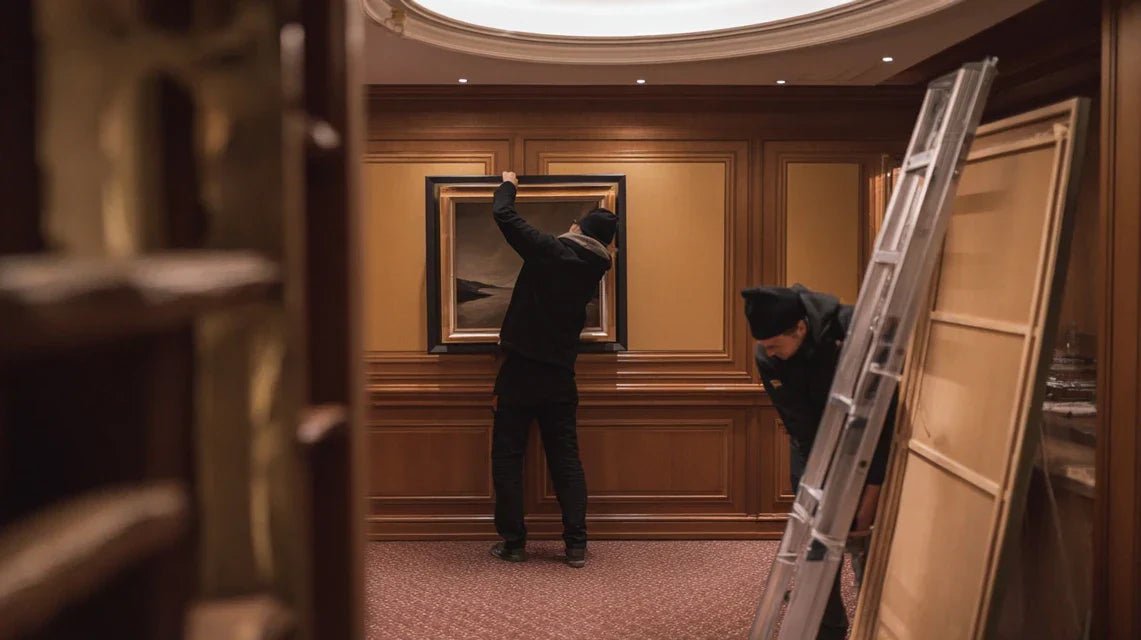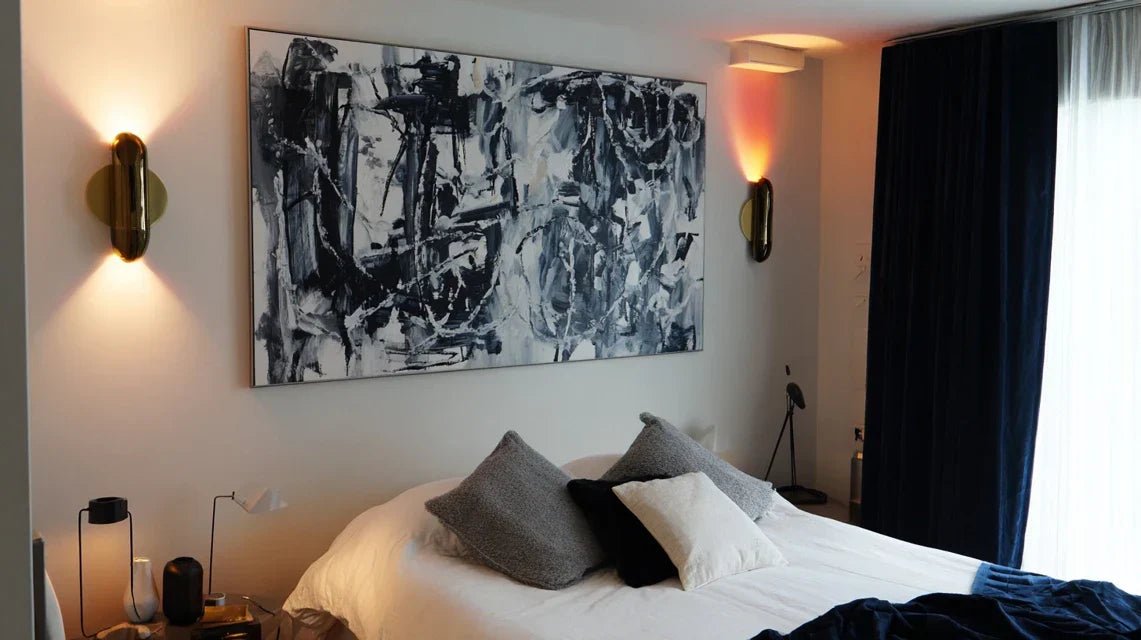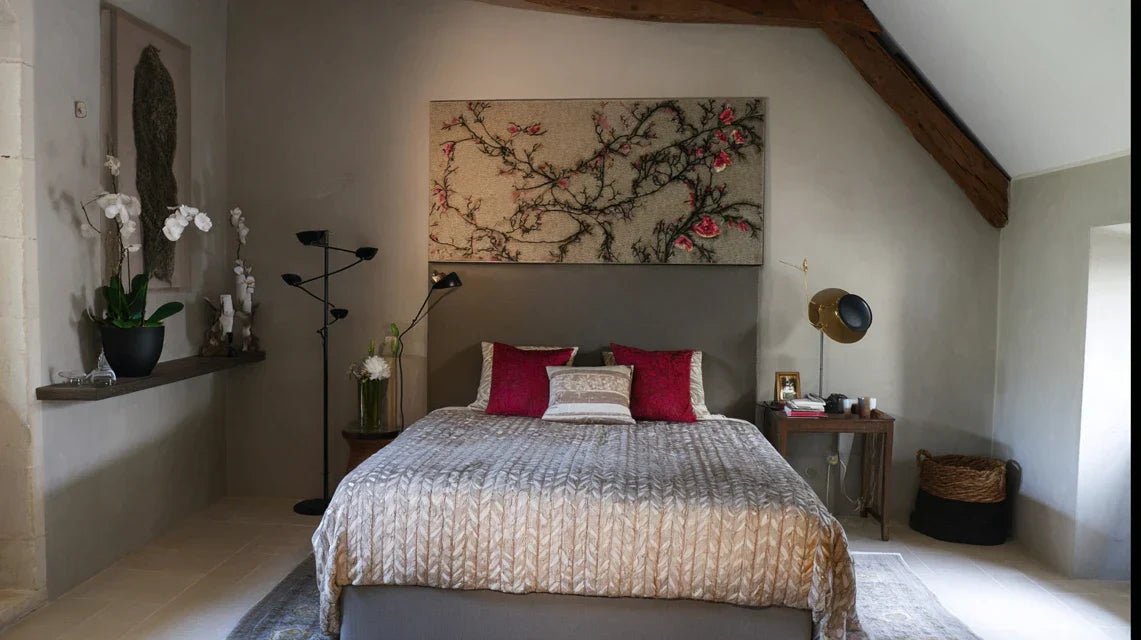
The living room remains frozen in a bland neutrality, the white walls mock you with their gaping emptiness, and this persistent feeling that something is wrong with the overall harmony follows you throughout your home.
You've already tried large colorful artworks, flashy gold frames, or even those store-bought reproductions, but nothing seems to recreate that natural sophistication and luxurious serenity you seek.
This is perfectly normal because no one has ever explained to you that quality wall art rests on a counterintuitive principle: the less it does, the more impressive it is. True distinction doesn't shout; it whispers with confidence.
By the end of this article, you will know exactly how to choose and arrange minimalist paintings to transform your interior into a true sanctuary of discreet luxury, where every glance at your walls will bring that deep satisfaction of having created something authentically refined.
Why do minimalist paintings revolutionize contemporary decor?
In a world saturated with visual stimulation, creating a soothing interior is no longer a luxury but a vital necessity. Waiting any longer means accepting living in an environment that drains your energy instead of regenerating it. Like a subtle fragrance that marks more than the most overpowering scent, minimalist art etches its presence into memories by its ability to create harmony rather than distraction. Every day spent without this visual serenity is a missed opportunity to transform your daily life into a soothing experience.
🏡 Interior architect testimonial: "I recently advised a client who owned a sublime Haussmannian apartment but complained of never truly feeling at home. After removing twelve disparate works and replacing them with three carefully chosen minimalist paintings, she confessed to me that for the first time, she felt that inner peace when returning home in the evening."
💬 Conversation with a decor expert
The golden rule of understated luxury: A minimalist artwork functions as a serenity amplifier that reveals the natural beauty of your space rather than competing with it. In 3 weeks, your guests will notice this soothing atmosphere without being able to explain it precisely.
Why haven’t your previous attempts created the desired effect?
Do you recognize yourself in these situations? You buy a painting that catches your eye and seems perfect in store, but once hung, it clashes with the whole. You multiply small works hoping to create a gallery, but the final effect evokes more a sales catalog than a refined collection. You constantly hesitate about the placement, moving your frames from one wall to another without ever finding that sought-after visual evidence.
What's really happening is that you are applying the codes of traditional decoration to an art form that obeys completely different rules. The problem isn’t your taste or budget, but the lack of a method adapted to decorative minimalism.
It's like trying to drive an electric car with the reflexes of a combustion engine: the controls seem familiar, but the behavior is totally different.
The first hidden cause: confusion between simplicity and ease
Contrary to popular belief, choosing an effective minimalist artwork requires more discernment than a complex work. When there’s only one line, one shape, or one color, every detail counts enormously and is immediately visible.
It's exactly like the difference between cooking a dish in sauce that masks imperfections, and preparing grilled fish where the quality of the product is instantly revealed.
This requirement explains why you sometimes feel this impression of "failure": your eye intuitively perceives the flaws in composition or quality that apparent simplicity cannot hide.
🔍 Immediate test: Look at your current artwork for 30 seconds, then close your eyes. If you can't mentally redraw it or precisely describe what touches you, it lacks that visual evidence characteristic of good minimalism.
The second cause: misunderstanding the role of negative space
Most people consider the empty space around a painting as a "void to be filled" rather than a decorative element in its own right. In reality, this "negative" space functions like the silence between notes of music: it gives meaning and power to what surrounds it.
Imagine a diamond set on a ring: it's not the amount of metal that makes the beauty of the jewel, but the way the setting highlights the central stone.
This misconception subconsciously leads you to "fill" the space, destroying the subtle balance that is essential for a successful minimalist interior.
The third cause: the trap of fashion versus timelessness
Many confuse "minimalist" with current decor trends, choosing works that imitate the aesthetics without understanding their essence. For example, buying a black and white geometric poster because "it's minimalist" instead of choosing a work that authentically resonates with your sensibility.
You can spot this mistake when you feel the need to justify or explain your decorative choice, rather than letting it speak for itself.
The impact on your daily life? You live surrounded by objects that visually fatigue you instead of replenishing you, creating a constant subliminal stress.
3 signs that your choice is not optimal:
- Rapid fatigue effect: After a few weeks, you no longer look at your painting - a sign that it does not have the emotional depth necessary for lasting art
- The need for justification: You find yourself explaining your choice to visitors - reveals a lack of confidence in the obviousness of your selection
- Feeling of incompleteness: You constantly seek to "complete" with other elements - indicates that the work does not fulfill its role as a visual anchor
The trigger element: the quality of the support and execution
What really makes the difference between a successful minimalist painting and a failure is the material quality of the artwork. Like a lever that multiplies force, a high-end support and careful execution transform a simple idea into a magnetic presence. You can identify it by observing the texture, the depth of colors, and this mysterious ability the work has to change according to the light of day.
The 3-second rule: A successful minimalist painting captures attention in 3 seconds and continues to reveal subtleties after several months. Test this rule by observing your reactions to different works.
| ❌ Classic approach | ✅ Authentic minimalism | 💡 Explanation | 🎯 Practical benefit |
|---|---|---|---|
| Filling all available walls | Choosing the ideal location for a strong artwork | The eye needs space to fully appreciate | Each look becomes a moment of contemplation |
Step 2: Optimize Placement and Lighting - The Art of Staging
You are now moving to the next level by creating optimal conditions to reveal all the beauty of your selection. This step transforms a simple hanging into a true professional staging. The snowball effect begins here: each adjustment improves the whole exponentially.
Strategic Positioning
Ideal height rule: Place the center of the artwork 1.60 m (5.25 ft) from the floor, which corresponds to natural eye level. This measurement automatically adapts to most canvas sizes and ceiling heights. Principle: The eye should meet the art effortlessly, in a comfortable posture.
⏱️ Time: 10 minutes of adjustment | ✅ Success when: You can look at the artwork standing without tilting your head up or down | ⚠️ Attention: Hanging too high is the most common mistake - the work becomes "floating" and loses its visual anchor
Optimal viewing distance: Make sure you can step back 2.5 to 3 meters (8.2 to 9.8 ft) to appreciate the whole thing. This distance allows the eye to grasp the overall composition while perceiving the details. Test from your usual seated and standing position - the artwork should be visible and pleasing in both cases.
⏱️ Time: 5 minutes of verification | ✅ Success when: The artwork remains impactful even from across the room | ⚠️ Attention: A painting too close creates a feeling of suffocation, too far it becomes decorative without emotional impact
Mastering Natural and Artificial Lighting
Analysis of natural light: Observe your wall at different times - morning, noon, late afternoon - to understand the evolution of the lighting. Ideally: a stable indirect light that reveals nuances without creating reflections. A good location transforms your painting into a poetic "weather vane" that embraces the variations of the day.
⏱️ Time: One day of observation | ✅ Success when: The artwork remains legible and attractive at every moment | ⚠️ Attention: Avoid facing windows (backlight) or in direct sunlight (fading and reflections)
🎯 Quality control step 2: Your staging is successful when the artwork seems "in its natural place", when it attracts the eye without forcing attention, and when it creates that feeling of harmony that makes you say "that's exactly how it should be". Your room begins to reveal its sophisticated potential.
Step 3: Refine the decorative environment - The signature of refinement
You are now reaching the level of professional finish that distinguishes a successful decoration from an exceptional transformation. This final step consists of eliminating visual distractions and creating a setting worthy of your work of art. The final result: a space that inspires that silent admiration and that desire to be lived in characteristic of the most beautiful interiors.
Strategic Space Purging
The "minus 30%" rule: Temporarily remove 30% of the decorative objects present in the field of vision of your painting. Keep only what dialogues harmoniously with your main work. This purging reveals the impact of each element and allows your painting to shine fully.
⏱️ Time: 20 minutes of sorting | ✅ Successful when: Each remaining object seems to have its reason for being | ⚠️ Attention: Resist the temptation to put everything back immediately - give yourself time to appreciate this new breath
Chromatic harmonization: Adjust the surrounding colors so that they support your painting without competing with it. Favor neutral tones and reserve bright colors for small accents placed strategically. The goal: create a visual symphony where your work plays the role of soloist.
⏱️ Time: 15 minutes of adjustment | ✅ Successful when: The eye naturally travels from the painting to the rest of the room | ⚠️ Attention: A cushion that is too colorful or a glaring object can ruin hours of harmonization work
🏆 Final project validation: Your transformation is complete when you feel that peaceful pride upon entering the room, when your loved ones immediately notice "something different" without being able to specify what, and when you realize that you look at your painting several times a day with renewed pleasure.
The minimalist progression rule: Do not move on to the next step until the previous step gives you complete satisfaction. Minimalism requires patience and discernment - rushing the process destroys the magic of the whole. Each phase mastered amplifies the impact of the following one.
You now master the fundamentals of authentic decorative minimalism. To go further, here are the subtleties that only true connoisseurs apply to transform their interior into an aesthetic reference.
🎨 Professional decorator's secret: Create a "visual breathing space" by always leaving at least 60 cm of free space around your main painting. This neutral zone acts as an invisible frame that multiplies the impact of the work. Concrete example: if your sofa is 2 meters from the wall, your painting will gain presence and your living room will gain elegance.
❓ "How do I know if my personal style truly aligns with minimalism?"
"I like the idea of minimalism but I'm afraid it might be too austere for my personality... I don't want to feel out of place in my own home."
I completely understand this concern - it’s even proof that you are approaching this transformation intelligently! True minimalism isn't about erasing your personality but revealing it with greater accuracy. Imagine your current style as a melody played with too many instruments: minimalism removes the extraneous notes to make your main theme stand out. Start with a single artwork in a secondary room - you will quickly see if this serenity nourishes or frustrates you. Trust your feelings: the right minimalism makes you want to spend more time at home, not escape.
💡 Personalized test: Choose your favorite color and search for a minimalist artwork that subtly incorporates it. Guaranteed result: you will discover that minimalism can be warm and personal.
The 5 mistakes that sabotage a minimalist decor (and how to avoid them)
Be careful, these pitfalls are so common that even enlightened enthusiasts fall for them. Knowing them will save you months of frustration and unnecessary purchases. These errors are normal but perfectly avoidable with the right reflexes.
- 🚫 Confusing "empty" and "minimalist": It's tempting to think that removing is enough to create harmony, but an empty space without intention remains just... empty. Consequence: a feeling of coldness and incompleteness that discourages. Solution: replace "remove a lot" with "choose few but perfectly". This is the most common mistake among enthusiastic beginners.
- 🚫 Buying only in black and white: This combination seems "safe" but often creates an atmosphere that is too rigid and cold. Result: an interior that impresses but doesn't invite relaxation. Alternative: integrate beiges, warm grays, or powdery tones that bring the necessary softness to a welcoming home.
- 🚫 Neglecting the quality of the support: A beautiful visual on a low-end substrate immediately betrays the whole thing. Impact: the artwork ages poorly and quickly loses its charm. Golden rule: it's better to have a small, high-quality format than a large, mediocre one - presence doesn't depend on size.
- 🚫 Copying a style seen on Pinterest: Reproducing an online decoration exactly ignores your personality and your specific space. Effect: a "catalog" result that lacks soul. Winning approach: be inspired by the overall atmosphere but adapt according to your tastes and constraints.
- 🚫 Wanting to transform everything at once: Urgency is the enemy of successful minimalism. Consequence: hasty choices that create costly inconsistencies. Wise method: proceed piece by piece, allowing time for each change to reveal its impact.
🛡️ Early warning system: Monitor these signals: constant need to "complete" your decor, rapid fatigue with your choices, impression that "something is wrong" without being able to identify what, ambiguous comments from loved ones. These indicators reveal an imbalance that is best corrected immediately.
🎁 Special offer for readers
Because you took the time to inform yourself, enjoy 10% discount on your first order:
⏰ Valid 72h after reading • Applicable to all our products
Frequently asked questions about minimalist paintings
Allow between 150€ and 400€ for a work of 60-80 cm that will satisfy you for years. This range guarantees professional support and execution quality. Optimization tip: it's better to save 2-3 months to acquire a reference piece than to buy several average pieces. Concrete example: a customer replaced five €30 reproductions with a single authentic €280 painting - result: tenfold satisfaction and real savings.
On the contrary, minimalism is magical in small spaces! A well-chosen painting visually expands a room by creating depth and organizing space. Key principle: in 30m², a 60 cm painting will have more impact than three small 30 cm paintings. Tip: prioritize light tones and horizontal compositions that "stretch" the space.
Excellent sense of caution! The rule of seasons works perfectly: if you still appreciate your selection after 4 complete seasons of observation, it has that sought-after timeless quality. Reliable indicators: you still discover details after several months, the work adapts to your mood changes, it dialogues well with the evolution of your decoration. Security: choose tones and shapes that resonate with your deep sensitivity, not with current trends.
Use appropriate anchors for the weight (usually expansion anchors for 2-5 kg) and prefer two attachment points for formats larger than 50 cm. Pro method: mark the points with a pencil first, check horizontality with a level, then drill. Artwork protection: maintain 3-4 cm between the wall and the artwork for air circulation. Safety: verify solidity by exerting a slight downward traction after installation.
Yes, but with a strong chromatic or thematic coherence. The rule of harmony: maximum 3 works per room, linked by a common element (color palette, line style, similar format). Advanced technique: create a "dialogue" between the artworks by spacing them 40-60 cm apart and respecting horizontal alignment. Avoid: mixing opposing styles (geometric + organic + photographic) that create visual confusion.
Your transformation into an accomplished minimalist decorator
In a few weeks, you will cross the threshold of your home with this deep satisfaction of entering a space that finally resembles you. Your walls, once sources of frustration, will have become these silent companions that soothe your gaze and regenerate your energy after each day. This discreet pride you will feel when your guests immediately notice "something different" without being able to specify what, this unique aesthetic signature that will make your interior a memorable reference.
Beyond decoration, you will have developed this quiet confidence of good taste which naturally translates into your other aesthetic choices. This newly acquired ability to distinguish the essential from the superfluous will enrich your view of art, architecture, and even your clothing choices. Your surroundings will recognize this subtle but undeniable evolution of your personal refinement.
The theory was the most difficult - now that you understand the mechanisms, all that remains is to choose your first artwork with the learned method. Start by identifying the wall that currently frustrates you the most, apply the 3-step selection method, and allow yourself this transformation that you may have been postponing for too long.
🌟 Your new beginning starts now: You now possess all the keys to create the atmosphere of understated luxury you dreamed of. The only difference between admiring the style of others and possessing your own, is to take action with confidence.