For a long time, I've observed this frustration in my clients: falling in love with an ambiance, creating it carefully, then growing tired of it after six months. In my Parisian showroom specializing in high-end modular solutions, I regularly receive owners who are jaded by their static walls. The sliding panel system has transformed my professional practice since 2015. This ingenious technology allows you to change the atmosphere of a room in minutes, without drills or dust.
Here's what wall panel sliding systems bring: the flexibility to renew your decor with the seasons, the elegance of invisible installations that enhance your works, and the freedom to create multiple ambiances in the same space. Imagine transforming your bright summer living room into a warm winter cocoon, simply by sliding new panels.
You know that feeling of confinement when facing a wall that no longer resembles you? That guilt of wanting to change without daring to drill again? You are not alone. My clients all tell the same story: the desire to evolve, blocked by the fear of construction. Wall sliding systems resolve this modern dilemma between permanence and renewal.
I reassure you immediately: installing a panel decorative sliding system does not require any particular technical skills. In this article, I reveal the solutions that I use daily to create living interiors, evolving, which tell the changing story of their inhabitants.
The silent revolution of decorative rails
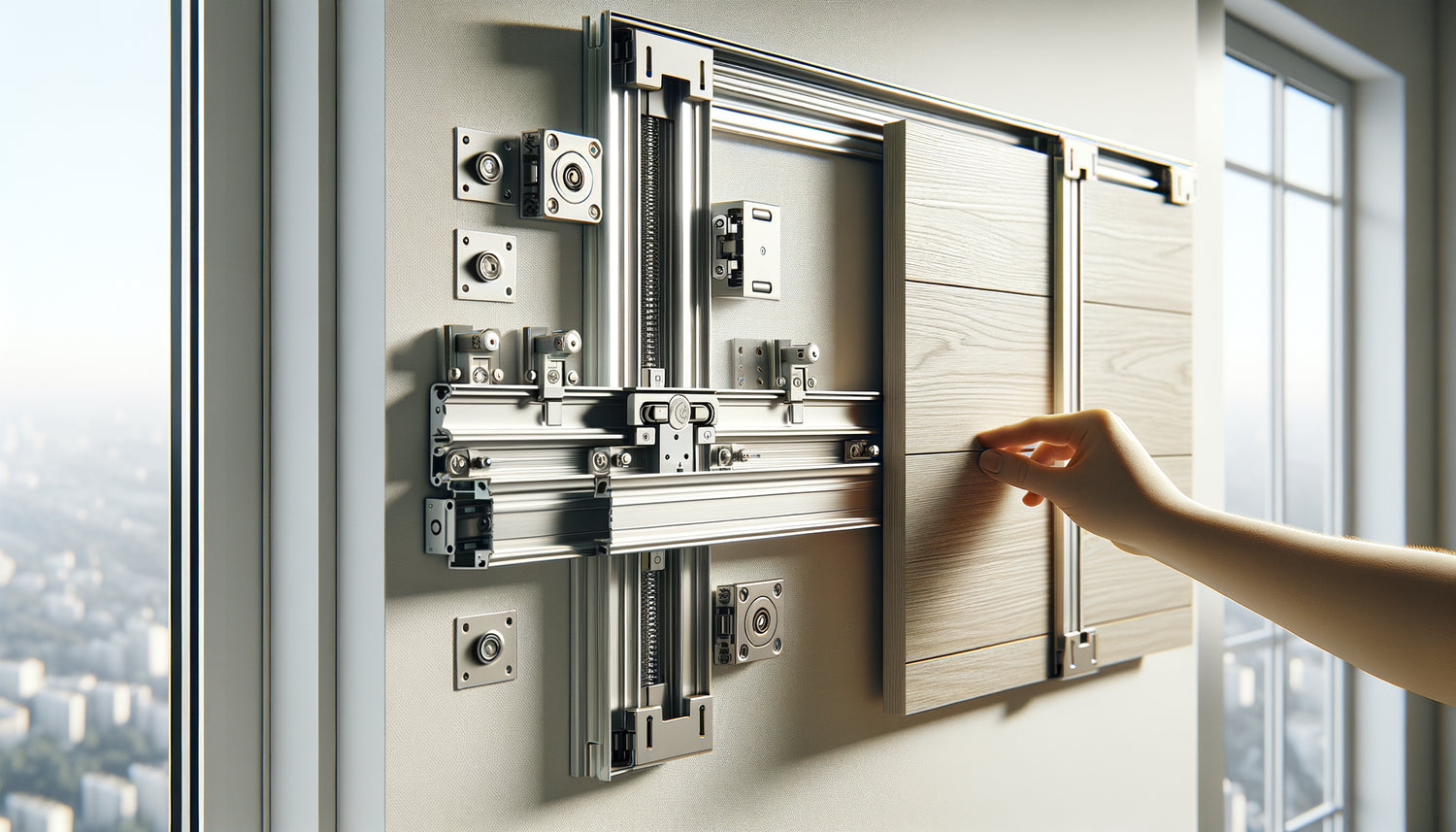
The wall panel rail system represents the most significant innovation in interior decoration for ten years. Unlike traditional fixings, these decorative slides consist of two elements: a rail fixed to the wall (single installation) and supports integrated into the panels. The principle? A simple vertical insertion then a horizontal sliding to lock the panel.
I personally tested about ten different systems. Top-insertion rails remain my favorites for their absolute discretion. The rail, often in anodized or lacquered aluminum, measures between 15 and 25 mm in height. Once the panel is in place, it becomes completely invisible. This technical finesse allows you to create the illusion of a floating panel, suspended magically against the wall.
Modular sliding systems offer remarkable flexibility. You can install a 3-meter rail and slide panels of different widths onto it. This modularity transforms your wall into a personal gallery where compositions and arrangements evolve according to your desires. An architect client uses this system to present his project boards: he modifies its configuration every week depending on the files in progress.
The three families of systems that dominate the market
The Click & Slide rail: German simplicity
This snap-on sliding system impresses with its child-like installation. The rail is fixed to the wall using conventional screws or structural adhesive depending on your support. The panels, equipped with integrated metal clips, snap into place in seconds. A slight click confirms the locking. To remove the panel, you simply lift it 5 mm and release it. I timed the operation: 8 seconds to replace a 120x80 cm panel.
The supported load generally reaches 15 kg per linear meter of rail. Perfect for lightweight wood panels, stretched fabric, or photographic compositions. The minimalist aesthetic of the Click & Slide rail is particularly suitable for contemporary and Scandinavian interiors.
The magnetic system: invisible elegance
My absolute favorite. Magnetic sliders for decorative panels use a fascinating technology: a rail containing powerful neodymium magnets, and panels with metal plates. The approach of the panel creates an irresistible attraction that perfectly presses it against the wall.
This magnetic fixing system excels in high-end environments. No visible clips, no complex manipulation. You simply position your panel near the rail and physics does the rest. Removal is done with a smooth gesture by pulling down on the bottom of the panel. This solution is ideal for stretched fabrics, decorative acoustic panels, and textile creations.
The investment remains higher (about 40% more expensive than a classic system), but the user experience amply justifies this extra cost. A designer client uses this system in her master suite: she changes her headboard panels according to her mood, creating radically different atmospheres with the same architecture.
The rotating hook rail: industrial robustness
For heavy panels (solid wood, metal, mixed compositions), the rotating hook sliding system is essential. Metal hooks fixed to the back of the panel are inserted into the rail and then pivot 90° to lock. This ingenious mechanism supports up to 30 kg per linear meter.
I recommend this robust fixing system for commercial spaces, showrooms, or living rooms with large decorative panels. Installation takes one minute longer than the Click & Slide system, but safety and stability more than compensate. A Parisian restaurateur uses this solution for his mobile decorative partitions: he reconfigures his space according to private events, transforming his restaurant into an ephemeral art gallery.

How to Choose the Right System for Your Project
Selecting the right wall panel sliding system depends on four essential criteria. Firstly, the weight of your panels determines the necessary robustness. Lightweight stretched fabrics accept magnetic sliders, while solid wood panels require hook rails.
Secondly, the frequency of change influences your choice. If you plan to modify your panels daily, opt for quick-lock systems. For seasonal rotations, all systems are suitable. Thirdly, aesthetics matter: a minimalist interior calls for invisible rails, while a loft industrial style can accommodate exposed fixings.
Fourthly, your budget naturally guides the decision. Basic sliding systems start at €25 per linear meter, premium magnetic solutions reach €90. I always encourage my clients to invest in quality: a professional rail system lasts twenty years, while a low-end solution wears out after three.
The Installation That Changes Everything: My Professional Secrets
The effectiveness of a decorative sliding system depends entirely on the precision of its installation. I always start by tracing a perfectly horizontal line using a laser level. A deviation of 2 mm over 2 meters is enough to create a disturbing visual effect. The rail must be absolutely straight, it's non-negotiable.
For plasterboard walls, I use Molly anchors spaced no more than 30 cm apart. On concrete or brick, impact anchors are sufficient every 40 cm. The fixing rail must be firmly anchored: it will withstand repeated manipulations for years. I systematically check the resistance after installation by pulling firmly on the rail.
One crucial detail that amateurs neglect: the sliding system must be installed at the exact height where your panels will create the desired effect. For a 100 cm high panel that you want to center at eye level (approximately 160 cm from the floor), install the rail at 210 cm. Measure twice, drill once.
Modular decorative wall panels also require careful preparation. Secure the supports (clips, magnetic plates, hooks) with millimeter precision. A slight misalignment will prevent smooth insertion into the rail. I always use a drilling template that I manufacture for each type of panel.

Creative applications that transcend decoration
Beyond a simple aesthetic change, wall panel sliding systems open up endless creative possibilities. A family with children uses chalk panels during the day (creative space for little ones) and replaces them with photographic panels in the evening (sophisticated adult ambiance). Two universes in the same room.
Interchangeable acoustic panels are increasingly popular. Musicians install absorbent surfaces during recording sessions, then replace them with classic decorative panels for everyday use. The modular rail system thus transforms a living room into a temporary studio.
I equipped a rental apartment with decorative sliders in each main room. The owner offers a library of panels: zen, industrial, bohemian, contemporary ambiance. Her tenants personalize their space without any permanent modification. This approach increases her occupancy rate by 30% according to her statistics.
Commercial spaces brilliantly exploit this flexibility. A fashion boutique changes its wall decorative panels each collection, creating perfect coherence between its products and its environment. The quick replacement system allows this transformation in a morning, without store closure.
Maintenance and durability: an investment that lasts
A quality sliding system requires minimal maintenance. Every six months, I recommend gentle dusting of the rail with a soft brush. Magnetic fixing mechanisms require no particular maintenance. For clip or hook systems, check annually for wear or deformation.
Anodized aluminum rails remarkably resist time. In my own apartment, I have been using the same system for eight years with weekly handling. No signs of fatigue, no loss of efficiency. This longevity transforms the initial investment into a substantial economy compared to repeated renovations.
The beauty of these modular systems lies in their scalability. You invest once in the infrastructure (the rails), and then your decor budget focuses on the panels themselves. One antique dealer customer has fifteen different panels for four meters of rail: she constantly renews her interior with a minimal annual budget.
Your interior deserves to tell multiple stories
Discover our exclusive collection of tableaux for real estate agency that will transform your professional spaces into elegant and inspiring showcases.
Visualize your transformation
Imagine coming home on Friday evening, tired from an intense week. In fifteen minutes, you replace your cool-toned panels with warm and woody textures. Your living room transforms into a comforting refuge, without a single additional hole in your walls. This freedom, this fluidity between your different decorative identities, is exactly what the wall panel sliding systems offer.
Start modestly: one wall, two or three panels according to the seasons. Experience the exhilarating feeling of renewal without destruction. Observe how this flexibility changes your relationship with your interior. Decoration ceases to be a comfortable prison and becomes an ongoing conversation between your desires and your space.
The modular decorative rails do not only revolutionize our walls, they free our domestic creativity. They embody this truth that I have learned in fifteen years of practice: the most beautiful interiors are not the most perfect, but the most alive, those that evolve with their inhabitants.