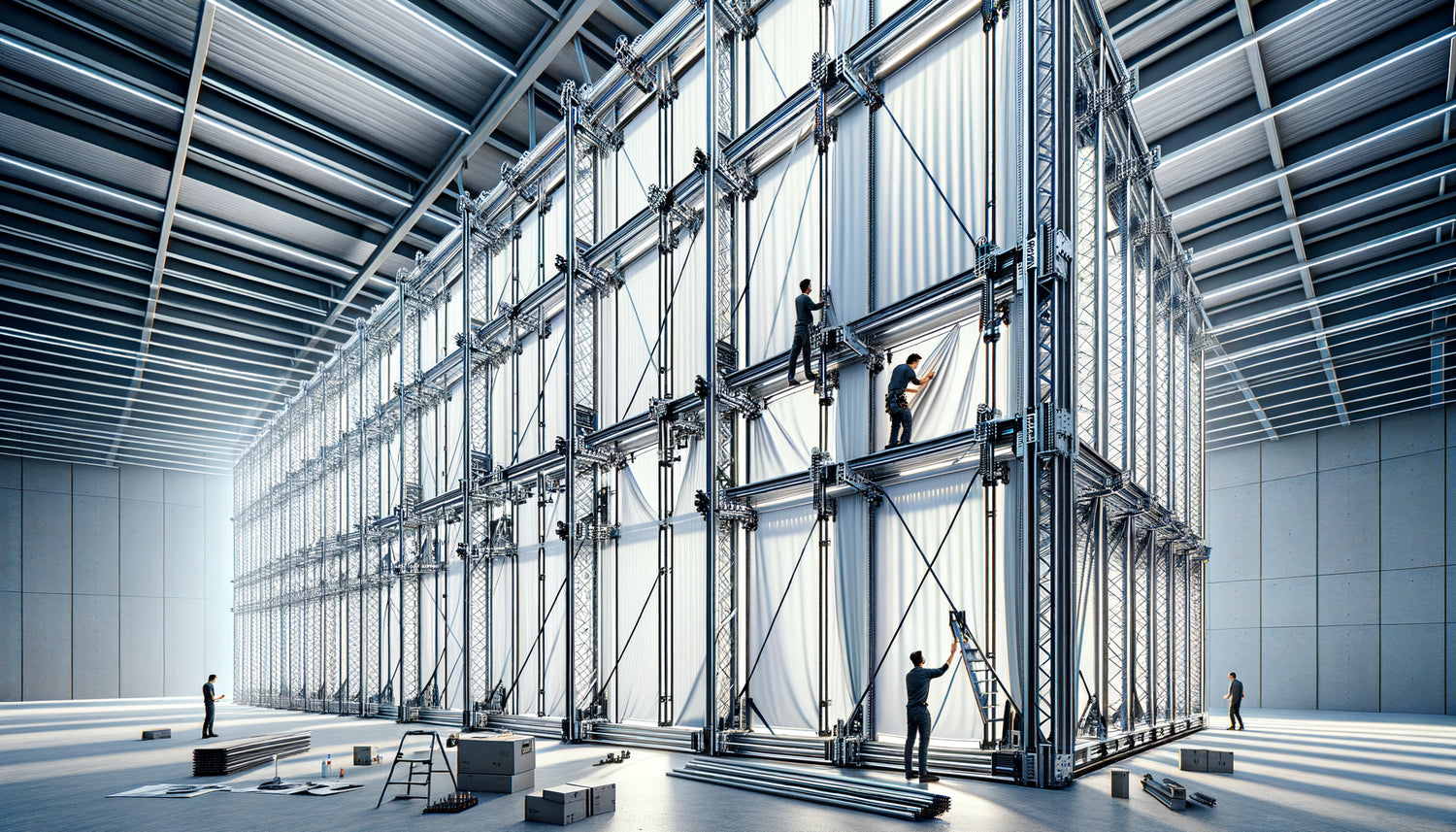
I almost gave up. This five-meter wall in the presidential suite of a Parisian hotel had been taunting me for three weeks. The custom-made wild silk fabric was waiting, magnificent and rebellious. Every attempt with a standard frame created unsightly creases, soft spots. Until I discovered the secrets of the metal framework that changed everything. This cursed project became my finest achievement.
Here's what the metal framework for stretched fabric brings: perfectly even tension over large surfaces, durability that lasts decades, and that architectural elegance that transforms a wall into a textile work of art. But not all systems are created equal, far from it.
You dream of dressing the large wall in your living room with stretched fabric, but you fear sagging, unsightly ripples after just a few months? You're right to be vigilant. Over five meters, physics becomes your enemy. The fabric, this living material that breathes and deforms, demands a metallic structure designed to tame these invisible forces.
Rest assured: solutions exist. After fifteen years of designing textile installations for high-end spaces - luxury hotels, industrial lofts, art galleries - I've tested all the framework systems. I'm going to reveal what really works.
In this article, you will discover which metal structure guarantees even tension over five meters, how to avoid costly mistakes, and the techniques I use for installations that stand the test of time.
The myth of the simple frame: why 5 meters changes everything
On a square meter, almost any metal frame works. Hardware stores sell standard aluminum profiles, and there you have it. But at five meters, the laws of physics brutally intrude.
Stretched fabric exerts a constant force on its framework. Imagine dozens of kilos of pressure distributed over the structure. At a small scale, it's negligible. At a large scale, the metal bends imperceptibly. A millimeter of deformation in the center is enough to create a visible pocket, an area where the fabric loses its nobility.
I measured this phenomenon on a failed project in Lyon: a 2 mm thick aluminum profile had bent 8 millimeters at the center of a span of 4.80 meters. Result: a permanent wave in Italian velvet costing €340 per meter. The client was not impressed.
Large-format fabric wall decor requires a structural approach, not a decorative one. You first build an invisible architecture, then you dress it with textiles.
Reinforced tubular framework: the secret of professional installations
The solution that saved my Parisian project? A system of reinforced tubular metal framework with cross braces. Not the classic solid tubes, too heavy and rigid, but hollow rectangular steel profiles.
Critical dimensions for five meters: minimum 60 x 40 mm, wall thickness 2.5 mm. These measurements don't come from nowhere. They are the result of calculations of admissible deflection (maximum acceptable deformation) that I have refined project after project.
The genius of this system? The intermediate spacers spaced every 120 to 150 centimeters. These crossbars, often overlooked by enthusiasts, divide the span into shorter segments. Instead of a single five-meter bay, you create four sections of approximately 1.25 meters. Rigidity increases exponentially.
On each spacer, I install fixing points for the stretched fabric. Special stainless steel clips that allow tension to be adjusted zone by zone. It's this granularity that makes the difference between an ordinary textile wall and a museum installation.
The invisible assembly that changes everything
The joints between profiles determine 70% of the final quality. I use reinforced angle brackets screwed AND glued with an epoxy structural adhesive. Simple screw-on brackets loosen over time and due to thermal variations.
At the four corners of the frame, 3 mm thick reinforcement plates distribute stresses. The stretched fabric pulls hardest at the corners - that's where everything breaks if the structure is weak.
For a five-meter installation, I also provide wall fixing every 80 centimeters. The metal framework should not only bear on its ends but be continuously supported. Discreet wall consoles, 15 centimeters deep, disappear behind the textile once installed.

Harpoon rail: when ceiling technology adapts to the wall
Discovering stretched ceilings, I had a revelation. Their harpoon peripheral rail technology elegantly solves the problem of even tension.
The principle: an extruded aluminum profile with a specific groove runs around the entire perimeter of the framework. The fabric, prepared in the workshop with a flexible border (the harpoon) sewn or welded, clips into this groove. Perfectly distributed tension, even adjustable after installation.
For five linear meters, I use a rail of the "reinforced wall" model - thicker section than standard ceiling versions. Barrisol offers suitable profiles, but Italian manufacturers like Clipso offer interesting alternatives with more discreet finishes.
The decisive advantage of this metal framework system? Reversibility. The fabric can be unclipped in a few minutes for cleaning or replacement. Impossible with traditional stapling methods which inevitably damage the textile.
The limit? The cost. Expect between 180 and 250 euros per linear meter of rail supplied and installed, versus 40 to 60 euros for a classic tubular frame. But with high-end fabric, this investment is justified.
The three fatal mistakes I made (so you can avoid them)
Mistake No. 1: Underestimating the shrinkage of the fabric. All textiles shrink under tension, some up to 3%. Over five meters, this represents 15 centimeters. My first velvet deformed because I hadn't anticipated this margin. Today, I always order 5% extra fabric and I carry out a test sample under tension for 48 hours.
Mistake No. 2: Neglecting hygrometry. Humidity causes some natural fabrics - linen, cotton, silk - to swell. In an adjoining bathroom, a magnificent Belgian linen relaxed in two months, creating pockets. Fibers with polyester retain their tension better. For humid spaces, I now prefer technical fabrics treated anti-humidity.
Mistake No. 3: Fixing the frame directly to a fragile partition wall. Standard plasterboard cannot support the load. The anchors gradually pull out. On an installation in Bordeaux, the entire panel came loose three months after delivery. Catastrophic. Today, I systematically locate the metal studs of the partition wall with a detector, or I create a reinforcing structure fixed to the floor and ceiling.
The tension test that I systematically perform
Before validating an installation, I run my hand flat over the entire surface of the stretched fabric. The pressure must be uniform everywhere - no soft areas in the center, no hard areas near the edges. If I feel a variation, I readjust the tension locally.
A textile tensiometer (device used by professional upholsterers) provides objective measurements. For a decorative velvet on five meters, I aim for 2.5 to 3.5 Newtons per centimeter. Too loose: the fabric ripples with air currents. Too tight: it tears at the attachment points.

Hybrid solutions: combining structure and aesthetics
Recently, I have developed a particularly elegant hybrid approach for large walls. Instead of completely hiding the metal frame, I integrate it into the design.
Vertical brass brushed elements, 30 mm wide, visually divide the five-meter span into three 1.65-meter panels. Each panel has its own independent tubular frame, fixed to these exposed uprights. Tension becomes easier to manage, and the architectural aspect adds character.
This compartmentalized fabric wall covering technique also allows you to play with different textures or colors. A textile triptych with natural linen in the center and midnight blue velvet on the sides - guaranteed sophistication.
The exposed uprights also serve as rails for integrated LED lighting. Discreet light bands installed behind the metal create a halo that enhances the fabric. In a bedroom, this indirect lighting transforms the wall into a soft light source.
The question of weight: steel versus aluminum
Steel offers superior rigidity at a lower cost. But it weighs three times more than aluminum. Over five meters with crossbars, a steel frame easily reaches 40 kilos. Aluminum peaks at 15 kilos.
For a load-bearing concrete or brick wall, weight is not critical. On a lightweight partition wall, aluminum becomes imperative. I then choose rectangular profiles of 80 x 50 mm to compensate for the material's lower strength.
Anodized aluminum resists moisture better - crucial in spaces like spas or kitchens where you want to install stretched fabric. Galvanized steel is perfectly suitable for dry rooms.
Installation: the professional gestures that make the difference
The installation always begins with precise marking. I trace the exact position of each wall fixing point with a laser. A 5-millimeter deviation over five meters creates a visible diagonal.
I first fix the wall supports with chemical anchors in solid materials, or heavy expansion anchors traversing the plasterboard to the metal studs. Each fixing point must support 15 kilos in tension - test them before installing the frame.
The metal frame is then installed on these supports. I check the squareness with a laser level: the four corners must be perfectly at 90°. A deformed frame inevitably produces a deformed fabric.
The installation of the stretched fabric itself follows a precise protocol: I always start by the center of one long side, then the center of the opposite side. Then the centers of the short sides. This "cross" sequence gradually distributes tension in a balanced way. Finish with the corners adjusting finely.
Between each fixing point, I stretch progressively, in successive passes. Three complete passes increasing the tension slightly each time are better than a brutal tightening that tears or deforms the fabric.
Essential tools for perfect tension
Beyond the basic equipment, three professional tools really make a difference on large surfaces:
A tension clip allows you to temporarily hold the fabric taut while you permanently fix it. Over five meters, you can't do everything with your two hands. These clips cost 25 euros and avoid hours of frustration.
A came tensioner (used by upholsterers) gives millimeter control over tension. I install four simultaneously - one per side - to balance forces before final fixing.
A professional-grade heat gun (not a DIY stripper) can slightly retract certain synthetic fabrics after installation. A delicate technique, but it saves compromised situations. The heat must be uniform and gradual - maximum 80 to 120°C depending on the textile.
Your textile wall awaits you, majestic
Discover our exclusive collection of wall art for real estate agencies that enhances your walls with the same commitment to quality and durability.
Maintenance and adjustments: fabric lives over time
Unlike paint, stretched fabric requires periodic attention. After six months, I recommend a systematic tension check. Natural fibers stabilize, synthetics may slightly relax.
On my installations with hook system, this control takes fifteen minutes. I unclip, retension if necessary, reclip. On traditional stapled systems, it's more complex - hence my attachment to modular solutions.
Cleaning depends on the textile. Velvets tolerate vacuuming with a soft brush. Delicate silks require professional dry cleaning - factor this constraint in from the fabric selection stage. In a hotel lobby with heavy traffic, I installed a washable linen-effect polyester that can even be steam cleaned.
The metal frame itself requires little maintenance if properly designed. An annual inspection of fixing points is sufficient. I check that no screws have come loose, that no console shows deformation.
Visualize your transformation
Imagine this wall that challenged you. Five meters of untapped potential. Now it breathes, dressed in a sumptuous fabric stretched to perfection. Not a wrinkle, not an unsightly shadow. Light glides over the fibers, creating subtle nuances that change with the hour.
Your guests approach, intrigued. They reach out - it's not paint, nor wallpaper. It's stretched fabric, noble, sophisticated, different. You explain that it is a custom installation, designed to last. They don't see the metal frame invisible which makes this magic possible, this discreet engineering that defies gravity.
In ten years, this wall will still be impeccable. Because you chose the right structure from the start.
Start by accurately measuring your space. Identify the nature of your wall support. Choose your textile, considering both its beauty and its mechanical properties. Then build the frame that deserves this textile, one that guarantees even tension year after year.
This is not a simple weekend DIY project. It's a textile architectural project that radically transforms a space. Patience and precision in choosing the metal frame make all the difference between an amateur result and a professional installation.
Your five-meter wall awaits you.
Frequently Asked Questions
Can you install a stretched fabric frame yourself on 5 meters?
Yes, it is technically possible if you have DIY skills and the right tools. I've seen motivated individuals succeed in beautiful installations. However, the difficulty lies in three often underestimated aspects: correctly calculating the resistance of the metal frame to avoid deformation, securely fixing it to the wall support (especially if it’s a lightweight partition), and stretching the fabric evenly over such a length. If this is your first textile project of this scale, I recommend starting with a smaller surface to acquire the technique. Or invest in a harpoon rail system that greatly facilitates installation and allows for adjustments. The real risk isn't technical failure, but wasting an expensive fabric if the tension isn’t mastered. Allow for a budget for a second length of fabric, just in case. And don't hesitate to have your frame project validated by a professional before buying materials - an hour of consultation can save you from 1000 euro mistakes.
How much does it actually cost to install stretched fabric on 5 meters?
The budget varies enormously depending on your choices. For the metal frame alone, expect between 200 euros (simple steel tubular system you make yourself) and 1200 euros (professional harpoon rail provided and installed). The fabric represents the major expense: from 30 euros per meter for basic polyester to 400 euros for exceptional natural silk. For five meters of standard 2.50m height, you will need 13 to 15 square meters depending on the scraps. So between 400 and 6000 euros just for the textile. Add the fixing hardware (100 to 200 euros), and optionally labor if you hire an installer (600 to 1500 euros depending on complexity). Realistic overall budget: 1300 to 9000 euros all inclusive. My advice? Don't skimp on the frame and wall fixing. It’s invisible but essential. On the other hand, intermediate quality fabrics (80 to 150 euros/m²) often offer an excellent value for money. Also keep a budget of 10% for unforeseen circumstances - they always happen in this type of project.
Which fabrics best resist tension over long lengths?
Mixed textiles with at least 30% polyester retain their tension remarkably well over time. Polyester hardly deforms with humidity and stabilizes natural fibers. I have excellent results with linen-polyester blends (70-30) which preserve the noble natural appearance of linen while benefiting from the stability of synthetic materials. High density cotton-polyester velvets (over 300g/m²) are also very effective - their thickness masks micro-tension irregularities and age beautifully. To be avoided for beginners: 100% natural silks that react strongly to humidity, pure linens that inevitably relax, and fabrics that are too thin (less than 180g/m²) which mercilessly reveal every defect of the metal frame. Technical fabrics for stretch ceilings (often polyester PVC) offer the best dimensional stability but have a less luxurious appearance. For five meters, also favor a tight weave: the more open the fabric is, the more it will deform under tension. Always request a sample that you can test by stretching it strongly for 48 hours. If it returns to its exact shape after release, this is a good sign.