In the Baoulé villages of central Côte d’Ivoire, walls are never neutral. Every geometric pattern traced on the facades of homes tells a millennial story: that of a society where art and social organization intertwine with fascinating precision. These complex designs, far from being simple decorations, constitute a true visual language that reveals the status, clan, and values of those who live in these places.
Here's what Baoulé mural patterns bring to our understanding of African design: a sophisticated system of visual communication, an artistic expression rooted in social structure, and an inexhaustible source of inspiration for creating interiors full of meaning. Yet, faced with these hypnotic geometric compositions, many feel helpless: how to decode these symbols? How to understand their deep meaning without falling into superficial cultural appropriation?
The good news? These mural patterns follow a clear logic, structured around the matrilineal and clan organization of the Baoulé. Each graphic element finds its reason for being in ancestral traditions, offering a magnificent bridge between art and anthropology. Together, let's explore how these murals embody the soul of a society where aesthetics carry collective memory.
Walls that speak: when architecture becomes social narrative
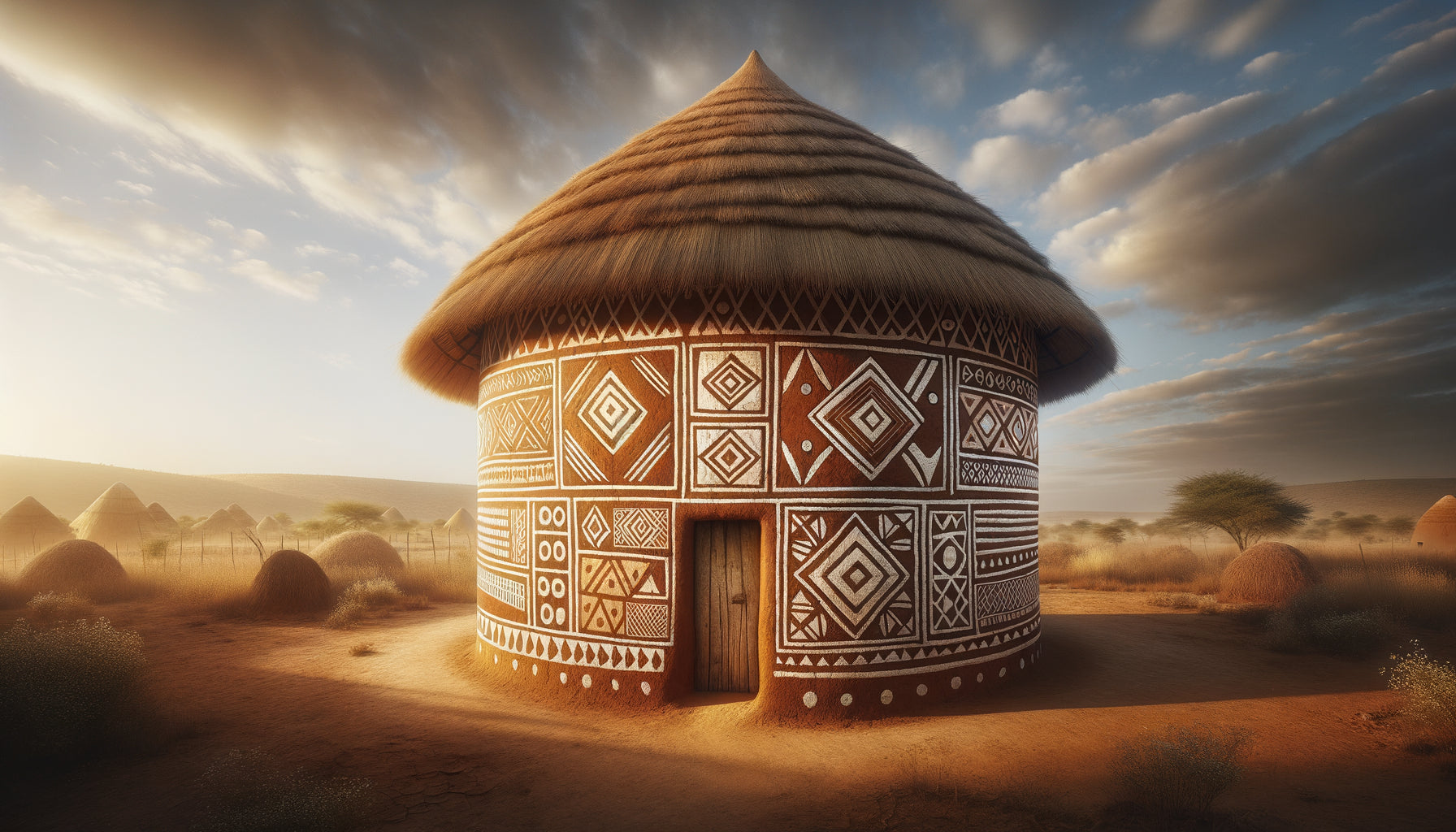
The Baoulé, mainly located around Bouaké, have developed an architectural tradition where the exterior walls of homes become narrative surfaces. These mural patterns are never applied randomly. Their presence, location, and complexity immediately indicate the social rank of the family occupying the home.
The houses of traditional chiefs and notables are distinguished by exceptionally rich geometric compositions: interlocking triangles, repeated diamonds, broken lines forming visual labyrinths. These Baoulé patterns sometimes cover the entire facades, creating an impression of movement and depth. The more elaborate the decoration, the higher the social status.
Conversely, homes of ordinary families have more modest decorations, limited to a few horizontal bands or simple motifs near entrances. This visual hierarchy transforms the village into a readable social map for all, where everyone can instantly identify their neighbor's place in the community organization.
The language of geometric shapes
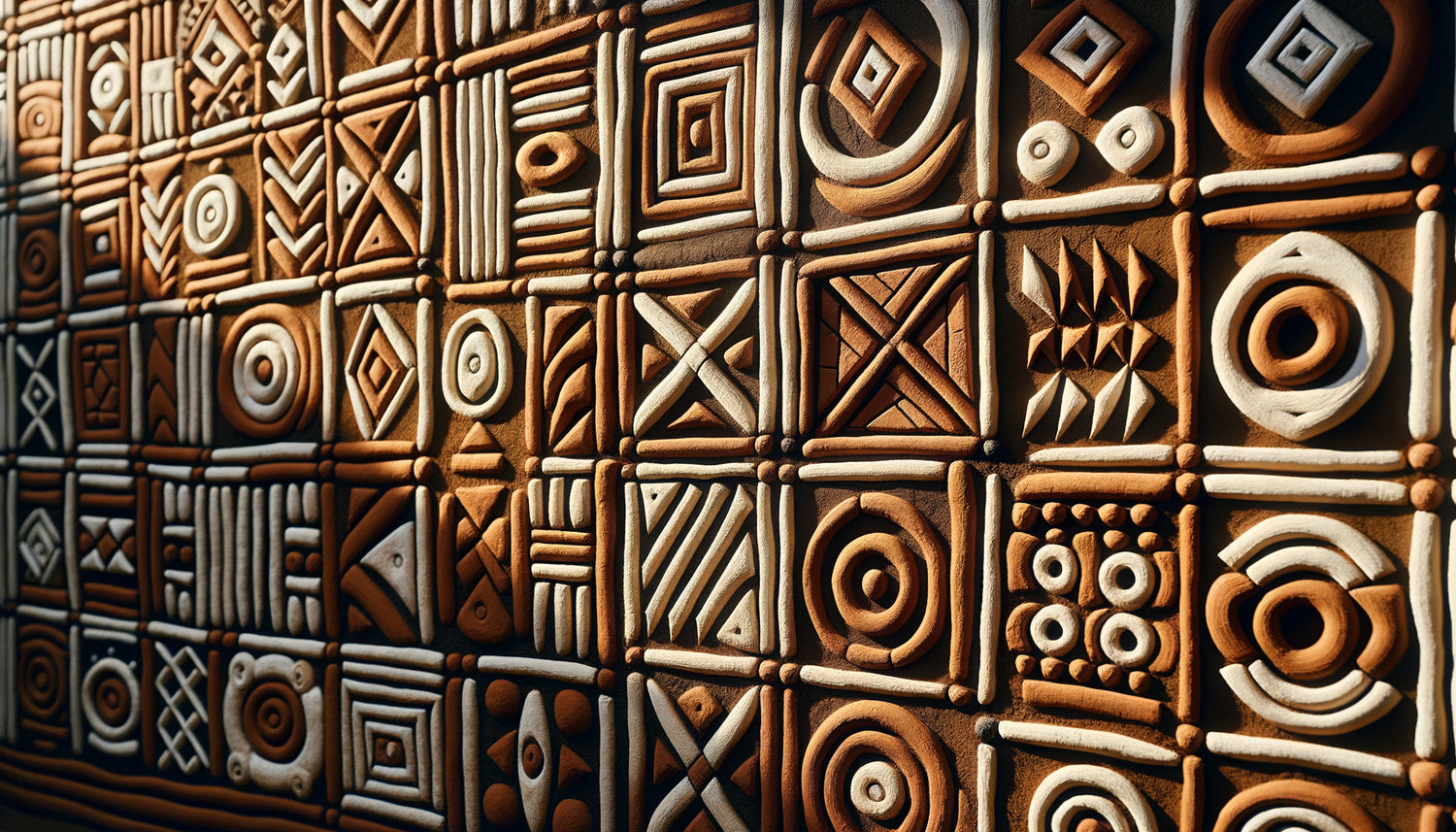
Triangles, omnipresent in Baoulé mural art, symbolize the sacred mountain and connection with ancestors. Their arrangement in friezes recalls the migration paths of the Baoulé people from present-day Ghana. Diamonds evoke fishing nets and the bonds that unite clan members. Each shape carries a social meaning passed down from generation to generation by women, the main artisans of these decorations.
The matrilineal organization inscribed in the earth
Among the Baoulé people, lineage is passed down through women. This fundamental characteristic of their social organization is directly reflected in the wall patterns. It is the women who prepare the clay plaster, trace the motifs, and pass on decorative techniques to their daughters.
Some motifs are exclusively reserved for prestigious maternal lineages. These compositions, jealously guarded, function as family crests that only legitimate descendants can reproduce. A trained eye can thus trace marital alliances and kinship ties by observing similarities between the wall decorations of different houses in the village.
Periods of facade renovation, generally after the rainy season, become moments of intergenerational transmission. Young girls learn from their mothers and grandmothers the precise gestures, exact proportions, and graphic taboos to respect. This artistic education is inseparable from learning the social codes and rules of propriety that structure the Baoulé community.
The colors of clan affiliation
Beyond the shapes, the pigments used reveal clan affiliation. The white kaolin, red ochre, and black charcoal are not chosen only for their aesthetics. Each Baoulé clan favors certain color combinations that signal its identity within the ethnic group. These visual codes function as a system of collective identification, reinforcing internal cohesion while marking differences between groups.

When the motifs celebrate rites of passage
The Baoulé wall patterns are not static. They evolve with the rhythm of events that mark social life. During an initiation, a marriage or important funerals, women modify the exterior decorations to announce these transitions.
A marriage in an influential family is accompanied by the addition of new intertwined motifs symbolizing the union of two lineages. Concentric circles, representing completeness and harmony, appear frequently during these celebrations. These temporary or permanent modifications inscribe the family history into the architectural space, transforming walls into visual chronicles.
Initiation periods for young people, crucial moments in Baoulé society, also see the appearance of specific patterns. Vertical zigzags evoke the difficult path to maturity, while spirals symbolize acquired wisdom. This geometric symbolism accompanies initiates in their social transformation, visually reminding them of the community values they must now embody.
The contemporary influence: from village to modern interior
Today, these decorative traditions are experiencing a remarkable resurgence of interest. Contemporary designers draw on this graphic repertoire to create interior atmospheres that celebrate Baoulé heritage while adapting to urban lifestyles.
Baoulé geometric patterns can now be found on wall textiles, wallpapers, ceramic tiles and framed artworks. This respectful transposition allows the richness of this visual culture to spread beyond geographical borders, while preserving the memory of its social roots.
Several contemporary Ivorian artists revisit these ancestral codes by projecting them onto large formats. Their creations establish a fascinating dialogue between tradition and modernity, recalling that behind each pattern lies a complex social structure, a system of values and a worldview. These works invite us to go beyond simple aesthetic appreciation to understand the anthropological depth of Baoulé arts.
Integrate these patterns with awareness and respect
To integrate these African motifs into a contemporary interior, the approach must be informed and respectful. Prioritize works created by Ivorian artists or in collaboration with Baoulé communities. Choose pieces accompanied by explanations of their cultural significance. This approach transforms your decoration into a medium for cultural transmission, far from superficial appropriation.

Faced with rapid urbanization and architectural modernization, traditional Baoulé wall motifs are threatened. Concrete houses are gradually replacing earth constructions, and with them disappears the support for this millennial artistic expression.
Fortunately, local and international initiatives are working to document and preserve this heritage. Anthropologists, in collaboration with the Baoulé communities, systematically photograph patterns, record techniques, and collect stories associated with each composition. This memory work is essential for future generations to understand how their society has organized itself and expressed itself through wall art.
Some villages have also developed cultural tourism projects where visitors can witness the creation of wall decorations and interact with the artisans. These initiatives generate income that encourages the perpetuation of skills while raising awareness among a wider audience about the richness of this tradition. Baoulé wall art thus becomes a bridge between past and present, between local and global.
Transform your space by celebrating African cultural heritage
Discover our exclusive collection of African paintings that embody the symbolic depth of Baoulé traditions and enhance your interior with authenticity.
When art becomes a mirror of society
The Baoulé wall patterns remind us of a universal truth: art is never free. Every line, every color, every composition carries within it the values, structures and beliefs of a community. In the case of the Baoulé people, these geometric decorations function as a sophisticated communication system where social status, clan affiliation, matrilineal ties, and ritual moments are expressed.
When contemplating these murals, we gain access to an intimate reading of Baoulé social organization, where visual beauty combines with identity function. This tradition invites us to rethink our own relationship with decor: do our interiors tell our story? Do they reflect our values? Do they create connections with our community?
Be inspired by this millennial wisdom. Choose works that carry meaning, that tell stories, that honor the cultures from which they come. Your home will then become much more than just a place to live: a space for dialogue between traditions and your own personal story.
Frequently asked questions about Baoulé wall patterns
Can I reproduce Baoulé patterns in my home without disrespecting them?
Absolutely, provided you adopt a respectful and informed approach. Prioritize purchasing works created by Ivorian artists or from fair collaborations with the Baoulé communities. Find out about the meaning of the patterns you choose and share this knowledge with your guests. Avoid appropriating sacred symbols or those reserved for specific lineages. By adopting this conscious approach, you celebrate Baoulé culture rather than reducing it to a mere decorative element. Your interior then becomes an authentic space for cultural transmission.
What are the Baoulé patterns best suited to a contemporary interior?
Geometric compositions based on triangles, diamonds and broken lines integrate wonderfully into modern interiors thanks to their elegant abstraction. Black and white patterns offer sobriety that dialogues well with clean spaces, while colored versions with ochres and earth tones bring organic warmth to living rooms. Opt for formats adapted to your walls: large murals create a striking focal point, while smaller compositions allow you to create narrative wall galleries. The key is to choose quality pieces, accompanied by information about their origin and cultural significance.
How to recognize an authentic Baoulé pattern?
Authentic Baoulé patterns are characterized by several distinctive elements. First, precise geometry with a predominance of angular shapes: triangles, diamonds, zigzags and broken lines rather than free curves. Then, an organization in horizontal friezes or rhythmic compositions that create visual movement. Traditional colors favor natural earth tones: kaolin white, red ochre, charcoal black, sometimes highlighted with brown. The symmetrical repetition of patterns is also characteristic, reflecting social order. Be wary of overly eclectic compositions mixing symbols from different African cultures: Baoulé art has its own aesthetic coherence. To guarantee authenticity, prioritize specialized galleries or recognized Ivorian artists.