In the neighborhoods of New Orleans, on the faded facades of Savannah, along the dirt roads of South Carolina, walls speak. They tell a story that books have often forgotten: that of a memory that refuses to die out. While official history erased traces, stubborn hands painted, drew, and engraved symbols from another continent onto the walls of their homes. These African mural traditions, crossing the ocean in the holds of slave ships, have survived the unspeakable.
Here's what preserving these mural traditions brings: a spiritual connection with ancestors, a visual language of cultural resistance, and an inexhaustible source of inspiration to create meaningful interiors. You might think that these practices have disappeared, drowned in forced assimilation? Think again. They still pulse today in the American South, passed down from generation to generation with remarkable ingenuity.
The problem is that we often ignore these heritage treasures. We admire African art in New York galleries without realizing that just a few states away, living legacies continue to express themselves on board walls, in hidden courtyards, on colorful facades. I promise you that by the end of this article, you will not only understand how these traditions have survived, but above all why they resonate with a particular urgency in our contemporary interiors.
Walls that refuse to forget: when memory becomes matter
On plantations in the South, while everything was done to uproot African cultures, slaves found roundabout ways to maintain their spiritual practices. Mural traditions were not mere decorations: they constituted a system of beliefs applied to the very architecture of housing.
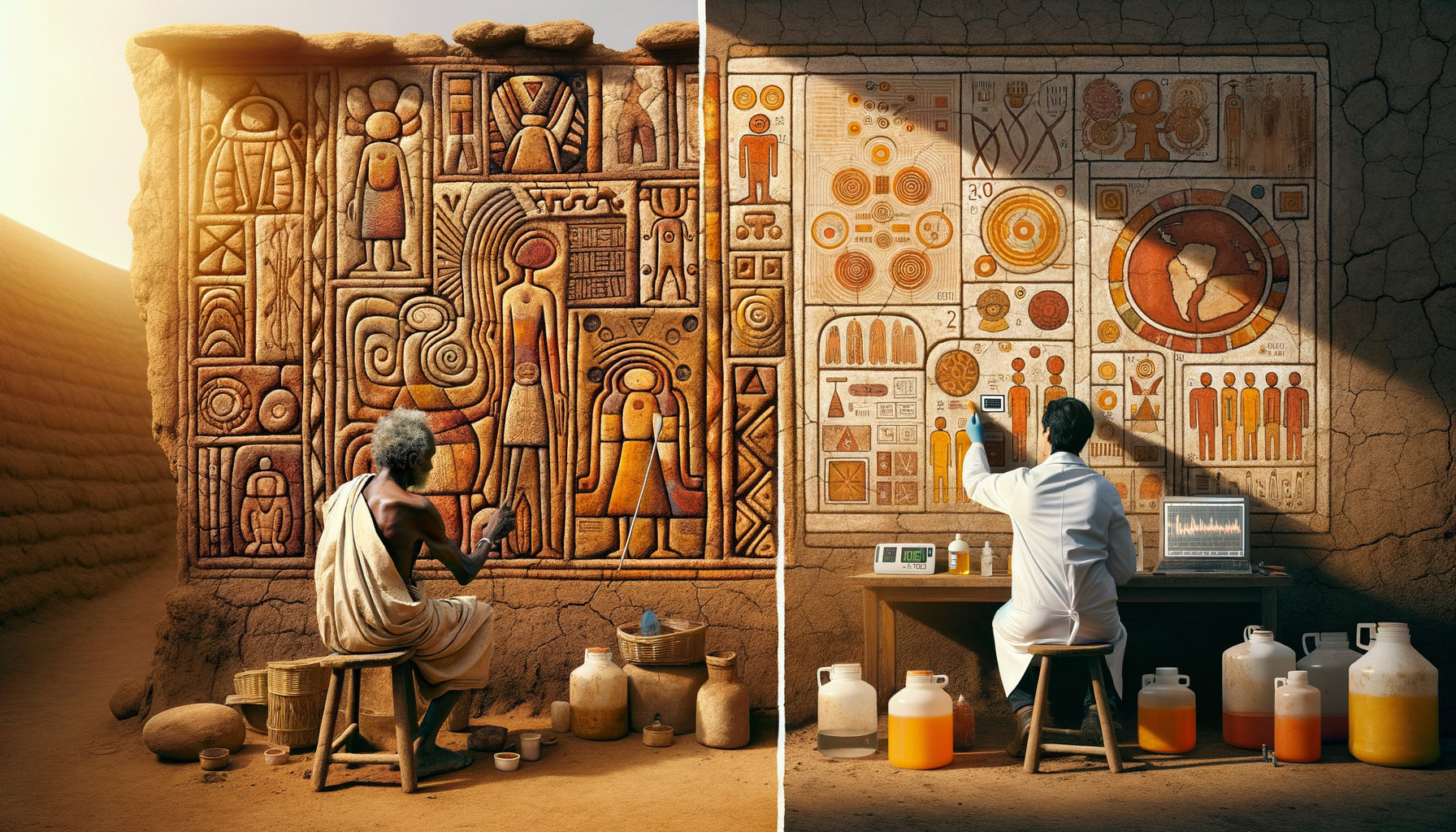
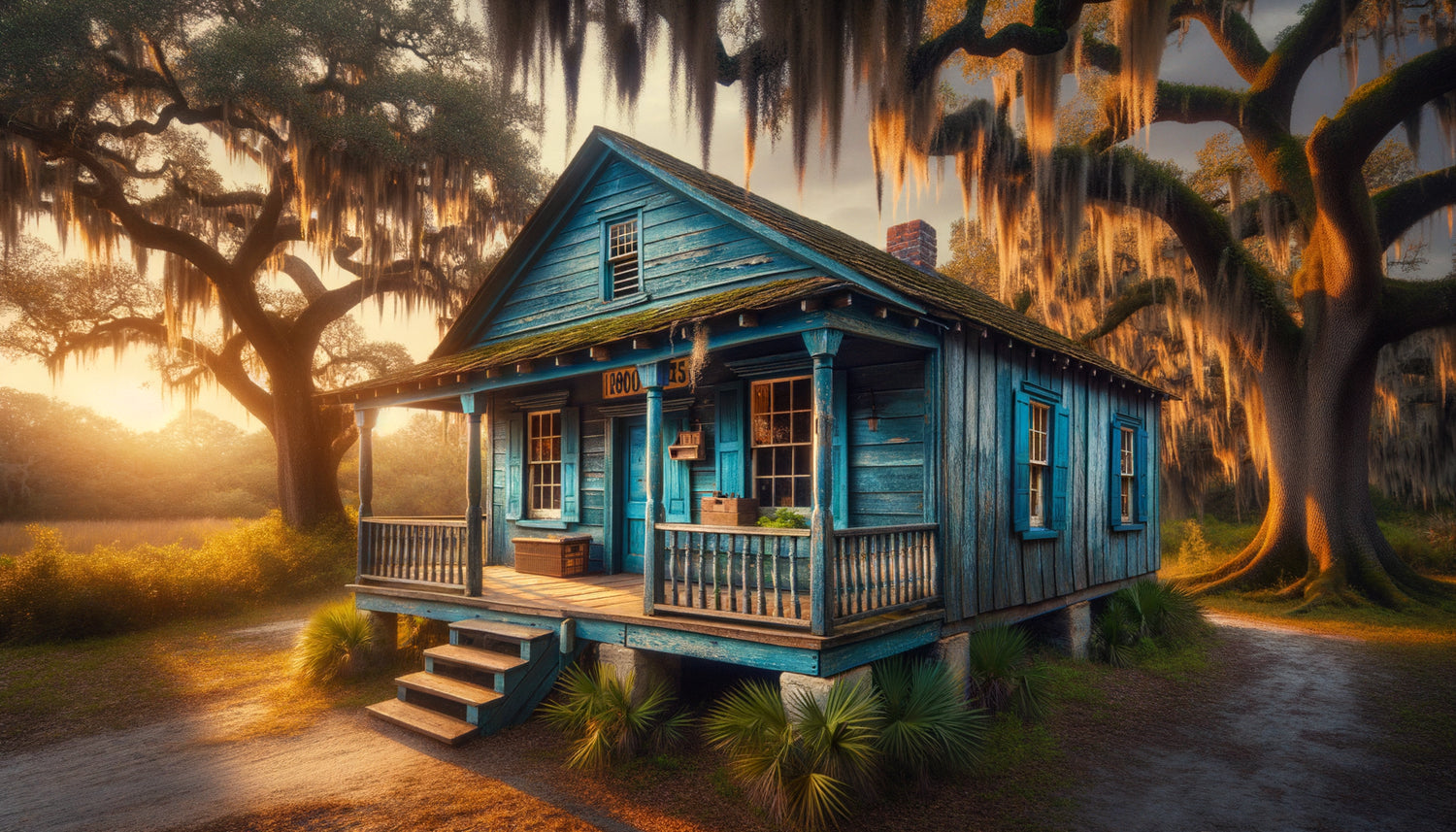
In slave cabins, and then in the homes of freed farmers, geometric patterns painted with lime, berry juice or clay could be found. These African symbols – concentric circles, cosmic crosses, spirals – served as spiritual protection. Kongo communities painted their doors indigo blue, a color that malevolent spirits could not cross according to their beliefs. This practice of haint blue has become so ingrained in the South that it is now an integral part of the aesthetics of Creole and Victorian houses in Charleston or Savannah.
The African-American communities transformed their constraints into creativity. Deprived of noble materials, they used what they found: crushed seashells, porcelain shards, pieces of mirror. These fragments adorned exterior walls, creating shimmering surfaces that recalled the sanctuaries of West Africa while also serving as a spiritual barrier.
The secret vocabulary of facades
Each item had its meaning. Colored bottles suspended from trees or driven into stakes around houses trapped evil spirits – a practice directly inherited from the Congo. The geometric motifs painted in the corners of houses were not random: they reproduced Bakongo cosmograms, these sacred diagrams representing the cycle of life.
This transmission took place in the secrecy of families, away from prying eyes. Grandmothers taught their granddaughters which symbols to trace, what colors to mix, what prayers to whisper when painting. An immaterial heritage made tangible on the walls of the American South.
Yard shows: when the yard becomes a sacred gallery
If you travel through certain rural neighborhoods in Georgia or Alabama, you may come across these extraordinary gardens that anthropologists call yard shows. A heterogeneous collection of objects covers every available surface: painted tires, figurines, transformed cans, metal assemblages. What looks like chaos to the untrained eye is actually a form of sophisticated African wall art transposed onto the ground and fences.
These installations extend the tradition of Yoruba sanctuaries and Vodun altars, where the accumulation of objects creates a spiritual charge. Southern communities have adapted these practices to their new environment: African gourds have become enameled basins, cowrie shells have been replaced by mother-of-pearl buttons, but the principle remains the same.
The walls of houses in these yards serve as a support for this creative expression. Cut metal plates, driftwood assemblages, naive paintings with bright colors are hung on them. Each element tells a story, invokes protection, honors an ancestor. This practice of preserving traditions continues today, notably thanks to artists like Lonnie Holley or Thornton Dial who have brought this vernacular aesthetic onto the international art scene.
The legacy of shotgun houses and their narrative walls
Shotgun houses, these narrow houses typical of the South, are another place for preserving wall traditions. Their rectangular plan without a hallway recalls dwellings in West Africa and Haiti. African-American communities have decorated the interior walls of these houses with ancestral techniques: earth-colored wash, geometric motifs painted above door lintels, assemblages of stretched fabrics evoking Ghanaian kente cloths.
In the Tremé neighborhood of New Orleans, community initiatives document and restore these wall decorations that testify to cultural resilience. Some families own homes where four generations have added their layer of symbols, creating unparalleled palimpsests on the walls.

The contemporary renaissance: when urban walls embrace heritage
Since the 1990s, we have witnessed a true renaissance of these African mural traditions in the American South. The urban frescoes of Atlanta, Memphis or Houston now consciously integrate ancestral symbols. Artists like Fabian Williams or BMike fuse street art techniques with Kongo geometric patterns, Yoruba color palettes, and compositions inspired by Akan fabrics.
This new generation is not merely reproducing: they are reinterpreting. Cosmograms become giant urban mandalas, Adinkra symbols blend with tags, portraits of ancestors coexist with pop culture icons. The walls of historically Black neighborhoods become places of active memory, where African heritage dialogues with contemporary issues.
Organizations like the African American Mural Project in Charleston systematically document these mural expressions, creating archives that establish continuity between the discreet paintings of slave huts and today's monumental frescoes. This approach to heritage preservation allows for officially recognizing these practices as an integral part of American cultural history.
Transmission workshops: training the new generation
In several Southern cities, community workshops teach young people ancestral techniques of wall decoration. In Birmingham, a collective teaches adolescents to prepare natural pigments using traditional methods, to understand the symbolism of motifs, to respect the spiritual dimensions of this art.
These initiatives are not about nostalgia: they respond to a deep need for identity connection. For communities long deprived of their history, these walls carrying memory constitute essential anchors. Painting an nsibidi symbol on the wall of one's room is not just a decorative gesture – it is asserting a lineage, claiming a heritage, projecting continuity.
How to integrate this heritage into your interior
You may wonder how to honor these mural traditions without cultural appropriation? The key lies in intention and knowledge. Rather than simply copying patterns, take the time to understand their meaning, their origin, their spiritual function.
Start with the color. The famous indigo blue of doorways works wonderfully in contemporary entrances, bringing that soothing depth that has spanned centuries. For interior walls, ochres and Sienna earths traditionally used create warm atmospheres that perfectly complement modern furniture.
Geometric patterns lend themselves beautifully to wall friezes. A simple frieze of triangles or lozenges above a bed evokes kente textiles without mimicking them. You can also create an accent wall with concentric circular shapes, reminiscent of cosmograms while remaining clean.
The approach of yard shows also inspires contemporary wall decoration: this idea of assembling various objects on a wall, each carrying personal meaning. Create your own wall composition with objects collected during travels, family heirlooms, flea market finds. The essential thing is that each element has a story, creates a connection.
Support artists who perpetuate the heritage
The best way to authentically integrate these traditions into your space is to acquire works by contemporary African American artists working in this vein. Painters like Wadsworth Jarrell or Faith Ringgold create wall artworks that beautifully reinterpret the African heritage. Investing in their work is actively participating in the preservation of these living traditions.
Many online galleries now offer reproductions of works by Southern American artists who incorporate these cultural references. Consciously choosing these pieces for your walls constitutes both an aesthetic and ethical gesture.
Transform your walls into bridges between continents
Discover our exclusive collection of African paintings that celebrate the heritage of wall traditions and give your interior an authentic cultural depth.

Towards a global heritage recognition
The journey taken is remarkable. What was once considered marginal vernacular practices fifty years ago is now recognized as a major cultural heritage. African American mural traditions in the South are now the subject of academic study, heritage protection, and exhibitions in prestigious museums.
This recognition is not merely symbolic: it allows for the protection of the last authentic examples of these historical wall decorations, to fund documentation programs, and to support artists who perpetuate these practices. Historic houses with their original murals are listed, yard shows are preserved in situ, contemporary urban frescoes benefit from conservation measures.
But beyond institutions, it is within homes that these traditions remain alive. Every time a grandmother from Mississippi passes down the secret of a color to her granddaughter, every time an artist from Atlanta incorporates an Adinkra symbol into his fresco, every time a family in Charleston repaints their door indigo blue, it is a victory against oblivion.
African American communities in the South have accomplished an extraordinary act of cultural resistance: transforming the walls of their oppression into supports for their memory, making their homes portable sanctuaries, inscribing their history into the very fabric of their habitats. These African mural traditions have not only survived – they have reinvented themselves, generation after generation, to remain relevant, powerful, necessary.
Today, as we all seek to create more authentic, meaningful interiors, and connect with narratives that transcend us, this heritage offers an inexhaustible source of inspiration. It reminds us that walls are never neutral: they always carry a memory, always tell a story. It is up to us to choose which one we want to honor.
Look at the walls of your home differently now. Imagine them not as simple surfaces to decorate, but as spaces for dialogue with history, transmission to the future, and connection with traditions that have crossed the ocean and centuries. Consciously choose what you hang on them, what you paint on them, what you inscribe on them. Make your walls guardians of memory, as these communities have done with admirable ingenuity and determination.
Frequently Asked Questions about African American Mural Traditions
Can I use traditional indigo blue for my door without cultural appropriation?
Absolutely, and it's even encouraged when done with knowledge and respect. The indigo blue of doors, called haint blue in the American South, has become a shared regional architectural feature. The important thing is to understand its origin: this practice comes from Kongo communities who believed that evil spirits could not cross water, and this color evoked water. Using this blue knowing its history is honoring the tradition. You can even delve deeper by choosing a shade prepared according to traditional methods, with true indigo. Many paint manufacturers in the South now offer specific palettes with the history of each shade. It's a beautiful way to create an interior that dialogues with the cultural history of your region while bringing that soothing depth this color provides.
Where can one still see authentic examples of these mural traditions?
Several remarkable places preserve these mural traditions. The Gullah Geechee historic district on the maritime islands of Georgia and South Carolina retains houses with their original wall decorations. In New Orleans, the Backstreet Cultural Museum documents decorative practices in Creole neighborhoods. The Birmingham Civil Rights Institute presents reconstructions of historical interiors. For contemporary yard shows, the Soulsville neighborhood in Memphis and certain rural areas around Macon, Georgia still offer living examples. I also recommend visiting during annual Gullah Festivals where workshops demonstrate traditional mural painting techniques. Finally, many urban murals in Atlanta, particularly in the Sweet Auburn district, consciously integrate these legacies into their contemporary aesthetics. Don't hesitate to contact the cultural tourism offices of these cities which often offer specialized tours.
What symbols are the most appropriate to use in a contemporary interior?
Universal geometric patterns are the safest and most respectful choice: concentric circles, spirals, diamond grids, alternating triangles. These shapes appear in many African cultures and translate beautifully into a contemporary context. Simplified cosmograms – a circle with an inscribed cross – work wonderfully as central motifs above a bed or sofa. To go further, learn about Ghanaian adinkra symbols, many of which have universal meanings such as wisdom, creativity, or harmony. The key is to know the meaning of what you are using. Avoid strictly religious or ceremonial symbols whose sacred significance you do not understand. Prioritize aesthetic and philosophical elements over liturgical ones. You can also opt for a chromatic approach by using traditional palettes – ochres, earth reds, indigos, limestone whites – which evoke heritage without literal reproduction of symbols. The idea is to create a respectful resonance rather than a copy.