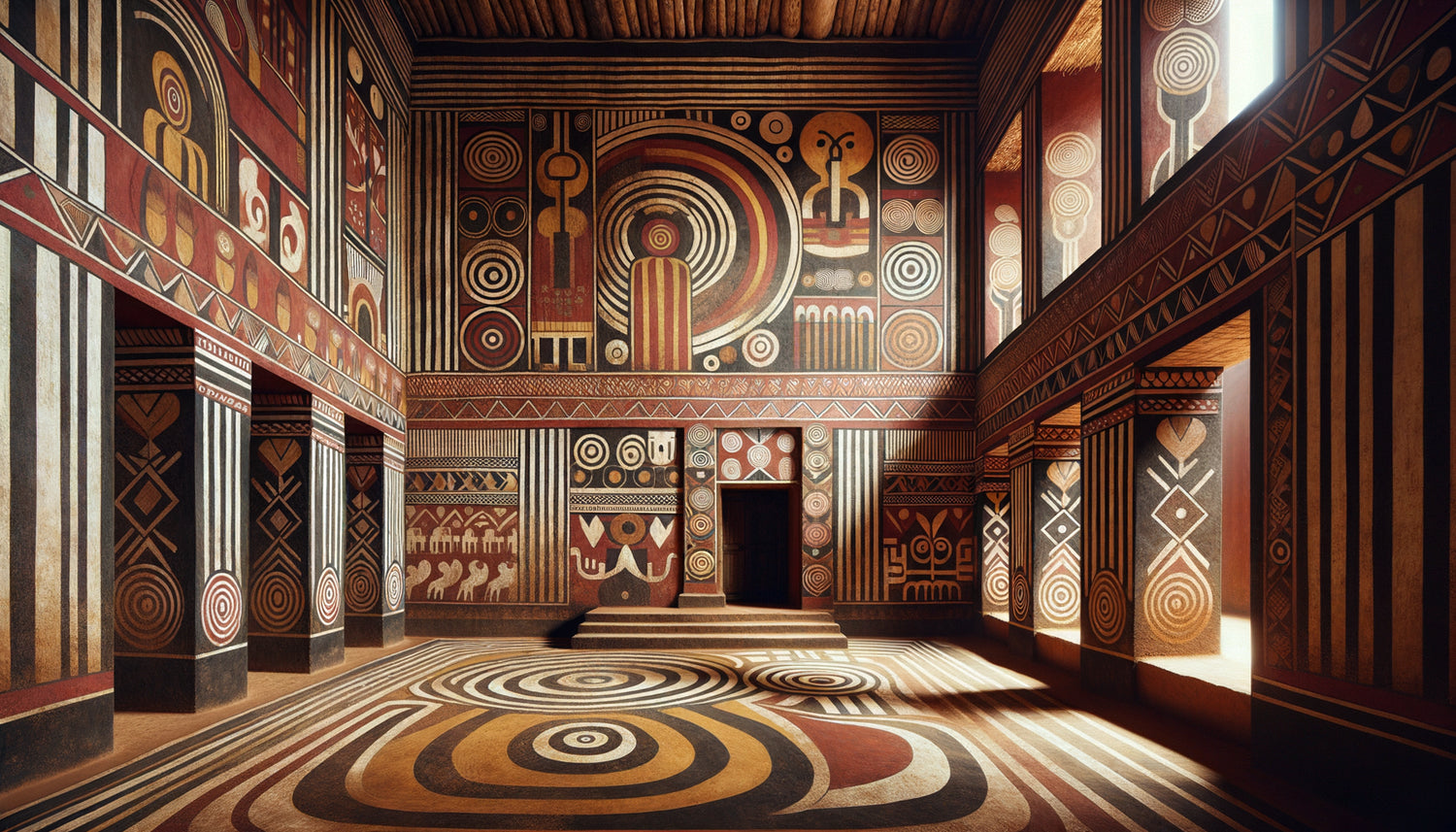
Imagine stepping through the doors of a palace where each wall tells a story spanning millennia. In Rwanda, the royal residences of the Abanyiginya were not mere dwellings: they constituted veritable visual libraries where murals etched into clay and plant fibers recorded the memory of a dynasty that reigned for over five centuries. In a kingdom where writing was absent, these sophisticated artistic compositions preserved genealogies, conquests, and alliances that underpinned the legitimacy of royal power.
Here's what these dynastic murals reveal to us: An ingenious alternative to writing that transformed architecture into a memory support, a system of visual symbols understandable by all subjects of the kingdom, and an artistic tradition that shaped Rwandan collective identity long before external influences arrived.
Today, facing interior homogenization and the loss of collective narratives, we desperately seek to create spaces that tell our story. We accumulate soulless decorative objects, mass-produced, which carry no memory, no narrative. Our walls remain silent when they could bear witness to our roots and transmit our heritage.
Yet, by understanding how Rwandan royal palaces transformed their surfaces into living chronicles, we rediscover an ancestral approach to decoration: one that makes each visual element a guardian of memory. This African tradition offers valuable inspiration for reinventing our interiors as narrative spaces.
I invite you to explore how these dynastic murals functioned as a system of historical preservation, and what this millennial wisdom can inspire in our contemporary decorative choices.
Walls that spoke: architecture as a memory support
In the palaces of Rwanda's kings, every wall surface carried a narrative intention. Murals were not mere ornaments: they constituted a complex system of visual archiving. Royal artisans, called abasizi, mastered the art of composing frescoes from colored clays, white kaolin, red ochres, and plant pigments extracted from indigofera.
These mural compositions in the Abanyiginya palaces followed a precise spatial logic. The entrance to the palace presented the mythical origins of the dynasty, with stylized representations of the founding king Gihanga. Central rooms exhibited the succession of monarchs, each reign being symbolized by specific geometric motifs and codified color arrangements.
The technique employed mixed smoothed clay and braided papyrus fibers, creating textured reliefs that captured light according to the time of day. This architectural dimension transformed murals into changing sensory experiences, where dynastic memory lived in rhythm with the sun traversing the palace openings.
A sophisticated visual language
The murals in royal palaces used a symbolic vocabulary that every educated Rwandan knew how to decipher. Long-horned cows represented the prosperity of a reign. Intertwined spears evoked military victories. Stylized jars symbolized marital alliances sealing pacts between clans.
This visual grammar allowed the Abanyiginya to preserve their legitimacy: by publicly displaying their genealogy on the palace walls, they made visible and undeniable their right to rule. Courtiers memorized these compositions like visual poems, capable of reciting dynastic history by scanning the rooms with their eyes.
When color becomes chronology
The use of pigments in dynastic murals followed a sophisticated chromatic logic. Red ochre, extracted from the iron-rich soils of the Nduga hills, signaled periods of conquest and territorial expansion. Kaolin white marked peaceful reigns dedicated to administrative reforms and agricultural innovations.
Royal artisans sometimes superimposed layers of color to indicate dynastic transitions. A wall mural could thus present three visible strata: the deep layer of the grandfather's reign, the intermediate layer of the father, and the fresh surface of the reigning monarch. This pictorial stratigraphy literally materialized genealogical continuity.
Visitors to the Abanyiginya palaces learned to read history in the verticality of the walls. A deep indigo blue, obtained from Indigofera tinctoria, evoked periods of drought overcome. Golden yellow, drawn from wild turmeric, celebrated years of exceptional abundance. Each chromatic tone became a temporal marker, transforming palaces into monumental calendars.
Pigments carrying spiritual meaning
Beyond their chronological function, the colors of the murals carried a sacred dimension. Kaolin white linked the Abanyiginya to Imana, the creator deity, and legitimized their role as intermediaries between the visible and invisible worlds. Red ochre evoked the blood of royal ancestors, a protective presence watching over the dynasty.

Geometry as genealogy
The geometric patterns of Rwandan wall murals constituted a veritable abstract family tree. The interlocking diamond compositions represented descending lineages, each point indicating a son who founded a cadet branch. Concentric spirals materialized dynastic cycles, with the founder monarch Gihanga at the center.
This geometric approach to dynastic memory allowed for the simultaneous reading of several generations. A single wall panel could condense eight successive reigns into an arrangement of rectangles, triangles and circles whose layout followed precise rules passed down from master craftsman to apprentice.
The palaces of the Abanyiginya thus contained entire rooms dedicated to genealogical charts, where visiting diplomats came to verify alliances and succession rights. These wall compositions functioned as visual notarial acts, enforceable during dynastic disputes that sometimes punctuated transitions of power.
Fractals Before Their Time
Remarkably, some dynastic wall murals used principles of scalar repetition: a motif representing one generation was reproduced at a reduced scale to represent its descendants, creating compositions of fascinating mathematical complexity. These structures foreshadowed what we now call fractal geometry.
The Ritual of Refreshing Memories
The wall murals of the Abanyiginya palaces were not frozen in time. With each new king's accession, elaborate ceremonies presided over the addition of new wall panels and the restoration of old compositions. These refreshment rituals mobilized the kingdom's best artisans for several moons.
The new monarch personally participated in applying the first layers of pigments to his own dynastic mural, a symbolic gesture representing his active assumption of collective memory. Elders of the royal council recited the deeds of each predecessor while artisans restored the corresponding wall murals, creating a synchronization between speech and image.
This practice ensured the intergenerational transmission of dynastic memory. Young apprentice artisans simultaneously learned pictorial techniques and historical narratives, becoming bicapital guardians of the royal heritage. Manual skill and historical knowledge were transmitted inseparably.

When Architectural Space Becomes Narrative
The spatial arrangement of wall murals in Rwandan palaces followed a sophisticated narrative logic. The visitor's journey was carefully choreographed to tell the dynastic story as a progressive account. Crossing the first door revealed mythical origins. Traversing the central courtyard led through glorious reigns. Reaching the throne room culminated in the reigning monarch’s present.
This narrative architecture transformed each palace visit into an educational experience. Noble children learned the history of the Abanyiginya while playing in the palace courtyards, their eyes absorbing daily the wall murals that structured their understanding of the world.
The king’s private rooms featured more esoteric wall murals, reserved for the education of heirs. These compositions revealed dynastic secrets, secret alliances, and political strategies known only to the royal inner circle. This spatial hierarchy of information thus created levels of reading adapted to the status of each observer.
An initiation journey
For future kings, memorizing all the palace wall murals was a mandatory initiation test before coronation. This knowledge proved their ability to assume the dynastic heritage and position themselves as legitimate successors to the lineage of the Abanyiginya.
The living legacy of dynastic murals
Although traditional royal palaces have largely disappeared after colonization, the spirit of dynastic wall murals continues to inspire contemporary Rwandan art. Current artists reinterpret ancestral geometric motifs and color codes in creations that dialogue with tradition while speaking to the present.
This creative continuity reminds us that the Abanyiginya wall murals were not mere decorations: they constituted a sophisticated memory technology, adapted to an oral civilization that refused to let its dynastic memory dissolve into oblivion. Their lesson resonates powerfully today, in the age of ephemeral digital media.
For our contemporary interiors, this tradition offers a valuable inspiration: that of designing our walls as narrative surfaces, bearers of meaning and memory. Rather than accumulating decorative objects without connection, we can compose visual ensembles that tell our story, our values, our identity.
Transform your walls into memory keepers
Discover our exclusive collection of African artworks that perpetuates the tradition of dynastic wall arts and creates spaces full of meaning and history.
Create Walls That Tell a Story
The wall paintings of the Rwandan royal palaces teach us an essential truth: our living spaces can become supports for memory and transmission. By consciously choosing the works that adorn our walls, by composing coherent visual arrangements, we create environments that carry meaning.
Imagine your living room transformed into a narrative gallery, where each African painting dialogues with others to tell a collective story. Visualize your guests gradually discovering the layers of meaning in your decor, like visitors to the Abanyiginya palaces deciphered the dynastic wall paintings.
This approach to decoration does not require royal means, simply an intention: to make our walls living surfaces rather than neutral backgrounds. Start with a room, choose works that resonate with your personal or family history, and compose a coherent set. Your walls will then become guardians of your own dynastic memory.
Frequently Asked Questions About Rwandan Dynastic Wall Paintings
Were the wall paintings of Rwandan palaces purely decorative?
Absolutely not. The wall paintings of the Abanyiginya palaces fulfilled a crucial mnemonic function in a society without writing. They constituted the main system for preserving royal genealogy, political alliances and major historical events. Each motif, each color, each spatial arrangement carried precise information that members of the court knew how to decipher. These mural compositions functioned as visual archives in dynastic disputes. Their decorative dimension certainly existed, but it was inseparable from their documentary role. The royal artisans were simultaneously artists and chroniclers, and the beauty of their creations served the memorization of the historical information they contained. This dual function perfectly illustrates the sophistication of pre-colonial Rwandan civilization.
How were the colors of dynastic wall paintings made?
Royal Rwandan artisans mastered an elaborate color palette obtained from local natural resources. White came from kaolin extracted in specific quarries controlled by the crown. Red and yellow ochres were produced from carefully selected ferruginous earths according to their shade. Indigo blue was obtained by prolonged maceration of indigofera tinctoria leaves in earthenware jars. Blacks came from soot collected in royal forges or finely ground charcoal. Each pigment required weeks of preparation according to recipes jealously guarded by the master artisans. These pigments were then mixed with natural binders such as gum arabic or vegetable resins to ensure their adhesion and durability on the smoothed clay walls of the palaces. This natural chemistry guaranteed the longevity of dynastic murals for generations.
Can we still see examples of these murals today?
Unfortunately, most original Rwandan royal palaces were destroyed or severely damaged during the colonial period and subsequent political unrest. The materials used, mainly clay and natural pigments, were also vulnerable to weathering and time. However, remarkable historical reconstruction efforts have been undertaken in Rwanda since the 2000s. The Nyanza Royal Palace, residence of the last kings of Rwanda, has been partially restored and now houses a museum where some mural painting techniques have been recreated according to the accounts of elders and ethnographic descriptions. Belgian and German photographers and anthropologists had also documented some palaces in the 1900s-1930s, leaving valuable visual archives. These images, although in black and white, make it possible to understand the complexity of dynastic wall compositions. Furthermore, the influence of these traditions persists in contemporary Rwandan art, where many artists reinterpret ancestral motifs and techniques in modern creations.