In the depths of Alexandria, beneath the sounds of the modern city, lies a fascinating artistic treasure. The Alexandrian hypogea, these underground tombs carved into the rock, reveal frescoes of astonishing iconographic richness. Examining these funerary paintings, one detail stands out: traditional Egyptian iconography harmoniously coexists with Greco-Roman elements, creating a unique visual vocabulary that belongs only to Alexandria.
Here's what this artistic fusion reveals: it bears witness to a cosmopolitan society where cultures mingled without canceling each other out, it offers creative solutions for honoring multiple traditions simultaneously, and it creates a hybrid aesthetic that continues to inspire contemporary designers. This visual alchemy is not accidental, but the result of an exceptional historical context.
Many imagine ancient Egypt as a monolithic block, frozen in its millennial traditions. This simplistic vision creates frustration: how can we understand these frescoes that seem to muddle the tracks, mix codes, defy our categories? Yet, by immersing oneself in the Alexandrian context, these works take on their full meaning. Ptolemaic and Roman Alexandria was a cultural melting pot unparalleled in antiquity, and its hypogea are its most authentic artistic expression.
I am going to take you to explore this fascinating phenomenon, decipher the deep reasons for this visual syncretism, and show you how this fusion continues to influence our way of thinking about decoration and cultural identity today.
Alexandria: when three worlds meet underground
Founded in 331 BC by Alexander the Great, Alexandria was never an ordinary Egyptian city. It was a cosmopolitan metropolis where Greeks, Egyptians and, later, Romans lived side by side, traded together, sometimes married. This coexistence was not just a matter of good neighborliness: it created a true hybrid culture.
The Alexandrian hypogea, dug mainly between the 2nd century BC and the 2nd century AD, reflect this sociological reality. Their commissioners often belonged to the Alexandrian elite, families who could have Greek, Egyptian or both ancestors. For these notables, displaying their double heritage was not a contradiction but a pride, a social marker.
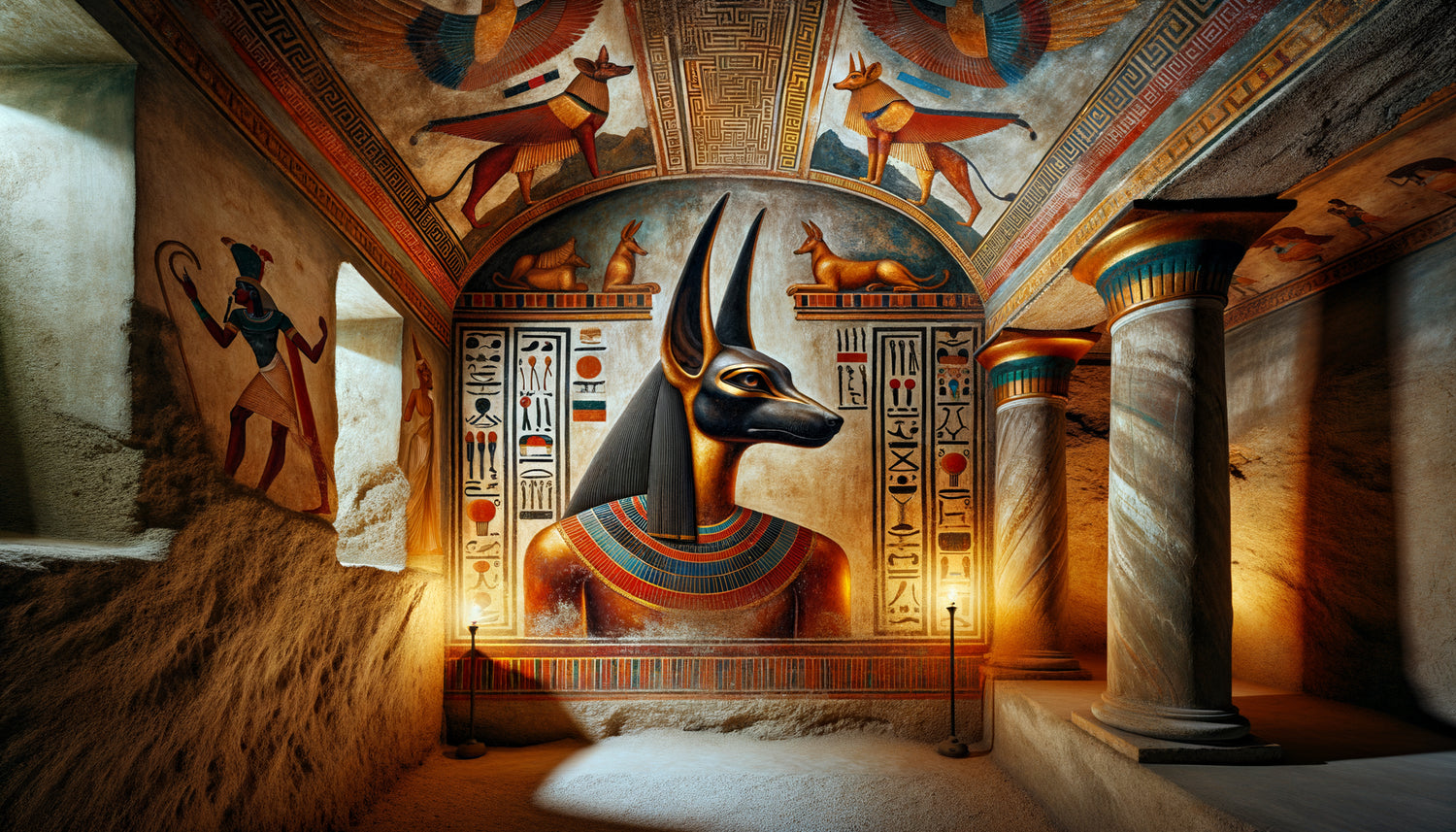
The iconography of the frescoes translates this plural identity. On the same wall, you can observe Anubis, the Egyptian god with a jackal head, wearing Roman armor. Elsewhere, Greek deities adopt the hieratic postures of pharaonic art. This iconographic fusion is not awkward: it is perfectly mastered, testifying to artists who intimately knew both traditions and knew how to harmonize them.
Death as a bridge between cultures
If the frescoes in the Alexandrian hypogea mix iconographies with such freedom, it is because death constituted an ideal meeting ground between cultures. Greeks, Egyptians and Romans shared a fundamental concern: to ensure the passage of the deceased to the afterlife and perpetuate their memory.
The Egyptians had developed for millennia a sophisticated funeral system, with its rituals, its psychopomp deities, its magical formulas. The Greeks and the Romans, while possessing their own beliefs, recognized the power of these traditions. Egyptian iconography, with its symbols of protection and rebirth, offered spiritual guarantees that many were not hesitant to borrow.
In the hypogea, we find typical Egyptian scenes: the weighing of the heart, mummification, solar boats. But these images are reinterpreted according to a Greco-Roman sensibility. Proportions become more naturalistic, faces gain in expressiveness, draperies soften. The result is a visual synthesis that speaks several symbolic languages simultaneously.
Deities that cross borders
The most striking example of this hybridization concerns the deities themselves. Anubis, traditional guardian of Egyptian deaths, regularly appears in Alexandrian frescoes, but transformed. He sometimes wears a Roman military breastplate, or adopts the posture of a Greek soldier. Osiris, master of the afterlife, can be represented with the attributes of Dionysos.
This practice, called interpretatio graeca or interpretatio romana, made it possible to identify local deities with their Greek or Roman equivalents. But in Alexandria, the process went further: it was not simply a matter of renaming the gods, but of creating true syncretic entities, halfway between two pantheons.

Art in the service of a complex identity
Why did these Alexandrian families care so much about displaying this double heritage in their tombs? The answer touches something deeply human: the need to affirm a complex identity without denying any of its components.
The commissioners of these hypogea were neither purely Egyptian nor purely Greek. They embodied a third way, that of the Alexandrian, inhabitant of a city that sought to be a bridge between East and West. Their funerary decoration expressed this multiple belonging. By mixing iconographies, they told their story: we are Egyptian by our roots, Greek by our culture, Roman by our citizenship.
This approach revolutionized the function of funerary art. Traditionally, in Egypt, tomb frescoes followed strict canons, passed down for centuries. In Alexandria, they became a space for creativity, experimentation, and affirmation of identity. Artists freely drew from multiple visual repertoires to create original compositions that existed nowhere else.
When architectural style meets Egyptian symbolism
The syncretism of Alexandrian hypogea was not limited to frescoes. The architecture itself of these tombs testified to this cultural fusion. The general structure borrowed from Greco-Roman models: atrium, peristyle, rooms arranged around a central courtyard. But the decorative motifs and symbols carved into the stone were often Egyptian.
Ceilings could be adorned with winged solar discs, an Egyptian symbol of divine protection. Pillars sometimes took the form of papyriform or lotiform columns typical of pharaonic Egypt. Doors were framed by Egyptian gorges, these characteristic concave moldings. This architectural combination created unique spaces, where each element told a part of Alexandria's cultural history.
The frescoes harmoniously integrated into this hybrid setting. They dialogued with the architecture, reinforcing the message of cultural synthesis. A visitor entering these hypogea literally crossed borders between worlds, visually experiencing what it meant to be Alexandrian.
Colors as a universal language
The color palette of Alexandrian frescoes deserves particular attention. Artists used traditional Egyptian pigments – ochres, Egyptian blues, copper greens – but applied them according to Greco-Roman pictorial techniques, with modeling, shadows, and play of light.
This approach created a distinctive visual quality. Colors retained the symbolic intensity of Egyptian art – blue for the sky and eternity, green for rebirth, gold for divinity – while acquiring a more naturalistic, more tactile dimension. The result was frescoes that functioned simultaneously as religious symbols and as aesthetic works, satisfying both Egyptian spiritual expectations and the Greco-Roman taste for formal beauty.

The Alexandrian legacy in our approach to decoration
What the Alexandrian hypogea teach us goes far beyond archaeology. They offer a fascinating model of successful cultural fusion, where respect for traditions does not prevent innovation, where multiple identities become a source of richness rather than confusion.
In our globalized world, where cultural influences constantly intersect, the Alexandrian example resonates strongly. It shows us that it is possible to draw on several heritages without diluting one's message, to create a coherent aesthetic from seemingly contradictory elements. Contemporary designers who are inspired by multiple traditions are ultimately updating the approach of Alexandrian artists.
The hybrid iconography of the hypogea also invites us to rethink our categories. We like to classify, separate, and define clear boundaries between styles. But Alexandrian art reminds us that living cultures are always in motion, in dialogue, in transformation. Stylistic purity is often a fiction: what matters is the coherence of the message and the quality of execution.