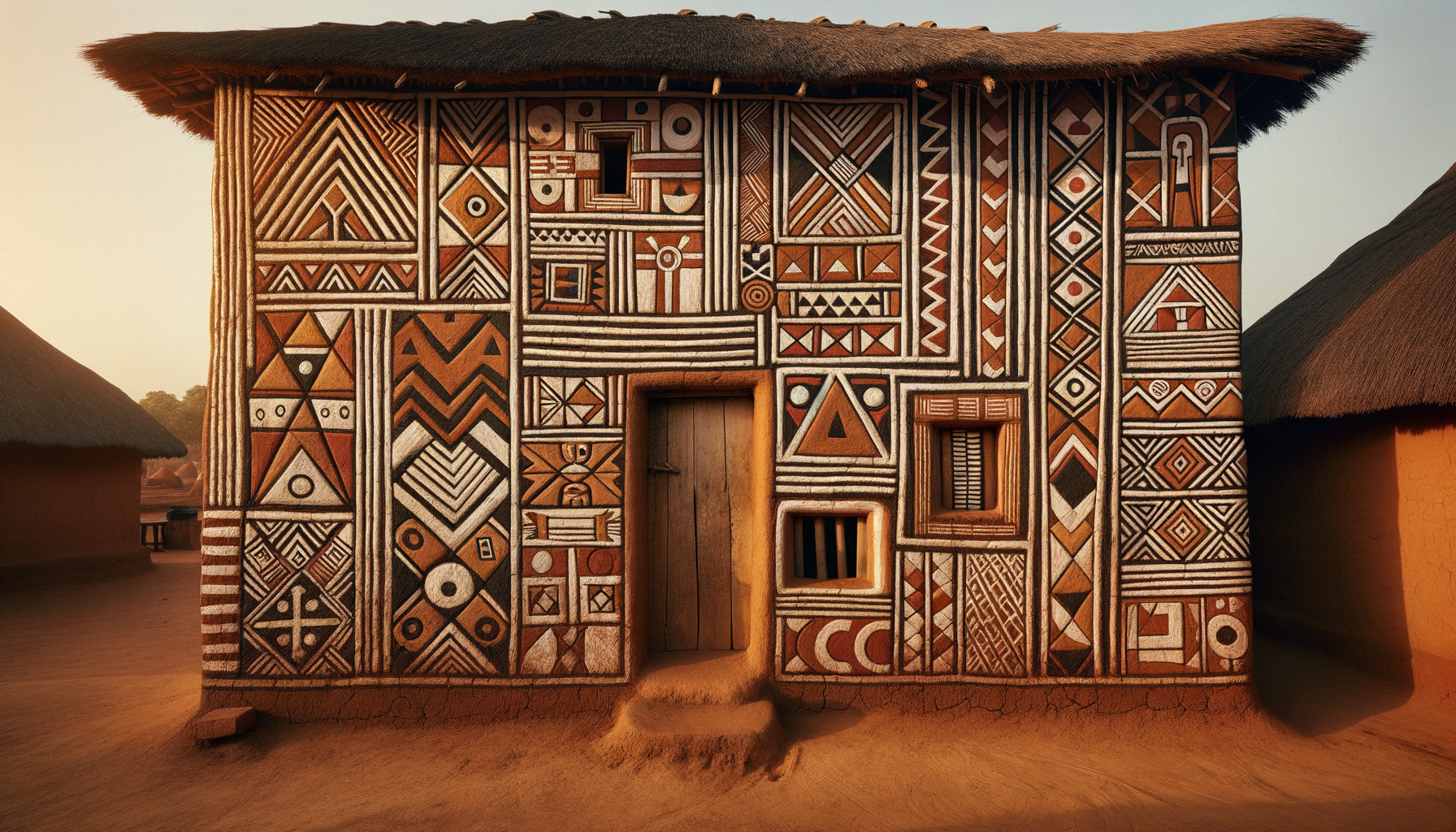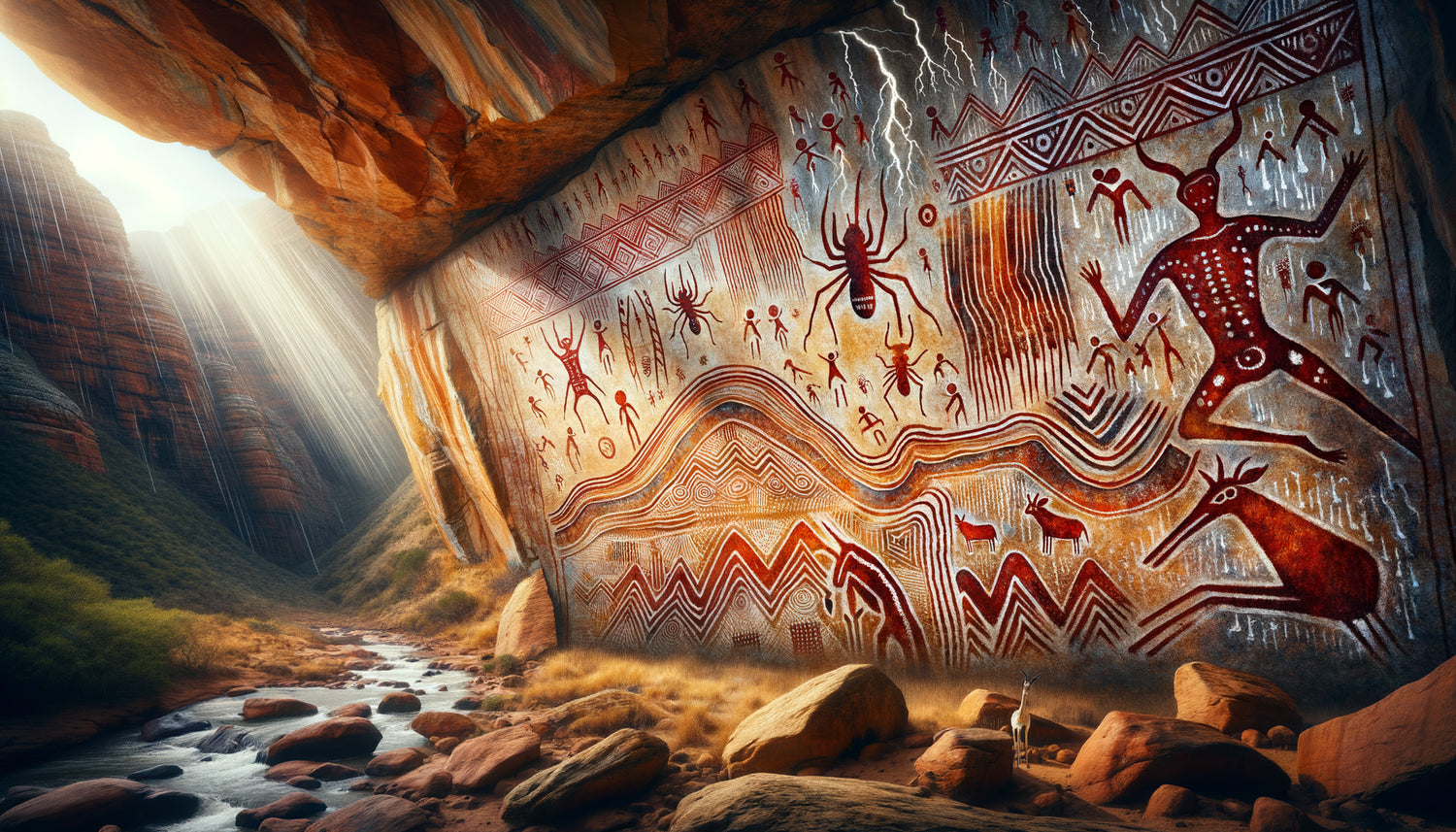
In the ancestral caves of Southern Africa, a motif traverses the millennia with a disturbing consistency: the zigzag. These broken lines, painted in red ochre and charcoal on rock, appear in hundreds of Khoisan sites, forming a visual language that our contemporaries rediscover with fascination. Far from being simple ornaments, these motifs carry within them the memory of profound spiritual experiences, a bridge between the visible and the invisible.
Here's what Khoisan zigzags reveal: a window into the altered states of consciousness of shamans, a system for noting spiritual visions, and a conception of the cosmos where energy circulates in perpetual undulations. These geometric symbols transcend simple decoration to become a map of the soul.
You may have fallen under the charm of these ancient African motifs, but their interpretation remains enigmatic. How can we understand what these prehistoric artists wanted to convey? Why does this obsession with the zigzag traverse so many ancestral cultures? Rest assured: ethno-archaeological research in recent decades has considerably illuminated these questions. I invite you to dive into the spiritual universe of the San, guardians of a millennial wisdom, to decode the profound meaning of these extraordinary murals.
Khoisan rock art: much more than wall decoration
The Khoisan populations of Southern Africa – including the San (Bushmen) and the Khoekhoe – have created one of humanity's longest artistic traditions for over 20,000 years. In the mountains of Drakensberg, the caves of Cape Town, and the rock shelters of Lesotho and Namibia, more than 15,000 sites adorned with paintings and engravings are counted. Among the recurring motifs: stylized animals, human figures in trance, fantastic creatures... and these enigmatic zigzags that dot the compositions.
I have spent years studying the symbolic systems of African cultures, and Khoisan murals represent a unique case. Unlike European Paleolithic art which favors naturalistic animal depictions, San art systematically integrates abstract geometric elements. These motifs are not decorative fillers, but essential narrative elements as much as the figures represented.
Shamanic trance: key to reading geometric patterns
The major scientific breakthrough came in the 1970s and 80s with the work of David Lewis-Williams and Thomas Dowson. By combining contemporary ethnography of the San and analysis of rock art, they established that zigzags correspond to entoptic phenomena – these geometric forms that the nervous system generates during altered states of consciousness.
The San shamans – called !gi:xa or !khwa:ka depending on the groups – entered a deep trance during nocturnal ritual dances. In this altered state, induced by ecstatic dance, hyperventilation and sometimes psychotropic substances, they traversed different perceptual stages. The first stage is characterized by the appearance of luminous geometric shapes: grids, points, zigzag lines, spirals, undulating curves. These patterns, universal in all shamanic cultures, are hardwired into our neurology.
The zigzags in the Khoisan murals therefore literally represent what shamans saw during their spiritual journeys. By painting these broken lines on rock, they mapped their visionary experience, creating a graphic notation of trance.
The three stages of shamanic vision
Research has identified that the shamanic trance unfolds in three distinct phases, each producing specific visions. In the first stage, geometric patterns – including zigzags – dominate the visual field. In the second stage, the shaman attempts to make sense of these abstract forms by interpreting them as familiar objects. Finally, in the third stage, he literally enters the geometric patterns to access the spiritual world where he meets power animals and spirits.
This progression explains why, in wall compositions, we often find zigzags associated with animal or human figures. The zigzag marks the threshold, the membrane between worlds, that the shaman must cross to accomplish his spiritual mission: heal the sick, control game, bring rain.

The zigzag as a representation of spiritual energy
In the San cosmology, the universe is traversed by a vital force called !gi or n/om depending on the dialects. This spiritual energy circulates in all living beings, accumulates in certain powerful animals (eland, lion, serpent), and can be activated by shamans during healing dances. When the n/om rises within the dancer's body, it causes intense physical sensations: heat, tingling, tremors.
The zigzags in wall art often symbolize this circulation of spiritual energy. Broken lines sometimes emanate from the noses of entranced figures (representing frequent nosebleeds during deep trances), from their heads, or connect different figures together. The zigzagging pattern visually translates the flow and movement of the n/om, this power that allows the shaman to transcend his ordinary state.
This energetic conception of the cosmos finds echoes in other spiritual traditions: Hindu prana, Chinese qi, or even the representation of lightning in many mythologies as a manifestation of divine force. The zigzag thus becomes an universal signature of energy in motion.
Snakes, rain and lightning: multiple readings of the zigzag
The meaning of Khoisan zigzags is not limited to representing entoptic visions. In the complex symbolic system of these cultures, a single motif can carry several levels of simultaneous meaning, creating remarkable semantic richness.
The snake occupies a central place in San spirituality. Some zigzags explicitly represent snakes, creatures that circulate between the earth and the underworld, endowed with considerable spiritual power. The rain serpent, a particularly important mythological being, was invoked by shamans during rituals to bring vital water. Zigzags associated with animal figures or hunting scenes can therefore evoke the presence of this snake-like spirit.
Water itself, rare and precious in Southern Africa, is often represented by undulating or zigzagging lines. Rain falling from the sky naturally traces these patterns, and meteorologists – the !gi:ten or rainmakers – used their power to negotiate with atmospheric forces. Zigzags thus become a metaphor for salvific rain.
Finally, lightning, a spectacular manifestation of celestial power, naturally fits into this symbolic register. Its broken path in the sky echoes the lines painted on the rock, establishing a link between the pictorial gesture and cosmic forces.
Polysomy and symbolic depth
This multiplicity of meanings is not contradictory but reveals the sophistication of San thought. A zigzag can simultaneously be: an entoptic vision perceived in a trance, a representation of the energetic flow n/om, an evocation of the mythological serpent, a symbol of water or lightning. This polysomy enriches the reading of wall art and loads them with exceptional spiritual density.

Contemporary inspiration: integrating Khoisan wisdom into our interiors
Today, motifs from African rock art are experiencing a remarkable resurgence in popularity. Designers, decorators and textile creators draw on this ancestral repertoire to create contemporary works. But beyond aesthetics, understanding the deep symbolic meaning of Khoisan zigzags transforms our relationship with these patterns.
Integrating a wall art inspired by San art into your interior is not simply adding an ethnic or exotic touch. It's welcoming home a fragment of millennial wisdom, a reminder that our ancestors developed complex systems to map the invisible, to give form to spiritual experience. These zigzags speak to the universal human quest: transcending the ordinary, accessing expanded states of consciousness, connecting with forces beyond our individuality.
The ochre tones, sienna earths, charcoal blacks and chalky whites of the rock paintings naturally harmonize with contemporary palettes favoring raw and authentic materials. A wall art featuring these motifs brings a particular vibration to the space, an energy that is both primal and sophisticated.
Transform your space into a sanctuary of ancestral energies
Discover our exclusive collection of African artworks that capture the spiritual power of tribal arts and infuse your interior with the wisdom of millennial cultures.
Preserving and honoring a threatened heritage
Khoisan rock art sites are now threatened by erosion, urban development, vandalism and uncontrolled tourism. Some paintings dating back several millennia are irretrievably disappearing. The San populations themselves, long marginalized and persecuted, are fighting for the recognition of their rights and the preservation of their culture.
Being interested in the meaning of zigzags and other motifs from Khoisan wall art is, in its own way, participating in the preservation of this heritage. It's recognizing that these peoples, often considered "primitive," have developed systems of thought of remarkable complexity, sophisticated spiritual practices, and an artistic tradition of exceptional depth.
Many organizations are now working to document and protect these sites. Digital technology allows for the creation of 3D archives of decorated caves before their eventual disappearance. Educational programs raise awareness among local communities about the value of this heritage. And contemporary San artists perpetuate this tradition by adapting it to modern supports, creating a bridge between past and present.
Beyond the zigzag: a lesson in humanity
Ultimately, what we learn from the zigzags of Khoisan wall murals goes far beyond the question of their literal meaning. They remind us that art is above all experience, an attempt to fix the ineffable, to communicate what escapes ordinary language. The San shamans were not decorators seeking to beautify their environment, but explorers of consciousness documenting their inner journeys.
In our contemporary world saturated with superficial images, these ancestral patterns offer a refreshing depth. They invite us to slow down, contemplate, and seek the multiple layers of meaning. A simple zigzag becomes a portal to a complex cosmology, a testament to mystical experiences, an archive of disappearing wisdom.
When you observe these broken lines on a wall art inspired by Khoisan art, let your gaze follow their jerky trajectory. Imagine the shaman in trance, seeing these luminous forms dancing before his eyes, feeling the n/om rise within him like spiritual electricity. Then imagine him, days or weeks later, climbing the mountain towards the sacred cave, grinding his pigments, and fixing the memory of his journey on the rock. Each zigzag is a time capsule, a message launched across the millennia, which reaches us today charged with mystery and power.
In conclusion, the zigzags of Khoisan wall murals are much more than decorative motifs: they constitute a system for noting altered states of consciousness, a representation of circulating spiritual energy, and a polysemic symbolic vocabulary evoking snakes, rain and lightning. This millennial artistic tradition offers us a unique window into shamanic spirituality and reminds us of the universal human ability to transcend the ordinary. By integrating these patterns into our contemporary spaces with awareness and respect, we honor the wisdom of indigenous peoples and create a dialogue between ancestral past and creative present. Be inspired by these broken lines that carry within them the memory of shamans, and transform your gaze on ancient African art: behind each zigzag lies a spiritual universe of unsuspected richness.