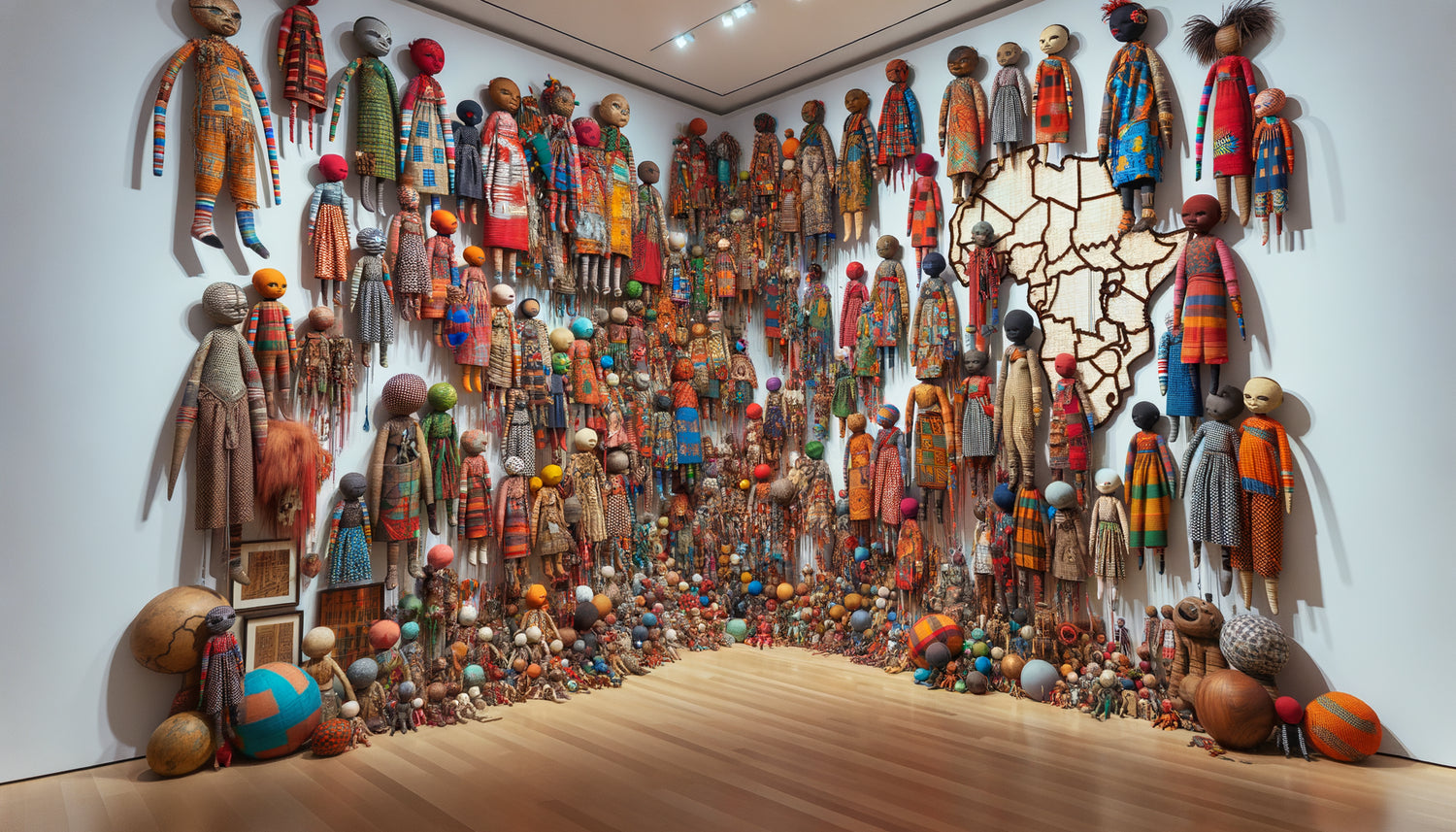
I discovered Pascale Marthine Tayou at a contemporary art biennale in Venice, and her wall installation literally stopped me in my tracks. Multicolored dolls hanging on the wall like deconstructed totems, assemblages of recycled materials forming impossible cartographies, a raw energy that exploded conventions. It was anything but a tame framed painting. It was alive, provocative, magnetic.
Here's what Pascale Marthine Tayou’s wall art brings to contemporary interiors: a narrative power that transcends classic decoration, a social critique that stimulates conversation, and a hybrid aesthetic between African tradition and international avant-garde.
You may be tired of conventional wall decorations that lack soul. These impersonal reproductions that tell nothing, these decorative works without depth that occupy space without transforming it. You are looking for something meaningful, thought-provoking, that affirms a strong cultural identity.
Good news: Tayou’s approach opens up radically new perspectives for rethinking wall art. His work teaches us how to divert, reinvent, hybridize codes to create spaces that tell authentic stories. Let's explore together how this Cameroonian artist is revolutionizing our relationship with the wall as a medium of expression.
Reinterpreted heritage: when tradition becomes subversion
Pascale Marthine Tayou does not reject African tradition; he diverts it with fascinating creative intelligence. Unlike artists who faithfully reproduce ancestral motifs, Tayou deconstructs the codes of African wall art to reinvent them in a universal contemporary language.
Take his famous wall installations composed of dolls and fetishes. Where traditional African art uses these objects in specific ritual contexts, Tayou suspends, multiplies, and colors them incongruously. He creates accumulations that evoke both ceremonial masks and Western consumerist shop windows. This ambiguity is intentional: the Cameroonian artist questions our relationship with cultural objects in the age of globalization.
His wall assemblages made from recycled materials work on the same principle. Bottle caps, plastic packaging, mismatched fabrics: Tayou transforms the waste of consumer society into new wall tapestries. He thus diverts the traditional decorative function of African fabrics such as kente or bogolan to create a commentary on pollution and economic colonialism.
The wall as a political territory
What radically distinguishes Tayou’s approach is its political dimension. His wall installations are never just aesthetic compositions. Each accumulation, each assemblage carries a message about postcolonial identity, the circulation of goods, and cultural stereotypes.
Her work with geographic maps perfectly illustrates this dimension. Tayou creates imaginary cartographies where Africa takes center stage, reversing the usual Eurocentric perspective. These wall compositions become visual manifestos that question our view of the world.
Materials and textures: the aesthetics of accumulation
Pascale Marthine Tayou's wall art is immediately recognizable by its material density. Unlike traditional painting, which favors a flat surface, Tayou constructs reliefs, protrusions, volumes that overflow from the wall.
Her installations use an extraordinarily diverse palette of materials: multicolored beads, feathers, fabrics, plastics, wood, metals. This profusion is not gratuitous. It evokes African markets, their chaotic vitality, their colorful abundance. It also echoes the aesthetics of recycling and recovery, central to contemporary African artistic practices.
What I particularly admire is how Tayou reinvents the notion of wall tapestry. Where traditional tapestry offers a homogeneous textile surface, Tayou creates heterogeneous assemblages that juxtapose contradictory materials. The precious meets the waste, craftsmanship dialogues with industry, creating a visual tension that keeps the gaze awake.
Color as a manifesto
The use of color in Tayou's work deserves special attention. Her wall compositions literally explode with saturated colors: vibrant pinks, electric greens, garish yellows, intense blues. This bold palette breaks with the purified minimalism that dominates Western contemporary art.
It is an aesthetic but also a political choice. Tayou claims a chromatic Africanity that rejects consensual austerity. Her wall installations affirm a powerful visual presence, impossible to ignore, which occupies space with confidence.

When the wall becomes a living installation
One of the major innovations of Pascale Marthine Tayou lies in her conception of the wall as a three-dimensional space. Her wall works do not just hang: they invade, overflow, transform the architecture itself.
Her installations with suspended dolls are a perfect example. These multicolored figures hang at different heights, creating an animated curtain that floats in front of the wall. The viewer does not contemplate a fixed image but traverses an environment, an atmosphere. The wall becomes scenery.
This approach radically transforms our relationship with domestic wall art. Imagine transposing this philosophy into an interior: rather than a static painting, you create an evolving composition that dialogues with the light, moves with the air currents, and changes depending on the viewing angle.
Narrative Accumulation
Tayou often works in series, multiplying similar elements over large wall surfaces. This logic of accumulation creates a hypnotic rhythm while allowing for subtle variations. Each doll is slightly different, each assemblage possesses its own singularity in repetition.
This principle of differentiated accumulation offers a valuable lesson for composing impactful walls: rather than a single isolated piece, think in terms of a constellation of elements that dialogue with each other while retaining their autonomy.
Transposing Tayou's approach into your interior
How to be inspired by Pascale Marthine Tayou’s approach without turning your living room into a contemporary art gallery? The idea is obviously not to copy her aesthetics but to understand her creative principles to nurture your own vision.
First, dare the detournement of objects. Tayou transforms ordinary elements into wall art. You can apply this principle by composing a wall with recovered objects that tell your story: travel souvenirs, flea market finds, family heirlooms. The important thing is to create an assemblage that carries meaning beyond its decorative value.
Secondly, free yourself from the single, central frame. Think of your wall as a space to inhabit entirely. Multiply attachment points, vary heights, create visual rhythms through repetition and variation. This approach generates dynamics that maintain interest.
Thirdly, don't be afraid of material density. Minimalist aesthetics have their merits, but Tayou’s approach reminds us of the power of controlled abundance. A richly composed wall can become the vibrant heart of a space.
Contemporary African art as a source of inspiration
Beyond Tayou specifically, the entire scene of contemporary African art offers radically new perspectives for rethinking our walls. Artists like El Anatsui with his tapestries of metal caps, or Yinka Shonibare with his détourned wax fabrics, offer visions that enrich our visual vocabulary.
Integrating these references into your decor is also a statement of cultural openness and intellectual positioning. It's recognizing that contemporary creativity thrives on intercultural dialogues, not rigid hierarchies.
Transform your walls into visual manifestos
Discover our exclusive collection of African paintings that capture this creative energy between tradition and modernity, for interiors that tell authentic stories.

The wall as a space for cultural dialogue
What makes Pascale Marthine Tayou's approach so relevant to our contemporary interiors is her ability to create dialogue rather than exoticism. Her wall installations do not seek to be ethnographic showcases but artistic propositions that speak of our globalized world.
When Tayou assembles traditional beads with Coca-Cola packaging, he doesn't create an easy contrast between tradition and modernity. He shows how these two universes coexist, contaminate each other, hybridize in contemporary African reality. This cultural honesty gives his work a depth that goes beyond simple decoration.
For your own wall compositions, remember this lesson: avoid stereotypes and simplifications. If you integrate elements of African art, look for pieces that carry real complexity, which question rather than reassure, which enrich your space with an authentic narrative dimension.
Art on the wall according to Tayou is always conversational. His installations generate discussions, provoke questioning, invite interpretation. A successful wall should function in the same way in your interior: be a starting point for exchanges, a catalyst for reflection, not simply a passive decorative element.
Creating your own wall language
The ultimate lesson from Pascale Marthine Tayou may be this: invent your own visual grammar. Don't just reproduce existing formulas, even brilliant ones. Use the wall as a testing ground to express your unique vision.
Tayou has developed an immediately recognizable vocabulary: his dolls, his accumulations, his cartographies. This language is uniquely his while engaging in dialogue with multiple references. You too can progressively build a visual signature that distinguishes your spaces.
Start by identifying what truly touches you. Which materials attract you? What colors resonate with your sensitivity? What objects have meaning for you? Then compose, allowing yourself experimentation, accumulation, and subversion. Accept that your wall evolves over time, gradually enriching itself.
Tayou's approach frees us from the tyranny of fixed good taste. His work proves that a wall can be dense without being heavy, colorful without being garish, narrative without being illustrative. It just takes daring to affirm a personal vision with consistency and conviction.
Imagine your living room transformed: a wall that tells your journey, your passions, your questions. Elements assembled with care that create a unique composition, impossible to reproduce. Visitors who stop, intrigued, who ask questions about the origin of such an object, the meaning of such an assembly. Your space becomes alive, conversational, authentically yours.
This journey into the universe of Pascale Marthine Tayou has, I hope, opened up new perspectives for you. His work teaches us that wall art can be bold, intelligent, and committed. That our walls can carry complex messages while remaining visually captivating. That tradition is reinvented in dialogue with modernity.
So, where will you begin? Perhaps by gathering objects that truly speak to you. By daring that asymmetrical composition you imagine. By hanging that contemporary African artwork that has intrigued you for a long time. The first step is always the most difficult, but it is the one that transforms intention into reality. Your wall awaits you, blank with possibilities, ready to welcome your story.
Frequently Asked Questions
Can we really draw inspiration from an artist as radical as Tayou for our interior decoration?
Absolutely! It's not about literally reproducing his installations but understanding his creative principles. Tayou teaches us three lessons applicable to any interior: dare to subvert ordinary objects to create meaning, think of the wall as a total space rather than just a support for a single frame, and embrace material density rather than default minimalism. Start modestly: a small entrance wall where you experiment with the accumulation of personal objects, for example. You will quickly discover that this approach generates a visual and narrative richness impossible to achieve with conventional decorative solutions. Tayou's boldness is not reserved for galleries; it can nourish deeply personal interiors.
How to integrate contemporary African art without falling into cultural appropriation?
Question essentielle ! The key lies in the approach: look for complexity rather than folklore. Prioritize contemporary African artists who engage with modernity rather than decontextualized reproductions of traditional motifs. Tayou himself creates resolutely contemporary art that draws on his roots without being confined by them. Find out about the artists whose works you acquire, understand their processes and messages. Avoid decorative clichés that reduce Africa to a few visual stereotypes. Appropriation begins when cultural symbols are used as mere ornaments. Respect begins when one recognizes the intellectual depth and sophistication of contemporary African art. Integrate these works as you would any demanding contemporary art: with curiosity, respect and desire to understand.
Doesn't a dense and colorful wall like those of Tayou risk visually tiring?
This is a legitimate concern, but it’s all a matter of balance and intention. Tayou creates dense installations for gallery spaces where maximum visual impact is sought. In a domestic interior, you can adopt his principles with more moderation. The trick is to create one or two strong walls that become the focal points of your spaces, while others remain more neutral. This alternation between density and breathing avoids visual fatigue. Also think about chromatic consistency: even with many elements, a controlled palette maintains harmony. Finally, a wall rich in details rarely becomes boring because it always offers something new to discover. It is the banal and conventional wall that we quickly cease to see. A wall composed with care, inspired by Tayou's approach, continues to captivate years after its creation.