In the vast plains of southern Kenya, where the red horizon blends with the sky, I was fortunate enough to witness a ritual that moved me deeply. A young Maasai woman, kneeling before the ochre wall of her manyatta, created geometric patterns with her fingers with astonishing precision. It wasn't just decoration: it was an ancestral language, a bridge between two worlds, an identity taking shape before my eyes. This scene, etched in my memory since my first ethnographic missions twenty years ago, illustrates the symbolic power of murals in Maasai rites of passage.
Here’s what these murals bring to Maasai transition ceremonies: they materialize the passage from one social status to another, they transmit the moral and spiritual codes of the community, and they create a sacred space where the individual transforms publicly. These ephemeral works tell far more than an aesthetic story – they embody the collective soul of a people.
You may be fascinated by African traditions, but you don't always understand the depth of symbolism in these practices. How can seemingly simple patterns carry so much meaning? Why are these paintings systematically associated with key moments in existence?
Rest assured: behind every line drawn on clay walls lies a system of meanings that I will reveal to you. By exploring the sacred, social and educational function of these murals, you will discover how an artistic gesture becomes a founding act of identity.
I invite you on a journey into the heart of Maasai rites of passage, where mural art literally transforms individuals and strengthens community bonds.
The language of pigments: when walls tell tales of metamorphosis
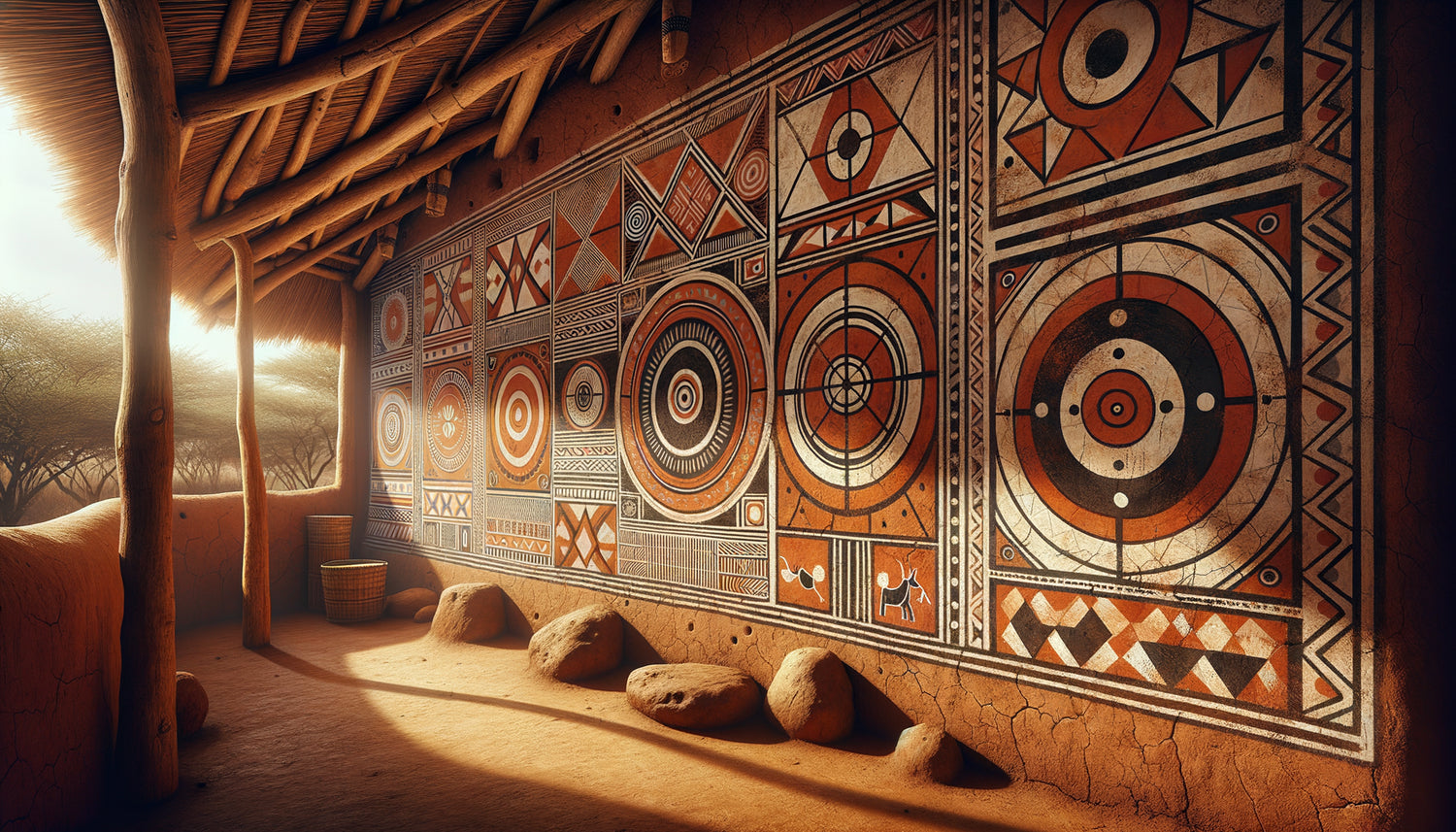
Maasai murals are never insignificant. Each color has a precise meaning that resonates with the stages of life. Red ochre, extracted from local soil and mixed with animal fat, symbolizes courage and blood shed during initiations. White, obtained from ashes or kaolin, evokes purity and spiritual rebirth. Black, derived from charcoal, represents the trials overcome and wisdom gained.
During young warrior initiation ceremonies, the walls of the manyatta – the traditional circular dwelling – are covered with complex geometric patterns. These drawings are not merely decorative: they constitute a visual map of the initiatory journey. Vertical lines represent the expected moral rectitude, zigzags evoke the challenges to be overcome, concentric circles symbolize the cycles of life and generational continuity.
I have observed how elder women, guardians of this ancestral knowledge, supervise the creation of these ritual frescoes. Their gestures are precise, almost choreographed. They use neither brushes nor sophisticated instruments – only their fingers, twigs or pieces of cloth. This apparent simplicity hides a technical mastery passed down from generation to generation, where every movement carries a spiritual intention.
The Visible Transformation of Living Space
Before a rite of passage, the manyatta undergoes a complete metamorphosis. The interior and exterior walls are carefully coated with a mixture of mud, cow dung and water, creating a smooth surface that will serve as a canvas. This preparation itself is part of the ritual: it symbolizes the spiritual cleansing necessary before any major transition.
The painted motifs vary depending on the type of ceremony. For the Eunoto, the rite marking the passage of young moran warriors to elder status, the murals incorporate representations of spears, shields and lions – symbols of masculine bravery. For female ceremonies such as the Emoratta, stylized floral patterns, undulating curves and shapes reminiscent of gourds used for milking are preferred, evoking fertility and the nurturing role of women.
Walls as Witnesses: The Communal Dimension of Ritual Paintings
What struck me most during my extended stays with the Maasai is the deeply collective nature of these wall paintings. Unlike our Western conception of art as individual expression, these creations are always the result of a community effort where everyone has their role.
Young girls who have not yet been initiated observe and learn by preparing the pigments. Married women execute the main motifs, while elders supervise and correct, thus transmitting aesthetic and symbolic codes. Men, although generally excluded from the creation itself, participate by collecting colored earth from specific sites, often remote and considered sacred.
This collective dimension transforms the act of painting into a social ritual that strengthens intergenerational bonds. The discussions accompanying the creation of the frescoes become moments of informal teaching where Maasai values are reaffirmed: respect for elders, the importance of courage, clan solidarity, harmonious relationship with livestock and nature.
The Ephemeral as Philosophy
A fascinating aspect of Maasai wall paintings lies in their temporary nature. Exposed to the elements, the scorching sun and occasional rains, these works are intended to gradually fade away. This impermanence is not a flaw – it is an integral part of their symbolic function.
The fading of the paintings reflects the Maasai philosophy of time and change. Just as the initiate abandons his former status to embrace a new one, the walls erase traces of the past to welcome the next ceremonies. This cyclical conception of time and identity contrasts radically with our Western obsession with conservation and permanence.
I have documented manyattas where one could distinguish, beneath the new paintings, the ghostly traces of earlier rituals – veritable cultural palimpsests testifying to the continuity of traditions despite social transformations.

The body and the wall: a symbolic continuity
One of the keys to understanding the function of wall paintings in rites of passage lies in the parallel between body decoration and architectural decoration. Among the Maasai, these two practices are inseparable and mutually respond to each other.
During initiation ceremonies, the bodies of young men are adorned with motifs similar to those that appear on the walls: bands of red ochre, white lines, charcoal geometric patterns. This visual continuity is not accidental – it means that the initiate becomes a living extension of the ritual space, that inner transformation is simultaneously inscribed in the flesh and in the architecture.
Body paintings are ephemeral by nature, dissipating with sweat and time. Similarly, wall paintings gradually fade. This double impermanence symbolizes the processual character of Maasai identity: one does not become a warrior or elder in an instant, but through a series of gradual and visible transformations.
The manyatta as a social body
In visual anthropology, we often speak of the manyatta as an extended social body. The wall paintings constitute its adornment, the ornament that signals to the wider community that an important event is taking place. From afar, a visitor can identify the type of ceremony simply by observing the dominant motifs on the dwellings.
This communicative function of ritual frescoes is essential in a semi-nomadic society where information circulates orally and visually. Painted walls become public announcements, tacit invitations to participate in celebrations, temporal markers in the community calendar.
Between tradition and modernity: the evolution of wall paintings
My recent research reveals fascinating transformations in the practice of Maasai wall paintings. While the symbolic functions remain largely intact, materials and some motifs evolve under the influence of modernity.
Some Maasai communities, particularly those near urban centers like Narok or Kajiado, are beginning to incorporate commercial pigments alongside traditional dyes. Contemporary motifs – stylized mobile phones, vehicles, and sometimes even logos – blend into ancestral geometric compositions, creating a surprising visual syncretism.
This hybridization does not necessarily dilute the ritual meaning of paintings. On the contrary, it testifies to the adaptive vitality of Maasai culture. Today's young initiates navigate between modern schooling and pastoral traditions, between smartphones and herds of cattle. Wall paintings now reflect this dual belonging, functioning as visual bridges between two worlds.
Revitalization through cultural tourism
Paradoxically, the growing interest of international visitors in Maasai rites of passage has contributed to preserving some wall painting practices that were fading. In villages open to ethical tourism, Maasai women are rediscovering the economic and cultural importance of their artistic skills.
Local initiatives, such as those I studied near Masai Mara National Park, allow Maasai artists to market reproductions on canvas or paper of motifs traditionally reserved for ritual walls. This transposition raises complex ethical questions: can a sacred symbol be extracted from its ceremonial context without altering its meaning?
The elders I spoke with express nuanced opinions. For some, this diffusion democratizes and values a culture long disparaged. For others, it risks transforming living symbols into simple decorative motifs devoid of their spiritual substance.

The transmission of knowledge: when painting becomes teaching
The pedagogical dimension of wall paintings in rites of passage is fundamental but often underestimated. These creations function as nonverbal teaching aids, particularly crucial in a traditionally oral culture.
Each motif encodes specific knowledge. Wavy lines can represent the temporary rivers that guide herds to seasonal pastures. V-shaped forms symbolize antelope tracks, teaching young warriors the basics of tracking. Divided circles evoke the four cardinal directions and the values associated with each in Maasai cosmology.
During initiation ceremonies, elders literally use the painted walls as ancestral blackboards, pointing to certain patterns to illustrate their oral teachings. Mythological tales, clan genealogies, rules of social behavior – all are visually inscribed in ritual architecture.
Collective memory embodied
The murals also serve as mnemonic devices. In a society without traditional writing, the memorization of historical events, lineages, and inter-clan agreements relies on visual and oral supports. The patterns painted during major ceremonies become chronological markers: 'This was the year we painted the north wall with the leopard motif for Sankale's initiation.'
This memory function transforms dwellings into living archives, visual libraries where collective history is inscribed. Each new layer of paint does not really erase the previous one – it superimposes itself in community memory, creating an invisible but deeply rooted cultural stratification.
Be inspired by the symbolic power of African art
Discover our exclusive collection of African paintings that capture the essence of ancestral traditions and transform your interior into a space for cultural contemplation.
Imagine your own connection with these living traditions
After twenty years documenting Maasai murals and their role in rites of passage, I remain amazed by the depth of this visual language. These ephemeral creations simultaneously accomplish what our modern institutions struggle to achieve separately: educate, socialize, spiritualize, and transform.
Each ochre stroke on the clay walls recalls that art has not always been designed to be passively contemplated in aseptic galleries. It can be lived, inhabited, traversed – a total experience where aesthetics, symbolism, and social aspects merge to accompany the most fundamental human transformations.
You may never have attended a Maasai rite of passage, but this ancestral wisdom can nourish your own relationship with art and space. Observe how your interior environment reflects your personal transitions, how the colors and shapes around you tell your own story.
The next time you contemplate a geometric pattern inspired by African art, remember: behind these seemingly simple lines lies a millennial system that transforms walls into witnesses, colors into moral values, and decoration into a sacred act.