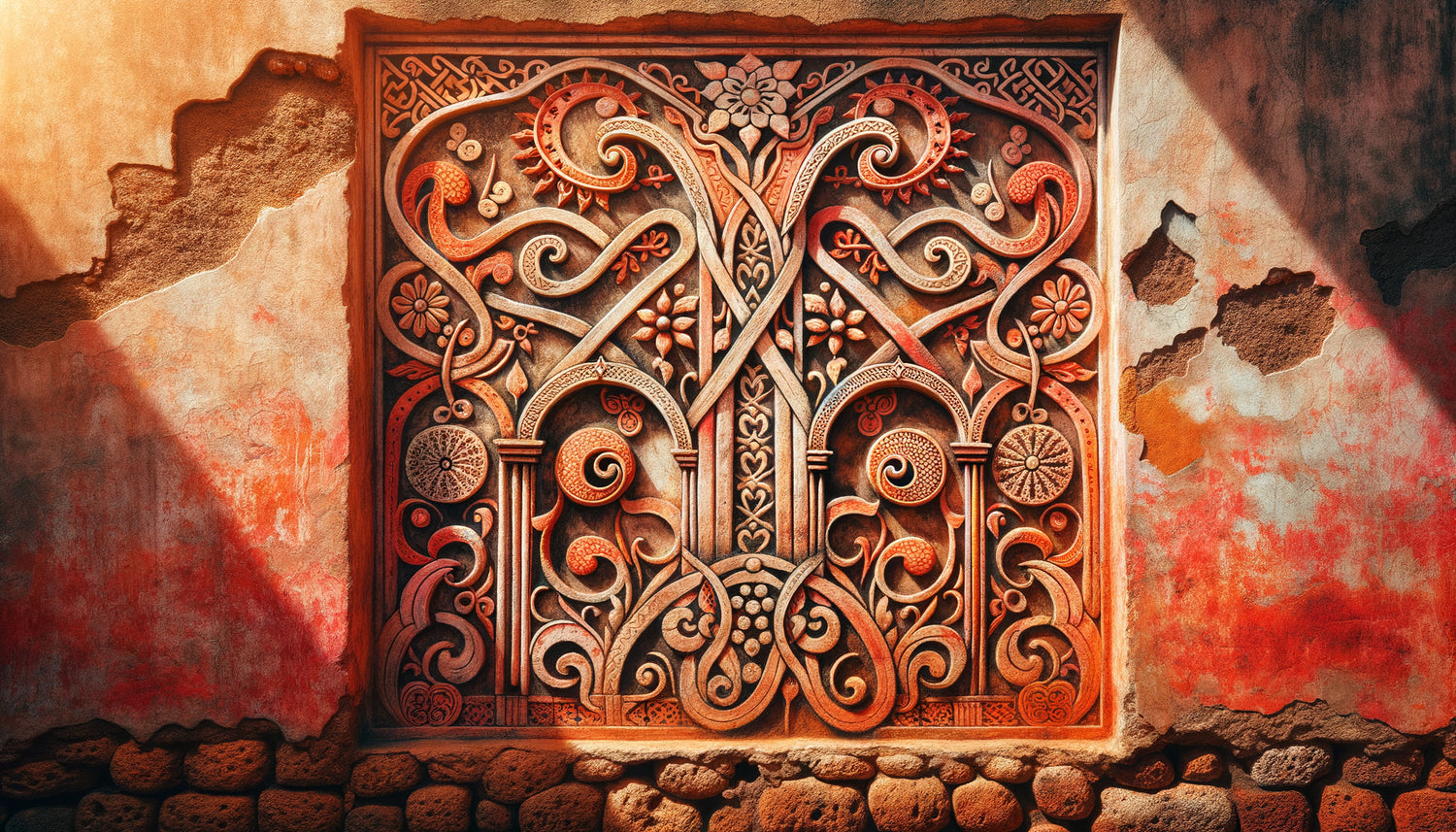
On the lime-washed walls of the old Lamu homes, a pinkish-orange hue of almost supernatural brightness continues to intrigue visitors. It is neither ochre nor cinnabar, but something far rarer: red coral powder, patiently ground into stone mortars. For centuries, this precious pigment has adorned the interiors of Swahili houses, testifying to an artistic mastery that transformed the treasures of the Indian Ocean into exceptional wall artworks.
Here's what using red coral as a pigment in Swahili art reveals: an ancestral technique for preparing marine colors, a symbol of social status and connection with the ocean, and a holistic approach to interior decoration that integrated architecture, nature, and spirituality.
You may be fascinated by natural pigments and their history, but information about Swahili artistic practices remains scattered, often buried in inaccessible academic studies. How did these artisans transform a marine organism into wall color? What was the symbolism behind this costly choice?
Rest assured: by exploring the techniques, rituals, and cultural significance of red coral in Swahili mural art, you will discover a little-known chapter in African artistic history. This article takes you to the fortresses of the East African coast, where the ocean dictated the artists' palette.
The red gold of the Indian Ocean: anatomy of a marine pigment
The red coral used by Swahili artists was not the kind found today in jewelry stores. It was mainly Corallium rubrum and related species, harvested from the depths of the Indian Ocean during perilous expeditions. Swahili divers, heirs to millennia-old maritime traditions, sometimes descended more than twenty meters to tear these calcareous branches from underwater formations.
Once brought ashore, the coral underwent meticulous transformation. The artisans carefully cleaned it, removing any organic traces that could compromise the purity of the pigment. Dried in the sun for several days, the coral became brittle, ready for grinding. This step was crucial: in stone or massive coral mortars, the fragments were ground for hours until a powder as fine as flour was obtained.
The grain size determined the intensity of the color. Coarse powder produced pale, almost pink hues, while prolonged grinding revealed deeper shades, tending towards orange-red. Swahili master artisans knew these subtleties and adapted their technique according to the desired effect. The red coral pigment was never uniform: it carried within it the variations of the ocean.
The preparation of the binder: when chemistry meets tradition
Coral powder alone was not enough. To adhere to the lime plaster walls, it had to be mixed with a binder. Swahili artists primarily used two substances: beaten egg white and a vegetable resin extracted from acacia or copal. Egg white, abundant in coastal communities, created an emulsion that fixed the pigment while preserving its luminosity. Resin, more durable, was reserved for frescoes intended to last through generations.
This alchemy was jealously guarded. Each workshop, each family of artisans possessed their own proportions, passed down from generation to generation. Some added lime juice to stabilize the color, others preferred seawater, creating a symbolic connection between the pigment and its marine origin.
Walls that tell the ocean's story: wall application techniques
In traditional Swahili homes, walls were not mere surfaces. They told stories, asserted status, invoked protection. The application of red coral powder followed specific codes, often linked to the particular architecture of these stone coral fortresses.
Artisans began by preparing the wall with several layers of quicklime, creating a smooth and slightly porous surface. This preparation was essential: the plaster had to absorb just enough pigment without diluting it. Timing was critical. The application of red coral was traditionally done on fresh plaster, using a technique similar to Italian fresco, allowing the pigment to penetrate the very structure of the wall.
Patterns varied by region and era. In Lamu, red coral decorative borders highlighted the recessed niches called zidaka, these alcoves where Chinese porcelain and precious objects were stored. In Zanzibar, geometric friezes combined red coral with other pigments: imported indigo, pure lime white, creating polychrome compositions of remarkable sophistication.
Sacred areas: where red coral took on its full meaning
Not all rooms received the same treatment. Red coral pigment was reserved for reception rooms and main bedrooms, never kitchens or service areas. In the marital bedroom, bands of red coral often framed doors and windows, creating a symbolic protection. This color, extracted from the depths of the sea, was believed to ward off evil spirits and promote fertility.
The baraza, these built-in benches where guests were received, frequently featured red coral inlays in their plaster. A detail that no one missed: possessing walls adorned with this pigment meant that the family had the means to finance diving expeditions, pay skilled artisans, in short, that they held a high social position in the Swahili hierarchy.

The Value of a Pigment: Economy and Trade of Red Coral
Red coral was not just an artistic material, it was a medium of exchange in the vast trade network of the Indian Ocean. Swahili merchants exported raw coral to India, Persia, and even China, where it was prized for jewelry and traditional medicine. In return, they imported pigments such as Afghan lapis lazuli or Chinese vermilion.
But reserving red coral for local wall art represented a deliberate, almost political choice. It was asserting Swahili identity, celebrating local resources rather than succumbing entirely to the allure of exotic materials. The great merchant families of Mombasa, Pate, or Kilwa commissioned wall decorations integrating red coral as a signature of their rootedness in coastal culture.
The cost of this pigment was considerable. A small box of red coral powder was equivalent to the price of several Indian fabrics or a jar of honey. Artisans charged accordingly for their services, transforming each mural project into a multi-year investment for those commissioning it. This expensiveness explains why, even today, only the old patrician residences retain visible traces of this precious Swahili pigment.
When the Sacred Meets Aesthetics: Symbolism of Coral Red
In the Swahili spiritual universe, a blend of Sunni Islam and pre-Islamic African beliefs, colors were never neutral. Red, in particular, carried an intense symbolic charge. Color of blood, life, protection, it was part of a complex cosmology where each hue corresponded to specific spiritual forces.
Red coral, because it came from the ocean, was doubly meaningful. The Indian Ocean, Bahari ya Hindi, was perceived as a liminal space, a border between the world of the living and that of aquatic spirits, the majini. Using a material from this space on domestic walls created a protective barrier, a way to tame oceanic forces rather than fear them.
Traditional healers, the waganga, sometimes recommended applying red coral in homes affected by bad luck or illness. The pigment was then mixed with Quranic verses written on wooden tablets, dissolved in water, and incorporated into the wall preparation. This practice, at the intersection of art and therapeutic ritual, testifies to the deep integration of the coral pigment into Swahili daily life.
Weddings and births: moments of pigment renovation
Major family events often triggered wall renovation campaigns. Before a wedding, wealthy families would bring in artisans to refresh the decorations in coral red, particularly in the room intended for the newlyweds. This costly and ostentatious practice publicly demonstrated the lineage's prosperity.
At the birth of a child, especially a boy destined to perpetuate the family name, some families added a new band of coral red to the existing decoration, creating a visual chronology of generations. These walls became veritable family archives, where each layer of pigment told a story of continuity and transmission.

Conservation and disappearance: the twilight of a tradition
Today, Swahili coral red wall art largely belongs to the past. Several factors have contributed to its decline. First, the scarcity of coral red itself, victim of overfishing and climate change. International regulations on coral protection have made their harvesting illegal in most areas, cutting off the supply to the few artisans who still perpetuated the tradition.
Secondly, the evolution of architectural tastes. From the 19th century onwards, Omani then British colonial influence introduced new decorative styles. Industrial paints, cheaper and easier to apply, gradually replaced natural pigments. The ancestral know-how was diluted, transmitted in a fragmented manner, until it became almost invisible.
Conservation efforts are recent and uneven. In Lamu, a UNESCO World Heritage site, a few historic houses jealously preserve their original coral red decorations. Restoration projects attempt to reproduce the ancient techniques, but face a major obstacle: the impossibility of using genuine coral red. Restorers turn to synthetic pigments or other natural materials such as hematite, but the effect is never quite the same.
Swahili red coral powder thus represents one of these artistic knowledges threatened with extinction, victim both of ecological and cultural evolution. The last witnesses of this practice, a few octogenarian artisans in the alleys of Stone Town, share their memories with anthropologists, aware of being the guardians of an immaterial heritage disappearing.
Let the artistic legacy of Africa illuminate your interiors
Discover our exclusive collection of African paintings that capture the chromatic and symbolic richness of the artistic traditions of the continent.
Contemporary resonances: when design draws inspiration from Swahili coral
Although the authentic practice has almost disappeared, its influence persists in contemporary African design. Interior architects in Nairobi and Dar es Salaam are reinterpreting Swahili aesthetics by incorporating coral hues into their high-end projects. These pink-orange shades, applied to tadelakt or polished concrete walls, evoke coastal heritage without claiming to reproduce it faithfully.
Some creators go even further by collaborating with marine biologists to develop bio-sourced pigments from algae or seashells, seeking to rediscover this original connection between architecture and the ocean. These experiments, although technologically advanced, are in line with the Swahili philosophy of a habitat that dialogues with its immediate natural environment.
The African contemporary art market has also rediscovered the interest in this tradition. Artists like Issa Samb or members of the Matatu collective have created installations that explicitly reference Swahili wall decorations, questioning the loss of artisanal know-how in a world dominated by industrial production. Their works, exhibited in international galleries, help to keep alive the memory of this precious pigment of Swahili art.
The use of red coral powder in Swahili mural art reminds us that true luxury does not lie in importing exotic materials, but in the ability to sublimate local resources. These coastal artisans, by transforming oceanic coral into wall luminosity, created more than just decorations: they wove links between architecture, nature and the sacred, in a holistic vision of habitat that our era rediscovers with respect mixed with nostalgia. Each preserved fragment of wall in Lamu or Zanzibar is a silent testament to this aesthetic wisdom, inviting us to rethink our relationship to pigments, colors, and the treasures hidden within our immediate environment.
Frequently asked questions about red Swahili coral pigment
Can we still find original walls decorated with red coral today?
Yes, but they are extremely rare and fragile. The best preservations can be found in the old patrician residences of Lamu, a UNESCO World Heritage site, as well as in some historic buildings in Stone Town, Zanzibar. These decorations are protected and access is often limited. Most have suffered from the erosion of time, humidity, and sometimes clumsy restorations with modern materials. If you visit these historical cities, some museums and carefully restored houses allow you to admire these testimonies. Local guides generally know the addresses where the most significant fragments still survive. It must be understood that these walls are not mere tourist curiosities, but valuable material archives of a disappearing culture. Their fragility requires respect and discretion during visits.
Why not reproduce this technique with farmed or synthetic coral?
Several initiatives have attempted to recreate this technique, but they face practical and symbolic obstacles. First, farmed coral remains rare and expensive, mainly intended for the restoration of reefs. Using synthetic calcium carbonate coral produces a similar color, but traditional artisans emphasize that the texture and luminosity are never identical. Natural coral contains microscopic organic inclusions that create subtle variations in the pigment, impossible to artificially reproduce. Symbolically, using a substitute empties the practice of its deep cultural meaning: the link with the Indian Ocean, the courage of the divers, ancestral transmission. It's a bit like replacing saffron with food coloring in a traditional recipe – technically feasible, but culturally unsatisfying. Restoration projects now prioritize the conservation of existing decorations rather than creating new ones with substitutes.
How to draw inspiration from this aesthetic in a contemporary interior without cultural appropriation?
Drawing inspiration from Swahili aesthetics in a respectful manner involves several precautions. First, prioritize understanding: thoroughly research the Swahili culture, its values, and its history. Then, work with contemporary African creators who reinterpret this heritage themselves, rather than directly copying traditional patterns. Opt for coral-orange hues in your palette without claiming to reproduce ancestral techniques. Integrate works by Swahili or East African artists into your decor, purchasing them through galleries that fairly compensate the creators. Use natural and local materials in your own context, drawing inspiration from Swahili philosophy rather than superficial appearances. Absolutely avoid decorating your walls with fake Swahili patterns bought at discount stores. Respectful inspiration consists of adopting the spirit – valuing local craftsmanship, celebrating natural materials, creating interiors full of meaning – rather than plagiarizing the aesthetics. Finally, if you travel to these regions, support heritage preservation initiatives by visiting historical sites and contributing to conservation projects.