In the twilight of a traditional house in central Mali, I once observed an ancient artisan freehand tracing enigmatic patterns on an earth wall. His precise gestures seemed to obey an ancestral grammar, each line carrying a symbolic weight that only initiates could fully decipher. These symbols of the komo – this Bamana secret society that protects the community from invisible forces – are not mere ornaments. They literally transform the domestic space into a living sanctuary.
Here's what incorporating komo symbols in Bamana wall decorations brings: an invisible spiritual protection enveloping the inhabitants, a tangible connection with ancestors and cosmic forces, and an austere beauty that transcends aesthetics to touch the sacred. These motifs carved into clay or painted with red ochre create much more than decor – they establish a permanent dialogue between the visible and the invisible world.
You may be fascinated by traditional African art, but you are confronted with the hermeticism of these ancestral symbols. How can you understand these enigmatic geometric shapes? Why this obsession with seemingly abstract patterns? And above all, how did these artists manage to infuse so much power into simple wall tracings?
Rest assured: behind the apparent complexity of komo symbols lies a deeply coherent visual logic. Bamana artists followed precise codes, passed down from generation to generation, which gave meaning and function to each decorative element. Their approach combined ritual constraints and creative freedom in a remarkable balance.
I invite you to enter the secret universe of these Bamana wall decorations. Let's discover together how these artists transformed simple walls into spiritual portals, what symbols they chose and according to what hierarchy, and what their approach can still teach us today about the power of wall art.
Sacred geometry: silent language of the komo
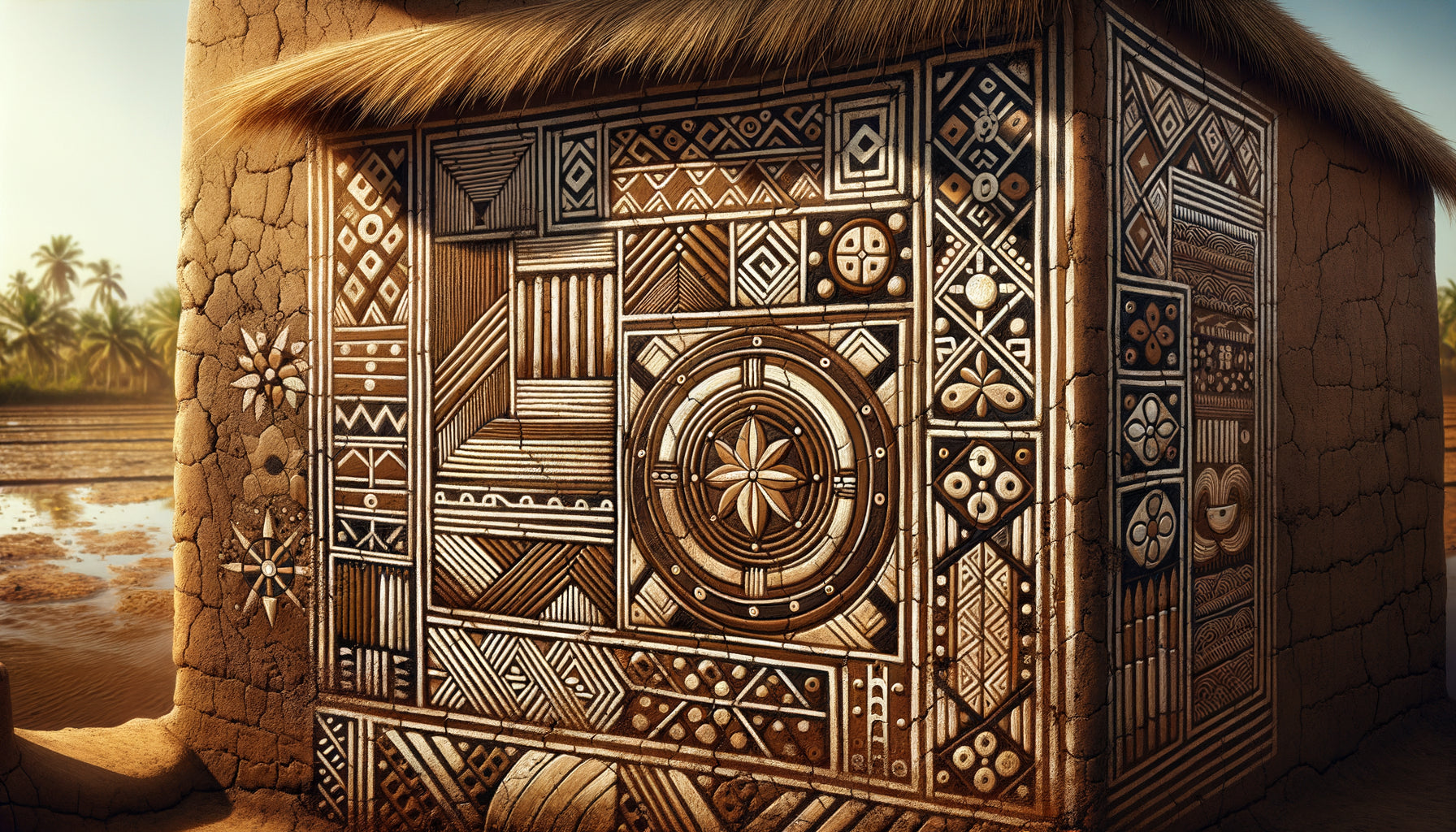
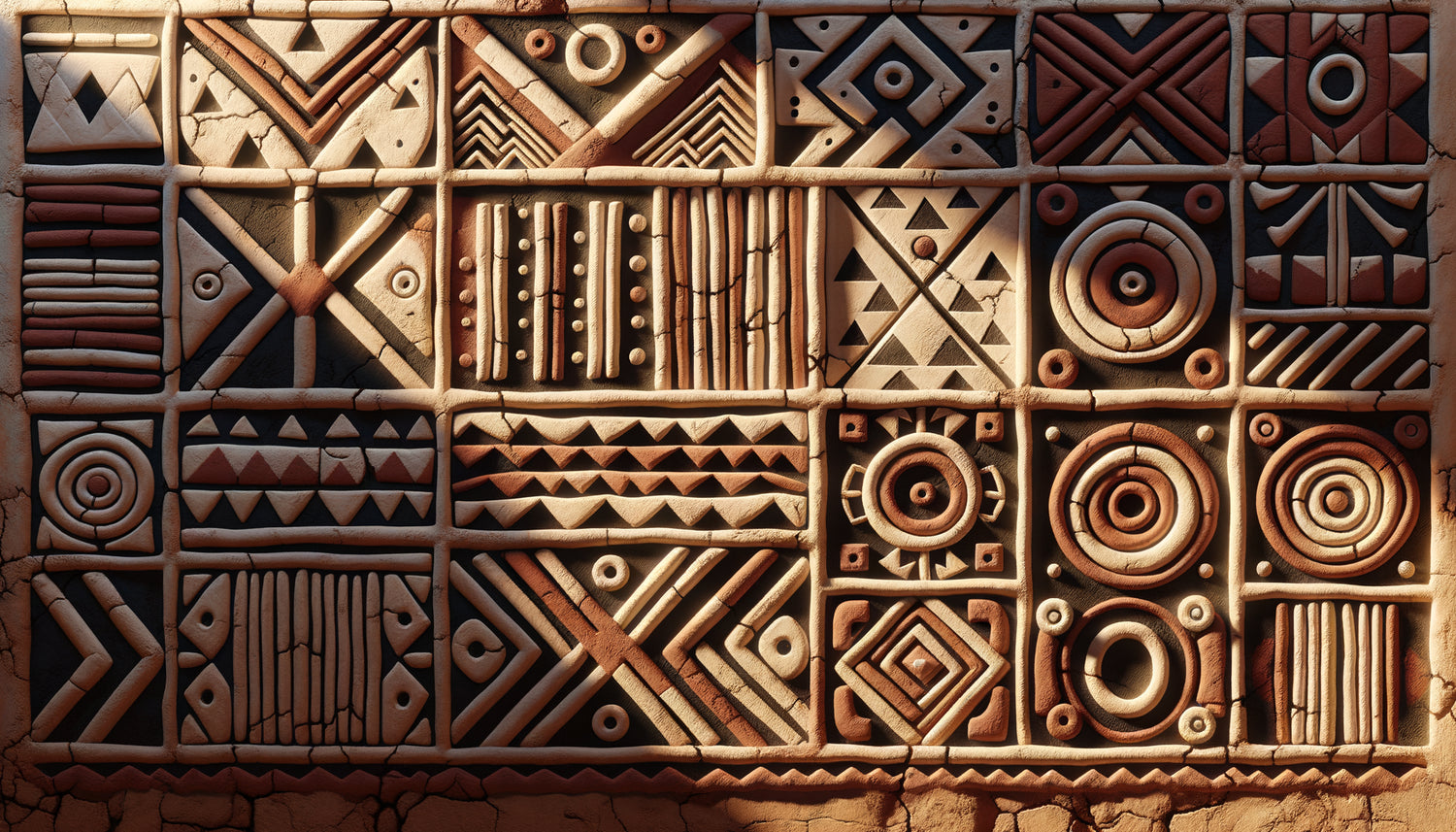
Bamana artists never drew randomly. Each komo symbol obeyed a rigorous sacred geometry, where the straight line, the zigzag and the circle constituted the fundamental visual alphabet. These elementary forms were not chosen for their simplicity, but for their ability to channel invisible energies.
The horizontal zigzag evoked the mythical serpent, guardian of the esoteric knowledge of the komo. In sanctuaries as well as domestic spaces, this motif generally snaked at eye level, creating a symbolic boundary between the profane world and the sacred realm. Artists traced it with red ochre mixed with ritual substances, reinforcing its protective charge.
The concentric circles represented the cosmic cycles and the Bamana universe structure. Arranged in the corners of rooms or framing openings, these komo symbols created energy concentration points. In some old dwellings, I observed how these circles were strategically placed to form an invisible but effective protective constellation.
The equal-armed cross, a symbol of the four cardinal directions and elemental forces, often appeared at the center of wall compositions. It anchored the space within the Bamana cosmic order, recalling that each home was a microcosm reflecting the structure of the world.
The art of concealment: visible symbols and hidden meanings
What makes Bamana murals particularly fascinating is their dual nature. Artists incorporated komo symbols according to a principle of progressive revelation: what the untrained eye perceived as simple geometric ornamentation became, for the initiate, a veritable spiritual cartography.
The motifs were often nested within each other, creating multiple levels of reading. A network of lozenges might seem purely decorative, but in reality contained coded references to the taboos of the komo, tutelary spirits or protective ancestors. This strategy allowed preserving the secretive character of esoteric knowledge while making it omnipresent in everyday space.
The transition zones – thresholds, recesses, corners – received particular attention. It was here that Bamana artists concentrated the most powerful komo symbols, as these liminal spaces were considered vulnerable to harmful spiritual intrusions. The motifs formed invisible but effective protective seals.
The color palette itself carried a profound symbolic meaning. Ochre red, the color of blood and life, dominated representations related to the komo. Kaolin white appeared to evoke purity and ancestral connection, while charcoal black marked areas associated with the deepest mysteries.

Wall techniques: when clay becomes a spiritual support
The incorporation of komo symbols into Bamana murals relied on specific artisan techniques, where the technical gesture and ritual intention merged. Clay walls were not mere neutral surfaces, but living materials, connected to the nourishing earth.
Artists first prepared the wall support with a mixture of clay, cow dung and chopped straw, creating a smooth and resistant surface. This preparation was never purely utilitarian: it was often accompanied by incantations and offerings, transforming the wall into a sacred receptacle even before applying the symbols.
To trace the motifs of the komo, several techniques coexisted. Relief allowed for the creation of three-dimensional symbols: the artisan modeled the fresh clay directly, bringing forth protective shapes from the wall. This technique gave the symbols a remarkable physical presence, projecting changing shadows depending on the daylight.
The incision technique offered a more graphic approach. Using a stick or bone fragment, the artist engraved the symbols into the still-damp plaster. These carved lines captured the light differently, creating a subtle play of textures that animated the compositions.
Finally, ochre painting allowed for the application of komo symbols to already dry surfaces. Natural pigments – red ocher, white kaolin, black charcoal – were mixed with plant binders and sometimes with ritual substances whose composition remained secret. This technique offered the greatest gestural freedom, allowing the most skilled artists to create subtle personal variations while respecting symbolic canons.
Spatial hierarchy: where to place protective symbols?
Bamana artists never placed komo symbols randomly. Each space in the dwelling obeyed a precise spiritual hierarchy, and wall decorations reflected this invisible organization of the world.
The main entrance constituted a critical point of any home. It is here that protective komo symbols were concentrated with the greatest density, forming a barrier against harmful influences from outside. Artists often traced spiral or labyrinth shapes there, designed to disorient evil spirits while letting beneficial energies pass through.
Interior walls received different symbols depending on the function of each room. In the resting area, motifs evoked nocturnal protection and prophetic dreams. Near the hearth, symbols related to fertility and abundance dominated, creating an environment conducive to family life.
Corners and angles were given particular attention. Considered as areas where energies stagnated and spirits could hide, they received komo symbols specifically intended to purify and energize these spaces. Artists often traced radiating patterns there that seemed to project their protective influence in all directions.
The ceiling, when accessible, sometimes bore cosmic symbols – stylized stars, solar circles – recalling the connection between the earthly dwelling and celestial forces. This upper decoration completed the protective envelope, creating a hermetically sealed microcosm against negative influences.

Between Tradition and Creative Improvisation
One of the most fascinating aspects of incorporating komo symbols into Bamana wall decorations lies in the subtle balance between respecting traditional canons and the artist's personal expression. Contrary to what one might imagine, these creations were not simple mechanical repetitions of fixed formulas.
Each artist developed their personal style within the limits allowed by tradition. Two walls decorated with the same komo symbols never looked exactly alike: the thickness of the lines, the density of the patterns, and subtle variations in proportions created a unique visual signature. This controlled freedom allowed the artist to infuse their own energy into the protective work.
Ritual constraints defined a strict framework: certain symbols could only be traced by initiates of high rank, others required specific temporal conditions (moon phase, time of day). But within this framework, the Bamana artist had considerable room for interpretation.
The transmission of knowledge was done through observation and progressive practice. An apprentice would begin by preparing surfaces and pigments, then trace the least symbolically charged patterns before gradually gaining access to the most powerful symbols of the komo. This initiation journey ensured that only those who deeply understood the meaning of the symbols incorporated them into wall decorations.
When a Wall Becomes a Bridge Between Worlds
Beyond their protective function, the komo symbols transformed Bamana walls into veritable spiritual interfaces. These decorated surfaces were not inert barriers but living membranes, permeable to beneficial influences and impermeable to harmful forces.
Artists designed their wall compositions as active devices. Some symbols functioned as calls to protective spirits, others as traps for negative energies. This dynamic conception of wall decoration far exceeded our modern purely aesthetic approach to wall art.
Activation rituals complemented the artistic work. Once the komo symbols were traced, specific ceremonies conferred their full effectiveness on them. These rituals transformed visual patterns into veritable operational spiritual tools. Without this activation, the symbols remained simple forms, beautiful but inert.
The temporal dimension also played a crucial role. Bamana wall decorations were not designed to last forever. They accompanied the life of the building, aged with it, and their progressive deterioration was part of the natural cycle. Periodically, artists retraced important symbols, renewing their protective power in a continuous regeneration process.
Let the power of ancestral symbols transform your interior
Discover our exclusive collection of African artworks that capture the spiritual and aesthetic essence of Bamana traditions, to create in your home a space full of meaning and timeless beauty.
The contemporary heritage of a millennial tradition
What do these ancestral practices of incorporating komo symbols into wall decorations teach us today? Far beyond their specific cultural context, they remind us that wall art can be much more than just decoration.
The Bamana approach invites us to consider our living spaces as meaningful environments, where each visual element carries an intention and contributes to creating a specific atmosphere. In our contemporary world often disconnected from symbolism, this perspective offers a rare depth.
Modern artists who draw inspiration from these traditions rediscover the power of repetitive geometric motifs, their ability to structure space and create meditative atmospheres. Without necessarily reproducing the komo symbols, they capture their spirit: this belief that visual forms act on our psyche and well-being.
Perhaps the most valuable lesson concerns the creative process itself. Bamana artists show us that it is possible to combine formal rigor and creative freedom, respect for traditions and personal expression. Their wall decorations prove that constraints – whether ritualistic, technical or symbolic – stimulate inventiveness rather than stifle it.
Imagine yourself standing in front of an authentic Bamana wall, observing these komo symbols that have protected generations. You suddenly understand that wall art can be a language - a silent dialogue between space, its inhabitants and the invisible forces surrounding them. Perhaps it is time to reintroduce this intentional dimension into our own spaces, to transform our walls into carriers of meaning and not just color.
The incorporation of komo symbols into Bamana wall decorations ultimately reminds us of a universal truth: our visual environments shape our daily experience in profound and often unconscious ways. By consciously choosing the patterns that surround us, we become co-creators of our own spatial well-being.
Frequently Asked Questions
Were the komo symbols accessible to all Bamana artists?
No, and that is where the fascinating complexity of this tradition lies. The incorporation of komo symbols into wall decorations was reserved for initiates who had received appropriate instruction within the secret society. However, there were several levels of symbols: some simple geometric patterns could be used by non-initiated artists for their aesthetic qualities, while the most powerful and esoteric symbols required deep initiation. This hierarchy ensured that the most sacred representations retained their spiritual charge and were not trivialized. Bamana artists thus developed a dual skill: technical on one hand, spiritual on the other, and it was the combination of the two that gave birth to the most powerful wall decorations.
Can these symbols be reproduced in a contemporary decoration without understanding their meaning?
This is an important ethical and aesthetic question. Strictly visually, nothing prevents you from drawing inspiration from Bamana geometric shapes to create contemporary wall compositions – these patterns possess intrinsic beauty that transcends their original context. However, it is crucial to approach this with respect and awareness. The komo symbols carry a deep spiritual meaning for the Bamana culture, and their purely decorative reproduction can be seen as superficial cultural appropriation. The most respectful approach is to draw inspiration from the spirit of these decorations – their intentional geometry, their protective function, their symbolic dimension – rather than literally copying sacred motifs. You can create your own personal symbols, charged with your intentions, drawing on Bamana compositional principles without exactly reproducing their ritual codes.
How did Bamana wall decorations resist the weather and time?
Bamana artists had developed a remarkable empirical knowledge of materials and their durability. The clay used for the walls was carefully selected and mixed with organic binders that improved its strength. Natural pigments – ochres, kaolin, charcoal – penetrated deeply into the porous surface of the plaster, creating a durable chemical bond. For exterior surfaces exposed to rain, artists sometimes applied a protective coating based on gum arabic or other vegetable resins which partially waterproofed the decorations. However, the Bamana philosophy did not grant these works the permanence that we often seek in Western art. Regular maintenance, periodic retracing of the komo symbols were part of the normal life cycle of these wall decorations. This ritual maintenance renewed both spiritual protection and visual beauty, in a cyclical conception of time and art perfectly consistent with the Bamana cosmology.