The first time I crossed the threshold of a Maasai manyatta, in the southern plains of Kenya, I was literally enveloped by this reddish-brown hue that seemed to vibrate under the grazing morning light. It wasn't simply a decorative color – it was a living presence, almost palpable, telling a millennia-old story. As an anthropologist specializing in East African visual cultures for twelve years, I spent months understanding this intimate relationship between the Maasai and their characteristic red ochre.
Here's what red ochre brings to Maasai murals: spiritual protection passed down from generation to generation, a sacred bond with ancestral land, and a cultural identity expressed through every pictorial gesture.
Many admire the aesthetics of African mural paintings without understanding the deep reasons that govern these chromatic choices. It is often thought to be a simple aesthetic preference, when each color carries a precise symbolic meaning, rooted in the cosmology of the people.
Yet, decoding these visual messages does not require being an anthropologist. It simply takes understanding how red ochre fits into the belief system and daily life of the Maasai.
In this article, I reveal the five dimensions that explain why this particular shade dominates the walls of Maasai homes – reasons that will transform your gaze on African mural art and perhaps enrich your own decorative choices.
Red earth: symbolic matrix of Maasai identity
Red ochre is not just a color in the Maasai universe – it's the foundational color, the one that structures their relationship with the world. When Maasai women prepare the pigment for mural paintings, they use red ochre (olkaria) mixed with animal fat and sometimes cow blood. This process is not just a technique: it’s a ritual that connects the community to the earth itself.
In Maasai cosmology, the color red symbolizes vital force, courage, and unity. It's the color of the blood flowing in the veins of warriors, the one that marks initiation rites, the one that protects against hostile forces. When a woman coats the walls of her home with this reddish-brown paste, she is not simply decorating: she inscribes her home into a spiritual and ancestral continuum.
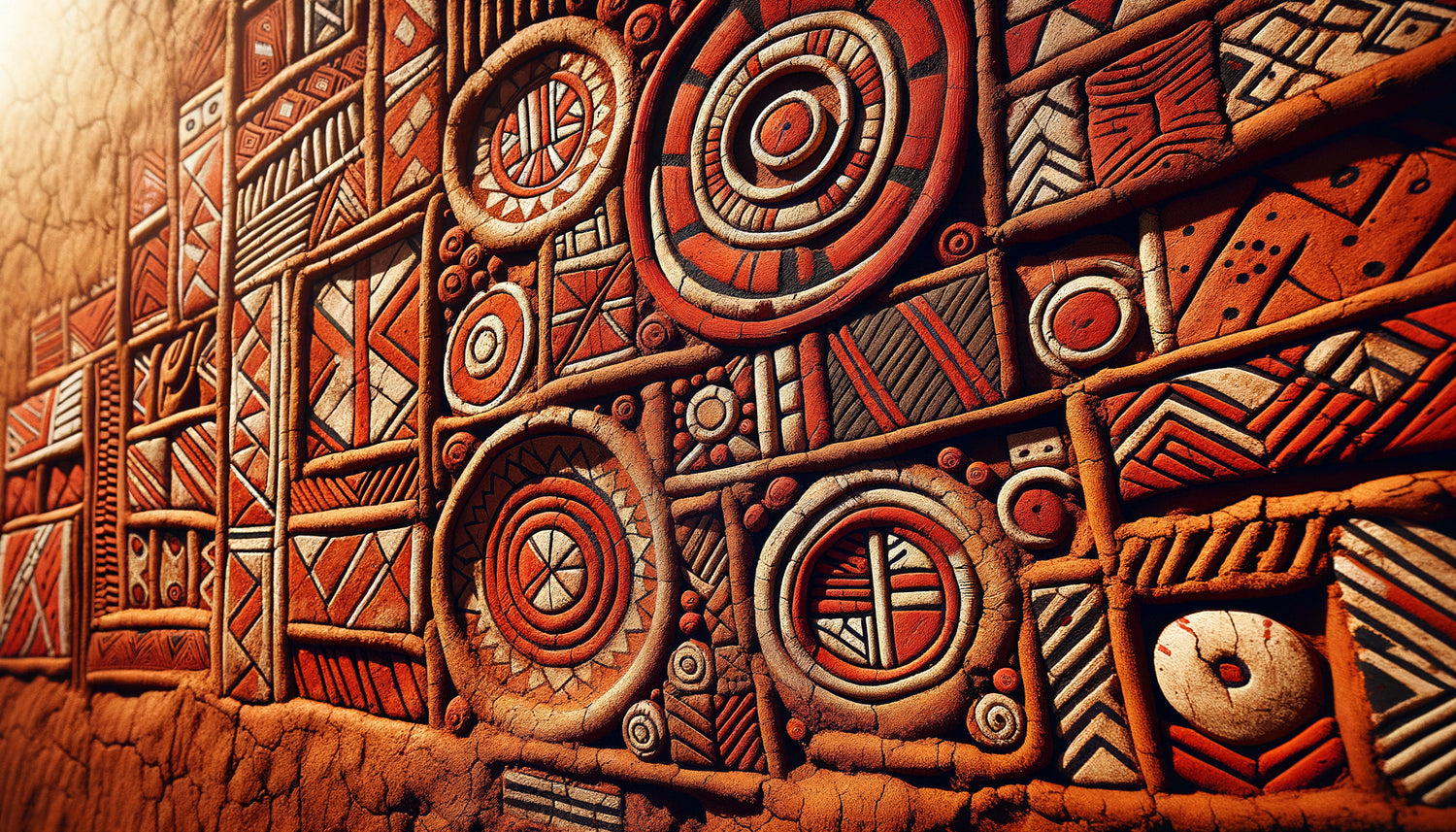
I observed this practice during the construction of a new manyatta near Amboseli. The matriarch of the family, Mama Nolturesh, explained to me that each layer of red ochre applied to the dried cow dung walls represents a blessing of protection. The geometric patterns traced afterwards – lines, triangles, diamonds – are not arbitrary: they tell the story of the family, invoke the prosperity of livestock, ward off evil spirits.
A palette dictated by the natural environment
The dominance of ochre red in Maasai murals is also explained by a eminently pragmatic reason: the availability of the material. The soils of the semi-arid regions where the Maasai live – from southern Kenya to northern Tanzania – are naturally rich in iron oxide, the mineral that gives ochre its characteristic red hues.
This red earth is extracted from specific sites, often known only to elder women who hold this traditional knowledge. Unlike modern synthetic pigments, natural ochre has remarkable properties: it is durable, weather-resistant and does not degrade under the intense sun of the savanna. Murals created in this way can retain their vibrancy for months, despite difficult climatic conditions.
I was fortunate enough to accompany a group of women on an ochre collection trip in the hills near Narok. They choose earths with subtle nuances – from deep brick red to almost purple brown – according to the intended use. For exterior murals, they prefer a darker, denser ochre, while for interiors, they opt for lighter and brighter tones.
The pigment preparation process
The transformation of raw earth into mural paint follows a precise protocol. The ochre is first pulverized on a flat stone, then sieved to remove impurities. It is then mixed with cow or sheep fat which acts as a natural binder and gives the paint its smooth texture. Sometimes fresh blood is added to intensify the color and strengthen the protective properties of the coating.
This preparation is exclusively carried out by women, custodians of this ancestral know-how. It is a collective activity that strengthens social bonds: young girls learn from the elders, perpetuating a tradition dating back centuries.

Ochre red and architecture: a functional symbiosis
Beyond its symbolic dimension, ochre red responds to specific architectural imperatives for Maasai dwellings. Traditional manyattas are built with a framework of flexible branches covered with a mixture of cow dung, earth and straw. This composite material, while effective, requires additional protection from erosion and parasites.
Applying a layer of paint based on red ochre mixed with animal fat creates a waterproof coating that protects walls from seasonal rains. The fat repels water while the ochre, rich in iron oxide, has natural antiseptic properties that deter insects and prevent degradation of the underlying material.
During my research in the Kajiado district, I measured the difference in durability between walls treated with red ochre and others left raw. The former maintained their structural integrity up to twice as long, resisting termites and rain erosion better. This feature explains why, even in Maasai communities who have access to industrial paints, many continue to favor the traditional mixture of red ochre.
The language of patterns: when red ochre tells stories
If the color red ochre dominates, it is the geometric patterns traced with this paint that give meaning to Maasai walls. Each line, each shape has a precise meaning, passed down orally from mother to daughter. These murals constitute a true visual language that communicates information about the family who lives in the manyatta.
Chevron patterns, for example, symbolize the herd of cattle – fundamental wealth in Maasai society. Circular motifs represent family unity or lunar phases that rhythm pastoral life. Vertical lines evoke the spears of warriors, symbols of protection. Each woman also develops her own repertoire of patterns, creating a personal visual signature that distinguishes her home.
I documented more than fifty variations of different patterns in a single community near Oloitokitok. Mama Naserian, an artist recognized for her exceptional murals, showed me how she adapts traditional patterns to family events: more elaborate patterns after a successful marriage, fertility symbols during childbirth, representations of strength during periods of drought.
The temporal dimension of murals
Unlike our permanent decorations, Maasai red ochre murals are ephemeral and cyclical. They are regularly retouched – often after the rainy season or during important events. This impermanence is not a defect but an essential characteristic: it allows women to constantly update their artistic expression, integrate new narratives, mark the passage of time.
This cyclic conception of mural art has deeply inspired me. In our Western interiors, we often seek permanence, while the Maasai tradition teaches us the beauty of regular renewal, constant dialogue between habitat and its occupants.

Ochre red and cultural identity facing modernity
In the contemporary context, the persistence of ochre red in Maasai murals represents a cultural resistance act. While many communities have adopted modern construction materials and industrial paints, choosing to maintain the tradition of red ochre affirms an identity continuity in the face of globalization pressures.
I observed a fascinating phenomenon in peri-urban areas: even when the Maasai build permanent houses with cement walls, many incorporate decorative panels treated with traditional red ochre, or reproduce ancestral geometric patterns with modern paints in similar shades. This adaptation testifies to the vitality of tradition and its ability to reinvent itself.
Red ochre has become a visually recognizable symbol of Maasai identity, even beyond the borders of their territory. In schools, cultural centers, artisan cooperatives, this distinctive color signals belonging to a community and pride in perpetuating an ancestral heritage.
Inspiring our interiors: lessons from Maasai ochre red
Beyond anthropological analysis, Maasai murals offer valuable lessons for our own spaces. The use of red ochre teaches us the importance of choosing colors that have a deep resonance, that tell a story rather than simply following ephemeral trends.
This warm, earthy hue has a remarkable ability to create atmospheres that are both energizing and soothing. It dialogues beautifully with natural materials – wood, linen, rattan – and brings an incomparable depth to contemporary spaces, especially in styles that value authenticity and connection with nature.
Several designers I know have incorporated shades of red ochre into their palettes, not to literally reproduce the Maasai aesthetic, but to draw inspiration from this philosophy of color: choosing hues charged with meaning, prioritizing natural pigments, creating patterns that tell our own family story.
Be inspired by the chromatic richness of Africa
Discover our exclusive collection of African paintings that capture the essence of ancestral pictorial traditions and bring this authentic cultural depth to your interior.
Conclusion: The timeless power of a sacred color
Ochre red dominates Maasai wall paintings because it simultaneously embodies a spiritual identity, a pragmatic technical solution, and a sophisticated visual language. This color is not simply an aesthetic choice; it is the thread that connects the Maasai to their land, their ancestors, and their vision of the world.
By understanding the multiple dimensions of this color – symbolic, functional, social, artistic – we enrich our own chromatic sensitivity. We learn to see colors not as simple decorative coatings, but as vectors of meaning and emotion that profoundly transform the experience of our living spaces.
The next time you choose a color for your interior, ask yourself: what story do you want it to tell? The ochre red of the Maasai reminds us that the most lasting choices are those that resonate with our deepest values.
FAQ: Understanding Maasai wall paintings
Can we use Maasai ochre red in our Western interiors?
Absolutely, and it's even a growing trend in contemporary decoration! Ochre red offers a palette of warm shades – from Sienna earth to brick red – that blend beautifully into modern interiors, especially those that value natural materials. You can opt for natural paints based on true ochre, available from manufacturers specializing in ecological paints. The trick is to use these tones on an accent wall rather than the entire room, combining them with neutral tones (off-white, beige, warm gray) and natural textures such as linen or raw wood. This approach captures the spirit of Maasai paintings – authenticity and connection to the earth – while remaining adapted to our Western aesthetic codes.
Do all Maasai geometric patterns have a precise meaning?
Yes, each pattern traced in ochre red on Maasai walls possesses a cultural significance, even if it can vary slightly from one region to another. Triangles generally represent sacred mountains or traditional huts, zigzag lines evoke the serpent (associated with rain and fertility), concentric circles symbolize community unity or kraals (cattle enclosures). However, there is also a personal dimension: each female artist develops her own visual vocabulary, enriching traditional patterns with her personal innovations. If you wish to draw inspiration from these patterns for your decoration, I recommend approaching them with respect and curiosity – not as mere decorative elements, but as symbols laden with history that can enrich your space with their cultural depth.
Why don't the Maasai use other colors in their wall paintings?
It’s a question I have long asked myself! In reality, the Maasai occasionally use other colors – white (based on chalk or kaolin) for certain ceremonial patterns, and sometimes black (charcoal) for specific details. But ochre red indeed dominates overwhelmingly, and this is explained by a combination of factors: its natural availability in the environment, its central spiritual significance in the Maasai cosmology (red as the color of life and protection), and its superior functional properties to protect walls. Moreover, in a culture where every element has a precise meaning, chromatic consistency creates a strong and immediately recognizable visual identity. This voluntary limitation of the palette is not a constraint but a conscious cultural choice that reinforces the symbolic power of color. It’s also a valuable lesson for our interiors: sometimes restriction creates more depth than abundance.