Imagine: a Saharan plateau swept by winds, ochre gorges sculpted by time, and suddenly, sheltered within a cavity, enigmatic wall figures gaze at you across eight millennia. Silhouettes with round heads, floating like astronauts, chariots drawn by impossible horses in this desert, scenes of life so detailed they seem to tell forbidden stories. In the Tassili n'Ajjer, in the vastness of Algeria, the rocky walls murmur a mystery that has fascinated archaeologists, lovers of rock art and seekers of enigmas since their discovery in the 1930s.
Here is what these murals reveal: an exceptional cultural crossroads, unsuspected migrations between Africa and the Mediterranean, and the dizzying hypothesis of contacts with distant civilizations or... from elsewhere. Some see them as aquatic deities from the Nile, others as prehistoric Mediterranean influences, a few dare to speak of extraterrestrial representations. You may have heard these fantastical theories in sensationalist documentaries, without ever understanding what the Tassili caves really tell. You wonder: simple shamanic art or evidence of intercontinental exchanges? Between myths and archaeological reality, how do you separate fact from spectacle?
Rest assured, the murals of the Tassili n'Ajjer speak a language that we are beginning to decipher. Far from Hollywood scenarios, they reveal something much more captivating: the story of a verdant Sahara, a meeting place for peoples, a witness to cultural revolutions that shaped North Africa. I invite you to dive into these natural galleries, to understand what these figures really tell us, and to discover why they continue to inspire interior architects, designers and contemporary creators in search of primitive authenticity.
A Sahara unlike the one we know today
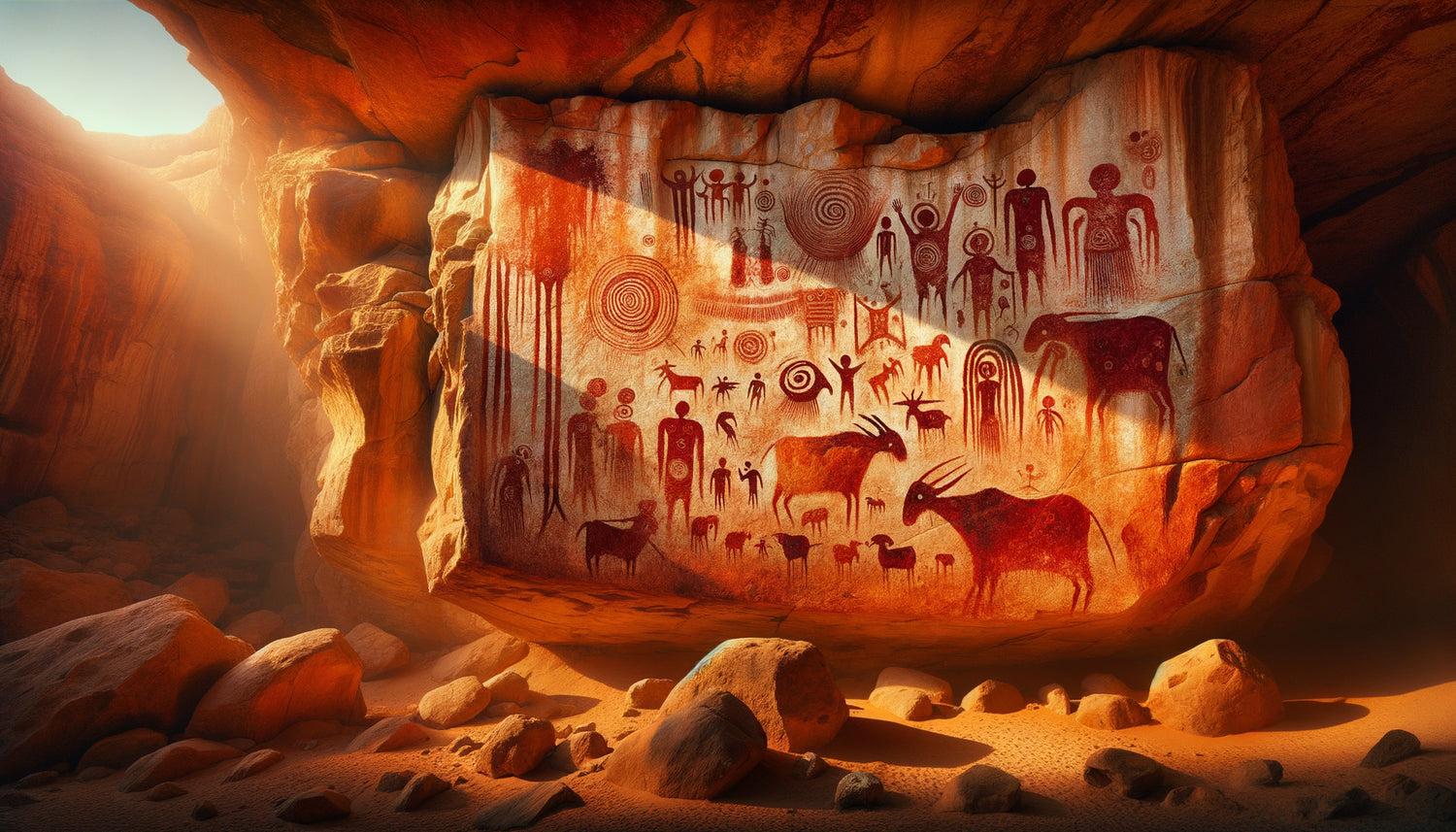
When the first artists engraved the walls of the Tassili n'Ajjer, around 8000 BC, the Sahara was a lush savanna. Lakes shimmered between the plateaus, herds of giraffes, elephants and hippos roamed verdant prairies. The murals from the so-called 'Round Heads' period show precisely this universe: scenes of buffalo hunting, ritual dances, human figures with strange proportions, sometimes gigantic, sometimes tiny, often adorned with complex body patterns.
What strikes you about these ancient representations is their graphic sophistication. The artists mastered perspective, played with superimpositions, created movement through dynamic postures. Some figures, several meters high, seem to float in an undefined space, draped in clothing that evokes spacesuits more than animal skins. Where does this enigmatic aesthetic come from? Do they represent shamans in trance, mythological deities, or as Henri Lhote (the archaeologist who popularized the site) suggested, 'prehistoric Martians'?
Mediterranean influences’ clues
Around 4000 BC, the Tassili paintings radically change in style. We then see representations of domestic bovines, beautifully detailed, with spotted or monochrome coats, characteristic lyre-shaped horns. This 'bovid period' coincides with the Neolithic revolution of the Sahara: breeding gradually replaces hunting. But what is striking are the clothing details and hairstyles of some human figures accompanying these herds.
Women wear loose dresses strangely similar to Cretan-Mycenaean costumes, men sport braided beards reminiscent of Egyptian codes. Archaeologists have identified decorative motifs - spirals, checkerboards, zigzags - which find disturbing echoes in the Neolithic art of the Mediterranean. Is it aesthetic convergences or evidence of intercultural contacts? Recent analyses lean towards the second hypothesis: the green Sahara was a vast space of circulation where herders, hunters and artisans exchanged goods, techniques and symbols.
Ghost chariots: proof of invasions or peaceful migrations?
The debate intensifies with the representations of chariots discovered at several sites in Tassili. These two-wheeled vehicles, drawn by galloping horses (the four legs detached from the ground), appear around 1500 BC. Their very streamlined graphic style contrasts with the naturalism of previous periods. For some researchers, these engraved chariots prove the arrival of populations from the Eastern Mediterranean or Aegean Sea, bringing with them bronze metallurgy and new social structures.
The hypothesis is fascinating: these chariots strangely resemble those used by the Sea Peoples who shook up the Eastern Mediterranean in the 2nd millennium BC. Did they cross the Sahara, still partially green, establishing trade routes that explain the presence of Egyptian pearls found in Niger? Other specialists, more cautious, see it as a local innovation inspired by sporadic contacts with merchants from the North. The murals of the Tassili n'Ajjer then become traces of a transcontinental exchange network much denser than we imagined.
Horsemen who tell the end of a world
The latest great artistic period of the Tassili, that of the horsemen and camels (from 1000 BC), documents the gradual drying up of the Sahara. The paintings become more schematic, almost hasty. We see warriors armed with spears, inscriptions in Lybian-Berber characters, the first camels that will allow crossing the desert which has become hostile. This climatic transformation forces populations to migrate towards the Nile, Niger or the Mediterranean, dispersing their artistic traditions throughout North Africa.
These migrations explain the striking similarities between the rock art of the Tassili and that found in Libya, Morocco, predynastic Egypt or even Neolithic Spain. Rather than a mysterious contact with an extraterrestrial civilization, the caves of the Tassili reveal a much more extraordinary phenomenon: the ability of prehistoric societies to communicate, travel and share their visions of the world across thousands of kilometers.

When extraterrestrial imagination seizes the caves
It is impossible to evoke the paintings of the Tassili without mentioning the controversy launched by Henri Lhote in the 1950s. By publishing his records of the figures with 'Round Heads', he nicknamed them 'the Great Martian God' or 'the astronauts of the Tassili'. These appellations, intended to captivate the public during the Cold War and space conquest, were a resounding success. Theorists of ancient astronauts, such as Erich von Däniken, seized the site as proof of a prehistoric extraterrestrial visit.
Let us objectively look at these famous figures: the 'helmets' are in reality ceremonial headdresses or ritual masks that are found in many traditional African cultures. The 'antennae'? Feather or plant fiber ornaments. The 'space suits'? Body decorations - paintings, scarifications, tattoos - hyperbolized by the graphic style. Careful analysis of the pigments, superposition techniques and archaeological context demonstrates unequivocally that this is shamanic art, representing altered states of consciousness during initiation rituals.
Why do these theories persist?
The extraterrestrial hypothesis persists because it meets a deep human need: mystery and wonder. The murals of the Tassili n'Ajjer are indeed stunning in their antiquity, artistic quality, and formal strangeness. Rather than accepting that our prehistoric ancestors possessed a sophisticated visual imagination and complex symbolic systems, some prefer to invoke an external intervention. Paradoxically, this does them a disservice: these works testify instead to the human creative genius, capable of producing images that still fascinate us eight millennia later.
For lovers of contemporary art and design, these ancestral representations offer an inexhaustible source of inspiration. Their clean forms, chromatic contrasts (ochres, whites, reds), their graphic strength have influenced creators from around the world, from Picasso to Scandinavian designers, through interior architects seeking this primal authenticity for their spaces.
Let yourself be transported by the visual power of ancestral Africa
Discover our exclusive collection of African paintings that capture the graphic and spiritual essence of these millennial rock arts. Contemporary works that dialogue with the deep history of the continent.
What the caves really teach us about contacts between civilizations
Beyond sensationalist speculations, the paintings of the Tassili n'Ajjer reveal three fascinating historical truths. Firstly, the prehistoric Sahara was not a barrier but a cultural bridge connecting the Mediterranean, sub-Saharan Africa and the Middle East. The stylistic similarities between the rock art of these regions are not coincidental but result from human circulations documented by archaeology, genetics and linguistics.
Secondly, these intercultural contacts did not necessarily involve invasions or dominations. Exchanges probably took place gradually, through marriages, trade, pastoral mobility. The caves of the Tassili show scenes of daily life, festivals, collective hunting - no battles or conquests. It is an image of a cosmopolitan prehistory that emerges, far from the cliché of isolated and primitive tribes.
Thirdly, the stylistic diversity of the murals (from hyperrealistic Round Heads to schematic chariots) proves that several artistic traditions have coexisted, influencing each other without completely merging. Each group retained its visual identity while borrowing motifs, techniques or subjects from its neighbors. This is exactly what happens today in contemporary African art: a permanent dialogue between local traditions and global influences.
Lessons for our time
These discoveries invite us to rethink our representations of prehistory. The creators of the Tassili paintings were not isolated individuals waiting for progress from elsewhere. They were accomplished artists, precise observers of their environment, thinkers capable of symbolic abstraction. Their works resist time not by accident, but because they used sophisticated techniques: judicious choice of rocky supports, preparation of mineral pigments, application in successive layers.
For those who love authentic African art, mentally visiting these caves of the Tassili n'Ajjer (the site being difficult to access and protected) is touching the origin of an aesthetic tradition that crosses the millennia. These streamlined shapes, earthy colors, this ability to suggest movement with economy of means: we find them in Dogon masks, Kuba fabrics, Akan sculptures. The Tassili is not an extraterrestrial mystery, it is the visual matrix of part of humanity.

Integrate the spirit of Tassili into your world
How to translate this ancestral power into a contemporary interior? Tassili rock art offers surprisingly modern formal palette: simplified geometric shapes, sharp contrasts, dynamic compositions. In interior design, this aesthetic translates beautifully into large format paintings where ochres, burnt earths and deep blacks create striking focal points.
The mistake would be to fall into folklore or literal reproduction. The spirit of the Tassili is first and foremost an economy of means serving maximum expression. Prioritize works that capture this essence: pure lines, stylized figures, compositions that seem to float in space like these mysterious Round Heads. Combine them with raw materials - stone, untreated wood, natural textiles - which recall the original supports of these millennial murals.
In a clean Scandinavian-style living room, a Tassili-inspired composition brings that mineral warmth sometimes lacking in overly sanitized interiors. In an industrial space, it naturally dialogues with the raw textures of concrete and metal. And in a more eclectic decor, it anchors the whole thing in a historical depth that transcends fleeting trends. That's the difference between a decoration that follows trends and a space that tells a universal story.
So, contact with other civilizations or local genius?
The murals of the Tassili n'Ajjer caves reveal contact with other civilizations? The scientific answer is a nuanced yes: yes to rich and constant intercultural exchanges between North Africa, the Mediterranean and probably the Middle East; no to extraterrestrial intervention or cultural colonization from elsewhere imposing its codes. The Tassili was a crossroads, not a periphery.
These contacts enriched without erasing local traditions. Each artistic period - Round Heads, bovids, chariots, riders - shows an creative adaptation to climate change, new techniques, encounters with other peoples. It is precisely this capacity for absorption and transformation that makes the art of the Tassili so current: it speaks to us of métissage, dialogue, resilience in the face of upheaval. In this respect, these rock paintings from 8000 years ago teach us something essential about our globalized present: openness to other cultures does not erase identity, it strengthens it.
When you contemplate a work inspired by the Tassili, you are not just looking at an African decorative motif. You welcome into your home the testimony of a unique moment in human history: when the Sahara was green, when caravans linked continents, when anonymous artists created on stone images that continue to question us millennia later. It is this dialogue across time that makes these ancestral representations irreplaceable in an interior that aspires to authenticity and depth.
Frequently Asked Questions about the Tassili n'Ajjer paintings
Do the figures of the Tassili really represent aliens?
No, this interpretation popularized in the 1950s does not withstand serious archaeological analysis. The famous 'Round Heads' appearing as astronauts are actually stylized shamanic representations, probably linked to initiation rituals. The 'helmets' are ceremonial headdresses, the 'antennas' feather ornaments, and the strange shapes correspond to artistic conventions for representing trance states or spiritual entities. Similar depictions can be found in many traditional African, Oceanian, and Native American cultures that have never been interpreted as extraterrestrial. Shamanic art naturally uses abstraction, distortion of proportions, and geometric forms to translate spiritual experiences - which explains their unusual appearance to our contemporary eyes accustomed to photographic realism.
Why are chariots found in desert paintings of the Sahara?
Representations of chariots at Tassili date back to around 1500 BC, a period when the Sahara was gradually drying up but remained partially passable. These vehicles testify to contacts with Mediterranean or Near Eastern populations who mastered this technology, probably via trans-Saharan trade routes. Archaeologists have identified traces of these ancient routes linking North Africa to Egypt and the Mediterranean. The appearance of these chariots coincides with the arrival of the horse in North Africa and marks a revolution in mobility and exchange. Rather than an invasion, it was likely a gradual diffusion of technologies via trade, intercultural marriages, and climate migrations. These engravings prove that the Sahara was a space of intense circulation, far from the image of a desert isolating civilizations.
How to integrate the aesthetics of Tassili into a contemporary decoration?
The rock art of Tassili translates wonderfully into a modern interior thanks to its refined and timeless formal vocabulary. Favor works with natural tones - ochres, sienna earths, charcoal blacks, chalky whites - which evoke the original mineral pigments without falling into literal copying. Look for compositions that play on geometric simplification and the dynamism of silhouettes rather than realistic detail. These pieces work particularly well in minimalist, Scandinavian or industrial interiors where they bring warmth and historical depth. Combine them with raw natural materials - stone, driftwood, ecru linen - to create tactile consistency. The spirit of Tassili is this ability to express the essential with economy of means: a few lines are enough to suggest movement, life, emotion. It is this powerful sobriety that makes these ancestral forms so current in our contemporary spaces seeking authenticity.