You just fell in love with this magnificent abstract painting with warm, golden tones, but now you're wondering if it will really harmonize with your interior when winter arrives with its cool colors and subdued light.
You already imagine your living room plunged into the winter gloom, with this painting suddenly seeming out of place, too vibrant, almost aggressive against your white walls illuminated by a pale artificial light.
You may have already tried to change your artwork according to the seasons, but the result disappointed you: either the colors clashed or the overall atmosphere lacked coherence.
This is perfectly normal! The problem isn't your artistic taste, but the lack of a structured approach to understanding how seasonal visual codes influence our perception of works of art.
By the end of this article, you will master the secrets to choosing wall artworks that enhance your interior all year round, creating a perfect harmony between your works and the natural atmosphere of each season.
Why seasonal harmony of your paintings determines the soul of your interior?
Imagine entering a house where every wall artwork seems to have been specially chosen to enhance the light of the moment: that's exactly what happens when you master seasonal visual codes. Not understanding this harmony is like wearing a winter coat in summer – technically possible, but visually jarring. Every day spent with unsuitable works of art is a missed opportunity to create that perfect cocoon which naturally evolves with the seasons.
🏠 Customer testimonial: Marie, an interior architect, recently told us: "I used to display my tropical paintings all year round until I realized they were depressing me in winter. The contrast was too violent with the outside greyness."
💬 Conversation with a decor expert
The golden rule of seasonal harmony: A well-chosen artwork amplifies the emotion of the season rather than fighting it. Like a good wine that reveals its aromas at the right temperature, your artworks express their full potential when they dialogue with the natural ambiance of the moment.
What's really behind your seasonal decorative malaise
Do you recognize these situations? You love your abstract painting with vibrant colors in summer, but it seems garish as soon as the first chills arrive. You hesitate for hours in front of your artworks without understanding why they no longer "fit" with your mood. Your guests comment differently on your paintings depending on whether they come in December or July.
What you are experiencing is not a matter of taste, but a conflict between the visual codes of your artworks and the seasonal ambiance of your interior. Your brain subconsciously perceives this dissonance and sends you signals of malaise.
It's like listening to a jazz piece in a meditation setting: technically, the music is beautiful, but the context creates a subconscious tension.
Natural light: the element that no one notices but changes everything
Here’s a truth few people realize: your wall paintings are never lit in the same way in summer and winter. Summer light, golden and direct, reveals certain colors. Winter light, bluish and soft, favors others.
Imagine the same dress under the lighting of a store and under natural light: it can look completely different. That's exactly what happens to your artworks depending on the season.
This revelation will transform your approach: instead of choosing "all-purpose" paintings, you will be able to optimize their impact according to the natural lighting of each period.
🔍 Immediate test: Take a photo of your favorite painting at 3 p.m. on a sunny summer day, then at 3 p.m. on a cloudy winter day. Compare the two images: you will immediately see how light transforms the perception of colors.
The psychological influence of seasons on your artistic perception
Many people think that our artistic preferences are fixed, but science proves otherwise. Your brain automatically associates certain colors and textures with specific seasonal emotions.
It's like your appetite which naturally changes according to the season: you don’t dream of hot soup in August, nor of fresh salad in January. Your eyes and mind work the same way with artworks.
Understanding this mechanism allows you to choose paintings that nourish your psychological well-being instead of creating subconscious tension.
The mistake of "neutral" tones that are never really neutral
Here's a trap into which 90% of art lovers fall: believing that a painting with "neutral" tones will work in all seasons. Marie, interior designer, discovered that her beige “timeless” painting became dull in winter and faded in summer.
You can test this at home: observe how your "neutral" decorative artworks seem to lose their presence some months of the year, as if they blend into the background.
This realization will revolutionize your approach: instead of searching for impossible neutrality, you'll learn to play with seasonal contrasts.
3 signals that reveal a painting not suited to the season:
- You subconsciously avoid looking at certain artworks: Your brain avoids visual dissonance, just as you would avert your eyes from a loud color in a soothing environment.
- Your guests comment on your paintings differently: In summer, they find them "vibrant," in winter "too intense" – their perception changes with the overall ambiance of your interior.
- You suddenly feel like “changing the decor”: This isn't a whim, but your instinct calling for harmony between your wall art and the energy of the season.
The trigger factor: the color temperature of your interior
Here’s what really makes the difference: each season brings a dominant color temperature to your interior. Summer favors warm natural tones, winter favors cool artificial tones. It's like an invisible filter that transforms the perception of your paintings. You can identify it by observing the color of light bathing your living room at different times of the year: golden in summer, bluish in winter.
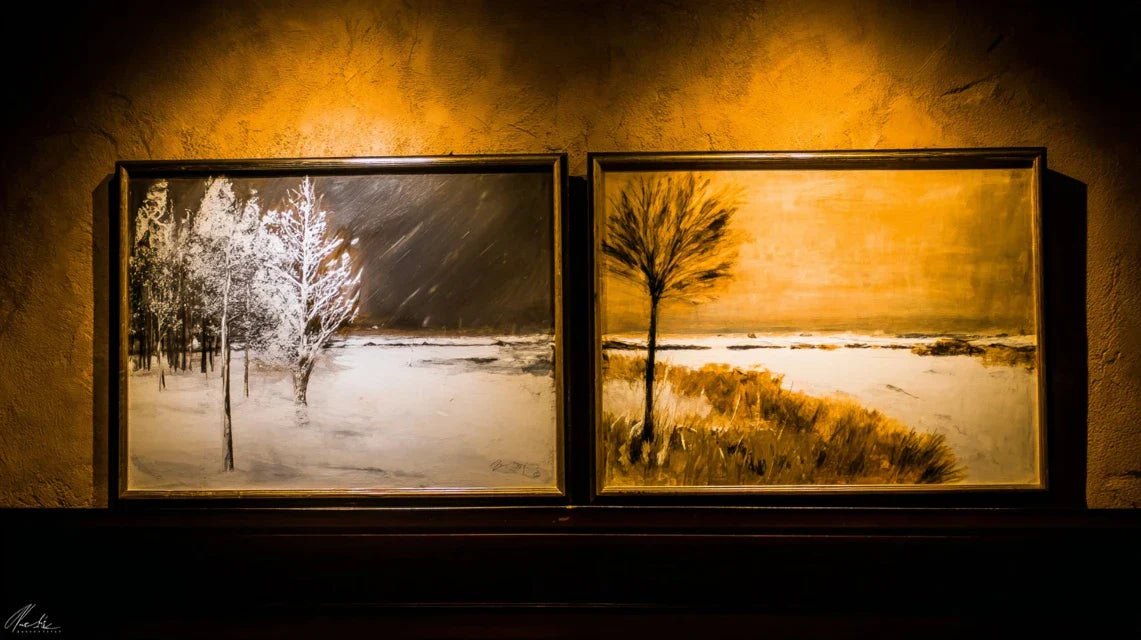
Rule of complementary temperatures: A painting with warm tones will shine in a cool winter ambiance, and vice versa. It's the principle of harmonious contrast that creates the perfect visual impact.
| ❌ Misconception | ✅ Reality | 💡 Why | 🎯 Benefit |
|---|---|---|---|
| You need warm colors in winter | Tempered contrasts create harmony | The eye seeks balance, not intensity | Optimal visual comfort all year round |
| Neutral paintings go everywhere | No color is truly neutral | Light always reveals nuances | Guaranteed visual impact in every season |
| Changing your artworks is wasteful | Rotation reveals their potential | Like a wardrobe, art follows the seasons | Permanent renewal of your decor |
| Art shouldn't follow trends | Seasonal harmony is universal | It’s psychology, not fashion | Authentic psychological well-being |
The method of seasonal harmonies: 3 steps to perfect paintings all year round
Don't worry, you’re not going to revolutionize your art collection! Like a chef who adapts his dishes to the seasons with the same basic ingredients, you will learn to orchestrate your artworks so they reveal their full potential. The progression is simple: first understand your works, then create associations, finally master rotations. At the end, you’ll have an interior that breathes naturally with the seasons, creating that feeling of a perfect cocoon all year round.
🎨 Method overview: Step 1: Analyze your current collection according to color temperatures. Step 2: Create complementary seasonal duos. Step 3: Establish a natural rotation system. Each step brings you immediate satisfaction and prepares the next.
Step 1: Decoding the Seasonal DNA of Your Current Works
Starting with this step is logical because it reveals the hidden potential of your existing collection. It's like discovering that you already have all the ingredients to cook a gourmet dish. Once this analysis is complete, you will feel the satisfaction of finally understanding why certain paintings touch you more at certain times.
What You Need for This Analysis
- A notebook: To note the characteristics of each artwork. Choose one that you enjoy handling, as you will use it often. Avoid mobile apps that distract you – paper promotes deep reflection.
- A source of natural light: Observe your paintings near a window, ideally facing south. Artificial lighting distorts color perception. It's the difference between seeing a diamond under neon and in sunlight.
- A measuring tape: To note dimensions and plan future locations. This will serve you for step 3 when you organize your rotations.
Let's move on to methodical observation now
How to Analyze Each Artwork
Identify the dominant temperature: Observe your painting in natural light and ask yourself: "Does this artwork warm me or cool me visually?" Warm tones (reds, oranges, yellows) warm up, cool tones (blues, greens, purples) cool down. Even in a multicolored painting, one temperature always dominates.
⏱️ Time: 2 minutes per artwork | ✅ Successful when: You can say "warm" or "cold" without hesitation | ⚠️ Attention: Beiges and grays seem neutral but always lean slightly towards warm or cold depending on their undertone.
Evaluate emotional intensity: Note whether the artwork energizes you (high intensity) or soothes you (low intensity). A flamboyant sunset will be warm and intense, a misty landscape will be cold and soothing. This combination determines its ideal season.
⏱️ Time: 1 minute per piece | ✅ Successful when: You clearly feel the energizing or relaxing effect | ⚠️ Warning: Your current mood influences your perception – do this analysis when you are in a neutral state.
Note spontaneous associations: Write down the first 3 words that come to mind when looking at the piece. These associations reveal its seasonal potential. "Warmth, summer, energy" indicates a summer painting. "Serenity, cocoon, meditation" suggests a winter painting.
⏱️ Time: 30 seconds per piece | ✅ Successful when: The words come naturally without reflection | ⚠️ Warning: Don't censor your first impressions, even if they seem strange – they are often the most revealing.
✅ Validation of step 1: You have a sheet per piece with its temperature, intensity and associations. You begin to see patterns emerging in your collection. If some pieces pose a problem, that's normal – you will come back to them with more perspective. The important thing is to have a global vision to tackle step 2.
OUR RECOMMENDED PRODUCTS
Step 2: Create your perfect seasonal pairings
Now that you know the DNA of your pieces, you are going to create magical associations between them. It's like composing a menu where each dish enhances the next. This step is more rewarding because you immediately see the effect of your combinations. The snowball effect begins: each successful association gives you ideas for the next.
Building complementary pairings
Pair the complements: Take your "warmest" piece and pair it with your “coldest” piece of the same intensity. This opposition creates a fascinating visual dialogue. Place them side by side temporarily to see the effect.
⏱️ Time: 5 minutes per pairing | ✅ Successful when: The two pieces reinforce each other | ⚠️ Warning: If the effect is too strong, look for pieces of more moderate intensity.
Test seasonal atmospheres: Imagine each pairing in the atmosphere of your living room in summer (golden light, slightly open blinds) then in winter (artificial light, cozy atmosphere). Note which works best in each context.
⏱️ Time: 3 minutes per pairing | ✅ Successful when: You clearly visualize the effect in each season | ⚠️ Warning: Do this exercise at different times of the day to validate your impressions.
🎯 Step 2 Validation: You've identified 3 to 5 pairings that work perfectly. Some evoke a summery warmth, others a wintery softness. You now understand why certain combinations spontaneously appeal to you – they respect natural seasonal harmony.
Step 3: Set up your intelligent rotation system
You're now at expert level! You master the principles and associations, now you’ll create a system that naturally evolves with the seasons. This is the level where your guests will notice that your interior always has that perfect harmony without ever understanding why. You'll have joined the circle of people who seem to have an innate gift for decoration.
Organize your rotations
Create your seasonal schedule: Establish 4 configurations: spring equinox, summer solstice, autumn equinox, winter solstice. Each configuration highlights 2-3 main works and stores the others. It's like having 4 different interiors with the same artworks.
⏱️ Time: 15 minutes | ✅ Success when: You have 4 clear diagrams with photos | ⚠️ Attention: Start with 2 configurations (summer/winter) before adding the in-between seasons.
Install the storage system: Prepare a storage space for artworks “at rest”. Use tissue paper and rigid boxes. Each artwork should be easily accessible and protected. The idea is to be able to rotate in 15 minutes maximum.
⏱️ Time: 30 minutes | ✅ Success when: You can take out any artwork in 2 minutes | ⚠️ Attention: Avoid attics and damp cellars – temperature variations damage the canvases.
🏆 Step 3 Validation: You have a complete system that works on autopilot. Your rotations become an anticipated pleasure, like changing your wardrobe. Your interior breathes naturally with the seasons and you receive compliments on your exceptional “decorative instinct”.
Rule of natural progression: Move to the next step when the previous one becomes automatic. If you're still hesitating about temperature analysis, stay on step 1. Mastery is better than haste.
You now master the basics, but here are the expert subtleties that transform a harmonious interior into a true seasonal work of art. These details make the difference between "it's pretty" and "it's magical".
🎭 Pro tip: Change the lighting of your wall artworks at the same time as their rotation. A warm spot (2700K) reveals reds and oranges, a cool spot (4000K) enhances blues and greens. It's like having two different artworks with the same painting.
❓ Reader question
"I'm worried that my guests will find it strange that my paintings change all the time. They'll think I'm unstable or don't know what I want..."
That’s a very legitimate concern! In reality, your guests will notice that your interior always makes them feel good, without necessarily understanding why. It's like a restaurant that adapts its menu to the seasons – customers appreciate the freshness without analyzing the system. If someone asks, you can explain that you like to adapt your decor to the seasons, just as you adapt your style of dress. This is perceived as a mark of refinement, not instability.
💡 Practical tip: Start with a discreet rotation – change only the main artwork in your living room. Observe the positive reactions: your guests will feel better at your home without knowing why. This validation will give you confidence to extend the system.
The absolutely essential pitfalls to avoid preserving the harmony of your artworks
Beware, some mistakes can ruin all your harmonization work! I'm going to reveal the 5 most frequent pitfalls so you can avoid them. These errors are normal – all art enthusiasts have made them – but now you can anticipate them.
- ⚠️ Changing too many artworks at once: It's tempting to revolutionize the entire interior, but it creates a visual shock. Your brain needs landmarks. Change a maximum of 3 works per rotation to preserve the identity of your decor. The mistake is understandable because enthusiasm leads to excess.
- 🎨 Ignoring existing lighting: Your decorative paintings may be perfect in theory but can fail if your lighting doesn't highlight them. Always test your combinations in the evening under your usual lighting. A painting that looks sublime during the day can become dull in the evening.
- 📏 Underestimating the importance of proportions: A small winter painting may seem lost on a large wall. Winter intimacy sometimes requires larger works to create a cocooning effect. Conversely, summer energy can support smaller and more dynamic formats.
- 🏠 Forgetting the architecture of the room: A room with low ceilings will be overwhelmed by too intense artworks in winter. Adapt the intensity of your choices to the proportions of your space. This is a common mistake because we focus on the works forgetting their environment.
- 📅 Forcing the calendar: Respect your feelings rather than official dates. If you still feel the summer energy mid-September, keep your summer artworks. Seasonal harmony follows your personal rhythm, not the calendar.
🔍 Quick checkpoints: Before each rotation, check: Does the overall atmosphere remain consistent? Have I kept at least one familiar artwork? Does the lighting highlight the new artworks? Do my guests feel immediately comfortable? If an answer is "no", adjust before finalizing.
🎁 Special offer for readers
Because you took the time to learn, enjoy 10% discount on your first order:
⏰ Valid 72h after reading • Applicable to all our products
Your practical questions about seasonal harmony of artworks
The analysis phase takes 2-3 hours spread over a week. The investment is zero if you use your existing collection. To optimize, budget €200-€500 for 2-3 complementary new works. Sarah transformed her living room with just 2 targeted acquisitions of €150 each.
This is very common! First identify your dominant style (warm/cold, intense/soothing), then gradually add complementary works. Start with a single "opposite" acquisition to test the effect. You may discover that you liked this harmony without knowing it.
In a studio or small living room, focus on 2-3 works maximum that you alternate according to the seasons. Prioritize quality over quantity. A single wall art well chosen can transform the atmosphere of a room. The advantage: your rotations are simpler and more impactful.
Observe which orientation dominates at different times of the day. A room can be "cold" in the morning (north facing) and "warm" in the afternoon (south bay window). Adapt your artworks to the dominant atmosphere of your presence time in the room.
Absolutely! Cushions, throws, candles follow the same principles. Start by mastering your decorative wall art, then gradually extend. The advantage: once the system is in place, your rotations become natural and consistent on all elements.
Your transformation into a seasonal harmony expert
In a few weeks, you will have that deep satisfaction of living in an interior that naturally breathes with the seasons. Your friends will ask you your secret for always having this perfect ambiance, this ability to instantly create a warm atmosphere in winter and refreshing in summer. You will smile thinking back to the time when you were suffering your artworks instead of orchestrating them.
This mastery goes far beyond simple decoration. You develop an artistic eye that will serve you in all your aesthetic choices: clothing, restaurants, travels. Your confidence in your personal taste blossoms naturally when you understand the mechanisms of visual harmony.
The hardest part was understanding that your wall art are not fixed elements but partners in your daily well-being. Now, grab your notebook and start by analyzing your favorite artwork. In 5 minutes, you will have taken the first step towards an interior that truly reflects you, in every season.
🌟 Your first victory awaits: Each work you analyze will reveal a secret about yourself and your relationship to beauty. It's a fascinating journey that begins now, and your perfect interior is only 3 steps away.