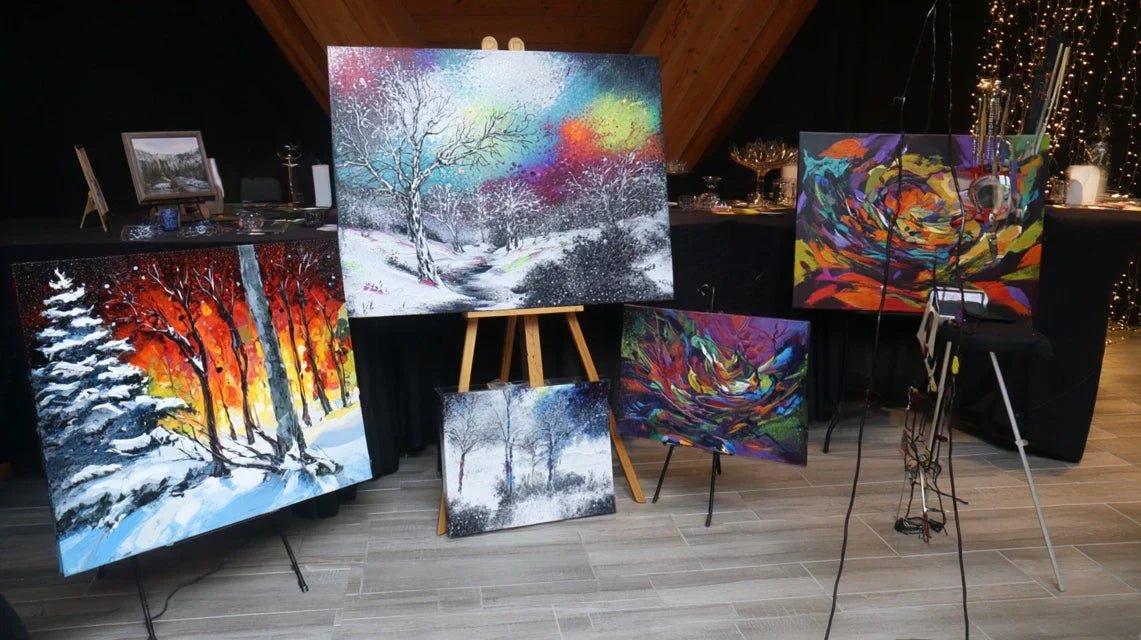
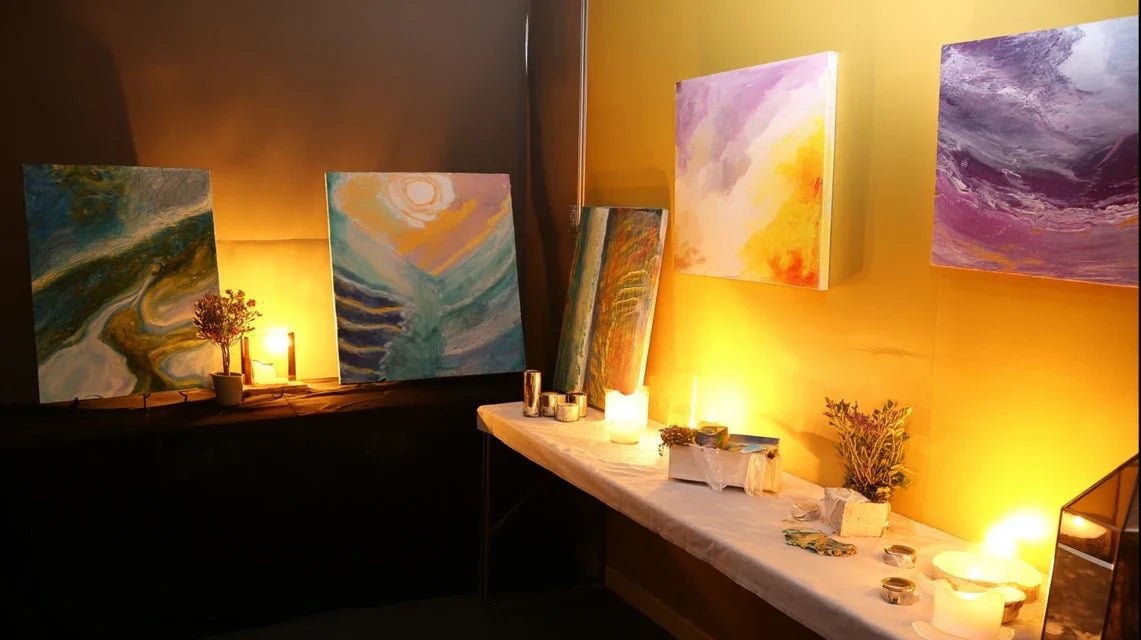
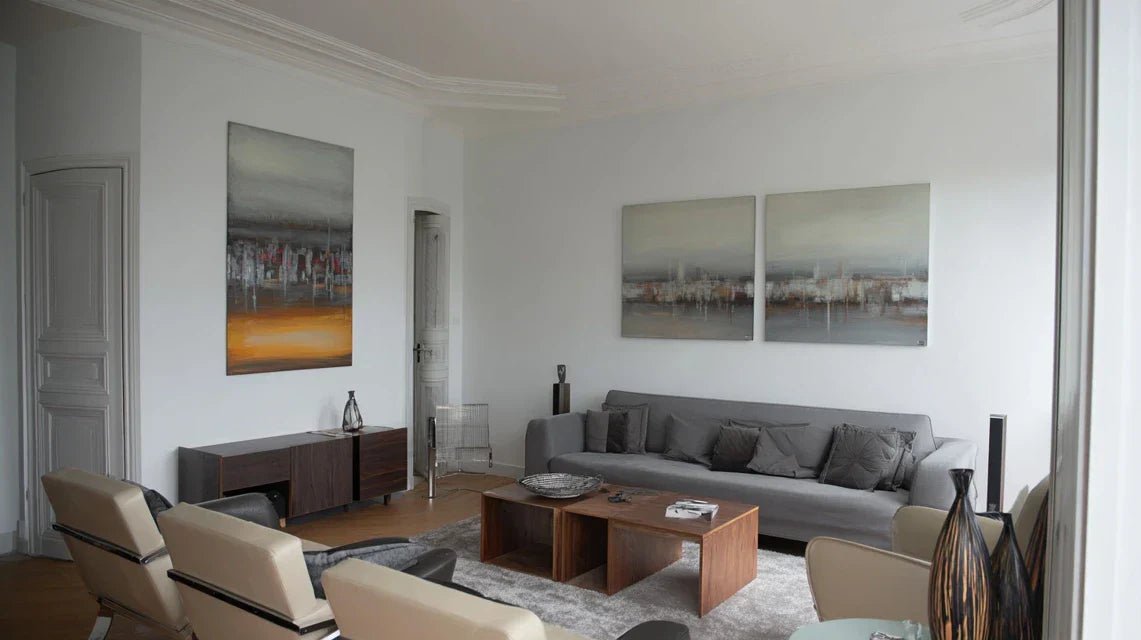
It's 5:30 PM, the days are already getting shorter, and you’re returning home to a house that seems to have lost all its warmth.
Your walls, once welcoming, now seem dull, almost cold, and this feeling of gloominess subtly settles into your daily life.
Every morning, you turn on all the lights to compensate for the lack of natural light, but the atmosphere remains heavy.
Your living room, carefully decorated, seems to have lost its soul at the first signs of winter.
You may have tried multiplying candles, changing your cushions for warmer tones, or even invested in a light therapy lamp.
But nothing works: your interior is sorely lacking that spark that makes all the difference.
It's perfectly normal, and it’s not a problem of decoration or budget.
The real reason? Your walls aren't working for you during this difficult time of year.
In the next few minutes, you’ll discover how to transform your interior into a true luminous cocoon with carefully selected artworks and rediscover that joy of living that winter seems to have taken away.
Why can your walls become your best allies against seasonal depression?
Winter is a real trial for our morale, and each day you spend without acting on your environment makes you miss a valuable opportunity to regain your energy.
It's like trying to warm a house while neglecting insulation: you waste your efforts instead of creating a true sanctuary of well-being.
The opportunity you risk missing? That of transforming these difficult months into a period of luxurious and comforting cocooning.
🏠 Testimonial: Sophie, an interior architect, shares how she discovered the impact of luminous artworks in her own home: "I mastered all the codes of decoration, but my living room remained sad in winter. The day I hung a canvas with golden and orange tones facing my window, my guests immediately noticed the difference. My husband said to me: 'It's like the sun never left us'."
💬 Conversation with a decor expert
“Colorful artworks are pretty, but they won't really change the atmosphere of my home... It’s more psychological than anything else, isn't it?”
Think again! Colors directly affect our brain and our serotonin production. It's like the difference between wearing gray sunglasses or glasses with golden lenses: your perception of the world really changes. A canvas with warm tones reflects and amplifies available light, creating a true luminous focal point in your room.
“I’ve always been told that you should avoid bright colors on walls in winter, that it looks vulgar...”
This rule was from a time when interiors were already overloaded! Today, in our streamlined interiors, a vibrant painting becomes a jewel that enhances the space. It's like the difference between wearing a black dress with a discreet necklace or with a magnificent golden pendant: the impact is not the same.
The golden rule for bright interiors in winter:A single strong and luminous element is enough to transform the atmosphere of an entire room. It's like lighting a fireplace in a living room: the whole space warms up instantly. You will feel this difference from day one, and your loved ones will notice it in less than a week.
What’s really happening in your interior during winter?
Observe your living room right now: the colors seem faded, the textures appear flat, and even your favorite objects have lost their luster.
You find yourself avoiding certain spaces in your home, spending more time under the duvet in your bedroom, or looking for excuses to leave the house.
What’s really happening has nothing to do with your decor: it's your brain reacting to a lack of positive visual stimulation.
Your eye, deprived of the chromatic richness of nature, goes into "energy saving" mode and no longer perceives the subtle nuances of your interior.
It’s exactly like the contrast between a sunny day and a gray day: the same landscapes, but your feeling is completely different.
The first hidden cause: your walls absorb light instead of reflecting it
Contrary to what one might think, it's not the lack of light that’s the problem, but how your current decor "swallows" the available light.
Most interiors are designed for summer, with neutral tones that seem sophisticated under generous sunlight, but become dull as soon as brightness decreases.
Imagine your living room like a cracked mirror: instead of reflecting and amplifying light, it disperses and absorbs it.
The impact on your daily life? You already wake up tired, you feel less like receiving loved ones, and you experience this inexplicable drop in energy.
What will change in your approach: you’re going to transform your walls into true light amplifiers.
🔍 Immediate test: Stand in front of your bathroom mirror with a lit candle, then move around your living room with the same candle. You will notice that the flame seems less bright in your living room: this is proof that your decor absorbs light instead of reflecting it.
The second hidden cause: lack of warm focal points
Many think you need to multiply sources of light, but the real secret lies in creating strategically placed "visual warmth" points.
The mechanism is simple: your eye needs a place to rest, an anchor point that gives it energy instead of taking it away.
It’s like the difference between a campfire and a string of fairy lights: one draws you in and warms you, the other illuminates but doesn't nourish you emotionally.
Why do you feel this sense of emptiness? Because your gaze wanders without finding a positive anchor point.
The solution that’s appealing: create "domestic suns" that capture and redistribute visual warmth throughout the room.
The third hidden cause: the psychological effect of cool colors
Here's what no one tells you: even if you love your gray and beige tones, they subconsciously activate your nervous system into "hibernation" mode.
Sophie, a decorator, discovered this when her 8-year-old daughter refused to play in the living room “because it was too sad.”
How to spot it in your situation? Observe your behavior: do you avoid certain rooms? Do you feel less creative? Do you have less desire to cook or entertain?
The impact on your daily life: this cold atmosphere influences your mood, your productivity, and even your sleep without you realizing it.
5 signs that your decor is working against you:
You turn on all the lights at 4 p.m.: Your brain compensates for the lack of positive visual stimulation, it's like trying to warm a poorly insulated room.
You feel less creative at home: The absence of dynamic colors puts your creative brain to sleep, like a garden in winter waiting for spring.
Your guests stay less long: They subconsciously sense the lack of visual warmth, like birds avoiding areas without sunlight.
The trigger: your decor's color temperature
What really makes the difference is the "emotional temperature" of your colors.
Like a thermostat that regulates physical heat, your paintings can regulate the emotional warmth of your interior.
The domino effect is immediate: a single canvas with warm tones can visually warm up an entire room.
The clues to identify it: look at your living room and ask yourself if you could spend a whole Sunday there purely for pleasure, not obligation.
The 70-30 rule for a balanced interior: 70% neutral tones, 30% dynamic colors. It's like a good dish: the base is neutral, but the spices make all the difference. You can check this immediately by evaluating the warm/cool color ratio in your main room.
❌ Common belief
✅ Reality
💡 Explanation
🎯 Practical benefit
Bright colors tire the eye
Warm colors nourish the eye
Your brain distinguishes between positive stimulation and visual aggression
Energy regained and mood boosted
You need to multiply light sources
One bright focal point is enough
The eye prefers a sun to a multitude of stars
Energy saving and maximum impact
Paintings are just decorative
Paintings influence your mood
Colors act on your nervous system
Improved daily well-being
How to create your luminous oasis in 3 simple steps
Rest assured, you don't need to revolutionize all of your decor. The beauty of this method is its simplicity: like a chef who enhances a dish with a single exceptional ingredient, you will transform your interior with a few carefully chosen elements.The progression is logical: diagnosis, selection, installation. At each step, you will feel a noticeable improvement in your well-being, as if gradually increasing an emotional thermostat.
🎯 Overview of your transformation: First, you identify strategic areas of your interior (5 minutes). Then, you select your "light amplifiers" according to specific criteria (30 minutes). Finally, you install them to create a circuit of visual warmth (15 minutes). Result: a home that welcomes you with kindness instead of sucking your energy.
Step 1: Identify your strategic areas
Starting with the diagnosis is essential because that's where the key to your success lies. Like an architect who studies the foundations before building, you need to understand how light circulates in your home. This step will give you the immediate satisfaction of finally understanding why some spaces attract you and others repel you.
What you'll need for this step:
Your smartphone (camera): To capture natural light at different times of the day. It reveals invisible shadows that your eyes get used to. Take a photo every 2 hours: you will discover surprising variations. Avoid flash, which completely distorts the luminous reality.
A notebook and pen: To note your feelings in each room without relying solely on your memory. The principle: your mood changes depending on the spaces, and this emotional map will guide your choices. Look for places where you naturally feel good versus those you avoid.
A pocket mirror: To test the reflection of light on your current walls. Place it facing different surfaces: those that reflect a soft light are your allies, those that absorb it should be compensated. This trick instantly reveals the luminous potential of each wall.
Now let's move on to practice with an infallible method
Your lighting diagnosis in 3 concrete actions:
The moods tour: Visit each room at 9am, 2pm and 6pm noting your spontaneous feelings (energized, neutral, or depleted). This method reveals the emotional impact of each space according to the available light. The variations will surprise you: a "dead" room in the morning can be magical in the afternoon.
⏱️ Time: 15 minutes per session | ✅ Success when: You have identified 1-2 "energy-consuming" rooms and 1-2 "recharging" rooms | ⚠️ Attention: Don't rely on your habits, your brain adapts and masks problem areas.
The revealing mirror test: Place your pocket mirror facing each wall to measure its ability to reflect light. Walls that return golden or white light are your assets, those that return dull light should be energized. This pro technique instantly reveals where to place your future artworks.
⏱️ Time: 5 minutes per room | ✅ Success when: You have classified your walls as "amplifiers" or "absorbers" | ⚠️ Attention: Test in cloudy AND sunny weather, the results can be opposite.
The focal point mapping: Identify where your gaze naturally rests when entering each room. These "natural anchor points" are the ideal locations for your future luminous artworks. Your eye intuitively guides you to strategic areas.
⏱️ Time: 3 minutes per room | ✅ Success when: You have spotted 2-3 "magnetic" locations per room | ⚠️ Attention: Distinguish natural anchor points from visual habits related to your current furniture.
✅ Check of this step: You should be able to explain in 30 seconds why one wall would be perfect for a luminous artwork and the other would not. If you are still hesitating, repeat the mirror test: light never lies. Congratulations, you have just developed a "decorator's eye"!
OUR RECOMMENDED PRODUCTS
Step 2: Selecting your light amplifiers
Now that you know your terrain, you can choose your secret weapons.
This step is more rewarding as you move from diagnosis to creation.
The snowball effect begins here: each judicious choice amplifies the impact of others, like instruments harmonizing in an orchestra.
The infallible criteria for your luminous artworks:
Warm dominant (yellow, orange, red, gold): These colors reflect light and warm the atmosphere like a fireplace. Look for canvases where these tones represent at least 40% of the surface. Check by squinting: warm colors should "pop" out of the frame. Avoid pastel shades which are too weak for winter.
The texture that catches the light: Favor techniques that create relief (thick paint, collages, mixed media). The principle: the more textured the surface, the more it captures and diffuses light from different angles. Test with your phone: a good luminous artwork is photogenic under all lighting.
The size proportional to the desired impact: Too small, it disappears; too large, it is aggressive. The 2/3 rule: your artwork should be 2/3 of the width of the furniture below it, or occupy 1/3 of the wall if it is alone. This proportion creates the perfect balance between presence and harmony.
Your 3 selection actions:
The "sunburn" test: Stand 2 meters away from your candidate artwork and close your eyes for 5 seconds. When you open them, you should feel a sensation of warmth, as if a ray of sunshine caressed you. This instinctive reaction never deceives: your brain immediately recognizes the beneficial colors.
⏱️ Time: 30 seconds per artwork | ✅ Successful when: You feel a micro-positive emotion | ⚠️ Attention: Do not rationalize your first impression, it is the most reliable.
The rule of 3 distances: Observe your artwork from 50 cm (details), 2 meters (overall impact), and 5 meters (presence in space). A good luminous artwork works at the 3 distances: precise up close, harmonious at medium distance, radiant from afar. This technique eliminates artworks that only work at one distance.
⏱️ Time: 2 minutes per artwork | ✅ Successful when: The artwork pleases you at the 3 distances | ⚠️ Attention: Some artworks lose their magic from a distance, others become aggressive up close.
🎯 Validation of your choices: Your selected artworks must pass the photo test: take photos of them with your phone, they should "stand out" naturally, as if they had their own light source. If an artwork disappears in a photo, it will disappear in your interior.
Step 3: Install your visual warmth circuit
You are now reaching the level of mastery where every gesture counts .
The difference between an amateur and a connoisseur is made here: the placement and height of your artworks .
The final result you can visualize: a home that welcomes you with the same warmth as a sunset, and which you will be proud to talk about with your loved ones.
Strategic installation in 3 actions:
The 145 cm rule: Place the center of your artwork at 145 cm from the floor (average eye height standing). This museum standard guarantees optimal visual comfort and a natural presence. Measure from the center of the artwork, not from the top or bottom, to avoid errors in proportion.
⏱️ Time: 5 minutes per artwork | ✅ Successful when: You look at the artwork without tilting your head up or down | ⚠️ Attention: Adjust if your ceiling is very high (150 cm) or very low (140 cm).
The complementary lighting: Install indirect lighting (spot directed at the wall, not at the artwork) that creates a luminous halo around your work. This gallery technique transforms your artwork into a true "window of light" that illuminates the entire room.
⏱️ Time: 10 minutes per installation | ✅ Successful when: The artwork seems lit from within | ⚠️ Attention: Avoid direct spotlights that create reflections and kill the effect.
The overall composition: If you are installing multiple artworks, respect the 5-10 cm rule between each piece and create a common baseline. The desired effect: a coherent gallery that guides the eye smoothly, like the notes of a visual melody.
⏱️ Time: 15 minutes for an ensemble | ✅ Successful when: The whole forms a harmonious visual unit | ⚠️ Attention: Draw an imaginary line: all centers must be aligned.
The winter progression rule:Start with one artwork in your main living room, observe the impact for a week, then gradually add to other spaces. This method allows you to adjust and optimize, like a perfumer who composes his blend note by note.
Congratulations, you now master the subtleties of professionals!
These advanced techniques give you a considerable advantage: while others suffer from winter, you create your own luminous microclimate.
🎨 Professional decorator tip:Create a "triangle of light" by installing three sources of visual warmth (main artwork + 2 complementary elements such as a golden cushion and a scented candle) in your main room. This technique creates an energy circuit that keeps your spirits high even on gray days. The effect is immediate and noticed by all your visitors.
❓ Question from a passionate reader
"I'm afraid my colorful artworks will clash with my current rather neutral decor... How can I be sure they harmonize well?"
I perfectly understand this apprehension, it's the number 1 fear of my clients!
The beauty of luminous artworks is that they sublimate neutral tones instead of competing with them.
Imagine a black dress with a colorful scarf: the dress becomes more elegant, not less.
My practical advice: start with an artwork where your dominant color (beige, gray...) appears in the background. This creates a soft and reassuring transition.
You will be surprised to see that your neutrals suddenly reveal all their sophistication!
💡 Compatibility test: Temporarily place an object of the color of your future artwork (a cushion, a book, a scarf) in your room and observe the effect for 24 hours. If the object makes you smile when you discover it, the artwork will have the same effect multiplied by 10.
The mistakes to absolutely avoid to preserve your investment
Warning, some errors can annihilate all your efforts and make you lose confidence in this infallible method.
These errors are tempting because they seem logical, but they transform your light amplifiers into real "energy vacuum cleaners".
⚠️ Placing a luminous artwork in a dark corner: It's tempting to want to "light up" the shadowy areas, but an artwork needs light to reveal its magic. Result: your investment becomes invisible and loses all its impact. Prefer walls that receive natural or artificial light, even indirect. This is a mistake made by 80% of beginners.
🎯 Choosing an artwork too small for fear that it will take up too much space: An undersized artwork completely disappears and creates a feeling of incompleteness. Your brain simply ignores it. Golden rule: better to have an artwork larger than expected than an artwork too small. Test with a cardboard the planned dimensions before buying.
🔄 Multiplying colorful artworks in the same room: More is not always better! Several luminous artworks "cannibalize" each other and create a visually tiring agitation. The desired effect becomes its opposite. Principle: one sun per room, accompanied by more discreet complementary elements.
📏 Neglecting accent lighting: An artwork without appropriate lighting loses 60% of its impact from 5 p.m. Your investment only "works" half the time. Systematically provide indirect lighting that reveals colors even in the evening. This is the difference between amateur and professional.
🎨 Choosing based solely on personal tastes: Your personal tastes may be unsuitable for your winter light needs. An artwork that you intellectually love can visually depress you. Rely on your immediate emotional reaction, not your usual aesthetic preferences.
🛡️ Your verification system in 4 points: Before any purchase, check that your artwork (1) makes you smile at first glance, (2) works at the 3 distances (close, medium, far), (3) will be visible from the entrance of the room, (4) will benefit from direct or indirect lighting. Warning signs: prolonged hesitation, need to "convince" your entourage, impression that "it will be better later".
Because you took the time to inform yourself, enjoy 10% discount on your first order:
ART10
⏰ Valid for 72h after reading • Applicable to all our products
Your most frequently asked questions about illuminated paintings
💰 "What budget should I allocate to effectively transform my interior?"
Allow between €150 and €400 for a quality painting that will really transform your daily life.
To optimize your investment, start with your main living room with an 80-100 cm painting, then gradually complement it.
Concrete example: Marie invested €280 in a gold painting for her living room and is now saving €40/month on electricity because she no longer needs to overlight her house.
🔧 "Is installation really accessible to someone who isn't a handyman?"
Absolutely! 90% of our customers install their paintings themselves in less than 20 minutes.
The secret: use screws suitable for the weight (indicated on the packaging) and a small spirit level.
Rassuring tip: start with a light painting (less than 2 kg) that only requires a simple wall hook.
🎨 "How do I know if the style of the painting really matches my personality?"
Your emotional reaction says more than your aesthetic references.
If a painting makes you smile spontaneously, it means that it resonates with your deep energy.
Validation technique: show it to a friend without comment. Their reaction reveals the real impact of your choice.
⚡ "How long does it take to really feel the difference?"
The impact is immediate, but deep improvement in mood takes 7 to 10 days.
Your brain needs this time to recalibrate its visual references.
Sign that it's working: you surprise yourself smiling when you come home, for no particular reason.
🌟 "Can we really talk about 'therapy' through decorative art?"
Warm colors effectively stimulate the production of serotonin, the hormone of well-being.
It is not medical therapy, but daily emotional support proven scientifically.
Think of it as a nutritional supplement for your mood: it does not replace treatment, but optimizes your overall condition.
Your new life begins now
Imagine yourself in 3 weeks: you come home from work in the evening, and instead of experiencing that feeling of coldness and gloom, your gaze is immediately drawn to this source of visual warmth that welcomes you.
Your living room has become your refuge, that space where you want to settle down with a tea, invite your loved ones, create and recharge.
Your friends ask you your secret: "What's changed about you? We feel so good in your living room!"
This transformation goes far beyond decoration: you have developed an expert eye that allows you to create well-being wherever you go.
You now understand the power of colors, the importance of light, and you know how to create spaces that nourish your soul instead of tiring it.
This new confidence is reflected in all aspects of your life.
You now have all the keys in hand, understanding was indeed the most difficult part.
The first concrete step? Take the mirror test today in your main room to identify your future ideal location.
Your future self will thank you for acting now rather than waiting for spring to smile again.
✨ Winter can become your favorite season:You have the power to create your own domestic sun! It's within reach, and the result will surprise you with its power. In a few days, you’ll wonder how you ever lived without this visual warmth that now illuminates your daily life.
📚 To further develop your decor expertise
Now that you master the art of illuminated paintings, discover how to adapt all your decoration to seasonal rhythms.
Autumn textures, spring colors, summer atmospheres: each season has its secrets to sublimate your interior.