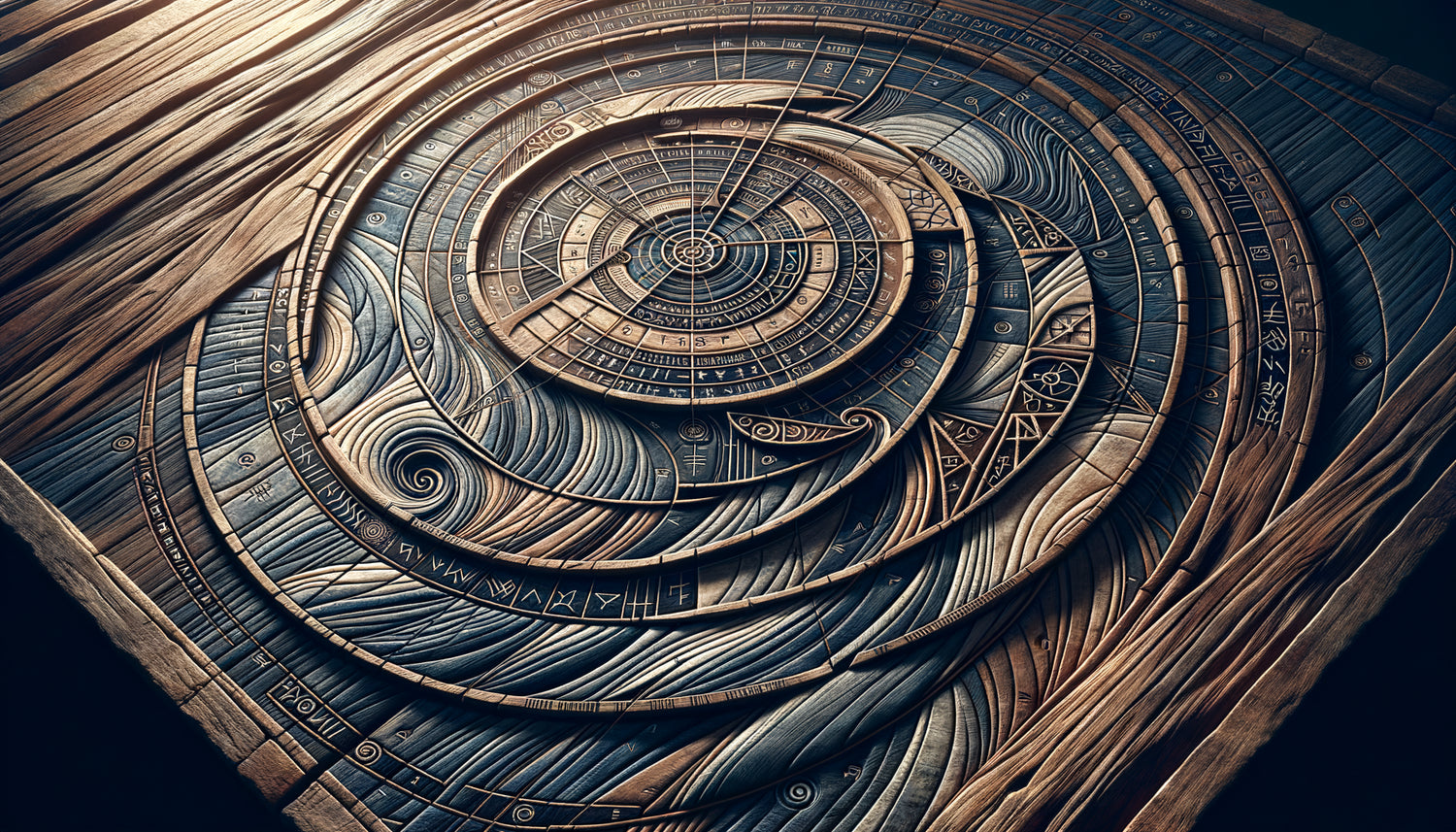
The first time I discovered Viking runic cartographies at the Stockholm museum, something resonated within me. These lines carved into stone, these stylized waves, these navigation crosses – they told of the sea in a way I had never seen before. Not as a faithful representation, but as an abstract essence, a vital force captured in bold geometric forms.
Here's what the influence of Viking navigational motifs brings to Scandinavian maritime abstraction: an ancestral visual grammar that transforms the sea into a universal language, organic geometry where Nordic rigor meets oceanic fluidity, and a spirituality of movement that goes beyond simple decoration to touch the very soul of navigation.
Perhaps you're looking to understand why these contemporary Scandinavian works hypnotize you, why these abstract lines immediately evoke fjords and longships without ever literally representing them. This mysterious connection between Viking past and modernism is not a coincidence – it’s the legacy of a civilization that had to abstract the sea to survive.
I'm going to reveal how Viking navigators invented, a thousand years before Kandinsky, a system of maritime abstraction that still influences today's greatest Scandinavian creators. You will discover the secret codes of this aesthetic and how to authentically integrate it into your own universe.
Runestones: First Manifestos of Nordic Abstraction
Vikings did not have maps as we know them. They carved navigation stones where maritime routes became stylized lines, where currents transformed into hypnotic spirals, and islands were merely points in a cosmic network. This necessity created the first maritime abstract language in history.
On the famous Jelling stone, the interlaces are not just decorative – they map the oceanic flows that navigators had to memorize. Each curve represents a current, each intersection a crucial decision point. Abstraction was not an aesthetic choice but a matter of life or death.
This tradition is found today in the works of creators like Olafur Eliasson or in collections of contemporary Scandinavian design. The same directional crosses, the same waves simplified to the extreme, the same obsession for the essential line that captures movement rather than form.
The Vegvisir: When a Compass Becomes Visual Architecture
The Vegvisir, this Viking navigational symbol often called a runic compass, is actually a masterpiece of geometric abstraction. Eight radiating branches, each different, creating a dynamic symmetry that foreshadows the kinetic art of the 20th century.
What fascinates about this motif is its ability to be simultaneously functional and contemplative. Modern Scandinavian artists have understood this duality. In contemporary maritime abstraction, you constantly find this radial structure: compositions that seem to turn, pulse, indicate invisible directions.
Look at the textiles of Almedahls or the ceramics of Gustavsberg from the 1950s-60s: the Viking navigation motifs are reinterpreted with a new chromatic boldness, but the underlying structure remains identical. This ancestral geometry brings a profound cultural legitimacy to Nordic abstraction.
The asymmetric Viking symmetry
A fundamental principle: the Vikings created a global symmetry from deliberately asymmetrical elements. Each branch of the Vegvisir is unique, but the whole finds its balance. This creative tension runs through all Scandinavian maritime abstraction, creating compositions that seem both ordered and wild, like the sea itself.

Stylized waves and temporal flows
On the prows of drakkars, the waves were never naturalistic. The Vikings represented them with parallel undulating lines, sometimes broken by sharp angles, creating a visual rhythm that evoked movement rather than appearance.
This graphic convention has profoundly marked Scandinavian abstraction. Think of the works of Hilma af Klint, a pioneer of Swedish abstract art: her aquatic series uses exactly this principle of superimposed undulating lines to create depth and movement. The Viking lineage is evident, even if rarely explicit.
In contemporary decorative art, these abstract waves are ubiquitous. They bring what I call a Nordic fluidity: softness in rigor, organicness in geometry. That's why they work so well in modern interiors, creating an emotional bridge between minimalism and nature.
The chromatic palette of the North Seas
Viking motifs used a restricted range: the blue-gray of the icy ocean, the white of foam, the deep black of polar nights, sometimes enhanced with blood red or rust ochre. This palette was not a limitation but a distillation of the essential maritime.
Contemporary Scandinavian maritime abstraction has retained this chromatic austerity. Creators like Ferm Living or Menu Design use these same tones, creating works that instantly evoke the fjords without ever representing them. That is the magic of the Viking heritage: a few colors are enough to summon an entire universe.
This understated approach is particularly well-suited to modern interiors. It allows for a strong maritime presence without visual clutter, creating a contemplative atmosphere reminiscent of long Viking voyages towards the horizon.
The Navigator's Blue
There is a specific blue in Viking art: neither classic navy nor modern cyan, but a deep blue-green with a touch of gray. It is the exact color of the Baltic Sea in the late afternoon. The best contemporary Scandinavian creators use precisely this shade, creating an immediate emotional connection with Nordic maritime heritage.

Ritual Repetition and Hypnotic Patterns
Vikings carved their motifs through obsessive repetition. The same element – a wave, a cross, a circle – repeated hundreds of times created a meditative, hypnotic effect. This approach foreshadows the minimalist works of Sol LeWitt or the Scandinavian patterns of Marimekko.
In contemporary maritime abstraction, this repetition creates what designers call a visual rhythm. Your eye follows the motifs as a ship follows the waves, entering a contemplative state that soothes the mind. This is particularly powerful in living spaces, where these works become anchors of serenity.
I have observed that interiors integrating these repetitive patterns inspired by Vikings create a unique sense of timelessness. The space feels both contemporary and ancestral, rooted in a millennial tradition while remaining resolutely modern.
Integrating Viking Heritage into Your Interior
How to bring this powerful aesthetic into your home without falling into pastiche? The key is to prioritize the essence over citation. Look for abstract works that use radial geometry, superimposed undulating lines, and the austere palette of the North Seas.
Favor compositions that create movement without agitation, that suggest navigation without depicting boats. Scandinavian maritime abstraction works wonderfully in minimalist spaces because it brings warmth and cultural depth without visually cluttering.
Also consider the materials: bleached wood, raw linen, light stone echo Viking materials and amplify the impact of maritime abstraction. It is a coherent language that unfolds through textures, colors, and forms.
Navigate to the Nordic essence
Discover our exclusive collection of abstract paintings that capture the spirit of Viking navigators in refined contemporary compositions.
The Viking soul of your interior awaits
Imagine yourself in your living room, facing an abstract composition where undulating blue-gray lines create a hypnotic movement. You don't see a boat, no fjord, but something deeper: the very spirit of navigation, this tension between order and chaos that Vikings captured a thousand years ago.
This connection with Scandinavian maritime heritage transforms your space into a contemporary sanctuary. You haven’t decorated – you have created a time bridge between runestones and your modern everyday life.
Start with a single piece that resonates with you. Observe how it changes your perception of space, how it brings this calm and powerful presence that only Nordic maritime abstraction can offer. The Vikings navigated the unknown with these abstract patterns as their only guides – let them now guide you to an interior that tells your own odyssey.
FAQ: Your questions about Viking maritime abstraction
How to recognize a work influenced by Viking motifs?
Look for three distinctive elements: an organic geometry that blends straight lines and flowing curves, a structure often radial or network (like the Vegvisir), and a restricted palette dominated by blues-grays and natural tones. The work should evoke maritime movement without literal representation. Repetitive rhythmic patterns are also typical, creating this characteristic meditative effect. If you feel rigor and fluidity simultaneously, order and wildness, you are probably facing an authentic Viking heritage.
Does Scandinavian maritime abstraction suit small spaces?
Absolutely, it is even ideal! This aesthetic relies on economy of means and structural simplicity, principles perfect for reduced spaces. Compositions with a light dominant (pale blue-gray, off-white) create an impression of openness to the maritime horizon. Undulating lines generate movement without visual clutter. Favor works with plenty of negative space – this typically Nordic breathing visually enlarges the room. A single abstract artwork inspired by Vikings can transform a small living room into a soothing sanctuary that seems larger than it is.
Can we mix Viking maritime abstraction and colorful decoration?
Yes, with strategy! The Viking chromatic austerity actually creates a perfect visual anchor for colorful touches. Use your maritime abstract artwork as a neutral and sophisticated base, then add colored accents in small doses (cushions, decorative objects, plants). The Vikings themselves enhanced their monochrome patterns with touches of red or ochre. The important thing is to maintain the Nordic dominance – 70% natural and marine tones, maximum 30% bright colors. This approach creates a dynamic tension that avoids coldness while preserving the essence of ancestral Scandinavian meditative aesthetics.