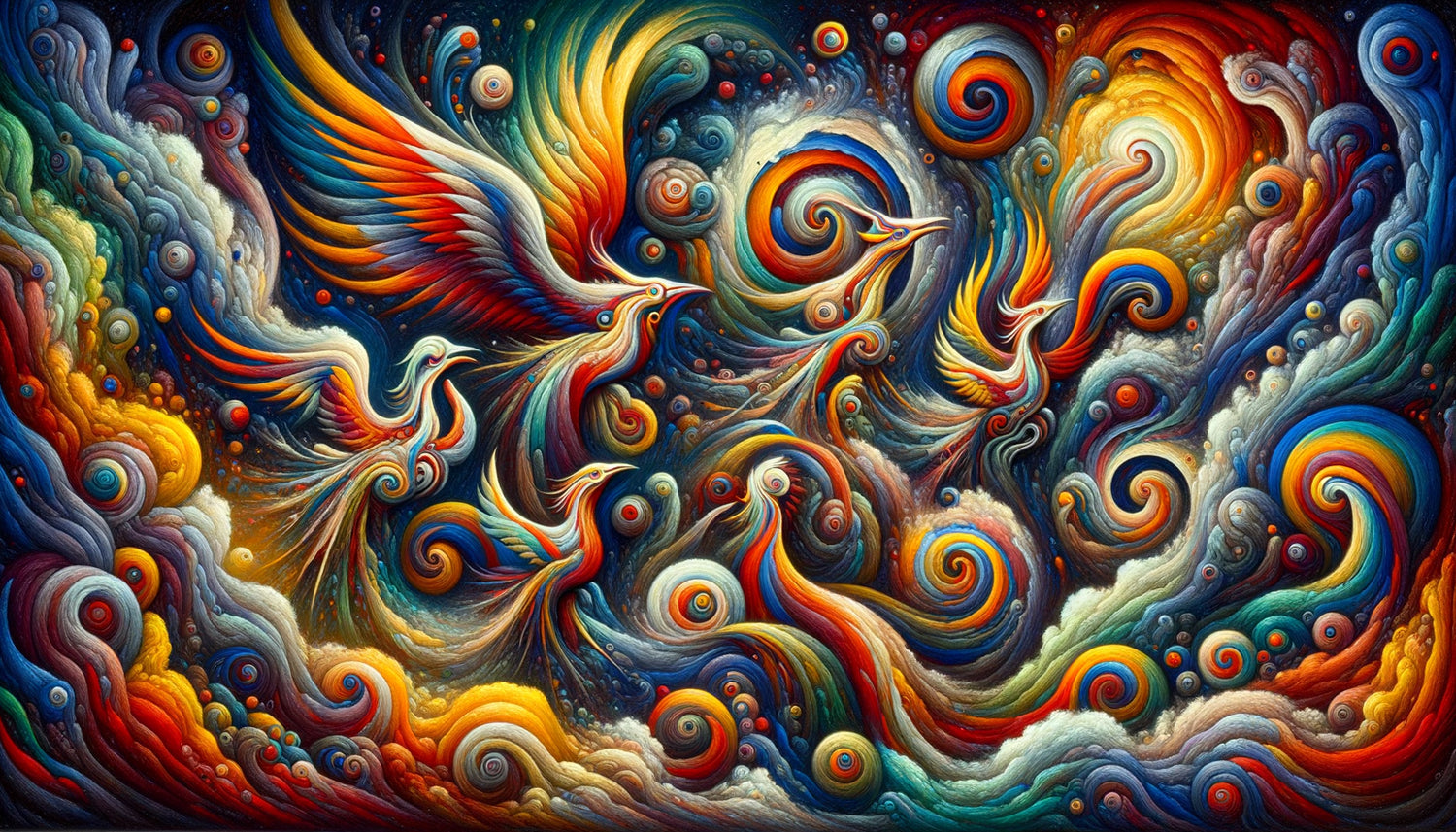
In the workshop of a visionary Danish painter, fantastical creatures were born on canvas every day. Impossible birds mingled with colorful suns, faces emerged from dreamlike landscapes, and an entire fairy-tale universe took shape under the vibrant brushstrokes of color. Carl-Henning Pedersen never sought to reproduce reality. He invented entire worlds, cosmologies where abstraction meets fantasy in an explosion of shapes and hues.
This is what Carl-Henning Pedersen's creative method brings us: total freedom in artistic expression, vital energy transmitted by pure color, and an invitation to reinvent our own visual universe. These fantastical abstract cosmologies continue to inspire designers, decorators, and lovers of contemporary art seeking authenticity.
You admire these vibrant works in galleries and museums, but you wonder how an artist manages to create such universes? How to transform a blank canvas into a cosmos teeming with life, color, and imaginary creatures? Pedersen's approach seems mysterious, almost magical, inaccessible to the common person.
Yet, behind this apparent spontaneity lies a very real method, rooted in the history of Nordic art, nourished by specific influences, and built on identifiable technical principles. Understanding his creative process reveals that these fantastical cosmologies were not born of chance, but from a coherent vision of the world and art.
I invite you to enter the fascinating universe of this exceptional artist, to decipher his method, and to understand how his fantastical abstract cosmologies have become icons of 20th-century Scandinavian art.
The CoBrA Legacy: The Source of Organized Creative Chaos
It is impossible to understand Carl-Henning Pedersen's cosmologies without mentioning the CoBrA movement, one of whose pillars he was. Founded in 1948 in Paris, this collective brought together artists from Copenhagen, Brussels, and Amsterdam (hence the acronym CoBrA). Their manifesto was clear: reject the cold intellectualism of post-war art to rediscover a spontaneous, primitive, almost childlike expression.
Pedersen found in this philosophy the perfect soil for his visions. Unlike the cold geometric abstraction that dominated the time, CoBrA advocated an organic, living abstraction populated with figures. The artists of the movement were inspired by children's art, graffiti, cave paintings, everything that escaped academic conventions.
This liberating approach allowed Carl-Henning Pedersen to develop his unique visual language. His fantastical abstract cosmologies were born from this desire to fuse pure abstraction with recognizable figurative elements: eyes, birds, faces, suns. He thus created universes both familiar and totally foreign, where the viewer recognizes forms without being able to anchor them in reality.
Nordic Mythology as an Invisible Narrative Structure
If Pedersen’s cosmologies seem to spring from a joyful chaos, they are in fact deeply structured by Norse mythology. Born in Denmark in 1913, the artist grew up lulled by tales of Odin, Thor, magical creatures and the multiple worlds of Nordic tradition.
These ancestral cosmogonic narratives permeate every canvas. Pedersen never literally illustrates them, but he retains their spirit: the coexistence of multiple worlds, the constant metamorphosis of beings, the presence of the sacred in nature. His fantastic birds recall Odin’s ravens, messengers between worlds. His suns evoke the eternal cycles of destruction and rebirth present in the Eddas.
This mythological dimension gives a narrative depth to his seemingly abstract compositions. Each element becomes a symbol, each color carries a cosmic meaning. Incandescent reds evoke primordial fire, deep blues suggest primordial oceans, vibrant yellows celebrate the vital energy of the Nordic sun.
Universal archetypes in personal forms
Pedersen transformed these mythological references into personal visual archetypes. His creatures resemble nothing known, yet they touch something ancestral within us. It is this alchemy between the universal and the singular that makes his cosmologies so captivating.

The technique: layers, transparencies and controlled spontaneity
Technically, Carl-Henning Pedersen mainly worked with gouache and watercolor, mediums that favor transparency and layering. This approach was fundamental in his creation of fantastic abstract cosmologies.
His process often began with a vibrant background color, applied in broad strokes. Deep red, intense blue, vibrant yellow: this first layer defined the cosmic atmosphere of the work. Then he gradually superimposed other shapes, allowing the underlying layers to show through the new ones.
This technique of stratification created spatial depth without classic perspective. The forms seem to float in an undefined space, both in front and behind, creating that effect of a cosmos where everything coexists simultaneously. Transparencies give the impression that creatures emerge from the colored matter itself, as if they were born from primordial chaos.
Pedersen worked with an apparent but mastered spontaneity. The outlines of his figures are often traced with a lively, almost instinctive gesture, but the overall composition remains balanced. He knew exactly where to place an eye, a bird or a sun to create dynamic visual tensions. This combination of gestural freedom and sophisticated compositional structure characterizes his best cosmogonies.
The chromatic explosion: color as emotional language
Color constitutes the soul of Carl-Henning Pedersen's cosmogonies. Unlike geometric abstractions that often used restricted palettes, Pedersen embraced total polychromy. His canvases literally explode with pure colors, juxtaposed without transition, creating intense optical vibrations.
This chromatic approach was not decorative but deeply emotional and symbolic. Each shade carried an affective charge: reds expressed vital passion, blues the spiritual dimension, yellows solar joy, greens earthly fertility. By combining these saturated colors, Pedersen created complex, contradictory emotions, similar to those provoked by the great myths.
He also used color to structure the pictorial space. Warm tones advance, cool tones recede, creating a purely chromatic depth. This technique allows his cosmogonies to retain their abstract flatness while suggesting infinite spaces where his fantastic creatures evolve.
Dissonant harmonies
Pedersen was not afraid to shock the eye with bold associations: an acidic violet next to a bright orange, a fluorescent pink juxtaposed with an emerald green. These dissonant harmonies create a visual energy that evokes the dynamism of the cosmos, always in motion, never appeased.

The fantastic bestiary: creatures between abstraction and figuration
At the heart of Carl-Henning Pedersen's cosmogonies live strange creatures. From stylized birds with impossible shapes, to faces with multiple eyes, to hybrid bodies half-human half-animal. These fantastic beings populate almost all his compositions, creating a bridge between abstraction and figuration.
These creatures are never drawn realistically. Pedersen reduced them to their essential elements: one eye is enough to suggest a conscious presence, two curved lines evoke a bird, a colored circle becomes a sun with awareness. This economy of means, inherited from primitive art and children's drawings, gives his cosmogonies an immediate evocative force.
The bird motif obsessively recurs in his work. A symbol of freedom, a messenger between heaven and earth, the bird perfectly embodies the cosmic dimension of his art. His fantastic birds do not fly in a real sky: they hover in colorful abstract spaces, embodying the perpetual movement of vital energy that animates his cosmogonies.
These creatures are never isolated. They coexist, intertwine, overlap in a visual density that evokes the abundance of life. This accumulation creates an effect of horror vacui (fear of emptiness) typical of CoBrA art, where every square centimeter of the canvas vibrates with creative energy.
Let the magic of abstract cosmogonies transform your interior
Discover our exclusive collection of abstract paintings that capture the same vital and fantastic energy to bring color and character to your living spaces.
The lasting influence on contemporary art and decoration
Carl-Henning Pedersen's fantastic abstract cosmogonies have profoundly marked the history of Scandinavian art and continue to influence contemporary creators. His approach has shown that it is possible to combine abstraction and narrative, compositional rigor and expressive spontaneity.
In interior design, his works directly inspire current trends towards colorful, joyful and bold interiors. In contrast to monochrome minimalism, Pedersen's spirit reminds us that color and imagination have their place in our living spaces. His cosmogonies demonstrate that an abstract composition can tell stories, evoke complex emotions, create atmospheres.
Many contemporary artists are now exploring this path opened by Pedersen: a populated, narrative, joyful abstraction. His legacy is found both in contemporary illustration and textile design, ceramics or even urban art. Wherever one seeks to re-enchant everyday life through color and imagination, the spirit of his fantastic cosmogonies resonates.
Understanding how Carl-Henning Pedersen created his universes allows one to grant oneself greater creative freedom. Whether you are an art lover, decorator, or simply seeking inspiration, his approach teaches us that structured imagination through a coherent vision can transform everyday life into a poetic experience. His cosmologies invite us to see the world not as it is, but as it could be: a space of infinite metamorphoses where color sings and fantastic creatures dance in the light.
Frequently Asked Questions About Carl-Henning Pedersen’s Cosmologies
What makes Pedersen’s cosmologies unique in abstract art?
What distinguishes Carl-Henning Pedersen’s fantastic abstract cosmologies is their ability to fuse abstraction and figuration without ever sacrificing one to the other. Unlike pure abstractions that reject any reference to reality, Pedersen populates his compositions with recognizable creatures: birds, faces, suns. But these elements never create a classic narrative scene. They float in a colored abstract space, creating a fascinating tension between the familiar and the strange. This hybrid approach, inherited from the CoBrA movement, allows his works to simultaneously touch our immediate visual perception and our symbolic imagination. His cosmologies tell stories without words, evoke myths without illustrating them, create worlds that seem both ancestral and totally new. It is this paradoxical richness that continues to fascinate and inspire more than fifty years after their creation.
How can I incorporate the spirit of Pedersen’s cosmologies into my decor?
To capture the energy of Carl-Henning Pedersen’s cosmologies in your interior, start by embracing color without reservation. His works teach us that bold polychromy creates joy and vitality. Choose a vibrant abstract masterpiece as a focal point for a room, then subtly repeat these shades in cushions, rugs, or decorative objects. The Pedersen spirit is also expressed through mastered accumulation: layer textures and patterns without fearing visual density, while maintaining chromatic consistency. Favor works that combine abstraction and stylized figurative elements, creating this characteristic poetic tension. Don’t hesitate to mix contemporary art with handcrafted objects, colorful ceramics, or ethnic textiles, recreating this connection with primitive art that inspired the Danish artist so much. The goal is to create an environment that stimulates the imagination rather than a soothing minimalist space.
What techniques can I use to create my own cosmologies inspired by Pedersen?
If you want to explore the creation of fantastic abstract cosmologies inspired by Carl-Henning Pedersen, start with aqueous mediums such as gouache or diluted acrylic, which allow for superimpositions and transparencies. Begin with an intense, uniform colored background that will give the overall feel of your cosmos. Then, work in successive layers, allowing each step to dry between applications. Gradually add semi-abstract shapes: ovals become birds, circles become suns or eyes, undulating lines suggest creatures. Do not seek technical perfection: the spontaneity of the gesture is essential. Pedersen valued the energy of the line more than its precision. Use a rich and contrasting palette without fearing bold associations. Finally, gradually fill the space without leaving any empty areas, creating this characteristic density. The point is not to copy Pedersen but to understand his philosophy: art as a joyful celebration of imagination and life, where color and form dance freely.