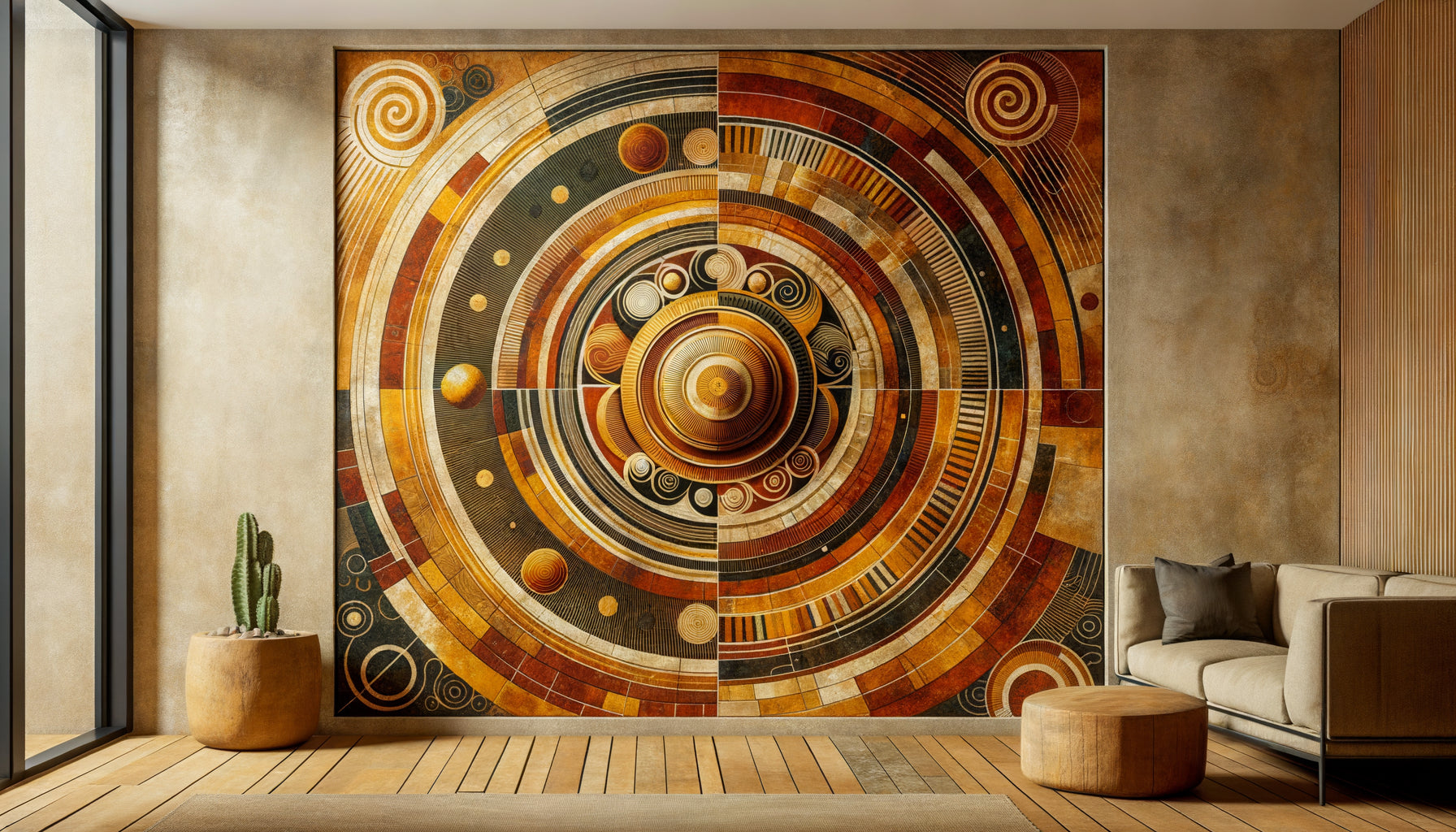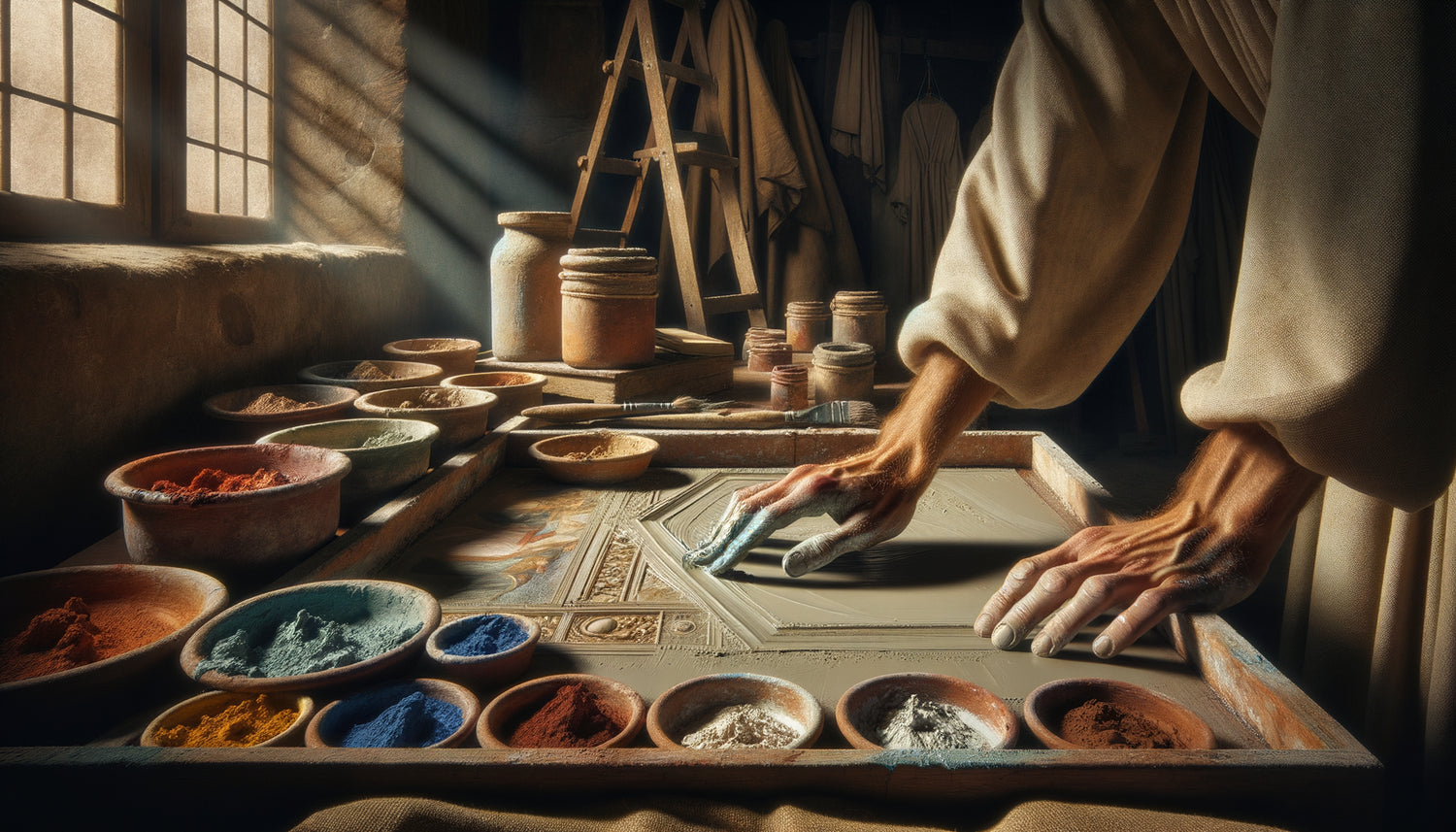
When restoring a Tuscan villa last year, my client nearly fainted when he saw the quote. "Why such a difference in price between these two techniques?" he asked me, his eyes glued to the numbers. Between a true fresco and a dry fresco, the difference can reach 300 to 500%. Yet, both seem identical at first glance. But behind this difference in cost lies a technical, artisanal, and temporal reality that few people truly understand.
Here's what the difference in cost between a true fresco and a dry fresco reveals: an ancestral demanding technique versus a flexible method, rare know-how versus contemporary accessibility, and an investment in eternity versus an immediate decorative solution.
You dream of adorning your walls with a spectacular mural, but the numbers make you dizzy? You hesitate between historical authenticity and budgetary pragmatism? You wonder if the additional investment is really worth it?
Rest assured. Understanding the factors that influence the cost of production of these two techniques will allow you to make an informed choice, adapted to your project and your budget. Because beyond the numbers, it's a whole artistic philosophy that expresses itself.
I am going to reveal the economic background of these two millennial techniques, from materials to completion time, including the expertise required. You will discover why some projects justify the investment in a true fresco, while others thrive perfectly with a dry fresco.
The true fresco: when every minute literally counts
The true fresco, also called buon fresco, imposes an implacable constraint: to paint on fresh plaster before it dries. This time window of 8 to 12 hours maximum transforms each working day into an artistic sprint.
Imagine the artist who must prepare exactly the surface he can paint in a day. No more, no less. Too small? Wasted time. Too large? The plaster dries and everything has to be redone. This technical requirement explains why the cost of production of a true fresco rarely starts below 800 to 1200 euros per square meter for a qualified artisan.
The invisible cost of technical mastery
The true fresco requires several years of training. Authentic fresco artists have become as rare as master luthiers. Their expertise comes at a price: count between 500 and 800 euros per day of work for an experienced professional, not including the assistants often necessary to prepare the plasters.
This scarcity of know-how explains why a true fresco of 10 square meters can easily reach 15,000 to 20,000 euros. The artist is not only selling his time, but decades of learning and an ability to work without possible repentance.
The materials: when authenticity has its price
For a true fresco, the traditional plaster is made of aerial lime and carefully selected river sand. The quality of these materials directly impacts the durability of the artwork. Professional-grade plaster costs between 40 and 80 euros per square meter, compared to 15 to 30 euros for the supports used in dry fresco.
Pigments represent another significant budget item. For a true fresco, only certain pigments resist the alkalinity of fresh lime. These finely ground natural mineral pigments can cost between 30 and 200 euros per 100 grams depending on the shades. Lapis lazuli or authentic cinnabar reach dizzying heights.
Dry fresco and its economical palette
Dry fresco, on the other hand, frees itself from these constraints. The artist can use acrylics, tempera or contemporary wall paints costing between 5 and 40 euros per liter. The support? A simple dry plaster, or even a properly prepared wall with an adhesion primer.
This material flexibility considerably reduces the production cost. For a dry fresco, expect between 200 and 500 euros per square meter depending on the complexity of the decor and the artist's reputation. The difference with the true fresco becomes obvious: we are talking about a ratio of 1 to 4, sometimes more.

Time: the enemy of true fresco, the ally of dry fresco
I have timed dozens of sites. A true fresco of 15 square meters mobilizes a fresco artist for an average of 3 to 4 weeks, not including the preparation of the support which can take an additional week. Each mistake is permanent, every hesitation is visible.
Dry fresco, on the contrary, allows corrections, revisions and adjustments. The artist can work in stages, return the next day without drying constraints. This temporal flexibility divides by two, or even three, the time required. The same surface area can be completed in 10 to 15 days.
Site organization and its budgetary repercussions
For a true fresco, the site must be perfectly organized. Stable temperature between 15 and 25 degrees, controlled humidity, absence of drafts... These optimal conditions sometimes imply costly adjustments: temporary heating, tarpaulins, controlled ventilation systems.
Dry fresco tolerates more variable conditions. The artist can interrupt their work without disaster, adapting their pace to the constraints of the site. This flexibility translates into substantial savings on logistics and coordination.
When investing in true fresco is justified
Despite its high production cost, true fresco represents a heritage investment. Renaissance frescoes still shine after five centuries. The carbonation of lime creates an exceptional mineral surface, resistant to UV rays, humidity and temperature variations.
In a historical restoration project, a prestigious residence or a public space intended to last for generations, true fresco is an obvious choice. Its initial production cost dilutes over decades, even centuries of maintenance-free durability.
Dry fresco for contemporary projects
For a private interior, commercial decoration or a project with a controlled budget, dry fresco offers remarkable value for money. With proper maintenance, it retains its beauty for decades.
Modern dry fresco techniques now include protective varnishes, UV fixatives and micro-porous paints that ensure excellent longevity. For 300 to 400 euros per square meter, you get a personalized mural work, completed in a few weeks, with the possibility of adjustments along the way.

The hidden costs that no one tells you
Beyond the direct production cost, several budget items are added. For a true fresco, support preparation can represent 30 to 40% of the total budget. Walls must be perfectly healthy, flat and free of any incompatible coating.
Scaffolding is another significant investment for high surfaces. Count between 500 and 2000 euros depending on the configuration. Dry fresco, being faster to execute, reduces the rental duration of this equipment.
Insurance and professional guarantees
A muralist creating a true fresco carries considerable responsibility. Their decade-long insurance and professional guarantee cost more than for a traditional building painter. These costs are reflected in the final price.
The dry fresco, considered a more conventional decorative technique, benefits from standard insurance coverage, which is less expensive. This administrative and legal difference also influences the price gap between the two techniques.
Transform your walls into works of art without breaking the bank
Discover our exclusive collection of abstract paintings that capture the essence of historical frescoes with contemporary accessibility.
Make an informed choice according to your project
The issue of production cost between a true fresco and a dry fresco is not simply a financial equation. It questions your priorities: are you looking for technical authenticity, centuries-old durability, heritage prestige? Or do you prefer creative flexibility, budget accessibility, and speed of execution?
In a listed chapel, a Venetian palace or a historic residence, the true fresco is essential despite its considerable investment. Only it guarantees this mineral fusion between pigment and support, this characteristic velvety matte finish, this resonance with the history of art.
For an urban loft, a contemporary restaurant or a primary residence, the dry fresco offers equivalent artistic freedom at a budget three to four times lower. Current techniques produce visually comparable results, even if the chemical composition differs fundamentally.
The essential thing is to find the right balance between your vision, your budget and the constraints of your space. A skilled artist will be able to guide you towards the most relevant technique, without judgment. Because ultimately, what matters is the emotion that the finished work evokes, not necessarily the method used to achieve it.
Start by defining your project precisely, consult several specialized artists, compare their approaches and quotes. Ask to see previous achievements in both techniques. Touch the surfaces, observe how the light caresses them differently. Your decision will naturally emerge from this sensory and budgetary exploration.
Frequently Asked Questions
Can you really see the difference between a true fresco and a dry fresco once they are finished?
From a distance, an untrained eye will have difficulty distinguishing a true fresco from a dry fresco of quality. The difference becomes perceptible in the surface texture: a true fresco has a characteristic mineral matte and slight roughness, while a dry fresco may have a slightly more film-like appearance depending on the paints used. To the touch, the distinction is immediate for an expert. But visually, a dry fresco executed with talent perfectly rivals a true fresco, especially in a contemporary decorative context where technical authenticity matters less than the aesthetic result. The higher production cost of a true fresco is mainly justified by its exceptional durability and heritage value.
How long does a dry fresco actually last compared to a true fresco?
A properly executed true fresco can last through the centuries without major alteration, as evidenced by the masterpieces of the Renaissance. Its exceptional durability justifies its high production cost. A professional quality dry fresco, protected from UV rays and excessive humidity, retains its beauty for 50 to 80 years under normal indoor conditions. Modern artistic pigments resist time remarkably well. The main difference concerns mainly resistance to humidity: a true fresco perfectly supports exposure to the weather, while a dry fresco requires protection outdoors. For a residential interior, this difference in longevity far exceeds the lifespan of an owner, making the choice more aesthetic and budgetary than practical.
Is it possible to reduce the cost of a true fresco without compromising quality?
The production cost of a true fresco is intrinsically linked to its unavoidable technical constraints. However, several strategies can optimize the budget. Reduce the painted surface by concentrating the true fresco on a central panel and supplementing with more economical techniques for peripheral areas. Simplify the iconographic program by favoring less detailed compositions, which require fewer days of work. Choose a color palette limited to the least expensive pigments: ochres, natural earths, iron oxides rather than lapis lazuli or vermilion. Participate in the preparation of the support if you have masonry skills, thus reducing ancillary costs. But be careful: cutting back on the artist's expertise or the quality of materials would turn your true fresco into a risky investment. In this case, a high-quality dry fresco is the intelligent alternative.