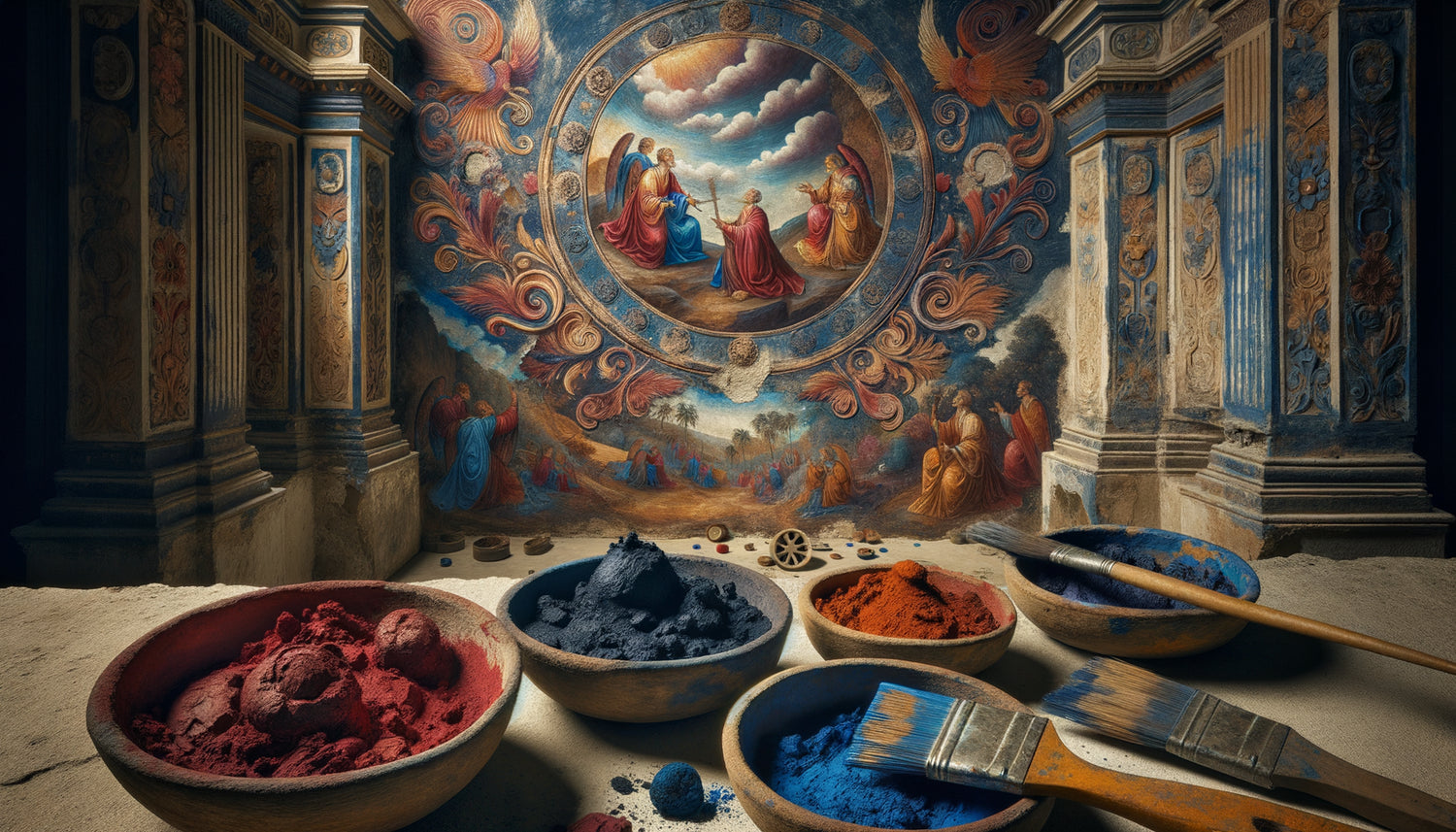
Behind every colonial fresco lies a story that is often preferred to be forgotten. These deep blues of Brazilian frescoes, these vibrant reds of Creole homes, these bright yellows of Caribbean churches... They tell more than just the aesthetics of an era. They whisper of maritime routes, ship holds, and inhumane exchanges that shaped our modern color palette.
Here's what the triangular trade brought to colonial wall art: a revolution in pigments unlike any seen before, the emergence of unique mixed techniques, and the establishment of visual codes still present in our contemporary interiors.
You may admire these saturated hues in decorating magazines, these vibrant colors inspired by the Antilles or colonial Brazil, without knowing their true origin. This lack of knowledge is normal: the history of pigments remains one of the blind spots of art and interior design history.
However, understanding these connections does not diminish the beauty of the works. On the contrary, it enriches our gaze and allows us to grasp the complexity of our visual heritage. Let's discover together how the slave economy transformed the walls of the colonial world into veritable chromatic laboratories.
The routes of pigment: when the triangular trade redistributes the colors of the world
The triangular trade did not transport only human beings and goods. It also carried raw dye materials that would revolutionize colonial wall art. Between Europe, Africa and the Americas, three distinct circuits were established as early as the 16th century.
Indigo arrives massively from India and West Africa to American plantations. This blue pigment, extracted from the indigo plant, becomes the blue gold of the colonies. Slaves cultivate, harvest and transform this plant under atrocious conditions. The fermentation process, particularly toxic, causes serious respiratory diseases. Yet, colonial indigo floods the mural painting workshops of Bahia, Havana, Saint-Domingue.
Logwood, extracted from the forests of Central America by a servile workforce, produces deep reds and purples. The religious frescoes of the Spanish missions bear its chromatic signature. This economically strategic pigment fuels trade wars between European powers.
Ochers and earths from Africa, embarked as ballast on slave ships, become the basis of colonial wall plasters. Mixed with local lime, these earths create warm, earthy tones that still characterize Creole architecture today.
The hands that paint: African know-how and technical innovation
Colonial wall art would not be what it is without African techniques. The deported slaves did not arrive with empty hands of knowledge. They brought with them centuries of pictorial traditions, botanical knowledge, ancestral gestures.
The color wash technique
In the realms of West Africa, the tradition of painted facades dates back millennia. Yoruba, Mandinka, Kongo slaves were perfectly familiar with the art of preparing colorful plasters resistant to tropical weather. They mastered natural binders: gum arabic, egg white, vegetable latex.
These techniques are directly reflected in Brazilian colonial frescoes. The Baroque churches of Minas Gerais show this hybridization: European pigments applied using African methods, creating exceptional resistance to time. The walls of Salvador de Bahia still bear witness to this forced alchemy.
Hidden geometric patterns
Look carefully at the borders of colonial frescoes. These interlacements, these repetitions, these visual rhythms are no accident. They are the subtle traces of African aesthetics, slipped surreptitiously by slave artisans into decorations imposed by European masters.
In Creole homes in Louisiana, Martinique, and Guadeloupe, these patterns persist. A trained eye recognizes Adinkra symbols, Kongo patterns, transformed, adapted, survivors. The slave economy wanted to erase identities; mural art became a space of visual resistance.

Colonial blue: anatomy of a color built on exploitation
Let's focus on this shade that still obsesses decorators today: this deep, slightly grayed blue, sometimes called "colonial blue" or "plantation blue." Its history perfectly illustrates the links between pigments and the slave trade.
Indigo plantations in the Caribbean and South Carolina operated under an extremely brutal system. Harvesting had to be done at a specific maturity point. The fermentation process in vats released unbearable ammonia fumes. Slaves assigned to indigo farms developed chronic pulmonary pathologies.
However, the quality of colonial indigo pigment was unparalleled. Its depth, lightfastness, and ability to blend with lime to create infinite nuances made it one of the most sought-after pigments. The frescoes on the plantations themselves displayed this blue, in a cruel irony: the color produced by slaves decorated the walls of their oppressors.
This colonial blue still permeates our decorative imagination. When you choose a "Caribbean blue" paint for your living room, you involuntarily inherit this complex history. Recognizing this genealogy does not mean renouncing the color, but inhabiting it consciously.
The mixed pigments: when local materials meet imposed techniques
Colonial chromatic innovation also arises from necessity. European pigments cost a fortune and arrived damaged by sea crossings. It was necessary to find local alternatives.
Slaves, holders of ancestral botanical knowledge, quickly identify American dye plants. Annatto produces orange reds. Genipa gives deep blacks. Wild turmeric offers bright yellows. These discoveries are not credited, obviously. They enter the colonial technical heritage without recognition.
Colonial murals in Mexico show this hybrid richness. Red ochres come from local soils. Blues combine imported indigo and native plant dyes. Whites blend European lime and crushed shells according to pre-Columbian techniques, passed down by enslaved populations.
This mixed palette creates a unique visual language. The colonial churches of Guatemala, Peru, and Brazil are unlike anything European despite their imported architecture. Their colorism tells the story of forced mixing, the creolization born of violence.

The contemporary heritage: how these colors still inhabit our interiors
Take the experience: open a contemporary paint chart. Count the references to colonial colors. "Charleston Blue," "Havana Ochre," "Burnt Sienna Earth," "Bahia Red." Our chromatic vocabulary remains steeped in this history.
Current decor trends value these "authentic," "warm," and "exotic" shades. Magazines feature interiors inspired by Southern plantations, Creole homes, and colonial haciendas. This aestheticization raises questions: can we celebrate beauty while obscuring the violence that produced it?
The answer is not binary. Colonial wall art exists, with its undeniable beauty and terrible history. Pigments from the triangular trade have enriched our palette. Mixed techniques have created lasting innovations. Ignoring this contribution would be a second form of erasure.
The challenge is more about looking at these colors with clarity. When you choose a "colonial blue" for your entrance, you can do so knowing its history. This awareness does not diminish aesthetic pleasure; it deepens, complicates, and matures it.
Transform your gaze on colors and their history
Discover our exclusive collection of abstract paintings that reinterpret historical palettes with a contemporary awareness.
Towards a responsible chromatic memory
How to inhabit this heritage today? Several avenues emerge. First, recognition. Museums are beginning to document the real origin of pigments, crediting African know-how that has long been invisible. Exhibitions trace the routes of colors, connecting aesthetics and economic history.
Next, creative appropriation. Contemporary artists of Afro-descendant origin are working explicitly with these historical pigments, reversing their symbolism. They paint resistances, memories, identities with the very colors of oppression. Indigo becomes a pigment of liberation.
Finally, education of the gaze. Learning to see in a simple colored wall the world history that made it possible. Understanding that a "colonial red" is not just a Pinterest trend, but the result of commercial circuits based on dehumanization.
This approach takes nothing away from beauty. It contextualizes it, makes it richer, more conscious. An interior decorated with this historical intelligence gains depth what it could lose in innocence.
Colors are never neutral. They carry the stories of the hands that made them, the lands that produced them, and the economic systems that distributed them. The slave economy has profoundly marked our contemporary palette. Recognizing this reality is to honor the memory of those who created our current chromatic landscape, often in suffering.
Next time you choose a color for your walls, you might take a different look at the color chart. And this informed gaze, far from tarnishing your decorative pleasure, will give it an extra dimension: that of human history in all its complexity.
Frequently asked questions about colonial pigments and wall art
Can we still use colonial colors in our interiors without an ethical problem?
Absolutely, and this question demonstrates an important sensitivity. Colors themselves do not pose an ethical problem: they are aesthetic tools. What matters is the awareness with which we use them. Choosing an indigo blue or ochre colonial knowing its history, recognizing African contributions to its development, valuing this memory rather than erasing it, is precisely an ethical approach. The important thing is not to renounce these magnificent shades, but to inhabit them with lucidity and respect for those who created them. Many contemporary designers are working to rehabilitate these palettes by documenting their origins and crediting the invisibilized know-how. Your interior can be both beautiful and historically conscious.
How to recognize a genuine colonial fresco from a modern reproduction?
Several clues allow this distinction. Authentic colonial frescoes have a particular texture due to the preparation techniques of plasters: several layers of lime mixed with local vegetable fibers, creating a subtle relief. Natural pigments age in a characteristic way: indigo blues tend towards gray, cochineal reds retain their depth but lose saturation. Cracks follow specific logics related to tropical humidity variations. Above all, look at the borders and secondary motifs: real colonial frescoes often show stylistic hybridations, African geometric patterns discreetly integrated, laying techniques that do not correspond to purely European methods. An expert can also analyze the chemical composition of the pigments to precisely date the work and identify its geographical origin.
Are there modern alternatives to historically problematic pigments?
Modern chemistry has developed syntheses for virtually all natural pigments, including indigo which is now mostly produced synthetically. These alternatives often offer better light stability and more controllable saturation. However, some artisans and decorators still prefer natural pigments for their unique chromatic subtlety and particular behavior in lime plasters. The ecological paints movement offers vegetable sources grown ethically: organic indigo, fair trade annatto, mineral earths extracted responsibly. If you want to reproduce an authentic colonial palette while respecting contemporary values, prioritize brands that document their supply chains and guarantee fair production conditions. The essential thing is to maintain historical memory while creating new respectful practices.