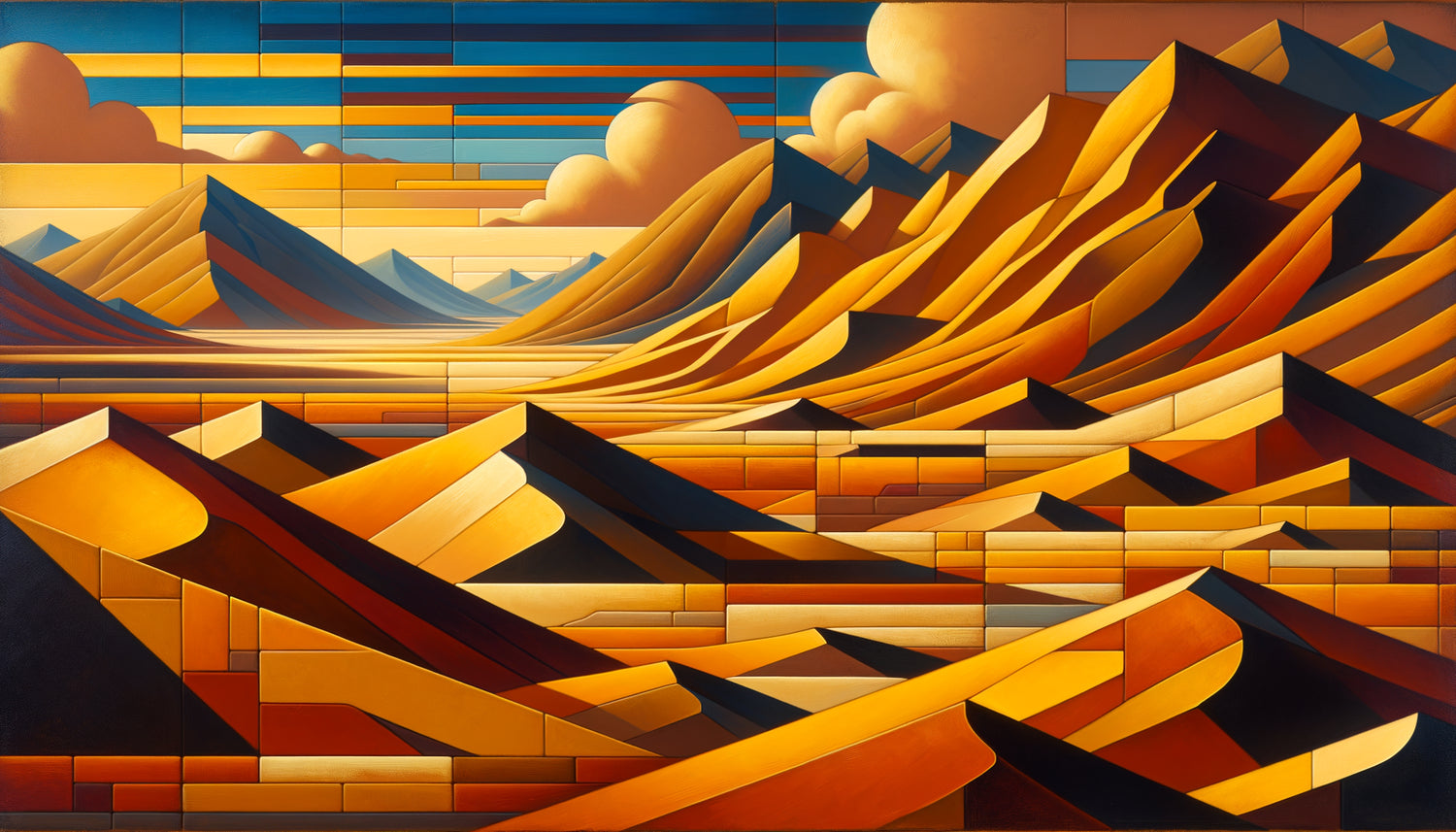
Imagine a moment these ochre mountains undulating under the sun of Central Asia, these valleys where light dances between arid reliefs, these immense skies that crush the horizon. It is in this grandiose geography that Ural Tansykbayev forged his unique pictorial language, that of an Uzbek abstraction which refused to cut ties with the land that saw him born. Unlike Western abstractions seeking total rupture with figurative art, the work of this Uzbek master wove a subtle dialogue between pure form and stylized landscape, between radical modernity and ancestral visual memory.
Here's what Tansykbayev’s approach reveals to us: a path towards abstraction that preserves the emotion of place, a modernity that does not require cultural amnesia, and an aesthetic that proves that stylization and territorial anchoring can coexist in the same composition.
Many believe that abstract art must necessarily erase all reference to the visible world to reach its purest form. This vision, inherited from Suprematism and European geometric abstraction, may seem like the only legitimate path. Yet, this approach ignores the multiple paths taken by artists who, like Tansykbayev, have developed their own abstract vocabulary without denying their geographical belonging.
Rest assured: understanding why Uzbek abstraction retained this reference to the stylized landscape requires no academic knowledge of Soviet art history. It is enough to observe how an artist can transform his environment into a personal visual language, how historical constraints can become catalysts for creativity.
In this article, we will explore the deep roots of this landscape abstraction, the creative tensions that shaped it, and how it can now inspire interior decoration that celebrates the balance between contemporary minimalism and organic warmth.
Uzbekistan in the skin: when geography becomes visual grammar
To grasp the essence of Tansykbayev’s abstraction, you must first understand his territory. Born in 1904 in a region where arid steppes meet mountainous foothills, the artist grew up amidst landscapes unlike any other. These stylized landscapes of Central Asia possess an almost abstract quality in their natural state: mineral curves that repeat endlessly, muted colors that vibrate under intense light, a dizzying horizontality punctuated by rocky verticals.
This visual geography was imprinted on his retina from childhood. Unlike Moscow artists who discovered abstraction in Parisian galleries, Tansykbayev already carried it within him, inscribed in his sensory memory. His mountains were not decorative motifs but lived presences, masses that structured his experience of the world.
In his early figurative works of the 1920s, one can already distinguish a tendency to simplify forms, to reduce the landscape to its essential components. Villages become aggregations of geometric volumes, reliefs transform into superimposed horizontal bands. This progressive stylization was not an intellectual process but a natural way of seeing, of synthesizing immensity within a manageable framework.
Between Moscow and Tashkent: navigating contradictory requirements
The years 1930 to 1950 represent a fascinating and perilous period for Uzbek abstraction. The socialist realism imposed by Stalin demanded clear, readable representations that were ideologically correct. Pure abstraction was considered formalist, decadent, bourgeois. Yet, Tansykbayev also had to meet another requirement: to express the Uzbek national identity in a modern language.
It is within this creative tension that his aesthetic solution emerged. By retaining a reference to the landscape, even stylized to the extreme, he technically satisfied the regime's requirements while pushing the limits towards abstraction. His compositions of the 1940s are remarkable in this regard: one can still identify mountains, valleys, skies, but their formal treatment brings them closer and closer to pure abstract composition.
Colors gradually detach themselves from their descriptive function. These ochres, browns, blues no longer seek to faithfully reproduce reality but to capture its emotional essence. The stylized landscape becomes a pretext for chromatic explorations that are more akin to musical harmony than naturalistic observation.
An embodied rather than conceptual abstraction
Unlike Kandinsky or Malevich who abundantly theorized their approach, Tansykbayev practiced an intuitive abstraction. His writings are rare, his statements restrained. His approach was phenomenological before its time: starting from experience, sensation, physical presence in the world rather than constructing a priori theoretical system.
This fundamental difference explains why his abstraction retained this landscape reference. He did not abandon the landscape because he was not seeking to reach a conceptual absolute, but to distill a sensory experience in visual form. His compositions of the 1950s-1960s show this maturity: colored surfaces that evoke without representing, rhythms that suggest the undulation of reliefs without describing them.

The lesson for our contemporary interiors
Why should this story interest us when we think about decorating our spaces? Because Tansykbayev's approach offers a valuable alternative to the cold minimalism that sometimes dominates contemporary aesthetics. His landscape abstraction shows us that we can embrace the modernity of clean forms while retaining warmth, depth, and emotional anchoring.
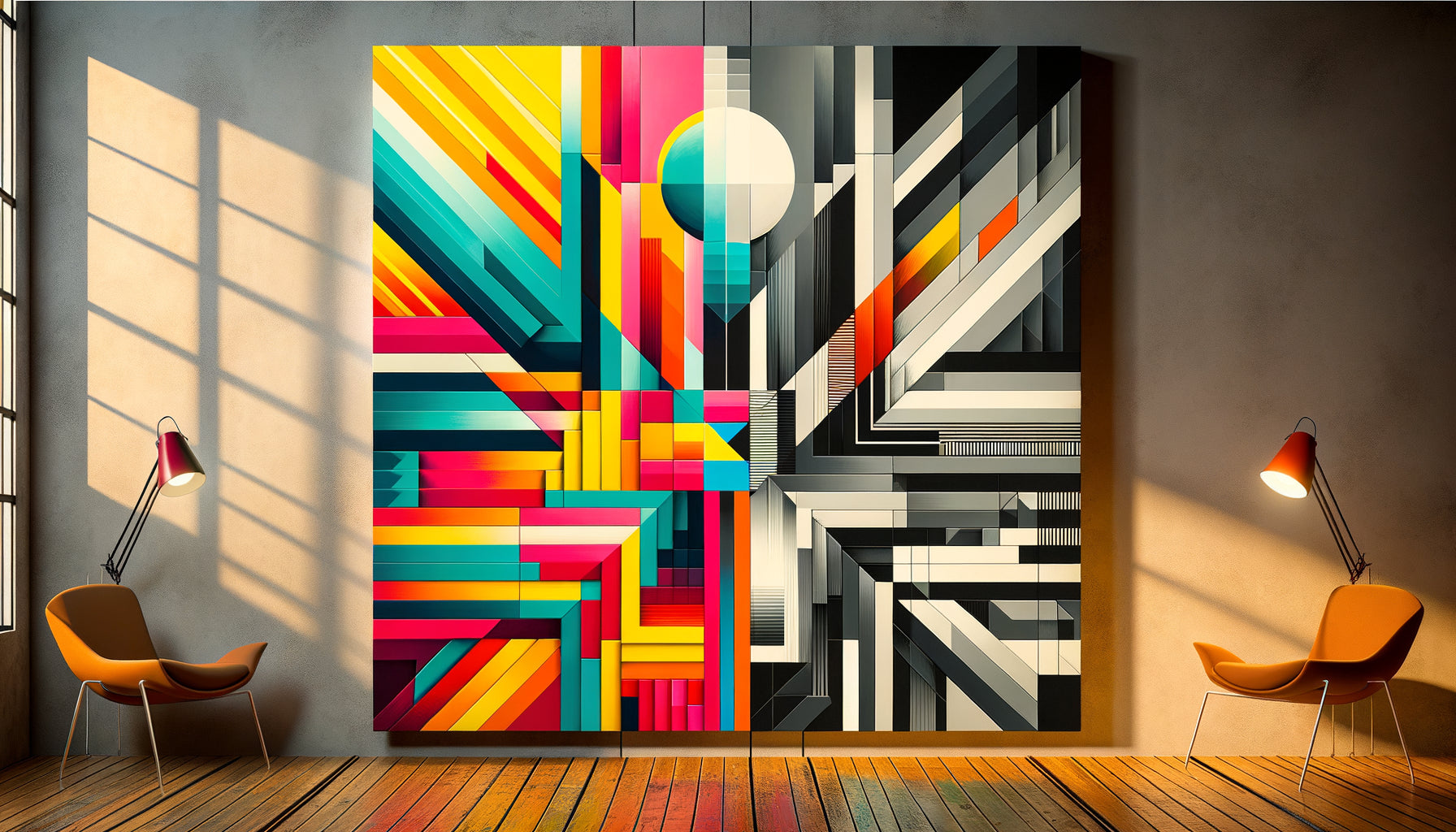
In a living room dominated by clean lines and contemporary materials, a composition inspired by this Uzbek abstraction brings that organic dimension that prevents the space from becoming sterile. These earthy colors, these shapes that evoke without illustrating, these horizontal rhythms that recall the expanse of landscapes create a focal point that is both sophisticated and welcoming.
The balance that Tansykbayev has found between abstraction and reference is exactly what we are looking for in our interiors: clean enough to integrate into a contemporary aesthetic, charged enough with presence to avoid conceptual dryness. It is this delicate balance that transforms a space into a lived-in place, a personal territory rather than an aesthetic demonstration.
The materiality of the stylized landscape
What is also fascinating about Tansykbayev's work is his attention to materiality. His painted surfaces retain a texture, a thickness that recalls the roughness of arid lands, the mineral density of mountains. This tactile dimension of his abstraction establishes a dialogue with interior architecture in a way that purely optical abstraction cannot achieve.
In a space dominated by natural materials—raw wood, linen, stone—this material quality of the landscape abstraction creates a harmonious resonance. The muted colors dialog with the organic tones of fabrics, the pictorial textures echo the grains of wood, and the horizontal compositions harmonize with contemporary architectural lines.
It is also this materiality that makes these works capable of aging gracefully in an interior. Where some graphic abstractions may seem dated after a few years, these compositions that carry within them the geological memory of landscapes possess a different temporality, slower, more durable.
Composing with natural light
An often overlooked aspect of Tansykbayev's abstraction is its particular relationship to light. Conceived under the intense sun of Central Asia, these compositions possess an internal luminosity that reacts remarkably to variations in natural lighting. In a Nordic interior where the light is softer and more changeable, these works reveal unsuspected chromatic subtleties.
In the morning, when grazing light accentuates textures, surfaces reveal their material complexity. Midday, under direct light, contrasts assert themselves and the compositional structure emerges clearly. At dusk, muted colors deepen, creating a contemplative atmosphere that transforms the room's ambiance.
Want to bring this organic presence into your interior?
Discover our exclusive collection of abstract paintings that capture this delicate balance between pure contemporary and landscape warmth, to transform your walls into sensory territories.

Inheriting a vision without copying it
The final lesson of Uzbek abstraction is not to reproduce its specific aesthetics but to understand its approach. Tansykbayev shows us that it is possible to develop a modern visual language while remaining faithful to a particular geographical and cultural experience. This approach resonates today where we seek to globalize without homogenizing, to modernize without erasing.
In our decorative choices, this translates into a new freedom: we do not have to choose between contemporary aesthetics and personal references, between formal purity and emotional depth. The example of this landscape abstraction allows us to create interiors that are both resolutely current and deeply rooted in our stories, memories, and affiliations.
Whether you are attracted to compositions with mineral colors evoking deserts, horizontal rhythms recalling marine expanses, or chromatic stratifications suggesting mountain reliefs, you can now understand that this referential abstraction offers a valuable middle ground between narrative figuration and hermetic abstraction.
Imagine yourself in your living room, facing a composition that evokes without illustrating, that suggests without demonstrating. You feel this calm presence, this depth that invites prolonged contemplation rather than rapid visual consumption. This is exactly what Tansykbayev's abstraction offers us: a door to contemplation in a world saturated with aggressive images.
Perhaps begin by observing the landscapes around you — urban or natural — with a new perspective: how could you distill them into essential forms, chromatic harmonies, compositional rhythms? This visual gymnastics, which Tansykbayev practiced throughout his life, transforms our relationship to the world and, by extension, our way of inhabiting our interior spaces.
FAQ : Understanding Uzbek Landscape Abstraction
What differentiates Tansykbayev’s abstraction from Western abstraction?
Western abstraction, particularly in its Suprematist or expressionist abstract manifestations, often sought a radical break with any reference to the visible world. Malevich wanted to reach pure plastic sensation, Pollock explored gestural automatism. Tansykbayev’s abstraction, on the other hand, deliberately maintained a link with the Uzbek landscape, not through an inability to detach from it, but through the conviction that this reference enriched rather than limited his language. It was an embodied abstraction rather than a conceptual one, rooted in a sensory experience of the territory rather than constructed upon aesthetic theories. This approach creates works that immediately communicate a spatial and emotional presence, whereas some pure abstractions require theoretical mediation to be fully appreciated. For our interiors, this translates into compositions that work intuitively, creating an atmosphere without requiring explanation.
How to integrate this aesthetic into a modern interior without creating dissonance?
Uzbek landscape abstraction integrates remarkably well into contemporary interiors precisely because it shares their formal vocabulary — streamlined, simplification, thoughtful composition — while bringing an organic warmth that counterbalances the potential coldness of minimalism. The key is to treat these works as architectural elements rather than added decorations. In a space with clean lines, a large composition in earthy tones creates a focal point that visually structures the room. Combine it with natural materials—raw linen, unvarnished wood, artisanal ceramics—which echo its materiality. Avoid overloading it with other strong graphic elements; let it breathe. Lighting is crucial: prioritize natural light or indirect sources that reveal chromatic subtleties without creating aggressive reflections. This approach transforms the work into a constituent element of interior architecture rather than a simple ornament.
Why does this reference to landscape remain relevant today?
In our era dominated by screens, virtualization and increasing disconnection from the physical environment, landscape abstraction offers a subtle but powerful grounding. Unlike landscape photography which can seem nostalgic or decorative, this stylized approach maintains a creative tension between presence and absence, between reference and formal autonomy. It reminds us of our belonging to a physical geography without falling into illustration. For our interiors, this translates into a presence that subtly reconnects us to the natural world without the didacticism of floral patterns or panoramic views. This is particularly valuable in urban spaces where contact with natural landscapes is limited. These compositions create what one might call an abstract landscape memory — they activate our sensory memories of expanses, horizons, masses and voids without imposing a specific landscape on us. This openness allows everyone to project their own experience, creating a personal relationship with the work that evolves over time.