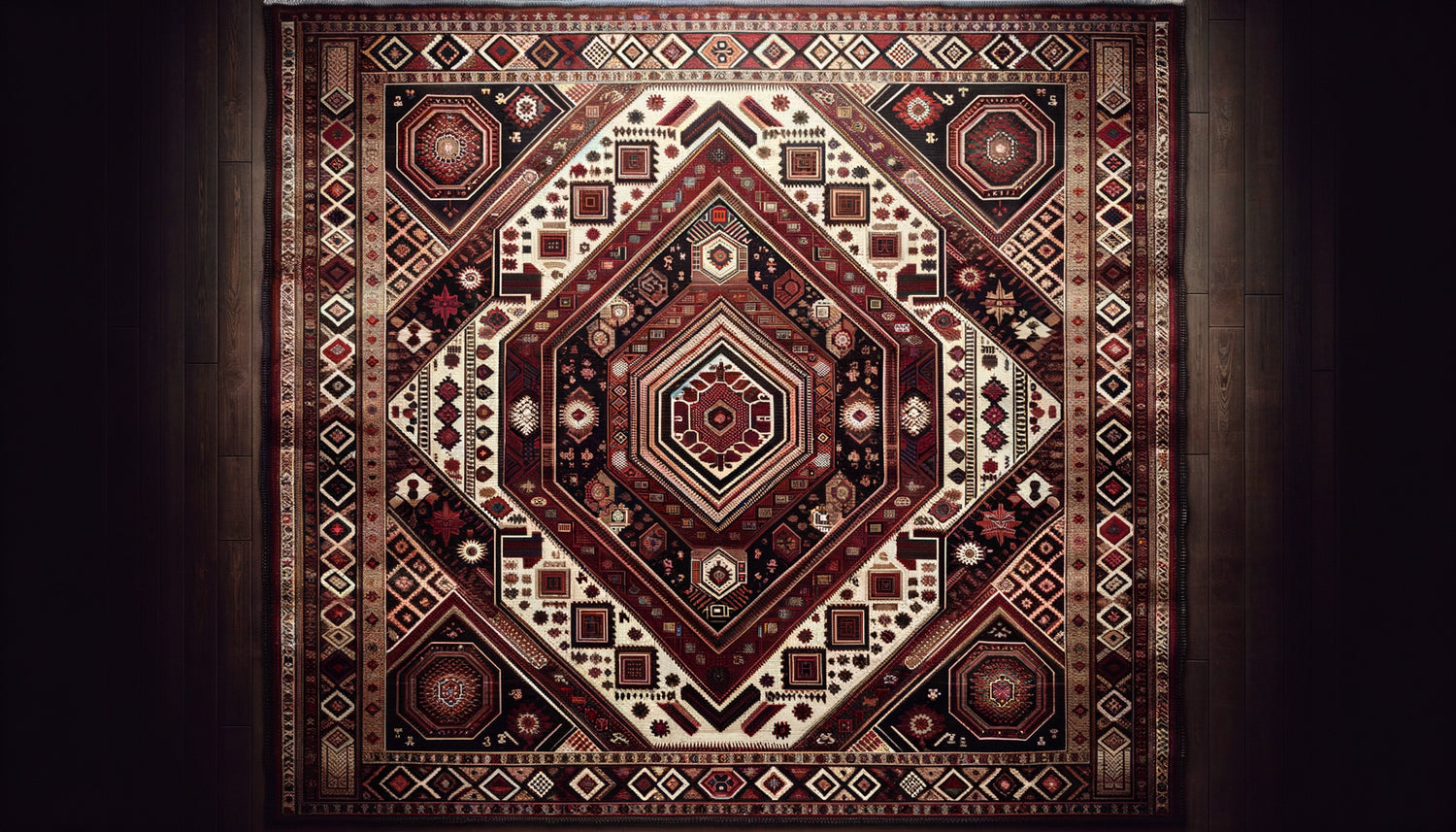
In the bazaars of Bukhara and Ashgabat, I spent hours contemplating these Turkmen carpets with hypnotic geometric patterns. Each gul, each border tells a millennial story, but never – ever – will you find an abstract composition in the modern sense of the term. This observation haunted me for years: how could a culture capable of creating such sophisticated geometric abstractions never take the step towards pure abstraction?
Here's what this limitation reveals: Turkmen abstraction remained confined to traditional stylized decorative arts due to a dense cultural fabric woven with Islamic religious constraints, a rigid tribal artisanal system, and a nomadic economy that valued utilitarian function over pure aesthetic experimentation.
You may be fascinated by these ancestral patterns and wonder why this visual richness hasn't exploded in a thousand creative directions. This question touches on the very heart of what defines art in different cultures. I promise you that by exploring this mystery, you will not only understand the soul of Turkmen craftsmanship but also how constraints paradoxically shape creativity.
The invisible weight of religious prohibition
Sunni Islam practiced by the Turkmens imposed a fundamental restriction: the prohibition of figurative representation. Unlike the West where abstraction developed as a conscious break with realism, Turkmen artisans never had that figurative starting point to transcend.
This religious constraint channeled all creativity into geometric shapes and stylized patterns that decorated functional objects: carpets, jewelry, embroideries, ceramics. Turkmen abstraction was not a philosophical or spiritual quest, but a pragmatic response to the limits imposed by faith. The famous octagonal guls of Tekke rugs or the diamond motifs of the Yomut existed only to embellish everyday life, never as autonomous works.
Local religious authorities scrupulously ensured that art remained in service of function. A carpet could be magnificent, but it must first serve to insulate from the cold floor of yurts. This informal but constant surveillance prevented any drift towards contemplative abstraction that might have been perceived as a pretension to rival divine creation.
Oral transmission as a creative shackle
In Turkmen tribes, patterns were passed down from mother to daughter according to a strict code. Each clan possessed its repertoire of shapes: the Salor had their specific guls, the Saryk theirs. This tribal codification turned Turkmen abstraction into a visual language where each element had a precise meaning, a delimited use.
Imagine a young weaver learning her craft: she wasn’t creating freely, but reproducing, subtly varying, yet always within the narrow confines of tribal tradition. Radical innovation would have been seen as a betrayal of collective identity. Abstraction remained captive to these ancestral conventions, unable to break free towards unexplored territories.
The nomadic economy and the tyranny of utility
The Turkmens lived in a hostile environment – arid steppes, sandy deserts – where every object had to justify its presence by its immediate usefulness. A rug protected from the cold, pottery contained water, embroidery reinforced clothing. The very idea of an object purely for contemplation was an inconceivable luxury in this survival economy.
This material reality explains why Turkmen abstraction flourished exclusively on functional supports. Unlike sedentary societies that developed classes of patrons and collectors capable of supporting autonomous art, nomadic tribes had neither the time, nor the resources, nor the social structure to encourage a pure abstraction detached from any practical function.
The rare moments when Turkmen art might have broken free coincided with periods of forced sedentarization under the Russian and then Soviet empires. But these brutal transitions rather fossilized traditions as identity markers in the face of assimilation, paradoxically reinforcing aesthetic conservatism.
Trade as a form fixer
As early as the 19th century, Bukhara and Russian merchants developed a lucrative trade in Turkmen rugs. But this international market had a perverse effect: it standardized patterns that appealed to Western buyers. Turkmen artisans discovered that certain traditional designs sold better than others, creating economic pressure towards reproduction rather than innovation.
This commercial dynamic transformed Turkmen abstraction into a frozen export product. Creative variations that could have led to freer forms were discouraged by the market itself. European collectors sought authenticity – that is, conformity to established canons – not experimentation. Decorative Turkmen art thus became prisoner of its own market value.

The absence of a class of conceptual artists
In societies where modern abstraction emerged – Europe, Russia, America – it was championed by individual artists who saw themselves as autonomous creators: Kandinsky, Malevich, Mondrian. These figures had access to education, philosophical debates, and intellectual movements that questioned the very nature of art.
The Turkmen world lacked this cultural infrastructure. There were no academies, no art critics, no theoretical manifestos. Creators were anonymous artisans whose names were lost in collective tribal production. Without this self-awareness as an artist, without a conceptual vocabulary to think of abstraction as a radical aesthetic project, Turkmen art remained necessarily rooted in its traditional forms.
This social structure explains why even the most talented Turkmens never crossed the threshold towards conceptual abstraction. They lacked not technical ability – their geometries are astonishingly complex – but the intellectual and institutional framework for thinking of their work other than as decorative craftsmanship.
When motifs become a community language
I realized during a conversation with an elderly weaver in Mary that what I called abstraction was, for her, a system of communication. Each motif had a name, a story, a social use. The gul was not a free abstract form; it was literally the emblem of the clan, recognizable among thousands, carrying belonging and pride.
This identity function of geometric shapes locked their evolution. Radically altering a tribal motif meant blurring identity markers in a society where clan affiliation was vital. Turkmen abstraction was therefore overdetermined by its semantic charge: it could not become pure visual form because it always meant something specific to the community.
This difference from Western abstraction is fundamental. Kandinsky sought to free color and form from any external reference to create a purely visual experience. Turkmen artisans, on the other hand, worked in a system where every visual element was already saturated with inescapable social meanings.
Modern attempts and their failures
In the 20th century, a few Turkmen artists trained in Soviet academies attempted to adapt traditional motifs to contemporary art forms – paintings, sculptures, installations. These experiences remained marginal and were often perceived as cultural betrayals by traditional communities.
The Soviet regime itself, despite promoting radical avant-gardes in Russia, adopted a policy of folkloric preservation in Turkmenistan. Turkmen arts were valued precisely for their traditional and decorative dimension, as a showcase of the cultural diversity of the USSR. This political instrumentalization reinforced aesthetic conservatism rather than fostering creative evolution.
Get inspired by the timeless power of abstract forms
Discover our exclusive collection of abstract paintings that dialogues with these ancestral legacies while embracing modern creative freedom.

What this limitation teaches us today
The history of Turkmen abstraction reminds us that creativity never flourishes in a vacuum. It is always the product of a specific cultural, religious, economic and social context. The constraints that kept Turkmen art within traditional decorative limits were not flaws, but structuring forces that gave rise to an incomparable richness of aesthetics.
Paradoxically, this limitation preserved a coherence and identity that many contemporary arts, in their quest for permanent rupture, have lost. Turkmen motifs still speak today with a clear, recognizable voice, carrying millennia of refinement. This constrained abstraction has produced works of beauty that transcend the centuries without aging.
For us, creators or lovers of modern art, this story poses an essential question: is total freedom truly the condition of great creation? Or can constraints – whether religious, community, functional – paradoxically generate deeper creativity, more rooted, more durable?
The next time you contemplate an antique Turkmen carpet, you will no longer simply see a beautiful decorative object. You will distinguish the visible traces of all those invisible factors that shaped each line, each color, each geometric repetition. You will understand that this abstraction, although limited by our modern standards, was in reality a total form of expression adapted to its context – and of absolute relevance.
Frequently Asked Questions about Turkmen Abstraction
Are Turkmen Motifs Really Abstract?
This is a fascinating question that reveals the ambiguities of the term abstraction. Formally speaking, Turkmen motifs are undoubtedly abstract: complex geometries, non-figurative compositions, games of repetition and symmetry. But conceptually, they are not abstract in the modern sense of the term. Each form has a precise meaning, an identity function, a codified use. Turkmen abstraction is therefore a symbolic stylization rather than pure abstraction. It does not seek to free itself from representation – it operates within a system where figurative representation has never existed. This nuance is crucial to understand why this art remained confined to decorative objects: it did not aspire to be anything else, because the very concept of autonomous art did not exist in this cultural context.
Why Didn't Turkmen Art Evolve Like Persian Islamic Art?
Excellent observation! While subject to the same Islamic restrictions, Persian art developed more varied forms including miniature painting, monumental calligraphy, and a much more elaborate ornamental abstraction. The difference mainly lies in the social structure: Persia possessed royal courts, enlightened patrons, a class of professional artists, and a millennial urban tradition. Turkmen people were mostly nomadic, organized into tribes without strong political centralization. Their art remained community craftsmanship rather than elite creation. Moreover, Persia was a cultural crossroads absorbing Greek, Indian, Chinese influences, while the Turkmen steppes were more isolated. This difference in cultural exposure and social structure largely explains why Turkmen abstraction has remained more conservative and limited to traditional supports.
Can Turkmen Motifs Be Integrated into Contemporary Decor?
Absolutely, and it's even a strong trend in interior design! Turkmen motifs possess a timeless modernity thanks to their pure geometry and often subdued color palette (deep reds, blacks, off-whites). The key is to use them sparingly to avoid an ethnographic museum effect. A single authentic Turkmen rug can ground an entire contemporary space, creating a fascinating dialogue between tradition and modernity. You can also draw inspiration from their compositional principles – repetitions, symmetries, multiple borders – to create wall displays with modern abstract artworks. The important thing is to respect their visual power by giving them enough space to breathe. These millennial patterns have this rare ability to feel both ancestral and surprisingly current, precisely because their geometric abstraction transcends ephemeral trends.