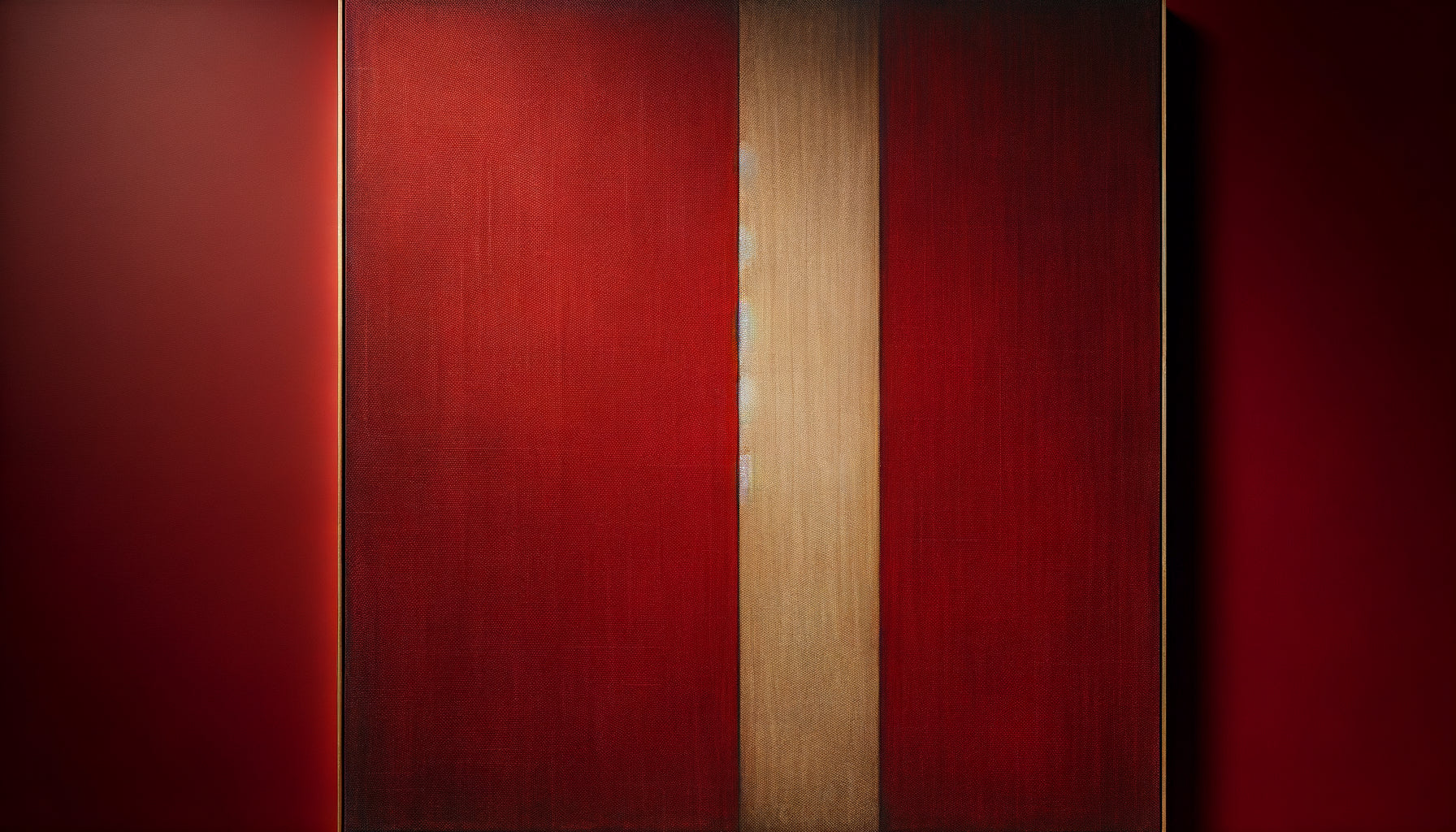
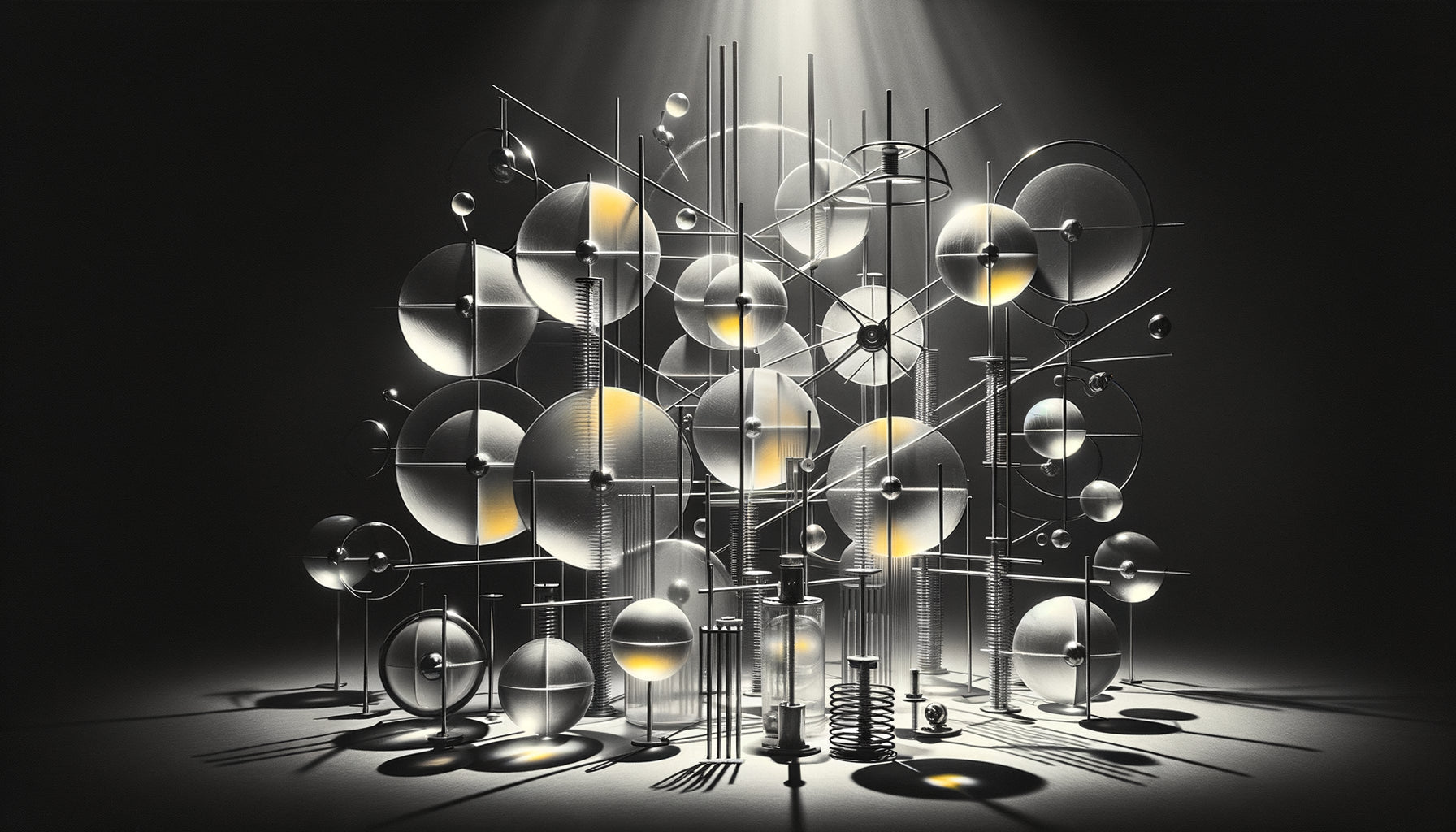
Imagine a workshop where geometric shapes become a visual alphabet, where colors converse without words, where the balance of a circle and a square tells a story accessible to all, regardless of their native language. This is precisely what the masters of Bauhaus invented in the 1920s: a revolutionary pedagogy that transformed abstract composition into a universal language, capable of transcending cultural and linguistic borders.
Here's what the Bauhaus method brings to your understanding of abstract art: a visual grammar accessible based on primary shapes, a sensory approach that connects color and emotion, and compositional principles applicable to any creative space.
You may be fascinated by abstract art but intimidated by its apparent complexity. These canvases of shapes and colors seem reserved for initiates, like a secret code you wouldn't have the key to. Yet, Bauhaus teachers believed exactly the opposite: abstraction is not elitist, it is universal. Wassily Kandinsky, Paul Klee, and Johannes Itten developed a pedagogy where everyone, artisan or architect, could learn this visual language as one learns to read. This article reveals their revolutionary teaching methods, still relevant for understanding and appreciating contemporary abstract art that adorns our interiors.
Shape as vocabulary: the fundamental course of Johannes Itten
At the heart of Bauhaus teaching was the Vorkurs, the mandatory preliminary course created by Johannes Itten in 1919. This six-month training began with a radical principle: forget everything you think you know about art. Itten asked his students to close their eyes and feel the materials before manipulating them. He taught that primary geometric shapes each possessed a distinct personality: the circle evoked fluid movement and infinity, the square represented stability and materiality, the triangle embodied tension and dynamics.
This approach transformed abstract composition into a communication system. Students learned to combine these shapes like words in a sentence, creating meaning through their juxtaposition, scale, and orientation. A large red circle dominating a small blue square did not tell the same story as an inverse composition. Itten insisted on sensory exercises: drawing with closed eyes, experimenting with tactile contrasts between rough and smooth, translating sounds into visual forms.
This revolutionary pedagogy established that abstraction was not a break from reality, but a distillation of its essences. A tree became a series of vertical lines and organic shapes, an emotion translated into tension between angular and curved forms. Students thus developed a universal visual vocabulary, intuitively understandable by all human beings, regardless of their culture.
Kandinsky's color theory: when colors speak to emotions
Wassily Kandinsky brought a spiritual and emotional dimension to the teaching of abstract composition. For him, colors were not mere decorative attributes but psychological forces capable of touching the soul directly. In his theoretical courses at the Bauhaus between 1922 and 1933, he developed a true chromatic grammar where each shade corresponded to an inner sound.
Kandinsky established precise correspondences: yellow radiated towards the observer with earthly energy, blue receded into celestial infinity, red vibrated with contained intensity. He also associated shapes and colors according to natural affinities: the pointed triangle harmonized with sharp yellow, the peaceful circle with deep blue, the stable square with dense red. These associations were not arbitrary but based on sensory experiences shared by humanity.
His students carried out systematic exercises: composing with a single shape in different colors to observe emotional transformations, creating visual dialogues between warm and cold shapes, translating musical compositions into chromatic arrangements. Kandinsky demonstrated that abstract composition functioned as a visual symphony, where each element contributed to harmony or created intentional tension.
This approach has profoundly influenced the way we perceive abstract art in our interiors today. An abstract painting is no longer an incomprehensible mystery but an emotional presence that dialogues with our sensitivity.

Practical exercises by Paul Klee: from observation to abstraction
Paul Klee proposed a complementary method in his teaching: starting from the visible world to gradually arrive at abstraction as a universal language. Unlike Itten's immediately conceptual approach, Klee guided his students through a process of simplification and distillation. He would take them to observe nature, then ask them to progressively reduce what they saw to its essential structures.
A flower first became a growth scheme, then a play of curved lines and points, finally an abstract composition of organic shapes. Klee taught that nature possesses its own laws of composition: the logarithmic spiral of a shell, the symmetry of a leaf, the rhythm of waves. By understanding these fundamental structures, his students accessed the universal principles that underlie any harmonious composition.
His courses on the theory of forms explored movement, balance and dynamic tension. He used arrows to indicate visual forces in a composition, showing how the eye travels through a painting. An isolated element created a focal point, a series of elements suggested a rhythm, shapes arranged diagonally generated dynamism. Klee demonstrated that these principles transcended styles and eras, truly forming a universal language of perception.
His teaching notebooks, filled with diagrams and annotations, reveal a complete system where abstract composition becomes an accessible science, based on empirical observations rather than arbitrary rules.
The textile workshop: Anni Albers and functional abstraction
The teaching of abstract composition as a universal language was not limited to painting at the Bauhaus. Anni Albers, leading the textile workshop, demonstrated that these principles applied to applied arts with equal relevance. Her woven compositions translated abstract theories into functional creations inhabiting everyday space.
In her classes, she taught that each thread, each color, each intersection created a visual language. Repeated geometric patterns generated visual rhythms, contrasts in textures added a tactile dimension to the abstract composition. Albers insisted that abstraction was not an escape from reality but a way of concentrating essential beauty into purified forms.
Her textiles, exhibited today in major museums, illustrate how the principles of the Bauhaus transformed the domestic environment. A curtain, a cushion, a rug became abstract works of art integrated into daily life, bringing harmony and functional beauty. This vision reconciled art and craftsmanship, high culture and accessible design.

Contemporary legacy: understanding abstraction in your space
The Bauhaus teaching method revolutionized our relationship with abstract composition. Today, when you choose an abstract work for your interior, you unconsciously activate these universal principles. You seek a balance between forms and colors, a harmony that resonates with your personal sensitivity.
Kandinsky's teachings on the emotional correspondences of colors explain why a painting dominated by blues soothes a living room, while intense reds energize a workspace. Klee’s principles on visual movement illuminate how an abstract composition guides your gaze through a room, creating visual pathways that structure the space.
Understanding that abstract art speaks a universal language based on our common sensory experience transforms the way you perceive it. It's no longer an elitist code but a direct communication between the artwork and your sensitivity. The shapes and colors resonate with your emotions according to principles meticulously mapped by the Bauhaus masters.
This approach democratizes abstract art: you don’t need a degree in art history to feel the dynamic tension of a composition or the harmony of a chromatic chord. Your intuition, educated by your sensory experience of the world, is enough to decode this universal visual language.
Let the principles of Bauhaus transform your interior
Discover our exclusive collection of abstract paintings that communicate with your sensitivity thanks to the universal principles of composition, form and color.
Your daily life transformed by the universal visual language
Imagine your living space inhabited by an abstract artwork that doesn't just decorate your walls but communicates with you according to the universal principles taught at Bauhaus. Every morning, these shapes and colors dialogue with your mood, structure your space, bring balance or dynamism according to your needs. You now understand that abstract composition is not a mystery reserved for connoisseurs, but a language your sensitivity speaks naturally.
Start by observing abstract works with this new reading grid: identify the primary shapes, feel the energies of the colors, follow the visual movements. You will discover that your intuition, enriched by this knowledge, guides you towards compositions that authentically resonate with your space and personality. The legacy of Bauhaus continues each time you choose a work that transforms your daily life into a conscious aesthetic experience.
The masters of Bauhaus proved that abstraction excludes no one: it speaks to everyone. It's up to you now to let this universal language enrich your environment and nourish your visual sensitivity every day.
Frequently asked questions about the teaching of abstract composition at Bauhaus
Did you have to be an artist to attend Bauhaus courses?
Absolutely not, and that's precisely what was revolutionary! The Bauhaus welcomed students without prior artistic training, convinced that a universal visual language could be learned like any other skill. Johannes Itten began his preliminary course with sensory exercises accessible to all: touching materials, feeling contrasts, translating emotions into shapes. This pedagogy was based on the principle that every human being possesses an innate visual sensitivity, which only needs to be awakened and refined. Artisans, architects, designers, and even people without creative experience learned together the fundamentals of abstract composition. This democratic approach proves that understanding and appreciating abstract art requires no elitist prerequisites, just curiosity and sensory openness.
How to apply Bauhaus principles to choose an abstract work?
Start by identifying the fundamental elements taught at the Bauhaus in the works that attract you. First, observe the primary shapes: circles bring softness and movement, squares offer stability and anchoring, triangles create dynamism and tension. Then, analyze the colors according to Kandinsky's approach: warm tones (yellows, reds, oranges) activate and energize a space, while cool tones (blues, greens, purples) soothe and invite contemplation. Also examine the overall composition: does your eye naturally travel through the work or remain focused on a central point? A balanced composition harmonizes your space, an asymmetrical composition enlivens it. Trust your immediate feeling: if a work creates an emotional resonance even before you analyze it intellectually, then the universal language of abstraction is at work. The Bauhaus masters valued this intuition as a legitimate guide.
Why is it said that abstract composition is a universal language?
Because it relies on sensory and emotional experiences shared by all human beings, regardless of their culture or language. Bauhaus teachers have demonstrated that certain associations work universally: we all perceive a circle as softer than a pointed triangle, a warm color as more energetic than a cold one. These reactions are not culturally learned but biologically rooted in our perceptual system. Kandinsky compared abstract composition to music: you don't need to understand musical notation to be moved by a symphony, because the sounds act directly on your sensitivity. Similarly, abstract shapes and colors communicate sensations of balance, tension, harmony or conflict that everyone feels intuitively. It is this fundamental accessibility that makes abstraction a true universal language, capable of creating meaning and emotion beyond linguistic and cultural barriers. Your eye and your sensitivity naturally decode this visual language without requiring intellectual translation.